David Paterson to Address Fair Wages for Workers with Disabilities

MEDIA ADVISORY


David Paterson to Address Fair Wages for Workers with Disabilities


Support Boycott of Goodwill Industries International, Inc.


Event:             Press Conference


Date:               June 20, 2012


Time:              11:00 a.m.


Place:             Steps of New York City Hall

                        260 Broadway
                        Manhattan, New York City 10007


David A. Paterson, the 55th Governor of the State of New York and a consultant to the National Federation of the Blind (NFB), will urge that all Americans with disabilities be paid at least the federal minimum wage.  The Governor will also express his support for the NFB’s recently announced boycott against Goodwill Industries International Inc., one of the largest and most well-known organizations paying subminimum wages to disabled workers.  If you are a member of the press and plan to attend, please RSVP to Sean Darcy at (609) 610-0543.


Coming Home

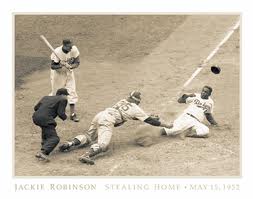
Jackie Robinson Stealing Home


By Andrea Scarpino

I missed raw vegetables—the huge salads I normally eat for lunch filled with chopped kale and carrots and whatever else I find in the refrigerator. I missed my cats and my computer, my shelves filled with books, having more than three changes of clothes. I missed speaking fluently, not in stuttered, ridiculously simplistic Italian or badly pronounced French. I missed feeling competent in my world—navigating successfully, seeing people I know on a regular basis, responding to questions without having to think through verb agreements. 

I love to travel in part because it brings me immediately out of my comfort zone. The small world I usually inhabit suddenly expands into unknown streets, unknown foods and smells, unknown customs and expectations. It’s humbling to be a traveler, to be one of hundreds of ordinary people waiting to board an airplane or buy museum tickets, one of thousands revolving through a hotel in any given season. It’s humbling not so speak a language fluently, not to be able to read signs or maps or grocery store items quickly and easily. It’s humbling to have to fully trust complete strangers for my safety, to be laughed at for making mistakes, to know that my unfamiliarity with a landscape makes me an easy target. 

And that humbling is a very good thing, a very good reminder not to take myself so seriously, not to limit my own thinking, not to get so caught up in petty debates. No one we spoke with in Italy, for example, had heard of the philosophers with whom Zac works, or the poets I most admire. We found common ground here and there with music, but my family was shocked that we didn’t know any contemporary Italian musicians outside of opera stars like Pavarotti. And political issues—forget it. People asked us about Romney on more than one occasion, but most of our most pressing political debates and important political figures didn’t overlap at all.

The world is enormous, traveling reminds me, full of 7 billion other people living lives mostly unlike my own—rich, important, complicated lives full of successes and sorrows and debates and important figures I will never know. As I return to my very small town, to my small circle of friends, my small writing community, my small job, I’m hoping to remember the humility I felt these last three weeks, the possibility I felt in knowing myself and my worries as really quite small, really quite insignificant. The possibility I felt in all that I don’t know, in being nothing more than one of the masses. 


Mitt Romney's Big Lie and Why People with Disabilities Need to Know

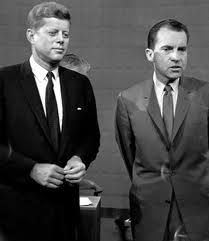
  JFK and Nixon at Debate


The big lie of this campaign has emerged and it’s this: “The American corporate tax rate is the highest in the world.”  This has been a central talking point of GOP presidential candidates since 2008 but now, in Mitt Romney’s hands it’s become the only talking point. Forget that it’s not true: it’s effective, much as JFK’s lie that the US was facing a “missile gap” with the Soviet Union was hard to beat in 1960. Lying in political circles only works when people already feel fear. (FDR’s famous line: “The only thing we have to fear is fear itself.” was an appeal to voters to resist the fear mongering of Wall Street and people shouldn’t forget it.) In a weak economy people certainly feel afraid. The corporate tax rate lie is this year’s missile gap.


Back in 2008 Igor Greenwald published an excellent article in SmartMoney entitled: “High Corporate Tax Rate is Misleading” and since nothing about corporate taxes has changed under Obama, it’s worth quoting from. Among other things Greenwald points out:


If you say something long enough and loud enough, there's every chance people will come to believe it's true, especially if your opponents tire of rebuttals.

This time-honored political strategy has been working overtime of late, as Republican presidential hopefuls romance the richer Florida retirees with appeals for cuts in corporate taxes.

You may have heard: U.S. corporations face one of the highest income tax rates in the world, though the mention of "rate" is often enough excised, so that what comes through is the assertion that corporations pay too much in taxes. This is simply untrue if your basis for comparison is the developed world. The truth is that while the 35% corporate income tax rate is high indeed, the creativity and global reach of U.S. corporations make them among the most lightly levied.

Between 2000 and 2005, U.S. corporate taxes amounted to 2.2% of the GDP. The average for the 30 mostly rich member countries of the Organization for Economic Cooperation and Development was 3.4%.

Why the disparity given the high federal rate, which rises to 39% counting state taxes? Part of the answer is that big U.S. companies have become expert at hiding profits in tax havens overseas. And many of the smaller ones simply pass through their income to owners who then report it on their personal returns. 

That Mitt Romney knows this is indisputable. That he’s willing to mislead voters is also clear. Romney after all has a brilliant strategy. And just like Nixon, who couldn’t argue with Kennedy about the missile gap without sounding like a wonky technocrat, Obama will find it hard to fashion a snappy comeback for the corporate tax lie. There are essentially three reasons for this: the very word “taxes” is loathsome to every citizen, “corporate” has only a foggy meaning, (Romney: “Corporations are people too, my friend.”) and finally, even though all serious economists discredited the idea long ago, the notion of “trickle down” profits still resonates with alliterate voters (Fox newsies, etc.)

President Obama has already demonstrated that the corporate tax attack is indeed his missile gap. His fumbled line about the healthy nature of the private sector is an indication that he’s on his heels. He needs to get off his heels right away. 

One way to do this is to avoid the spurious argument about the evident corporate tax rate (the old “no they’re not, yes they are” fight will only help Romney) and instead campaign vigorously on closing international corporate loopholes. That’s a position that will resonate with voters and expose Romney’s lie. 

I have a small blog, one that’s mostly about disabilities, sometimes about poetry and nonfiction. But I have a dog in this hunt. The Romney economic plan calls for the entire gutting of medicare, make no mistake about it. That’s also the Ryan plan. First the plan calls for taking money off the top of existing medicare and social security, then it calls for passing the federal money back to the states. In turn the states can use it anyway they want. You see, Romney’s lie at the top, the corporate tax rate lie, is the glittering and dangled pocket watch designed to mesmerize voters, especially middle class voters to vote against their own interests. Hell, it’s worked before.


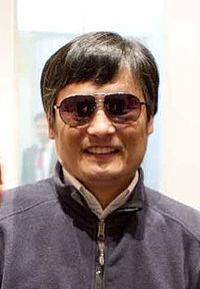
Chen Guangcheng: Blind in the 21st Century


The arrival of Chen Guangcheng in the United States is significant on many levels but perhaps, lost in the narratives of triumph and political bravery is the fact that his blindness does not define him. This has been easy to overlook given dominant headlines characterizing him as “the blind human rights activist” or “the blind lawyer”. These are designations that sell stories but (as any successful blind person will tell you) probably have almost nothing to do with Chen Guangcheng’s life. Blindness is no more a defining marker of experience than hair color or height: it is a physical condition that ceases to be an impediment when you have the proper tools.


We romanticize blindness by making it a larger obstacle than it really is. We let symbolism return us to an earlier time, an age when vision loss was considered a calamity equivalent to contracting tuberculosis. In the 19th century, both in Britain and the United States, blindness meant incarceration, segregation, poverty, and marginal schooling. Understood via this history, blindness lingers in the public’s imagination as steep and forbidding, and the capabilities of real blind people are thought to be profoundly limited.


When Chen Guangcheng climbed a fence eluding his captors he was brave. But he simply did what all athletic blind people know how to do: he navigated. Blindness in no way inhibited his character, his skills, his ambition, or his intellect. He was heroic because he insisted on human rights.


Blindness in our time is a problem of perception. The National Federation of the Blind, one of the largest advocacy organizations for visually impaired people in the U.S. has long argued that: “The real problem of blindness is not the loss of eyesight. The real problem is the misunderstanding and lack of information that exist. If a blind person has proper training and opportunity, blindness can be reduced to a physical nuisance.”


I am wishing Chen Guangcheng a life of simple physical nuisance, a life where his bravery is understood as human courage, democratic courage, not blind courage. I wish him the proper tools for study at New York University: full access to computers and websites, speedy and professional accommodations. Most of all I wish him deliverance from outmoded perceptions about his disability so he can go about the urgent business of being a leader without a 19th century ghost on his shoulder.


Truth to Say: Romney and Your Hometown

“[The president] wants another stimulus, he wants to hire more government workers. He says we need more firemen, more policemen, more teachers. Did he not get the message of Wisconsin? The American people did. It’s time for us to cut back on government and help the American people.”

–Mitt Romney

This is a story of deception disguised as sober management. Let’s pretend Mitt Romney is your father. No, better not. Let’s pretend he’s your president. His plan is to cut federal spending in every area except for defense. His plan is the Ryan plan.

Romney’s vision calls not only for fewer firefighters, policemen, and teachers, it also would assure us of fewer scientists, lessened environmental protection, a worsening of our already perilous infrastructure, zero investment in alternative fuels, and of course the gutting of Medicare.

What would that world look like? Well…


Some Thoughts on Casey Martin's Return to the PGA

We received the email below from a good friend, a longtime disability rights advocate:


I came across an interesting article in Golf.Com about Casey Martin. You may or may not remember when Casey Martin v. PGA was decided by the Supreme Court. Very briefly Martin sued the PGA under the Americans with Disabilities Act, asking for the right to use a golf cart in PGA tournament play as an accommodation. The underlying issue was how are accommodations determined to be reasonable. Was the “endurance” represented by the PGA rule that players walk the course truly essential to the game of golf? If not then riding a cart would be a reasonable accommodation. The decision was that riding a cart was a reasonable accommodation under the law.

Mr. Martin’s condition took him out of the game by the time the decision was made, but this year he is back in U.S. Open play.

The article provides a brief history of the case, but more interestingly discusses how the response to his return and use of accommodation reflects changes in society’s understanding of disability, accommodation, and what is important!

http://www.golf.com/tour-and-news/casey-martin-play-us-open-cart-14-years-after-legal-battles?hpt=hp_t2


NYTimes: Jeb Bush Questions G.O.P.’s Shift to the Right

“For the better part of three decades, there has been no more prominent family in Republican politics than the Bushes.
But tough talk about the state of the party on Monday by former Gov. Jeb Bush of Florida — who went so far as to say that Ronald Reagan and his father would have a “hard time” fitting in during this Tea Party era — exhibited a growing distance between the family, which until not very long ago embodied mainstream Republicanism, and the no-compromise conservative activists now driving the party.”

From The New York Times:

Jeb Bush Questions G.O.P.’s Shift to the Right

Mr. Bush said today’s Republican Party is out of step with the legacy of his father and Ronald Reagan.

Stephen Kuusisto
Director
The Renee Crown University Honors Program
University Professor
Syracuse University

Coming Soon: Letters to Borges by Stephen Kuusisto

http://rcm.amazon.com/e/cm?t=wwwstephenkuu-20&o=1&p=8&l=as1&asins=1556593864&ref=tf_til&fc1=000000&IS2=1&lt1=_blank&m=amazon&lc1=0000FF&bc1=FFFFFF&bg1=FFFFFF&f=ifr

Stay tuned for a special offer!

**************************
Professor Stephen Kuusisto, blind since birth, is the author of Eavesdropping: A Memoir of Blindness and Listening” and the acclaimed memoir Planet of the Blind, a New York Times “Notable Book of the Year”. He has also published “Only Bread, Only Light“, a collection of poems from Copper Canyon Press. As director of the Renee Crown University Honors Program and a University Professor at Syracuse University, Steve speaks widely on diversity, disability, education, and public policy.

Of Cripples and Lawyers

Thank you Smartasscripple. I say “unscrupulous lawyers for everyone!”


Ervin: How Can I Get In On Those ‘Unscrupulous’ ADA Lawsuits?

(SmartAss Cripple Blog)
June 8, 2012

CHICAGO, ILLINOIS– [Excerpt provided by Inclusion Daily Express] The horror stories have been going around for years. I’m sure you’ve heard them. The New York Times was ranting about it a few weeks back.

It all starts with unscrupulous lawyers. They recruit cripples to be plaintiffs in lawsuits suing small businesses for being inaccessible under the Americans with Disabilities Act. Maybe the business has no ramp or too steep of a ramp or a counter or shelf that’s too high. Then the case gets settled. The lawyers collect fees and then they pay the cripple a fee for their time.

The Times says a couple lawyers have filed more than 300 suits in the last three years in New York alone. And some cripples have built a cottage industry out of being repeat plaintiffs.

When I read about my fellow cripples teaming up with unscrupulous lawyers to behave in this manner, it really pisses me off. Why can’t I find an unscrupulous lawyer to team up with me? I mean, I live in Chicago, dammit. You can’t swing a dead cat by the tail around here without hitting an unscrupulous lawyer.

Entire article:
Unscrupulous

http://smartasscripple.blogspot.com/2012/06/unscrupulous.html
Related:
Disabilities Act Prompts Flood of Suits Some Cite as Unfair (New York Times)

http://tinyurl.com/ide0608127a