It would be worth the while to select our reading, for books are the society we keep; to read only the serenely true; never statistics, nor fiction, nor news, nor reports, nor periodicals, but only great poems, and when they failed, read them again, or perchance write more.Instead of other sacrifice, we might offer up our perfect thoughts to the gods daily, in hymns or psalms. For we should be at the helm at least once a day. The whole of the day should not be day-time; there should be one hour, if no more, which the day did not bring forth.Scholars are wont to sell their birthright for a mess of learning. But is it necessary to know what the speculator prints, or the thoughtless study, or the idle read, the literature of the Russians and the Chinese,or even French philosophy and much of German criticism. Read the best books first, or you may not have a chance to read them at all.
Author: stevekuusisto
Poet, Essayist, Blogger, Journalist, Memoirist, Disability Rights Advocate, Public Speaker, Professor, Syracuse University
White House Sends U.N. Disability Treaty to the Senate for Ratification
|
|
Pavarotti, 1980, When the Master Had His Chops!
Earth Too Huge to be Grasped, Or, Why I Blog
We are living in the age of new connections because of digital technologies and this is all to the good, inasmuch as the new task of humankind is to become conversant in the arts of joy and suffering, to learn the vocabulary of life itself. This is the kind of thing I think about when I look at facebook and see a photo of a kitten alongside a cry for humanitarian assistance or a call for the affirmation of human rights. Even the braggarts on facebook serve a purpose–they remind us how weak we are and small.
I don’t hold with the Atlantic Monthly’s recent article that proposes we are lonelier because of facebook. I think that people with disabilities will attest, overwhelmingly, that connections are now possible for those of us who have a hard time getting around. The vocabulary of life itself.
Czeslaw Milosz wrote: “Where does humility come from? From sitting down and putting little signs on paper with the hope of expressing something.” Life itself.
This blog is my exercise in humility, for even when I’m thundering against cruelties or social injustices I’m admitting my obvious powerlessness and lamenting my obvious insufficiencies. I never had that opportunity as a child with a disabiity; didn’t get the chance at school–it doesn’t materialize in a classroom. And poetry, for all its glories is often flinty, accepting humility only in doses and with the proper figures. You see, the blog is the place where the vocabulary of insufficiencies gets worked out, at least for me, in this time and place.
A couple of years ago when I was editing a special issue of the literary magazine Seneca Review–an issue devoted to what I called “the lyric body”–bodies of difference; bodies that have recovered from illnesses; bodies that are transgendered; disabled bodies; aging bodies; gay bodies; depressed bodies–all were welcome because all have their inventive and original intelligences–well, when I wrote to people asking them to submit work, one poet, (nameless here) wrote a note proclaiming that she was sick and tired of being asked to write about disability, why don’t people ask her for work about anything else?
What I understood by that note was that she wants a world without identity, a pure world, a place where people are electric and shrewd and compelling on the page, without regard to autobiography. I love that idea. I also love the idea that in winter the sun is trapped inside a mountain in Karelia (bear with me, there are no mountains in Karelia). I love lots of ideas.
For me, poetry and nonfiction are the places where I can explore my daily consternations, hopes, disappointments, acquired understandings, whatever sparkles from the wheel of mind, as Whitman would say.
I am both a person with and without a disability, second by second, but I’m never without the essential humility of personal discord, dismay, surprise, wonder, and dark and bright tears.
The Industrial Prison Complex and Disablement
There is an excellent piece at Monthly Review by Jean Stewart and Marta Russell which details the unspeakable fact that people with disabilities represent 1/5 of America's prison population. Here is the article's provocative opening:
"The story of disablement and the prison industrial complex must begin with a trail of telling numbers: a disproportionate number of persons incarcerated in U.S. prisons and jails are disabled. Though Census Bureau data suggest that disabled persons represent roughly one-fifth of the total population, prevalence of disability among prisoners is startlingly higher, for reasons we will examine later. While no reliable cross- disability demographics have been compiled nationwide, numerous studies now enable us to make educated estimates regarding the incidence of various disability categories among incarcerated persons. Hearing loss, for example, is estimated to occur in 30 percent of the prison population, while estimates of the prevalence of mental retardation among prisoners range from 3 to 9.5 percent."
Italy
Family is a difficult word, a word I’ve often cringed to use—too full of obligation and drama. Family is what you make it, I’ve often said, having felt closer to friends than to relatives. When your family of origin has been full of dysfunction, factions hating other factions, embroiled in decades-long disagreements you don’t quite understand, when you’ve never felt totally accepted by any side, too close to all the wrong people at any given time, it makes sense to cobble together a family from people who don’t demand anything but your friendship, kindness.
And then an email came from Italy: “My mother and I were searching for you as she, part of the Scarpino family, was wondering if you were Pasquale's daughter.” And later, “I am very happy that my son found you on the web. I immediately recognized your face as part of our family.”
And something shifted. Cousins I didn’t know existed had found my website, and from my website, my email address. Suddenly we were writing. And for the first time, I learned how my grandfather came to the US, how his brother remained in Italy—stories I had never heard before, stories my father never told me. How some of my father’s first cousins are still living, how I have second cousins eager to meet me.
And then, photographs. And clearly, my face is theirs, their faces are mine. Family: people who recognize my face, who think enough about me to search for me online. One cousin wrote recently, “You are part of my family and you have my blood so at the end of the day, you are like a sister to me.” This isn’t the sense of family I have ever before embraced—too much dysfunction. But now—something has shifted.
I’m trying to keep my expectations low for this trip—less chance of disappointment. But the truth is: I am beyond excited. Something deep inside me needs Italy. Needs to meet this side of my family. Needs so badly to embrace—and be embraced by—these relationships. Family—la famiglia. And yes, a part of me is hoping this trip brings me closer to my father. This summer, he’ll have been dead five years; through his blood-ties, a piece of him. But more than that: a living family.
Zac and I leave in a week for Italy. We’re going to visit my cousins, stay with them. We’re going to visit the town in Calabria my grandfather left to move to the States. Hear my family’s language for the first time outside of a classroom—the language my father heard growing up, the language he didn’t teach me. We’re going to drink Italian wine, try to speak Italian, wander city streets, see some Botticelli. And most importantly, meet family.
Bodies Inert, They Moved a Robot With Their Minds – NYTimes.com
Now THIS is an important, ring the bells story:
http://www.nytimes.com/2012/05/17/science/bodies-inert-they-moved-a-robot-with-their-minds.html?hp
Stephen Kuusisto
Director
The Renee Crown University Honors Program
University Professor
Syracuse University
More on Gertrude Stein and Hats
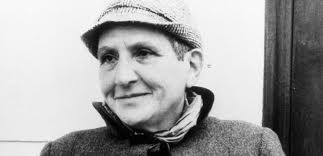
Our good friend LB has written per our post about hats and the wives of geniuses:
Perhaps it was a jaunty hat that lured Ms Stein into driving a supply
truck for the American Fund for French Wounded during WWI. And then
in WWII, perhaps a rather broad-brimmed, lower-profile chapeau would
be more appropriate as she, an American Jewish lesbian, quite
remarkably sat out the German occupation of France with famous art
collection and life completely unscathed, perhaps as an active Nazi
collaborator. This is an interesting and complex story. I remember
reading a perhaps somewhat romanticized version of some select
incidents related to their years during the occupation in Alice B's
famous cookbook that reflect anti-Nazi sentiment. But here I've just
found some added research that adds additional information about those
years:
560,000 Americans With Disabilities Never Leave Home Due To Transportation Problems
Personally, I think this number is too conservative. But see this important article.
SK
(AAPD)
May 11, 2012
WASHINGTON, DC– [Excerpt provided by Inclusion Daily Express] As conferees begin debating how to move forward with the federal transportation reauthorization, two civil rights organizations are highlighting massive disparities in transportation access for people with disabilities.
"Equity in Transportation for People with Disabilities," a report by The American Association of People with Disabilities (AAPD) and The Leadership Conference Education Fund, documents the lack of funding, enforcement, and oversight of transportation programs that allow people with disabilities the opportunity to participate fully in community life.
The collected findings demonstrate that federal and local policymakers have failed to fulfill the promise of the Americans with Disabilities Act and provide equal access to affordable transportation for all communities through federal surface transportation legislation.
Mark Perriello, president of AAPD, commented that "access to transportation is a prerequisite to full civil rights for people with disabilities. The goals of the Americans with Disabilities Act — economic power, independent living, political participation, and equal opportunity — can only be realized with affordable, accessible transportation systems."
Entire article:
People with Disabilities Still Left Behind In Transportation Debates
http://tinyurl.com/ide0511121a
Report:
Equity in Transportation for People with Disabilities (AAPD & The Leadership Conference Education Fund)
http://tinyurl.com/ide0511121b
Thank You Neil Marcus
Disability activist and poet Neil Marcus writes:
“How can I speak of cripple and not mention the wind.
How can I speak of crippled and not mention the heart.
Heart, wind, song, flower, space, time, love. To leave
these absent is to leave cripple in stark terms.
As if we were made of medical parts and not flesh and bone.
There is always wind in my cripple….
Cripple is not extraordinary or ordinary.
Cripple is a full plate….”
I was thinking of Neil’s lines this morning–in fact I was talking to myself like one of the old savants of Lapland and I felt gratitude that Neil had written these lines.
So I’m sharing my gratitude! Thank you Neil Marcus!
 Planet of the Blind