When Bob Marley Saved My Life

Photo description: black and white photo of a smiling Bob Marley.  He’s standing outside and almost appears to be leaning on a guitar, the neck of which he’s holding in his right hand.

First let me say that anyone who has known discrimination also knows that going forward is steep. You have, after all, been told you don’t belong and worse, you’ve been instructed to get the hell out of town. As a blind person I’ve been in that spot throughout my life. Grade school teachers, high school principals, college professors, graduate school instructors–even a college president–have told me that because of my visual impairment I should go away. Perhaps the worst moment was in 1985 when I was enrolled in the Ph.D. program in English at the University of Iowa and two senior faculty along with the department chair told me I didn’t fit, that my need for extra time to complete assignments was ridiculous, and that I was a whiner.

This is a familiar story among people with disabilities. Even today (over 20 years after the passage if the ADA) only one in four college students with a disability will graduate. The unemployment rate for pwds is still estimated at 70%.

If you’re blind you can’t wait tables, drive a cab, or do most of the available jobs that are perfectly honorable. In 1985 all I could imagine was reading and writing vs. nothing. Nothing would mean living on Social Security Disability checks and moving in with my parents. If i embraced Nothing it would be an admission of failure so great that I would have to retire from my life, live as a kind of back room invalid, a prospect that terrified me since my mother was an alcoholic and slept all day with the shades drawn– would that be my life?

As it happened, I did move home and lived for quite some time in my parents’ basement. I had a beat up typewriter, an exercise bike, and a tape machine and that’s when I began listening to Bob Marley in earnest. I’d been gently listening to Bob ever since his first US album “Catch a Fire” appeared in 1973 but now I was soaking in his rare and utterly astonishing combination of rage and redemption, a combination you will not customarily find in the arts–a combo like milk and iodine. In poetry very few possess this–Yeats comes to mind and Nazim Hikmet, and Neruda. In popular music almost no one has Marley’s quality of the sword in the cloud–the rage is just rage or the milk is just syrup.

In my basement with the volume up I began working. Bob Marley’s voice and lyrics moved through me and I felt a half weightless sense of a pending disembodiment and then the authentic tears of deep deep discrimination salted with hope came to me. I could go on and on about the songs, the lyrics stitched from sublime wing shadows of the soul that fans the body, but it’s enough to say that Bob Marley remains for me the most authentic voice of “becoming” that I have ever heard.

Previously published on Steve’s other blog, Planet of the Blind

**************************

Professor Stephen Kuusisto, blind since birth, is the author of Eavesdropping: A Memoir of Blindness and Listening” and the acclaimed memoir Planet of the Blind, a New York Times “Notable Book of the Year”. He has also published “Only Bread, Only Light“, a collection of poems from Copper Canyon Press. As director of the Renee Crown University Honors Program and a University Professor at Syracuse University, Steve speaks widely on diversity, disability, education, and public policy.
 

Dear Mr. President, Support People with Disabilities Now


If you support the U.N. Convention on the Rights of People with Disabilities  ask the White house to submit the Convention to the Senate for ratification without delay.   With campaigning under way this critical protection for U.S. Citizens abroad (vacationers’, students, individuals working or doing business) with disabilities is unlikely to get the attention it deserves unless you make yourself heard.   Ratification by September is necessary If the U.S. is going to participate in in a leadership role during the next three years.   If you agree with me and think this is important contact the White House:


·         White House Comment Line: 202-456-1111 (TTY/TTD: 202-456-6213)

·         Email White Househttp://www.whitehouse.gov/contact/submit-questions-and-comments

The simple accessible form allows you to send an e-mail.  Please use “Foreign Policy” for the category and ask for a response.


Feel free to use the bullet points (or the entire message) below: 


I am writing to urge the White House to send the Convention on the Rights of Persons with Disabilities (CRPD) to the Senate with haste and to vigorously promote its ratification.  Ratification of the CRPD is a human rights issue; congruent with the administration’s stance, current federal law and U.S. public policy on disability.  In fact obligations under our own laws negate the  concerns over “sovereignty” that are sometimes leveraged in opposition to engaging in international treaties through the U.N.  If the Senate fails to ratify the CRPD, America’s role as a world leader, particularly when it comes to human rights will significantly diminish along with our voice and our influence in international affairs. 


It is essential that this treaty be ratified by the US Senate prior to the September CRPD Committee meetings when election that will guide treaty implementation will be held.  The next window with of opportunity for high level  participation and leadership is 2015.  Following ratification, the U.S. will:

·         Have an opportunity for a U.S. disability leader to be elected to the CRPD Committee to guide implementation of the convention across the globe

·         Ensure global initiatives on disability issues and rights will continue to be influenced by U. S. disability leaders

·         Ensure students with disabilities from the U.S. and all countries will have opportunities for accessible, inclusive education including higher education. 

·         Ensure that U.S. travelers, entrepreneurs and employees with disabilites working abroad have can access transportation, housing, retail and commercial facilities.

·         Take its proper place among 112 nations including Australia, Canada, France and Japan in ratifying this 21st century treaty affirming the rights of the disabled around the world, including disabled veterans.


Thank you for continuing this work with allows  disabled individuals from our country and around the world to take their proper place in our increasingly global society.. 

Sincerely,


When Bob Marley Saved My Life

First let me say that anyone who has known discrimination also knows that going forward is steep. You have, after all, been told you don’t belong and worse, you’ve been instructed to get the hell out of town. As a blind person I’ve been in that spot throughout my life. Grade school teachers, high school principals, college professors, graduate school instructors–even a college president–have told me that because of my visual impairment I should go away. Perhaps the worst moment was in 1985 when I was enrolled in the Ph.D. program in English at the University of Iowa and two senior faculty along with the department chair told me I didn’t fit, that my need for extra time to complete assignments was ridiculous, and that I was a whiner.

This is a familiar story among people with disabilities. Even today (over 20 years after the passage if the ADA) only one in four college students with a disability will graduate. The unemployment rate for pwds is still estimated at 70%.

If you’re blind you can’t wait tables, drive a cab, or do most of the available jobs that are perfectly honorable. In 1985 all I could imagine was reading and writing vs. nothing. Nothing would mean living on Social Security Disability checks and moving in with my parents. If i embraced Nothing it would be an admission of failure so great that I would have to retire from my life, live as a kind of back room invalid, a prospect that terrified me since my mother was an alcoholic and slept all day with the shades drawn– would that be my life?

As it happened, I did move home and lived for quite some time in my parents’ basement. I had a beat up typewriter, an exercise bike, and a tape machine and that’s when I began listening to Bob Marley in earnest. I’d been gently listening to Bob ever since his first US album “Catch a Fire” appeared in 1973 but now I was soaking in his rare and utterly astonishing combination of rage and redemption, a combination you will not customarily find in the arts–a combo like milk and iodine. In poetry very few possess this–Yeats comes to mind and Nazim Hikmet, and Neruda. In popular music almost no one has Marley’s quality of the sword in the cloud–the rage is just rage or the milk is just syrup.

In my basement with the volume up I began working. Bob Marley’s voice and lyrics moved through me and I felt a half weightless sense of a pending disembodiment and then the authentic tears of deep deep discrimination salted with hope came to me. I could go on and on about the songs, the lyrics stitched from sublime wing shadows of the soul that fans the body, but it’s enough to say that Bob Marley remains for me the most authentic voice of “becoming” that I have ever heard.

New York's Governor Proposes Legislation to Combat Disability Abuse

“We all know that for years our state services have not been doing what they should be doing in this field,” the governor said in a news conference crowded with advocates and a number of people with disabilities, adding, “It’s an unfortunate microcosm of the deterioration of state government, in my opinion, over the past 15 years.”

See full story here.


Reading the Poems of Gregory Orr

By Andrea Scarpino


Once before I read Gregory Orr’s Concerning the Book That Is the Body of the Beloved. I was still in graduate school, and while I had experienced loss—one grandmother died when I was in kindergarten, and after that, several family friends—I didn’t know loss. Loss as an ache deep inside my chest. Loss as a constant friend. I didn’t know grieving’s most perilous moments. I didn’t know how grieving keeps the lost one close.

I read Concerning the Book That Is the Body of the Beloved and I liked it. I typed up several poems that I still keep taped above my desk even after two cross-country moves. But I didn’t yet know loss. I didn’t yet understand beloved.

Several weeks ago, I decided I needed to read the book again. I am mired in the end of the semester, in the stress that comes from grading and late papers and the management of panicked student emails. This is my least favorite time of the year—no teaching happens, no joy of sharing and muddling through ideas. Just anxiety and personality management and the deep sense that a system producing this much stress is flawed.

So I read Orr. The first poem of the collection ends, “That death not be oblivion.” Yes, I thought. I now know grief. I now know loss. I know what it means to think of death as oblivion, to long for another understanding. But there is something else in these poems besides loss. Hope, maybe. A belief that loss is not all there is to know. A belief in words, in poetry. A belief in the beauty of the world, even amidst loss. A belief in the beloved, in the body of the beloved.

In one poem, Orr writes:


            I’ve known grief. I don’t

            Take it lightly. Know how

            It gnaws your bones hollow

            So you’re afraid to stand up,

            Afraid the lightest wind will

            Knock you over, blow you away.


Yes, I thought, this is it, exactly. The way grief becomes bodily, the way it consumes everything. But the poem doesn’t end there; it continues:


            But maybe the wind is supposed

            To blow right through you;

            Maybe you’re a tree in winter

            And your poem translates

            That cold wind into song.


A tree in winter, I thought. Yes, I would like that. I would like to translate cold wind into song. I would like to feel the cold wind moving through me. That way, loss doesn’t win. Grieving isn’t all there is. It is one thing, a cold wind. But it doesn’t get to be all the wind. It doesn’t get to be all the seasons.

And isn’t this one of poetry’s greatest gifts? That it teaches us to understand something as large and complicated as loss in entirely new ways. That it helps us to remember beauty. To remember that loss is “the place/ Where beauty starts. Where/ The heart understands/ For the first time/ The nature of its journey.”

I wasn’t ready for Orr the first time I read his book. I thought the words were lovely, the movement from one poem to the next an important study. I liked the poems. I felt something important happening in them. But now that I know loss—an indelible marker—now that I know beauty, I am reading an entirely new book. And it is changing me, changing my thinking—hopefully for the better. 


What the Ancient Dogs Knew

I want to tell a small story. In ancient times when the wind spoke to men and women it also spoke to dogs. When an ancient dog heard the wind he heard everything. I believe this is not customarily understood. Anthropologists say that dogs came to the human realm because we were throwing out the bones. But you can’t understand a creature just by its appetites. Dogs have always understood that the air is enchanted all around us. They have always understood the telegraphy of swallows crossing and recrossing the sunbeams between trees. Like an arrow they came just to tell us the good news. And dogs know the darkening tunnel inside the wind. I tell you they know who lives there. That is what you hear when a dog is dreaming. I tell you, dogs pour out in choirs their dreamy souls. 


Disability and Poetry, Part 145

Thanks to Chris B whose blog, Through Alien Eyes, is a thoughtful and lovely place for disability reflections. He heard me speak recently on disability and poetry at The Ohio State University and has written a kindly analysis of my presentation.

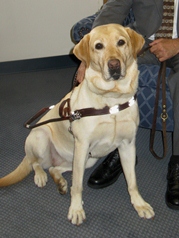
When I am In New York City with my guide dog the happiness of the city is mine. Swiss tourists want to tell me about their Labradors at home. Doormen call out as we walk by. It’s a different city for us, communal, improbably humane even at moments ecstatic. This must go into the living poem of physical difference.

So too the damages and the ugliness. What I like to call the mercenary labeling of ableism. People with disabilities experience the crackling, unspoken diminishing glares of strangers. Until they are spoken. Then the day tilts like a bad amusement park ride. This must also go into the living poem of physical difference.guide dog, Nira

What the guide dog schools won’t tell you, or by turns, tell you imperfectly, is that guide dog teams will encounter public incomprehension and outright discrimination as they walk around. In my case this discovery came 18 years agoin New York City when I tried to get into a cab and the driver began screaming expletives. Despite this I got into the car. His language and mine became an instant study in art for all the ingredients of creativity were present: tension, incomprehension, passion, and spontaneity.

Sitting stern as a tree in the backseat, I told him that the law permits guide dogs for the blind in all taxis–in fact guide dogs are allowed everywhere. Hell, I even had an ID card from the school with my picture and the dog’s picture and all the appropriate legalese. But the driver, my driver, did not believe in the bravery or happiness of others. He began revving his engine and revving up his shouting.

What can you do? My driver hated me and my dog and was refusing to budge. I was reciting the law. Oh the godforsaken wilderness of human rage. When you have a disability every moment of discrimination evokes all the others: you’re again the boy who was told he couldn’t play with others, couldn’t go to school with them, sat alone in a room. This must also go into the living poem of physical difference.

Then again, the shy, unanticipated joy: in Central Park a man says to me, “You can’t tell, but I am the statue of liberty.” “Me too,” I say.

Previously published on Steve’s other blog, Planet of the Blind

**************************

Professor Stephen Kuusisto, blind since birth, is the author of “Eavesdropping: A Memoir of Blindness and Listening” and the acclaimed memoir “Planet of the Blind”, a New York Times “Notable Book of the Year”. He has also published “Only Bread, Only Light“, a collection of poems from Copper Canyon Press. As director of the Renee Crown University Honors Program and a University Professor at Syracuse University, Steve speaks widely on diversity, disability, education, and public policy.