
Start with alder leaves
The veins so green
They stay long into autumn
Call it from stems
Like leaves the wheels
Like rolling living wind
Start with alder leaves
The veins so green
They stay long into autumn
Call it from stems
Like leaves the wheels
Like rolling living wind
They used to argue about the origins of socialism in the old worker’s bar I loved when I was in my early twenties–nights, an accordionist, mist from the canal, and beer soaked legerdemain viz Babeuf and the Society of Equals. Now I live in a covert. Soon I’ll drink the potion of the very old. It’s terrible to have no one to talk to. As for the accordion, it was always a Marxist music box though they won’t tell you on National Public Radio.
Auden told a friend of mine that traveling was hard because he had no one to converse with. He was in Iowa when he said it. My pal was then a young poet who’d driven from Iowa City to Des Moines to hear the great man read. Afterwards, and for reasons difficult to explain—especially since it isn’t my story—Auden was all alone in the student union drinking tea. There was no one to talk to, Auden said, no one at all. The young poet was Marvin Bell. Marvin’s story tells of the loneliness of art, even when its creator is in public circulation.
Now I don’t really live in a covert, the current pandemic notwithstanding, and I’ve enough recognition to have the privilege of being invited to read from poetry in far flung places. I really don’t know why W.H. Auden was all alone in a Drake University cafeteria. Did the faculty who invited him to campus find him repellent and run away after the reading? Was there a melancholy whisper over the campus calling the locals to late Vespers? We’ll never know. Marvin Bell and I speculated that there simply wasn’t a culture of poetry talk at Drake University at the time. There were events. Even a poetry reading by the world’s most famous poet would have been nothing more than a lecture on entomology. Marvin was a student at the Iowa Writer’s Workshop in that era. The workshop was a different order and back then one of the only places (in a university setting) where writers gathered to talk.
And yet there’s another kind of loneliness and Auden was right to suggest it. The Elizabethans called it “melancholy” and understood it’s inside us just as our blood and hearts. In this way the Elizabethans were more reliable than we are. Robert Burton, whose pen name was Democritus Junior was the first to assert everyone who can read has the blues. The Anatomy of Melancholy argues the reader has a choice as to how he shall be blue.
No one to talk with and we shall never know one another precisely nor will we ever know what ails us.
Crossing the street in hot traffic
The pills make a mariachi sound
As if we’re at a party
And not plunging blindly
Into the hop-scotch faith-game
Called being-alive-going-places
Shik shik go the pills
Which are made for those
Without faith
Shik shik
Under the shimmering sun
As if a countdown
Has started
And so one morning you’re visited by Elizabethan devils, each wearing the costume of his humor—bloody sage, Saturn rising…
“How did you get in?” you ask knowing the question is hopeless.
“We’re your birthright,” says the short one with the little box.
Dear reader: do you or don’t you ask what’s in the box?
**
The real dead…you know, the vast chorus of souls freed from superstitions…well, they don’t play no fucking Ouija…
**
Rain journeys road calls bird walks small child turns knob on radio…
**
So much fire out in space
Gives me hope
**
Thinking of Auden
They used to argue about the origins of socialism in the old worker’s bar I loved when I was in my early twenties–nights, an accordionist, mist from the canal, and beer soaked legerdemain viz Babeuf and the Society of Equals. Now I live on books, alone in a covert. Soon I’ll drink the potion of the old. Its terrible to have no one to talk to. As for the accordion, its a real Marxist music box though they won’t tell you on National Public Radio.
**
C’mon dogfish let’s find the catfish and get the hell out of here…
**
On a Train
Night crosses the desert of my understanding. I wonder if I can stick to one thought, like a small hunting dog?
The houses in my neighborhood
Move sideways at night
Reposition
Before dawn—
Sleepers with trumpets
And swords
Storm Ninevah…
The houses look normal at sunup
But between this window and that
From this chair to that
I’m not alone
See here Stephen
A white sky
Impossible to know
Who got here first…
I grieve inside my clothes but also when I’m naked
There’s no escaping the matter
I raise my hands to the ceiling
And walk about aimlessly
Didn’t I once know you old salt?
Oh, I thought you were a man—
Blind on a park bench
Lost in the shadow world
A friend calls to say
There’s so much bad poetry
Written nowadays
But I’m tired
And a maple sapling
I’ve been trying
To keep alive
Has died and the loss
Is insurmountable—
I’ve no words for it—
And I listen to him name
Poet after poet who
He says stinks and yes
They probably do stink
But my little tree…
Top Ten Reasons “Normal People” Wish They Were Disabled…
10. We have that “cute little logo”.
9. We don’t have to stand up for the national
anthem.
8. We have psychic powers: All disabled people know all other disabled
people.
7. They’re jealous of our specialty clothing.
6. Disabled people are “more musical”.
5. We have sign language and Braille and other
“sneaky stuff”.
4. We can park anywhere, just like the Pope.
3. We have really cool pets and we can take them
anywhere.
2. We have our own stalls in public restrooms,
some with “high-tech” devices.
And the number
one reason normal people wish they could be disabled:
1. Airline employees actually have to help us. (Though they are seldom happy about it…)
I can’t tell you how to live your life
Though I’m overloaded with it
Life, I mean—the sparrows
Inside me; the glowworms
Behind my eyes; my fingers
Signaling to the moon—
Life, I mean, unpredictable
Rain loving, silver
And green
In poor photographs
Life that can’t tell you
How to live
Life where we must work
And run
Without direction
I can’t say
Though the white sun
Follows, though
I touch my face
Lie down
At mid day
Dream just a little
Feel the power of circulation
Feel the world
When Building a Wheelchair…
Start with the alder’s leaves
Make it from the stems
Vision the pear shaped
Serrated leaves
The veins so green
They stay
Long into autumn
Wheels like leaves
Like living rolling wind
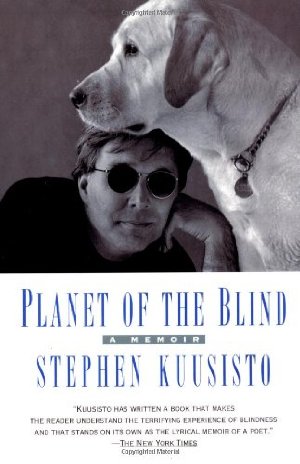
 Planet of the Blind