Wild turkeys! Enough to make the Neanderthal dog’s nose fall in love all over again!
Sent from my iPhone
Author: stevekuusisto
Poet, Essayist, Blogger, Journalist, Memoirist, Disability Rights Advocate, Public Speaker, Professor, Syracuse University
Podcast Hell
I don't know what came over me. I clicked on a British website devoted to theology. Soon I was listening to an infantilizing lecture about God's plan, which as near as I could tell was and is all about remaining hidden from human beings because we are small. I tried to turn off the podcast but the button wouldn't work. Click. Click. And all the while this treacle voice telling me how tiny we are. Tiny and undeserving. So I did what all inestimable creatures must do: I went out into the world. I walked around. When I came back the podcast was over. But the voice lingered in memory. Tiny. Tiny. The colonizing Bishop. So sweet and so cold!
S.K.
Title IX
By Andrea Scarpino
After watching the US women’s soccer team battle Japan through 90 minutes of World Cup finals play; after watching 30 minutes of tense overtime; after watching the US lose in penalty kicks; after their disappointment; after Japan’s jubilation; finally, I remembered Title IX.
Title IX, which amended the earlier Civil Rights Act of 1964, was enacted in 1972. While it has broader implications for education than sports participation, it’s often associated with women’s sports and the advancement of women in sporting arenas. All of the US players in this World Cup grew up with Title IX protection, meaning that their access to and participation in sports was, in theory at least, guaranteed by US Law.
And all of the women in this World Cup were fiercely athletic. They ran for hours on end, strategized with one another, pushed and shoved and tripped opponents when they needed to. They jumped crazy high, moved their bodies in crazy shapes. They got injured. They cried. They showed that all that is a part of the game, of pushing a woman’s body harder and longer than people would have thought possible even fifty years ago. Even twenty years ago, when the first Women’s World Cup was played.
Take Abby Wambach. Broad shouldered. Inches taller than most other players. Intense. She runs at the ball with her head, runs full-speed at other players. She looks fearless. Take Hope Solo. Stunningly attractive, long-haired—in many ways, stereotypically feminine. And tall. Muscular. Stunningly tough. I’ve read that she suffers from near-constant shoulder pain, and yet, she throws the ball over her head like it’s no big deal. Dives to the ground without flinching. She looks fearless.
I’m not an athlete in any sense of the word. When my friends were playing sports growing up, I was medically exempt from gym class, a person with disabilities struggling to walk without pain. But in my early 30s, I realized that I could push my body to run for hours, do incredibly hard yoga, weight lift. I realized that exercise made me feel good, physically and mentally, realized that “You’re strong” is an incredible compliment.
And my participation in athletics, while trivial compared to most, is also a product of Title IX. Because of Title IX’s success, it’s more societally acceptable for women to be athletic and strong, to get sweaty and grass-stained, fall to the ground. To be muscular. To scream across a field at one another. Because of Title IX’s success, I can choose from a plethora of sports bras and sports tanks, a plethora of shoes in my size. I can enter myself in marathons officially (only 40 years ago, women were denied entry in the famous Boston Marathon). I can be vocal about exercise. I can watch a group of women unabashedly announce their desire to win. Unabashedly play to win. And even when they come in second place, I can stand amazed at their accomplishment.
Poet and essayist Andrea Scarpino is a frequent contributor to POTB. You can visit her at:
Micro Day, Rattlesnake Island
A friend calls, says, “Bartleby the Scrivener” is a “one trick pony”–and this is a compliment. I throw a log on the fire: “Heart of Darkness” is also a one trick pony. Then I tell my pal a dirty joke having to do with the tricks a lawyer’s dog can do. Just two old friends on the phone, both laughing at the sheer improbability of being sentient, upright beings when the evolutionary numbers are against us. We suspect we won’t come back in these forms. We talk about a man who drowned this week while trying to save his buddy who couldn’t swim–this man saved his friend and died in the process. There is such sweetness behind each unassuming human gesture. One trick pony. I felt like weeping in the middle of the afternoon. Took my dog for a walk in the New Hampshire woods. A single Phoebe was calling from a stand of birches.
The pony comes out of the trees, his single trick? He wants to be one of us.
Simpleton: An Essay
A friend of mine, a poet, wrote: How do raindrops house all the components of a man or a woman?
I was alone all day. I was not of myself.
I wanted simple talk. There was no one in my vicinity.
The light of October was all about.
Jung said each of us has two souls.
I stood in my garden in the light that is so terribly insufficient.
I was helpless before the end of the day.
I traced the veins of the oak leaf that had fallen beside me.
“What an amateur you are,” I thought. “What a jester, talking to yourself in the raspberry bushes.”
“Lean your head on the larch, my boy…”
Think of D.H. Lawrence:
And the larch that is only a column, it goes up too tall to see:
and the balsam-pines that are blue with the grey-blue blueness of
things from the sea,
and the young copper beech, its leaves red-rosy at the ends
how still they are together, they stand so still
in the thunder air, all strangers to one another
as the green grass glows upwards, strangers in the silent garden.
So I think to myself: to be a creature of moods is one thing; knowing what to do with them is another.
Ah, there’s the rub. Do moods have to be productive?
Must we go on and on as the children of Freud?
I am sad, or more accurately, “tender”.
This is simply a fact like a shoe horn or a dropped glove.
Garden sadness…
Robert Louis Stevenson to the wind:
“O you that are so strong and cold,
O blower, are you young or old?
Are you a beast of field and tree,
Or just a stronger child than me?”
Garden sadness is the stronger child.
I pull berries off a yew tree. Walk in a slow arc. Find that my lips are moving. What am I saying? Maybe I’m turning into a Victorian poet in her garden, say someone like Violet Fane?
“Let me arise and open the gate,
to breathe the wild warm air of the heath,
And to let in Love, and to let out Hate,
And anger at living and scorn of Fate,
To let in Life, and to let out Death.”
By my yew tree I think of the Victorians and their fevers, poxes, how opening the gate of the garden is akin to opening the window of a sickroom and letting in the air of health as well as of heath—“to let in Life, and to let out Death” is really the poetics of Florence Nightingale.
The garden is a ruse; we hope to abjure thoughts of dying; but death appears there, has always appeared there.
“I want death to find me planting my cabbages,” said Montaigne.
And of course that’s where the old rummy will find you.
One thinks of Fernand Lequenne, the botanist who remarked:
“If you really want to draw close to your garden, you must remember
first of all that you are dealing with a being that lives and dies; like the
human body, with its poor flesh, its illnesses at times repugnant. One must
not always see it dressed up for a ball, manicured and immaculate.”
Understood this way, my garden is as melancholy as I am. My garden is young Werther. My garden is crazy. The poor thing. No wonder the wind is soughing in the unkempt willow. God help us, the whole world is a sallow and neurasthenic poet.
Silly. Talking in the garden, uttering old New England cliches:
“Bless the flowers and the weeds, my birds and bees.”
I was alone. I was not of myself.
It was a cold day. It was sharp in my heart. Come my love, my autumn garden, let us lie down together. It was sharp in our shared heart. O I was not of myself I tell you.
S.K.
Krugman's Dark Humor
There aren’t many positive aspects to the looming possibility of a U.S. debt default. But there has been, I have to admit, an element of comic relief — of the black-humor variety — in the spectacle of so many people who have been in denial suddenly waking up and smelling the crazy.
Yes, that's Paul Krugman in today's NY Times. One fair imagines that such humor is made possible because Mr. Krugman has his money in the Cayman Islands. Sorry. I'm a funny man but there's no humor in this situation at all. Those of us with disabilities are frightened to death.
SK
Open Society
There’s a fine piece over at The Nation by Richard Sennett entitled “A Creditable Left” which proposes that progressives can gain lost ground in the U.S. by engaging with civil society rather than expending energy on electoral politics. Those of us who hail from historically marginalized positions know this is often true and I will add that civic engagement generally reveals and affirms progressive values, particularly at the local level.
One reason for this is that when they’re not watching television Americans are (for the most part) fair minded and generous. I remember a town hall meeting some years ago in Worthington, Ohio where the issue of installing two talking crosswalk signs for the blind was under discussion. I had been invited to speak as a disability advocate and I pointed out that since the town was using federal money to upgrade the crosswalks, a request to install talking street signs was actually a reasonable accommodation under the ADA–my point was that in essence installing these signs was not only the right thing to do, it was also required. I think I also made a reference to the old Fram oil filter commercial where the mechanic says “You can pay me now or pay me later.” In the vernacular I was telling the city council to “just get her done.”
An interesting thing happened when a firebrand malcontent (who was obviously a familiar figure at the council meetings) stood up and began haranguing the representatives about how entirely inappropriate it was for the town to be spending his tax dollars on street signs for blind people. It’s hard to capture just how venomous this guy was but I can attest he was the human equivalent of the famous Burgundy Goliath Bird Eating Tarantula of Venezuela. (The largest and meanest spider in the world.)
He tried to argue that a survey should be done to ascertain just how many blind people lived in their town.
I pointed out that civil rights laws don’t work that way. One doesn’t survey how many black people are in your town before segregating the public school, etc.
He tried to argue that a talking street sign would keep his children awake–his house was just a few steps away from main street.
I pointed out that his house was just a few steps away from the fire station. Did he really propose having no fire engines?
In any event, the town unanimously adopted the talking street signs. And Spider-Cum-Tea Party-Man went home as antisocial and poisonous as ever.
I shouldn’t generalize. I’ve had my share of local defeats. But never because people lacked decency. Fear will trump the common cause; people will vote down a new elementary school because they don’t want their taxes raised, and what the hell, their children are no longer of school age; locals will vote down a levee for the library–but not forever. Fear has a half life. Decency does not.
The Tea Party is not really a local phenomena and therein lies its true weakness.
S.K.
– Posted using BlogPress from my iPad
Try to Remember Some Mercy
The following comes to us via http://www.InclusionDaily.com and we pass it along.
Blind Vermont Law School Student Sues Bar Examiners Over Test Accommodation
(Washington Post)
July 11, 2011
MONTPELIER, VERMONT– [Excerpt] Deanna Jones says she might like to devote her legal career to representing people with disabilities. But it appears she'll have to win her own fight first.
The 44-year-old Vermont Law School student, who is blind, is suing the National Conference of Bar Examiners and the Act Inc. testing company, saying they aren't providing the accommodations she needs in order to take the legal ethics exam all lawyers must take before they practice in Vermont and most other states.
Those accommodations — two pieces of computer software that help the visually impaired read — enable Jones to work at her best and have been key to the high B average she's maintained as a law student, she said.
Trouble is, the Multistate Professional Responsibility Examination is still administered as a pencil-and-paper exam: no computers, so no computer software allowed.
Her lawsuit, filed in U.S. District Court in Burlington, put it this way: "Unless Ms. Jones takes the MPRE in an electronic format with Kurzweil 3000 and ZoomText screen access software, her results will not accurately reflect what the examination purports to measure, but will instead reflect her impaired sensory and processing skills."
Entire article:
Blind Vermont Law School student sues bar examiners over test accommodation
http://www.InclusionDaily.com/news/2011/red/0711c.htm
Disability and Washington
It's a fact that people with disabilities are now "smack dab" at the center of our ugly national debate about debt limits, social services and budget cutting. President Obama issued today a stern warning that social security disability checks will not be going out if Congress fails to achieve a compromise on raising the national debt limit. It was, I think, not a coincidence that while the White House was sending that message the President was presiding at an award ceremony granting the Medal of Honor to a wounded Army Ranger. Is it fair to say that in symbolic terms there's a considerable amount of unbandageing going on? I think it's fair. The President can protect wounded warriors and Americans with disabilities by unlinking the debt ceiling debate from the larger ideological tug of war now going on though doing so would destroy the debate about who has who hostage. Is it fair to say that mercy demands severity? I think its fair.
S.K.
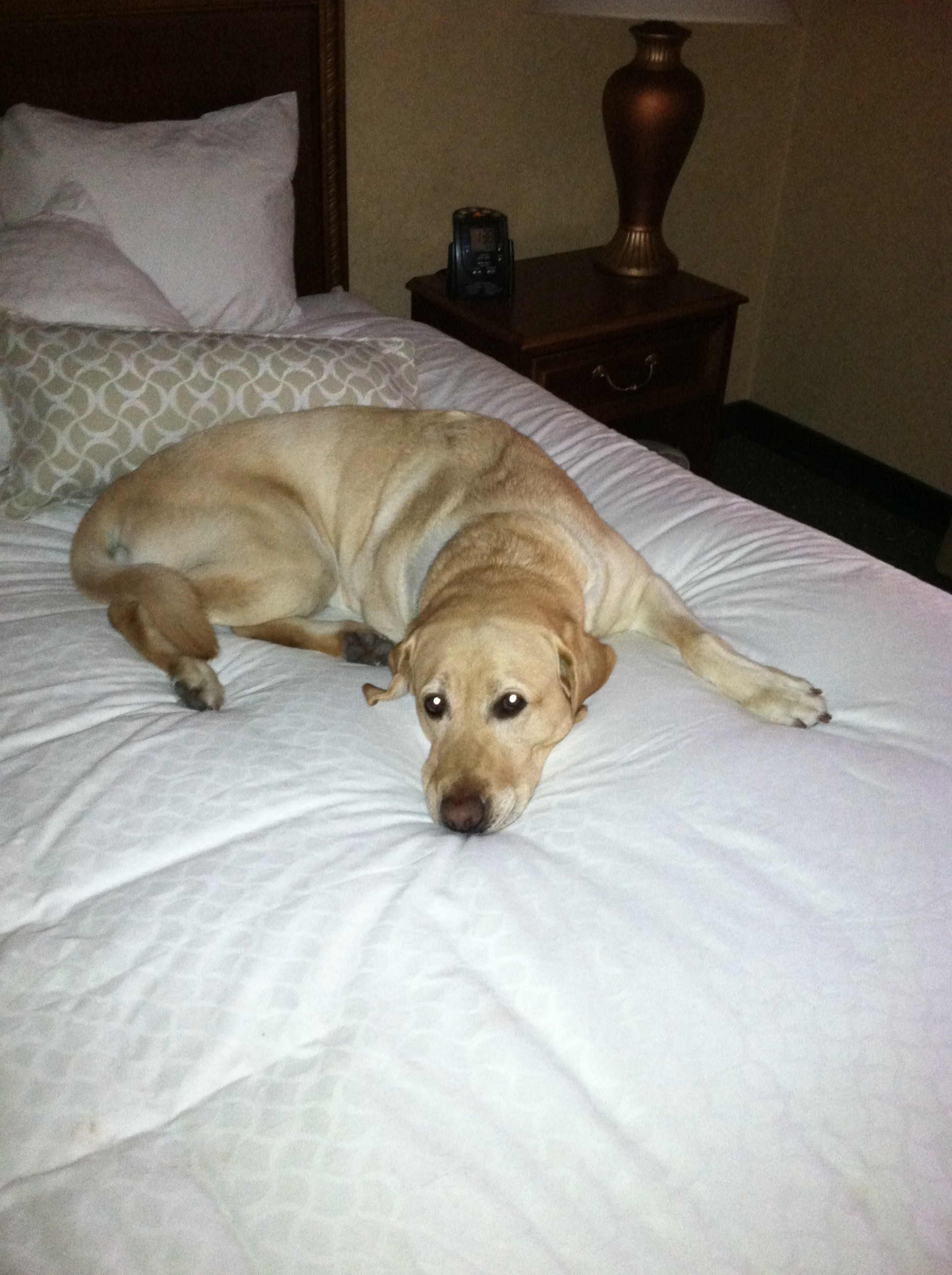
Out walking this morning with guide dog Nira we encounter 4 rabbits, many purple daisies, one poodle, two bull frogs, and a hawk. A good fifteen minutes. Dog outings are always a refuge as any dog will tell you. Now time for a nap!
 Planet of the Blind