One morning Henry Kissinger awoke to discover that he had scrabble hooves and a soul patch. This was especially exciting to him because when he was a human being he really didn’t have a soul. He stood long before his mirror admiring his new goatish mein and prancing on the Iranian carpet, which was given to him by his old buddy, the Shah of Iran. Occasionally he raised a hoof and swayed on three legs. When he did this he found that he could almost dance as he admired himself. This was much better than being Secretary of State. He hoped, rather ardently, that he would never return to his humanoid posture. Now. How to get some garbage delivered to his suite at the Waldorf…
SK
Author: stevekuusisto
Poet, Essayist, Blogger, Journalist, Memoirist, Disability Rights Advocate, Public Speaker, Professor, Syracuse University
Pinch and Ouch
That was the name of a text book aimed at teaching English to Japanese students. We were a group of inexperienced academics and our mission was to teach English in a summer program but we didn't know our sushi from Saigon. We didn't know anything. This was at a small college some twenty years ago. A senior administrator thought the summer language gig was a cash cow and this same fellow didn't particularly care that we were incompetent. Incompetent? No problem. We were only teaching language.
In general terms incompetence is like water weeds: it's all over the place and it produces like crazy. And of course one gets tangled in it. Soon you have weeds up to your neck. Eventually you're breathing through a straw.
But it was day one and I wasn't yet mindful of disaster. I was like a cabin boy on the Titanic who enjoyed his new uniform.
So I made jokes. "Pinch and Ouch," I said, "Shouldn't that be Twist and Shout?" Since no one laughed I said, "How about Shop Til You Drop?"
But everyone at the table understood our collective incompetence and no one thought there was anything funny about it. One woman reprimanded the man next to her for snapping his chewing gum. We were off to a promising start.
The book was largely worthless because it was designed for picnic ants. No human being above the age of three weeks could possibly find the exercises engaging. Some of us recognized this fact right away and we made private vows to abandon the damned thing and go it alone in the classroom. Others would stick to the book as if they were at bible camp.
Our students were Japanese women–young women between the ages of 16-19. None of them spoke any English. We were assured of this. We were also told that they would be the most serious students we'd ever seen.
I don't know whether my cavalier belief that everything would be okay was a result of my graduate work in poetry writing or not, but I decided that the only way to teach was to go into the classroom and talk, draw pictures, ask them questions, talk and talk, ask and ask–keep moving, persist in lingo, and smile like mad. I knew I'd never look at the book. Meantime I saw the bible camp instructors sweating and fretting like virgin lion tamers. They were sad and frightened and they gave off the stink of failure. I stopped going to the planning sessions. There was nothing for it but to drink coffee and jump into the fray.
Here's how it went:
The Japanese women were all lively, spirited, and ready for good humor.
They understood far more English than the administrators had let on.
They loved singing Elvis Presley's "All Shook Up" and taking turns doing the signature: "A Hey, Hey, Hey Hey!"
They were happy to play at conversation as long as it was in some way culturally relevant and yes, silly.
I couldn't get them to shut up.
Meanwhile the bible teachers looked ashen. Their copies of "Pinch and Ouch" were damp with tears.
Here's more of how it went:
The "Pinch and Ouch" teachers didn't like me because they could hear laughter coming from my classroom. They told one another that I obviously lacked intellectual rigor.
That's how it is with language. Rigor is in the speaking and not always in the book.
S.K.
Crip Street
I try to be the best person I can be. I don't mean this as some kind of ersatz kindergarten scenario―rather it's a kind of nominal hoping. I hope to be someone of discernment. When I'm honest with myself I recognize that I'm batting .500 on most days, a pretty good average for baseball but still problematic for street life. I yearn to possess more emotional intelligence but I'm a person who has a disability―that is, I hail from a historically marginalized group. My very existence is a shambling matter of misunderstandings. It's useful to think of disability as a kind of magnification: whatever occurs to a non-disabled person will be exaggerated in a disability centered setting. Sometimes I try to convince myself that matters are otherwise but this is usually a mistake.
A friend once went with me to the airport. I'd told him how my presence at the security checkpoint always causes hand wringing, flustered speech, and various other inappropriate gestures. My friend who is a literary writer and a cultured man was stunned by the nutty chaos that a man with a guide dog could produce in a small town Pennsylvania airport. Some people grabbed me, some barked senseless orders. The idea that someone with a dog and who as a matter of physical difference could not see, so entirely shattered the TSA agents' sense of decorum that my personhood was rendered into a public spectacle. My friend saw first hand how my brand of physical difference tormented the nerve of routinized life. I have hundreds of friends with disabilities and they will all tell you how hard it is to be in this hyperbolic and problematic space.
If you have a disability of any kind –whether it's invisible or visible, you can't ever tell when the moment will occur―that signature instance when the trap door of circumstance opens beneath you and drops you into social chaos. All too often that chaos is painful. Untrained airport service personnel talk about you in the third person, then offer you grudging help, some of them making a moue of disgust. I can tell you that as a frequent flyer I've been treated to a hundred indignities and I suspect this is a conservative estimate. But conservative or not you can see the pickle that people with disabilities are in: the public sphere is a place of capricious turns, a location of severely shifting acceptances and agreements, and accordingly it's a challenge to remain altogether composed while traveling or just walking the ordinary street. When you have a disability there is no ordinary street.
As a teenager I began to read voraciously. I'm in no way remarkable for that. My point is that reading will acquaint you with the broader community in ways that the customary street may not. James Baldwin puts it this way: "You think your pain and your heartbreak are unprecedented in the history of the world, but then you read. It was books that taught me that the things that tormented me most were the very things that connected me with all the people who were alive, or who had ever been alive."
Baldwin was not seeking the solace of comparative pain―that old bromide that suggests all suffering is essentially democratic with a small d. Instead he was suggesting that there's a communitarian value to injustice which is the only space for hope.
That's a dark lesson to be sure. I will also offer the opinion that it's a lesson most Americans don't like to hear.
We like stories with unambiguous and happy endings. We don't like any symbolism that speaks to unhappiness in our public square. People with disabilities are encouraged to appear always sunny. If there are dark and complicated dynamics to our respective experiences we are bucked up and told to keep these to ourselves.
This is an impossible way to live and that's that.
Charles Dickens puts it this way:
“Sadly, sadly, the sun rose; it rose upon no sadder sight than the man of good abilities and good emotions, incapable of their directed exercise, incapable of his own help and his own happiness, sensible of the blight on him, and resigning himself to let it eat him away."
**
I think of Crip Street as a place of opposition. But the resistance concerns what Dickens calls “the blight”–at least this is the case with me―I don't want to live the bitterness of abjection any more than I want to breathe second hand smoke.
Still, every time I book an airline ticket, each time I set out on a journey I face the real prospect of being treated like a stigmatized, taboo mannequin, talked about in the third person, grabbed and steered or sneered at. Taxi cabs refuse to give me rides, civic authorities fail to redress the problems. It's more than a jungle out there, the public arena is often a toxic place, save for what you can make of it in your head. And the place inside my head is what I call Crip Street.
**
Crip is of course an abbreviation of cripple and those of us in the disability rights community who have long felt the rococo complexities of our identities have come to embrace the term for its straightforwardness. As Nancy Mairs says famously: “As a cripple I swagger.” I'll add to that: as a crip one has immediacy.
I think the immediacy of a crippled identity has everything to do with knowing that you are a body―that is, you are not a cognition machine living a separate life from your embodiment, you are the body. Not long ago I tried to address this in a lyric poem about my early childhood:
Solo Dancing
Do you remember hiding in the cellar as a child?
Of course you don't–you were likely one of the strong ones.
The strong are made of air–so they don't see the need for a skin,
They are the light of god, the electrolysis of bone.
But the boy down stairs is all spine.
He's upright, clouded, flexing, shoeless,
Standing like a rake, lifting his arms,
Yellow flowers in his mind's eye.
Crippled kid, all body.
All body.
Think of that.
I think it's fair to say the mind and body are not separate as we are customarily taught and I think this is particularly evident to anyone who must puzzle out the ways and means of living what is still often imagined as a spoiled or ruined identity. (See Erving Goffman.)
Crip Street is where this knowledge is enacted and vitalized. As Crips we take our solo dancing outside.
**
Still the way forward is often difficult. The public sphere is not a child's basement. A Crip's reception is often a conditional matter. Just this week, while flying from Portland, Oregon to Cedar Rapids, Iowa, I was treated poorly by a sub-contracted airport employee whose job was to escort me from one gate to another.
She stared at me as I got off the plane with my guide dog. Just stared. Said nothing. Finally I said: “Are you here to help me?” She wasn't going to acknowledge my presence so I had to do the talking. Crips know all about this. This is how things go in the public sphere.
The escort lady didn't like my dog. Either that or she thought my condition might be catching. But no matter, she was giving me the silent treatment. I said: “Look, I'll just find my way on my own, you obviously don't have any interest in acting like a professional.” I took off.
I get so tired of this. Get tired of the dual pressure to be sensitive to other people's discomfort about disability, forgive them, imagine that they grew up in what we nowadays call developing nations, places where people with physical differences are thought of as a burden―Jesus, I'm tired of being treated like shit. And rather than lose my cool with the woman in question I just walked away. The pressure was on me to be cool. If you're a crip and you lose your temper you're automatically a person who has both a questionable identity and a bad attitude. “Which came first,” says the public mind. “He must be cranky because he's a blind person.” Only the crip knows what's going on. You've been reduced. You are beneath acknowledgement.
So I walked away.
The only reason I'm relating this incident is that the woman decided to follow me. She lent no meaningful help but she trailed my dog and I through the airport. She was essentially covering the bases―she could report to her superiors that she did her job. And of course by trailing me she simply compounded the insult.
It is tiring, this business of being a crip.
I decided to make no complaint. Crips know the path of least resistance.
But each of these incidents is a little porcupine quill in the life of the mind.
**
Crip Street is a dance floor. It’s liminal space. It’s both inside and outside our customary public square. That’s not an easy concept–in fact, it sounds petulant, as if I said, “I’m your neighbor sometimes, and sometimes I am not.”
But you see, Crip Street is a place in the mind. Living there I understand that not all the gates are open to my able bodied friends. When I understand this I begin to experience the power of my alterity. We Crip people are beginning to live the Eleusinian mysteries of our differences. And we will let you in from time to time. But not always.
S.K.
Guide Dog Nira's Day Off
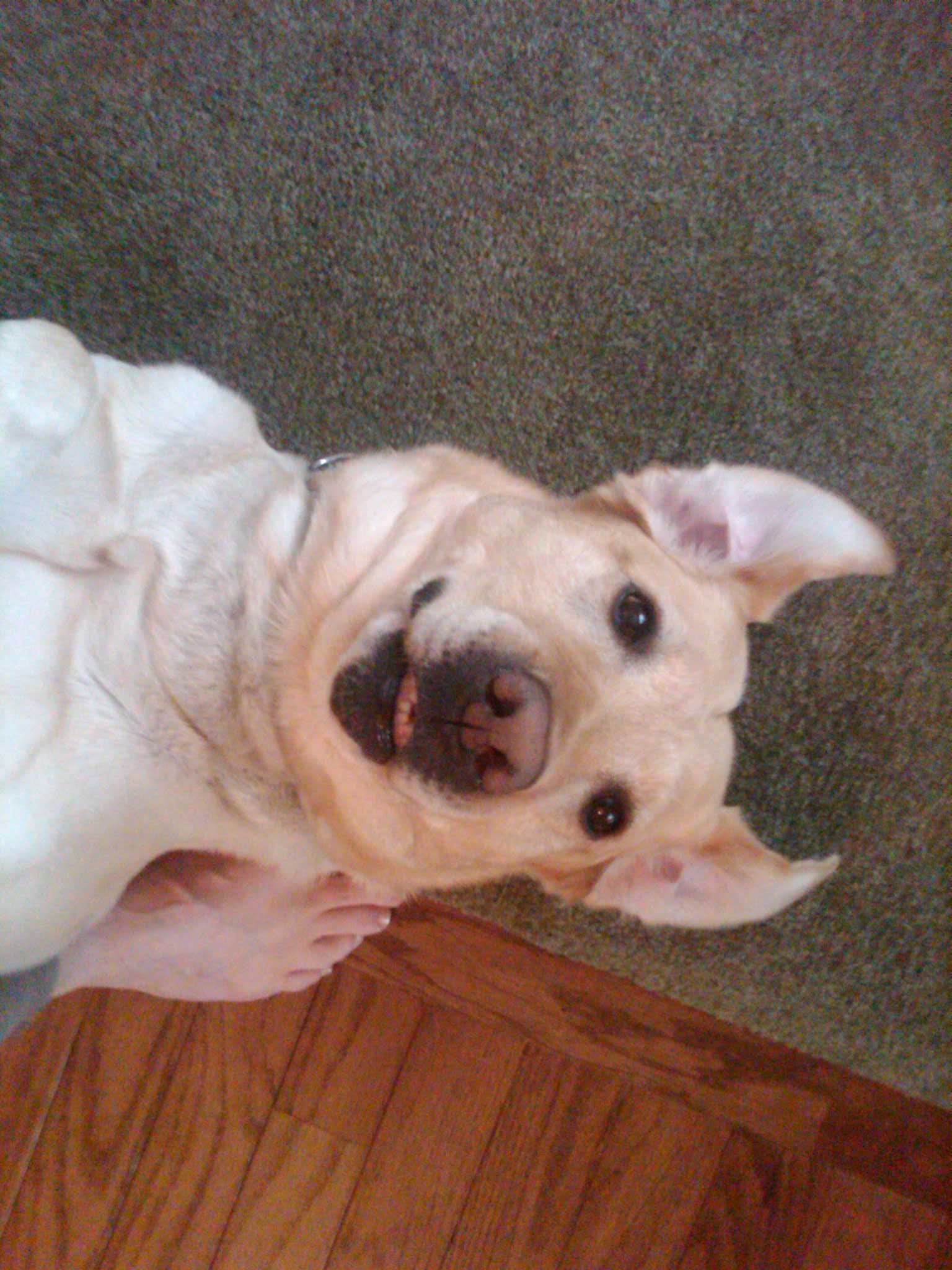
Hooray for Sally Labrador
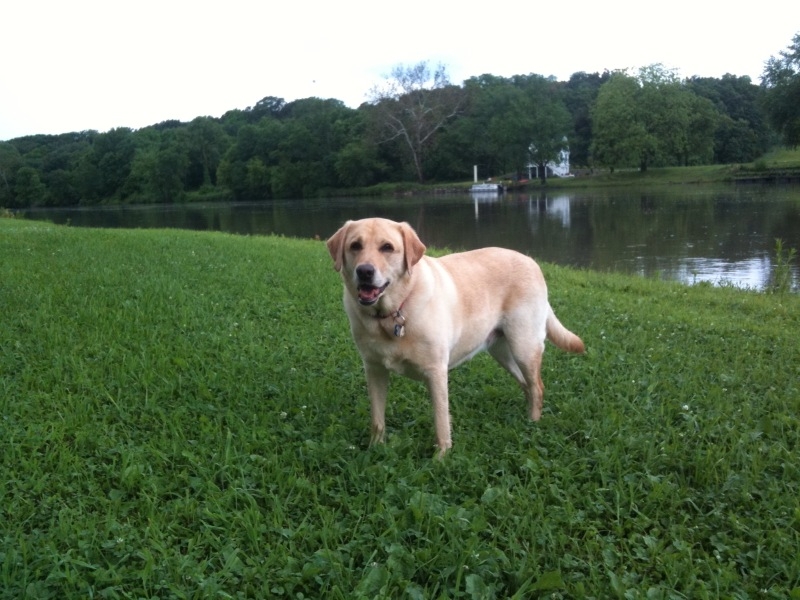
Sally Labrador, seen above, has just been certified by the Delta Society as a "Read with the Dogs" canine assistant–she's ready to work with kids in public schools. Sally spends a lot of time with readers and writers in Iowa City where her mom Jeanette directs the Iowa City of LIterature non-profit arts organization. We are pleased to be a part of Sally Labrador's fan section!
SK
World Health Report on Disability
Shame on Frontier Airlines
This story comes to us via Inclusion Daily. As a person with a disability who has been humiliated on airplanes more than once, I can attest that the airline industry is still doing a woeful job of educating its workforce about the laws of the United States.
SK
Quadriplegic Passenger Forced Off Frontier Flight
(KMGH)
June 21, 2011
DENVER, COLORADO– [Excerpt] A quadriplegic man from Fort Collins was forced off a Frontier Airlines plane because a pilot said it wasn't safe for him to fly.
His mother, Kathleen Morris, said there was no problem two days earlier when her son flew Frontier from Denver International Airport to Dallas to attend a family wedding.
But Sunday afternoon, when he boarded in Dallas to come home, John Morris and his family said they were humiliated.
"When a flight attendant saw John strapped in, they said they would have to clear it with the captain," said Kathleen Morris.
Entire article:
Quadriplegic Passenger Forced Off Frontier Flight
http://www.thedenverchannel.com/news/28291011/detail.html
The Advantages of Learning
Tell me again the story of our family’s hunger
& how it wrapped the house in superstition
As if the moon was in the walls
For that was the year we played the game called
Let's pretend we're eating.
We raised our spoons you still remember,
The wheelwright built three caskets
From a single broken sleigh…
Lorca
A man whose eyes are shot through with gold thread,
Whose eyes are numbers, sums foretelling the wires–
Whose lips steer a song of the harvest knife
Though there are many, too many to be sung.
A man can be the wheat at the end of summer,
Can be a wheel, innocent, his pulse
The revolutions of a long, clear night of love.
& when September comes
A man can be the first leaf in the fountain–
Perfect, death's butterfly…
S.K.
Shame on British Airways
The following excerpted news article comes to us via Inclusion Daily:
British Airways Turns Girl Away Because She Has Down Syndrome
(Daily Mail)
June 20, 2011
LONDON, ENGLAND– [Excerpt] A girl of 12 was refused a plane ticket by British Airways staff because she has Down's syndrome.
The mother of Alice Saunders was stunned when she was told her daughter could not fly unaccompanied as it was the company's policy not to accept passengers with Down's travelling alone.
Heather Saunders, 49, had phoned the airline to book Alice a flight from Gatwick to Glasgow.
Heather said: 'I explained I wanted her to travel as an unaccompanied minor, she was 12 years old, she had Down's syndrome and was very independent. 'The woman said, "Our policy says we don't take children with Down's syndrome".'
When asked why, the BA customer service agent responded: 'Because we've had problems in the past.'
Entire article:
BA turns girl away because she has Down's syndrome: Alice, 12, barred from Gatwick-Glasgow flight
http://www.InclusionDaily.com/news/2011/red/0620b.htm
Related:
British Airways apologizes for turning away girl with Down syndrome (MSNBC)
http://www.InclusionDaily.com/news/2011/red/0620c.htm
 Planet of the Blind