The Barftastic Holiday

By Andrea Scarpino


7-year-olds can do many things very well: draw butterflies, make pancakes, tell knock-knock jokes and recite weird animal facts. They also are excellent carriers of disease, as I found this Thanksgiving when my 7-year-old friend Zoe brought us stomach flu.

The first day of our visit was wonderful. We made our own spa products—lip balm from Shea butter and drink mix crystals, sparkle-filled body gel, chocolate bath bombs that turned the bathtub a murky, sick color. We made ornaments for our Christmas tree, ate lots of pizza.

But then, in the night, Zoe got sick, really sick, throwing up every hour for hours on end. By the morning, she was still feeling miserable, screaming in pain, inconsolable. So off we went to the Emergency Room for fluids and monitoring. By the next evening, her dad had the stomach flu. Then her mom. Then me. One by one, we succumbed to vomiting, fever, aching heads and backs, throbbing legs.

Because Zoe was in the ER most of Thanksgiving, we promised we’d save our dinner until Friday, when she would hopefully feel well enough to eat. But by Friday evening, the rest of us were beginning to get sick and we never all actually sat down together to share our holiday meal. The potatoes we had peeled went bad—still sitting in the pot on the stove. The stuffing lost its crunch. Even the cranberry bread Zoe and I baked before she felt sick became strangely slimy. We finally froze the green beans and pumpkin pie in order to save them, threw away the roasted chestnuts.

“A disaster. . .” I said to Zac on more than one occasion. Here we had tried so hard to plan for a fun holiday with our friends—bought all the food they requested, mapped out several hikes we could do if the weather was good, planned on a trip to the Children’s Museum. Instead, we mostly spent time in the hospital, lying in bed, feeling miserable.

I’d like to think that our terrible holiday brought us closer together as friends, will be a funny story Zoe remembers when she grows up—the year of the barftastic Thanksgiving. I think, though, that we’ll all remember it as the first terrible attempt at a Thanksgiving without Gracie. It seems fitting, then, that Zoe cried out in pain her first Thanksgiving without her big sister, that she spent hours in a place made expressly for emergencies. That we were all sick—physically and mentally—most of the holiday. It seems as if our bodies wouldn’t let us forget what our minds were trying to ease us through.

But maybe that’s making too much of it. Maybe we were just unlucky. Kids are disease magnets—and combined with the many germs of the flights to Marquette, maybe we were all going to get sick, no matter what. I don’t really know the answer. But I feel disheartened, sad—that I couldn’t provide a better first-holiday-after-Gracie’s-death, that I couldn’t give my friends some comfort.

As Zoe would say, “the first is the worst.” Of course by her logic, that means the second will be “the best.” And then we have to be prepared for the third to be “the one with the hairy chest.” After this terrible virus-ER-no-dinner Thanksgiving, most anything would be an improvement.


Andrea Scarpino is a poet and essayist and the “rust belt Bureau Chief” of POTB. You can visit her at:

www.andreascarpino.com

Written Broadly (Lines from a Helsinki Notebook)


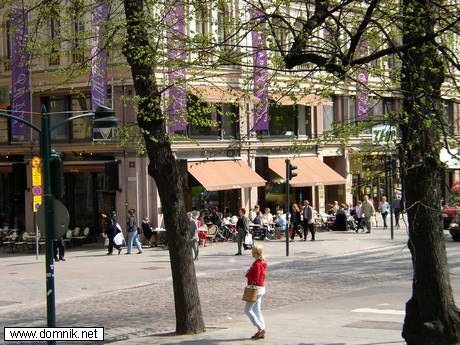
Cafe Strindburg, Helsinki


Helsinki. April & snowing. I walked to the Strindberg Café for coffee.

I walked & counted my steps.

Down the wintry Esplanade I went

My footfalls muffled by snow.

I could hear my heart beating under the sweater.

“My heart,” I thought, “is gliding without me.”

The heart like a rich man in his sleigh…

(I was at step thirty; halfway to go…)

Just to amuse myself

I pictured my heart as the last Czar of Russia.

It was going to the opera–the grandeur of Boris Gudonov,

That terrible dance with death & the hands of a nightmare clock…the palace

Like a ship on the winter sea…the audience hushed, not a soul breathing…

& Chaliapin standing in a staged moonbeam,

Hands pressed to either side of his enormous head,

His twisted, bearded face raised to the wheeling, soulless stars.

That’s how it was. I would soon find the doors of the café.

Chaliapin saw the angel of winter, something at once cruel & beautiful as a swan

& reached for a low note, a gasp from the plates of the earth.


S.K.

Objects and Shadows

Most days I think about art not as a co-determinate of politics or of social influence but rather as the vehicle for the representation of line and color; of objects and shadows. These fascinations must always come first. Then comes the compulsive thaw when we see what we’ve been about as Jackson Pollock once famously said. For poets this secondary stage is the place of the head with all it’s distortions and playfulness. In other words, it’s what you feel about the shadows makes the poem.

Here is an example, a fine poem by the Estonian poet Jaan Kaplinski, translated by Sam Hammill:

This summer is full of insects.
As soon as you go to the garden,
a cloud of flies buzzes around your head.
Bumblebees nest in the birdhouses,
wasps nest in the hazel,
and as I sit at the window
I hear a buzz I cannot name,
whether the voice of bumblebees, wasps,
or electric lines,
a plane in the sky, a car on the road,
or the voice of life itself that wants
to tell you something from the inside out.

S.K.

The Road to the Interior

Flock of Sheep

Yesterday we had to stop off at a Target Mega-store in Cedar Rapids. While my wife and step-kids gathered purchases I wandered into the “entertainment” section where I felt like a stranger newly arrived in Bedlam—every movie and CD was just an iridescent, plastic advertisement for mindless sex or gratuitous violence. This of course isn’t news. It just isn’t news. But seeing commodified slick spasms of blow dried sexual fantasies and human dismemberment on shelf after shelf under gaudy Christmas tinsel was like waking up in the midst of a saturnalia. And of course there was holiday music.

Because I don’t see well I had to nose my way through the shelves, sticking my face closer to the packaged goods than your average customer would be likely to do. And I peered at pools of blood flowing from pyramids with vastly muscular men armed with machine guns leaping into the foreground. Next: big bosomed girl looking to be no more than 13 making kissy face at gangsta who of course affected a glassy stare.

And that was the thing: I saw how all those people on the album covers were dead. They were dead on the inside and on the outside and in turn the shoppers were dead. I saw that the Target store was an Etruscan village where the dead were buying more tokens of deadness.

Seeing the spectacle of dead money and dead wishes made me wild to get outside. As Anselm Hollo once wrote in one of his fine poems:

“Virgil! Virgil! Wait for me! Virgil!”

S.K.

Zounds! Gadzooks! Etc.

I worked all through the night in my dreams. I moved in and out of several houses toting a trunk of books. I don’t know why I had to keep moving but it all felt right. Old friends were there and they were moving too. This morning over coffee I saw that the dream was about the imagination–people carried poetry through the myopic streets of the unconscious.

That is of course a good dream. We were moving and there were no landlords.

S.K.

Thanksgiving Prayer

Gods, whoever you may be, let me come down now out of these dark thoughts; let me at the start of winter be one child of one body of one earth; let me say the word “wait” with more graciousness; let me hear more feather sounds; let me regard the rock pool; let me touch the ankles of goodness; return to the deep forested calculations of mind with its still leaves. Let us in late afternoon in our time give thanks and consider our lives.

S.k.

Working Through the Sleet

I’ve always loved a poem by Robert Bly entitled “Eleven O’ Clock at Night” in which he inserts a recurring line–“And for this there is no solution”. I know I will regret the hours spent today talking to Verizon and Direct TV. I will regret hunching over the computer knowing it was unproductive. Outside the northern windows one could watch sleet came across the corn fields like an illness. One hopes for a larger premise than these seasonal vagaries. For a better position on winter see my friend Andrea’s post below. Wittgenstein: objects become facts as we organize. The fact is, sleet is the tears of our bones. Yes, Wittgenstein wasn’t much fun. And for this there is no solution.

Pie helps. I like mince meat.


S.K.

Bring it On, Or the Temporary Lunacy of First Snow

Andrea Scarpino

Marquette, MI

First snow of the season. Car tracks in the street. Thin icicles hang from branches in the back window. This is the beginning of winter in Marquette, the beginning of what may decide whether Zac and I can actually live in this town long term. Everyone says to expect 12 to15 feet of snow a year. It’s always dark now when I wake up, and it’s dark again by 6pm. Zac bought us a special light that he sets to gently glow in the corner of the room before our morning alarm rings. I haven’t seen the real sun in days.

The locally grown vegetable section of our grocery store is getting smaller and smaller—a few bunches of kale, some potatoes and squash. The ice cream store is boarded up, restaurants have moved to their winter hours. Even the parking situation has changed—cars aren’t allowed now on downtown streets between 1 and 6am, I guess for the snowplows.

But Marquette is a place where people pride themselves on surviving the winter. Thriving in it, even. Zac says that his students still routinely wear shorts and flip-flops. When we went for a run the day after the snow, leaves crunched under our running shoes, puddles of water cracked with ice. I wore two shirts and a jacket, two pairs of pants, gloves, a hat. Then we rounded a corner on the lake path and saw someone paddle boarding in Lake Superior. Full wetsuit. No matter that it was 30 degrees, this man was clearly having a blast catching winter-storm waves, pushing himself back and forth along the shore.

Hearty folks, salt of the earth, we keep hearing. I don’t know how hearty I am. I miss the sun. I miss bare legs, strappy sandals. So far, I don’t really mind layering, but I do feel like it takes a lot of time to get in and out of the house, a lot of putting on, taking off, wrapping up. Much of the time, I feel like a sausage—layer upon layer of clothing wrapped into my jacket’s shell.

But the first snowfall was so beautiful, I found myself lamenting how quickly it melted. I loved hiking in it, having snow blow around my hair, around my knees. I loved how bright the earth looked. I’m ready for some skiing, some serious playing outside. Of course, I may be kicking myself in February for being so anxious for winter to actually take hold, but I’m ready now. Ready to really put my winter gear to work, ready to get out into the thick of things. Ready for winter to really bring it on.


Andrea Scarpino is our Rust Belt Bureau Chief. She lives and writes in Marquette, Michigan. Visit her at:

www.andreascarpino.com

Questions to Answers


–for Marvin Bell

I was guilty of reversing things

So that water was sky when I rowed the boat early mornings

& I could see the purpose of trees was the perfection of earth—

Boyhood was like swallows in June, I flew everywhere upside down & fast


O & I made solemn work of shadows

Begging the darkness

With my own darkness

A trick of the blind

Always the smallest grains of feeling


This is why the gravity of seasons

Holds me awake—

Almost foolish to say

I believe snowfall

Is the form and habit of gods

& they return against our will

& they talk of natural facts


They talk of natural facts


Whenever I want to cry I think of boyhood & the gods

The virtual emptiness of a child’s early mornings blind in a boat…


S.K.