Autism Rights

First Autistic Presidential Appointee Speaks Out
(Wired)
October 12, 2010

SYRACUSE, NEW YORK– [Excerpt] When Ari Ne’eman walked onstage at a college campus in Pennsylvania in June, he looked like a handsome young rabbi presiding over the bar mitzvah of a young Talmudic scholar.

In truth, Ne’eman was facilitating a different kind of coming-of-age ceremony. Beckoning a group of teenagers to walk through a gateway symbolizing their transition into adult life, he said, “I welcome you as members of the autistic community.” The setting was an annual gathering called Autreat, organized by an autistic self-help group called Autism Network International.

Ne’eman’s deliberate use of the phrase “the autistic community” was more subversive than it sounds. The notion that autistic people — often portrayed in the media as pitiable loners — would not only wear their diagnosis proudly, but want to make common cause with other autistic people, is still a radical one. Imagine a world in which most public discussion of homosexuality was devoted to finding a cure for it, rather than on the need to address the social injustices that prevent gay people from living happier lives. Though the metaphor is far from exact (for example, gay people obviously don’t face the impairments that many autistic people do), that’s the kind of world that autistic people live in.

Now, as the first openly autistic White House appointee in history — and one of the youngest at age 22 — Ne’eman is determined to change that.

Entire article:
Exclusive: First Autistic Presidential Appointee Speaks Out
http://www.wired.com/wiredscience/2010/10/exclusive-ari-neeman-qa/
Related:
Autism Network International
http://www.autreat.com/

U.S. Employers Give Mere Lip Service to Hiring People with Disabilities

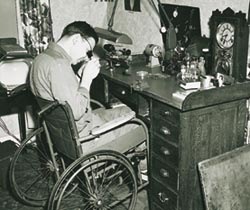
man_fixing_radios


The following excerpted article comes to us from Inclusion Daily: 


Poll: Most U.S. Employers Give Mere ‘Lip Service’ To Disability Diversity
(Harris International)
October 6, 2010
NEW YORK, NEW YORK– [Excerpt] A new survey sponsored by Kessler Foundation and National Organization on Disability (NOD) finds that although corporations recognize that hiring employees with disabilities is important, most are hiring very few of these job seekers and few are proactively making efforts to improve the employment environment.

These results, from the Kessler Foundation/National Organization on Disability 2010 Survey of Employment of Americans with Disabilities conducted by Harris Interactive, are especially important given the focus on employment by media and government and with October recognized as National Disability Employment Awareness Month.

Data released in July 2010 from an earlier study, the Kessler Foundation/NOD Survey of Americans with Disabilities, found that little progress has been made in closing the employment gap between people with and without disabilities since the passage of the Americans with Disabilities Act in 1990. In fact, only 21 percent of people with disabilities, ages 18 to 64, reported that they are working either full or part-time, compared to 59 percent of people without disabilities.

From this latest survey, although 70 percent of corporations polled have diversity policies or programs in place, only two-thirds of those with programs include disability as a component. Only 18 percent of companies offer an education program aimed at integrating people with disabilities into the workplace. The low figures are particularly notable given that a majority of employers perceive the costs of hiring a person with a disability to be the same as hiring a person without a disability (62 percent).

Entire press release:
Harris Interactive Survey Finds Largest Minority Group Falls Behind in Companies’ Attempts to Diversify

http://www.InclusionDaily.com/news/2010/red/1006a.htm
Related:
2010 GAP Survey of Americans with Disabilities

http://www.2010disabilitysurveys.org/index.html

Scarring

By Andrea Scarpino

Scars run lengthwise up each of my heels, maybe 6 inches, maybe a bit more, the result of an operation I had at four months old to lengthen each Achilles tendon. When I was growing up, other kids asked about them pretty regularly; a childhood friend once even said, If I had those scars, I would always wear socks to cover them. But most people don’t seem to notice them any more—or if they do, they don’t ask me about them like they used to. I got lulled into thinking they were nearly invisible.

So this week, I tried to console a friend whose son might have the same surgery by showing him my own scars. They’re no big deal, I said. I thought I was offering comfort, pulled up my pants leg, rolled down my sock. He gasped, Oh my god, looked away. I quickly back peddled, Well I’m sure they have more advanced surgery nowadays.

I don’t think he was trying to be offensive—I think they honestly shocked him. And then I felt bad that my attempt at comforting failed miserably, felt bad that maybe I don’t see my scars the way they really exist. The truth is, without them, I wouldn’t be able to walk, wouldn’t be able to flex my feet. Which is not to say I romanticize them—I still have limited flexibility, still have to layer band aids and moleskin over each scar to keep them from blistering when I break-in new shoes. Sometimes they still feel tender. Sometimes I feel nauseated when other people touch them. But they’ve given me more than the inconveniences they create: movement. Freedom.

And the truth is, I like them. I like that they remind me of the frailty and strength of my body. Of every body. I like that they remind me how precious movement is. Help me to find gratitude in the things my body can do instead of anxiety over the things it can’t. I like that, like Achilles, my weakness lies in my heels. Another friend’s seven-year-old daughter recently told me her own birthmark helps make her unique. Isn’t it cool that we have marks that make us different? she said. And I agreed.

So maybe my scars are shocking, ugly, strange. Maybe they’re more visible than I think. But I am so grateful for what they have given me, grateful for the ways they help me move through the world. Grateful of all they remind me about my body, about the bodies of others. I know it’s a cliché but even if I could, I don’t think I would trade them for perfect tendons, for unscarred, perfectly smooth skin. They’re part of me. Part of how I see myself, part of how I understand myself moving through the world.


Poet and essayist Andrea Scarpino is a regular contributor to POTB. You can visit her at: www.andreascarpino.com

Para-equestrian at World Games

Para Equestrians Share Stage With Able-bodied Riders At World Equestrian Games
(Louisville Courier-Journal)
October 5, 2010

LEXINGTON, KENTUCKY– [Excerpt] Throughout the Kentucky Horse Park, athletes in wheelchairs, on crutches and with prosthetic limbs are preparing to compete in the Alltech FEI World Equestrian Games.

Para dressage, which starts today with the team competition, will mark the first time athletes with disabilities have competed on this international stage.

“It’s such a big step for us to be included in such a big sports venue,” said Rebecca Hart, the top-ranked member of the U.S. team.

The rules of para dressage are the same as for standard dressage — in which horses and riders must perform a prescribed set of movements or maneuvers.

Para equestrians have competed internationally for many years, but typically those competitions are part of the Paralympics or held by themselves.

“This is what it’s all about, bringing elite athletes together — whether they are disabled or able body,” said Hope Hand, president of the U.S. Para Equestrian Association.

Entire article:
Para equestrians share stage with able-bodied riders at World Equestrian Games
http://www.courier-journal.com/article/2010310040104

Torture in Your Own Backyard

From Inclusion Daily:

Torture Allowed In Our Back Yard: Judge Rotenberg Center
(Washington Post)
October 4, 2010

CANTON, MASSACHUSETTS– [Excerpt] “We don’t torture,” President Obama said just days after taking office. Perhaps he is not aware of what is happening in his backyard — to children with disabilities in Massachusetts.

During investigations into treatment of detainees at Guantanamo Bay and Abu Ghraib, detainees reported being short-shackled, verbally abused, isolated, hooded and threatened in ways designed to induce fear of injury, pain and death — including threats that they might be tortured with electric shocks.

State reviews of the techniques used at the Judge Rotenberg Center (JRC) in Canton, Mass., and the center’s Web site have cited skin shocks, shock chairs, shock “holsters,” shackles and social isolation — some of which are applied to school-age children.

Known as a school of last resort, this taxpayer-funded residential facility — at more than $220,000 per child per year as of 2007, according to Mother Jones — has a controversial history. Started by Matthew Israel, a devotee of the behavioral psychologist B.F. Skinner, the school employs “aversive treatment,” a program of behavior modification involving rewards and punishments.

Entire article:
Disabled children at Mass. school are tortured, not treated
http://www.InclusionDaily.com/news/2010/red/1004a.htm
Related:
Judge Rotenberg Center — Facility Uses Electric Shock To Change Behavior (Inclusion Daily Express Archives)
http://www.inclusiondaily.com/news/institutions/ma/jrc.htm

Disability or Max-ability?

This article comes to us via Inclusion Daily Express:

Developer Imagines “Disability” As A Thing Of The Past
(Scientific American)
October 1, 2010

LOUISVILLE, KENTUCKY– [Excerpt] Hugh Herr has made it his mission to eliminate the word “disabled” from our vocabulary when describing people who require assistance of some sort to perform the daily tasks that most people take for granted. Listening to Herr speak here Thursday at Idea Festival, it’s not hard to believe he’ll succeed.

Herr’s credibility comes mainly from two sources. As the director of the Biomechatronics Group in the Massachusetts Institute of Technology’s (M.I.T.) Media Lab, he has pioneered the development of technologies such as advanced prosthetic limbs and exoskeletons for people with missing or damaged limbs. And as a double amputee, Herr is a prime candidate for testing many of his creations. “I’m basically nuts and bolts below the knees,” he pointed out during his Idea Festival presentation.

“I realized that technology has the ability to heal and, in my case, augment,” said Herr, whose legs were amputated 15 centimeters below the knee in 1982 after he spent four days stranded in deep snow on New Hampshire’s Mount Washington. “Imagine a world so advanced where amputees can run, jump and skip better than people with biological limbs.”

Entire article:
Biomechatronics aims to erase the entire concept of ‘disability’
http://www.InclusionDaily.com/news/2010/red/1001c.htm

Characters with Disabilities Virtually Nonexistent in Television

Excerpt from Inclusion Daily

New Study Reveals Lack Of Characters With Disabilities On Television
(Tri-Union Performers with Disabilities Committee)
September 30, 2010

LOS ANGELES, CALIFORNIA– [Excerpt] October is National Disability Employment Awareness Month and a new report released today on minority representation on broadcast television shows that scripted characters with disabilities will represent only one percent of all scripted series regular characters — six characters out of 587 — on the five broadcast networks: ABC, CBS, The CW, Fox, and NBC. Not only is this invisibility in the media misrepresentative of people with disabilities, it also means few opportunities for actors with disabilities to be cast.

While people with disabilities are largely absent from the television scene, they are very present in the American Scene. According to the U.S. Census Bureau’s 2008 American Community Survey, the percentage of U.S. citizens reporting an apparent disability is slightly more than 12% (or 36.2 million people). The inclusion of people with non-apparent, ADA-covered disabilities, such as cancer or HIV, greatly increase this census number. Yet, even the original figure is nowhere nearly reflected by the broadcast networks.

As of this count, three of the six series regular characters with disabilities scheduled to appear in the upcoming season are on the Fox network: the title character on House, who uses a cane, Dr. Remy “Thirteen” Hadley on House who has Huntington’s Disease, and Artie Abrams on Glee, who uses a wheelchair. On three other networks, Saul on Brothers & Sisters (ABC) is living with HIV, young Max Braverman on Parenthood (NBC) has Asperger syndrome, and Dr. Albert Robbins on CSI: Crime Scene Investigation (CBS) has a prosthetic leg.

Entire article:
New Study Reveals Lack of Characters With Disabilities on Television
http://www.InclusionDaily.com/news/2010/red/0930e.htm
Related:
Tri-Union Performers with Disabilities Committee
http://www.iampwd.org/home

The Thermal Layer

Several years ago I came across a small pamphlet called Rejoicing in Diversity by Alan Weiss. The subtitle of the booklet was: "A Handbook for Managers on How to Accept and Embrace Diversity for Its Intrinsic Contribution to the Workplace"–certainly a mouthful and perhaps not much of an advertisement. But I liked the word "rejoicing" and I also liked "intrinsic" for when you put these words side by side they speak of poetry. (The Chinese have two ideograms that stand together for poetry: a figure for "word" and a figure for "temple"). In any event, diversity in the workplace is seldom framed in ways that suggest spirit. Yet at the core of culture, spirit is all there is. Take away politics, real estate, the fighting over which end of the egg to crack and what you have left is the human wish for meaning. We tend to lose sight of this in Human Resources circles, substituting phrases like: Raising the Bar, Leadership, Assets, and the like. Talking about spirit is embarrassing. Its like talking about the philosophers' stone. Not even medieval historians feel comfortable talking about alchemy. You might look foolish. And we all know that the workplace should not be foolish.

I have advised many organizations on matters of disability and inclusion over the years. These opportunities came about because my first book of nonfiction was a bestseller and because for a time I was a senior administrator at one of the nation's premier guide dog traning schools. I had the opportunity to travel widely. Between 1995 and 2000 I visited 47 of the states in "the lower 48" and spoke at local, state, and federal agencies and public and private colleges. I have advised lots of blue chip organizations including the Museum of Modern Art in New York, the Metropolitan Museum, the Kennedy Center, even resorts and hotels. Inevitably, wherever I have spoken I've heard the rhetoric of middle management: "empowerment"; "equal opporthnity"; "productivity"; "zero tolerance"; "bias"; "sensitivity" and the like.

There is nothing wrong with these terms but to paraphrase Bill Clinton there's nothing right about them either. And this is because the terms have no alchemy in them. They're just nouns. Not all nouns have spirit inside them. The word "battleship" has no spirit but the word "blueberry" does. One of the first things a poet has to learn is that not all nouns are obedient to the soul.

Well meaning organizations (and some that may not be so) rely on the rhetoric of inclusion without imagining the opportunities for soul–and I mean "soul" the way Marvin Gaye would mean it: its what's goin' on. The human soul is present everywhere whether management acknowledges it or not. By way of analogy one can thik of management as playing "battleship" while the soul is picking berries. Human souls are looking for ways to be fed and to be happy; management is often trapped in brittle or arrid pronouncements.

Many organizations talk a good game when it comes to diversity. The top echelon recites the right words. My own employer, the University of Iowa, has lots of websites that propose equal opportunity and where matters of disability are concerned, the university has sites that suggest that accommodations for people with disabilities are easy to obtain. The web sites look great. They have all the right language. The trouble is that the university of Iowa has what Alan Weiss calls "a thermal layer" –the metaphor is atmospheric–one can think of it as an administrative echelon that's capable of distorting communications and directives it receives. Here's what Alan Weiss writes about the subject:

"I have had the rather unique experiences of providing comprehensive reports to top-level executives on the acceptance of diversity in the workplace, only to have them shout, wide-eyed, "That's not my company you're describing!" Yet the feedbhack has been based on extensive focus group and survey work. Who's wrong?

No one is wrong. What's happened is that the respondents have reported what they are actually experiencing, I've conveyed that feedback accurately, and the executives are using their own intent and strategy as their frame of reference. The psychologists would call it cognitive dissonance–fully expecting one set of circumstances, while experiencing quite another.

The phenomenon at work is what I call the "thermal layer," which is a management layer capable of distorting communications and directives it receives, turning them into something quite different. Managers in the thermal layer are the ones who actualy control resources, make daily decisions and deal with the customer. They often have strong vested interests in preserving the status quo…think they have a better way of doing things, don't trust senior management, don't buy-into the strategy or, for whatever reasons, have some agenda of their own. "

Alan Weiss has perfectly described the breakdown that most often creates obstacles to true diversity and inclusion–or to use the language of the soul, communal berry tasting and picking.

For the past three years I've been asking folks at the University of Iowa to take ownership of disability and accessibility issues and have found a deeply invested thermal layer–a phenomenon I like to call the "Iowa Rope-a-Dope" to borrow from Mr. Ali. The Iowa Rope-a-Dope takes advantage of a highly silo-ed administrative hierarchy to in effect pass the buck where disability and accessibilityy are concerned. Let's be clear: no one wants to be identified as being part of the thermal layer just as no faculty member wants to be outed for being "dead wood"–and let's also be clear that the person who persists in calling for blueberries when everyone else wants to talk about battleships will eventually be the victim of considerable distortion.

Alan Weiss again:

"Organizations seldom if ever fail in their intent, executive direction or strategy formulation. They fail in the execution and implementation of their initiatives. Nowhere is that more true than in the accommodation of diversity."

For my own part I have called for the university to provide accessible bathrooms in the student union building and in the Enlgish department–and to date, one floor's restrooms have been modified and I can assure you that this isn't enough. I can also assure you that at the level of departmental administration, no one knows who's in charge of these matters. That's because the thermal layer is in charge. And the T.L. has a hundred silos. It also has committees.

I was put in mind of all this when, this past week, I was upbraided by someone from the human resources department. I've been calling for the installation of assistive technology in the classrooms where I teach for three years. The lack of compliance and communication around this issue has been comical and my method of handling it has been to bring my own talking laptop into each classroom and manfully wire it to the projection system–sometimes this works and sometimes it doesn't. My every teaching experience is therefore a kind of gamble. Have I asked for help? Yes. I've asked the information technology office for help for a full three years. I've discussed this with deans, with department chairs, with the UI's president's office, with HR with the library, and with a stray dog that I met while walking with my guide dog. No one is in charge.

How was I upbraided? I was told that by calling attention to my difficulties with assistive technology compliance that I'd done considerable damage to my reputation with the committee that handles disability issues–the point being that I've apparently not gone through the proper channels in my requests for accommodations. This is how the thermal layer works. The thermal layer likes to deflect by distortion.

Alan Weiss:

"How could anyone oppose an accommodating, equal-opportunity workplace?"

"Well, we know that some people can, sometimes with malicious motives, sometimes with prejudicial judgment, and sometimes because they perceive themselves to be adversely affected by the policies. You must be constantly on the watch for thermal zone reactions and distortions. If there's a policy or value which causes conflict in the workplace, bring it to the surface and discuss openly. If there are misconceptions about policies, resolve them. The failure to do this doesn't make the policies go away, it simply preserves the thermal layer until, like the executives above, the key decision makers get some shocking news. The reaction to that is usually worse than any other alternative, because senior management will try to legislate change rather than help people to embrace it."
This brings us back to blueberries vs. battleships. The spirit of diversity vs. the demeaning of diversity initiatives through the employment of thermal language.

S.K.
Queer Matters

By Angel Lemke

The first publicly “queer” thing I did was attend a candlelight vigil for Matt Shepard during those hours when the machines were still keeping him alive. I knew I was implicitly outing myself by going. I hadn’t yet been to a gay bar, hadn’t yet brought a girl home to meet my mom, didn’t even own anything with a rainbow on it. By being there, I knew I was saying to the world, this matters to me. And by the logic of homophobia, the deaths of queers only matter to other queers. Maybe their immediate family members, if they happened to be lucky in their birth.

But there were straight kids there, after all. And straight faculty. I particularly remember a stodgy theology professor who I would’ve never guessed was an ally. And what that moment told me was that the homophobic message was wrong. This didn’t matter because that kid was gay. This mattered because that kid was human.

Others have written about how Shepard’s race and class status and relative gender normativity made the problem of homophobic violence, momentarily, visible in ways that so many deaths before his had not. It mattered, too, we must now admit, because that kid was white. I think of Eminem’s statement on the Columbine shooting: “Middle America, now it’s a tragedy/Now it’s so sad to see/An upper class city/Havin’ this happen.” And of course, it is a tragedy. But neither case was anywhere near the isolated incidents they appeared to be in media reports. The tragedies themselves are compounded by our inability to see them as part of a larger system of oppression, the world’s apparent indifference to deaths like that of Angie Zapata, to take one recent example. Matt Shepard dies over and over again.

But in the years since that vigil I have had to believe that–however overlaid with race and class bullshit the media coverage might be–the visibility of both Shepard’s murder and Columbine prevented other tragedies from occurring in all those places that Middle Americans cannot seem to see, if only because, for a brief moment, the country stopped to say these kids and their suffering matter to us all. And for a few of us—queers and allies alike—that was enough to keep us going. It was enough to convince us of the message Dan Savage is now trying valiantly to get to these kids: It can get better.

I don’t know much about Tyler Clementi yet. (If Shepard’s case is any indication, we will soon know his life in excruciating detail, a posthumous interrogation.) I know the pictures I’ve been seeing remind me of the “clean-cut,” “all-American” (read: white) Matt. I know he was attending a relatively elite school and played an instrument not often favored by working-class folks. The media response is uncannily similar – the constant presence of that picture, the focus on his activities before and after, the waffling about how much blame we should put on his attackers. They even brought poor tireless Judy Shepard out to speak on a morning news show this morning.

It’s just short of twelve years since Matthew’s death. The fact that this country didn’t notice that it was still going on during that time infuriates me. Let’s not let that happen with Tyler. We’ve broken through the haze of American apathy for a split second. Let’s use it.

Let’s use it to say this: Matt matters. Tyler matters. Angie matters. To all of us. And not just for this news cycle, but until this story disappears from the earth.

Angel Lemke lives in Ohio where she is fighting the good fight.

Why I Write

By Andrea Scarpino

Before I could read or write, I would sit my mother down at her typewriter and speak poems to her that she would type. I didn’t really understand what a poem was, but I knew that I had words inside of me that I needed to share with someone else. Almost my entire life, then, I’ve been creating stories, characters, playing with language, listening for moments and words and colors that I needed to record. Words are how I make sense of the world. Writing them down is how I make sense of the world.

I don’t know why I write other than I have to. That I don’t feel whole, complete when I’m not writing. That writing nags at me, the need to write nags at me. I can go weeks, months without really writing a poem, just recording a quick note here or there, listening for words that I want to return to later. But when too long passes, I start to lose my sense of who I am in the world.

Which makes writing sound incredibly narcissistic—it’s all about me, my stories, my needs. And maybe being a writer necessarily entails some narcissism, some fundamental belief that my ideas and words matter enough for me to record. But writing also helps me to experience other lives, feel empathy for other situations. It’s how I dip my toes into a life I can’t experience any other way. Even when I’m not writing about myself or my own experiences, I write myself into a fuller understanding of the world, the world’s working.

Writing is how I make sense of my experience on this earth. Writing is how I feel alive. Writing is how I remember. How I forget.

In truth, I don’t know what I would do if I didn’t have writing, didn’t have some ability to explore on the page. There’s something about that page, that piece of paper, that matters to me. That necessitates my understanding. My life. I write because there’s no other way. No other possibility. I write myself into existence. Write the world into existence. Day after day.

Poet and essayist Andrea Scarpino is a frequent contributor to Planet of the Blind. Visit her at: http://www.andreascarpino.com