Don't You Just Love Google Translator?


I am proud that my memoir Planet of the Blind is now available in a Turkish translation. But I must say that the Google translator has a strange slant on the Turkish book jacket.

Book Summary

Limited number of books on the visually impaired in our country are published. Human nature loved ones  a nice thing to see in the mirror itself is not.  Life is completely dark for one of the visually impaired. Stephen Kuusisto Stephen Kuusisto considers this aspect of his life trying to be a light for the visually impaired. While travel memories has witnessed throughout his life sometimes laughing and sometimes touched by the events live as you will read. This book does not have enough to think about if we close an important gap, this novel tells the moment-we can think.


Any visually impaired person’s life than with a hot to approach this book in private ‘status’ can say will make clear as possible. Or less visible in their childhood memories for the author in this field focused. Also unique in a world of darkness says it all. See the other hand, also says: Life is beautiful even in the dark!


Book Cover

Körler Gezegeni Planet of the Blind
Stephen Kuusisto Stephen Kuusisto
· Şenocak Yayınları · Şenocak Publications
· Basım Tarihi : 10 – 2009 · Publication Date: 10-2009
· ISBN : 9786055615024 · ISBN: 9786055615024
· Etiket Fiyatı : 14.00 TL · Tag Price: 14.00 TL


S.K.

Opening Books at Random


Sometimes in my abstract moments I pity the ancients. The scholars of Alexandria couldn’t open a scroll and discover the gift of an unanticipated page. (Opening a scroll is much like taming a lion: the whole matter must be handled with extreme delicacy–one needs an assistant or two and equal parts rigor and patience, perhaps even the right body language for papyrus has a mind of its own.)  

There are many great books on the history of literacy. Human kind was transformed first by written language and then by the book with its stitched pages and its articulated, transitive planets of mentation. Open a book at random and there before you is a rising moon, the summer moon of Finland, thin as an old woman’s ear.

I adore opening books somewhere in the middle–anyplace really, just to find wiser hopes than the customary seconds routinely afford. Here are some examples just now:

“I think and I do believe/we know the way to glory, or to what can be/glory for this worn-down bedraggled race–/peace, freedom, losing, and passing on. And place/We know it if anyone would listen.”

–Hayden Carruth from Brothers, I Loved You All

“sometimes I feel like an idiot boychild/longing for mama ocean”

–Anselm Hollo from No Complaints

“But there are beds and beds in this life. Beds of pain, beds of procreation, the irresistible beds of printing presses.”

–Marvin Bell from Old Snow Just Melting

“I thought I heard the sky squeak./Oh, it’s Nothing, it’s Uncle

Nothing/coming down from his tree.”

–James Tate from The Lost Pilot

“Inside me there is a confusion of swallows,/Birds flying through the smoke,/

And horses galloping excitedly on fields of short grass.”

–Robert Bly from Silence in the Snowy Fields

“In summer/come the old dreams of living on a boat/and walking home to it as the evening/

is beginning”

–W.S. Merwin from The Compass Flower

“The stars fatten like pearls./Not enough light to read your face by./And useless to wish on,as restless/

As we are, growing or shrinking./All we can do/is lend our bodies to life.”

–Deborah Tall from Come Wind, Come Weather

“Heavy for you, I hear the futile speech/Of air in trees, of shadows in your hair.”

–James Wright from Saint Judas

“The soul is driven by the hierarchical perspective of spirit into regions it considers even more distal and low, the organic body, where the soul makes its presence known as symptoms.”

–James Hillman from Healing Fiction

“There is nothing so scary/about grasshoppers sharpening scythes./

But when the troll’s flea whispers,/

be careful.”

–Olav Hauge Trusting Your Life to Water and Eternity

(translated by Robert Bly)

And so I open books at random and feel the rings of Saturn, the ghosts of my dogs, the atavistic organs of sensation whispering from their jars. This is a shy, unrehearsed and daily pleasure, a small thing, but maybe not so small, maybe not…


S.K. 

Disability and the Mainstream Sunflowers

First off, let me tell you about my maternal grandfather who had a grade school education and managed to make millions of dollars during World War I by manufacturing munitions for the U.S. Army. He made a fortune on the bad luck of others and at the height of his new found wealth (1917) he invested all his money in the Russian Czarist government. Thereafter my grandfather spent most of his time in the woods of New Hampshire blowing up barns with dynamite, but not as a vocation–dynamite became his hobby and the sole reason for getting out of bed. You can think of my grandfather as a perverse variant of Mozart’s Papageno–he sang to himself in the forest but instead of a bird cage and net he had TNT and blasting caps.

In the field of disability studies we talk about the “defective people industry” –a term that designates organizations both public and private that raise money on behalf of “the disabled” (perhaps for cures but sometimes for social services) and always implicit in the philanthropic pitch is the idea that people with disabilities are a different class of our citizenry. Another way to say this is that people with disabilities are thought of as being irrevocably outside of our cities and towns, our workplaces and universities…

Though its crude to reduce large social forces to simple maxims its possible to say that the defective people industry or DPI has a long standing investment in the idea that disability should be outside the city’s walls. For if PWDs are effectively part of the municipal and social activities of our society then the image of the lost disabled person who needs our cradle to grave support would vanish.

Imagine every corner gas station has a wheelchair repair service. Imagine wheelchair users doing the work…

Picture blind people inside that gas station, selling the gasoline…

Deaf people as television anchor men and women…professors…

As our nation ages and our sophistication about bodily differences continues to grow we will have to effect these transformations.

My university currently has its student disability services in the basement of a dormitory. It should be in the busy university owned shopping mall. They should be encouraged to sell technology and educate the broader public.

My grandfather was disabled by his lack of education. Our culture is disabled by its lingering inability to think with imagination about disability inclusion.

In a poem called “Among Sunflowers” James Wright wrote: “You can stand in among them without/being afraid.”


S.K.

A Sea Change on the "R" Word?


The following excerpted article from the Washington Post comes to us from The Inclusion Daily Express.

Tim Shriver deserves a special Valentine from everyone in the disability rights community.


S.K.


Emanuel Says He Will Join Effort To Stop Use Of ‘Retarded’
(Washington Post)
February 4, 2010
WASHINGTON, DC– [Excerpt] White House Chief of Staff Rahm Emanuel apologized again Wednesday for using the word “retarded” during a private meeting last summer, telling advocates for the disabled that he will join their campaign to help end the use of the word.

The controversy over Emanuel’s remark continued to dog the sometimes foul-mouthed senior Obama adviser despite his having privately apologized to Special Olympics Chief Executive Tim Shriver shortly after the comment was made public last week.

In a statement after an afternoon meeting at the White House, Shriver and five other disability rights advocates said Emanuel had “sincerely apologized” for the earlier comment during a strategy meeting, which was reported in the Wall Street Journal.

“We are happy that he will join more than 54,000 other Americans in pledging to end the use of the R-word at http://www.r-word.org, and that he committed that the administration would continue to look for ways to partner with us, including examining pending legislation in Congress to remove the R-word from federal law,” they said in the statement.

Entire article:
Emanuel says he will join effort to stop use of ‘retarded’

http://www.InclusionDaily.com/news/2010/red/0204a.htm
Related:
Rahm Emanuel “Retarded” Comment Puts Offensiveness in Spotlight (ABC News)

http://abcnews.go.com/print?id=9738134
Obama chief of staff’s ‘retarded’ insult brings fallout, Palin criticism (Yahoo! News)
http://news.yahoo.com/s/ynews/20100202/pl_ynews/ynews_pl1101/print
Palin vs. Limbaugh Over ‘Retard’ Comment? (US News and World Report)
http://www.InclusionDaily.com/news/2010/red/0204b.htm
Spread the Word to End the Word
http://www.r-word.org

Up in the Tree

I’m a writer which is like saying you’re a house painter. Everybody is a writer. Your uncle Dortmunder is working on a memoir; aunt Kitty is writing a variorum history of the fall of Rome with recipes. Sometimes I wonder if violinists have this problem? Of course they don’t. If the famous violinist says: I’m a first chair violinist for the Uppity Orchestra” the person next to her on the aeroplane doesn’t say “Me too!”

That it takes hard work to become a writer is scarcely credited by the happy many and lately I’ve begun to see that this is a good thing. (I used to think otherwise, snarl a bit with the kind of exceptionalism usually reserved for brain surgeons and rocket scientists.)

If everyone believes she or he is a writer then they still believe in tribal meaning, still want to make signs, share something around the fire…

Black Elk speaks. Then the amateur Black Elks spoke. Everybody got to speak.

You don’t have to be Ernst Cassirer to like that picture.

And the dogs get up, circle three times, then lie back down.

May you have a good story today.


S.K.   

Why I am Not a Smart Blogger


If you spend enough time in the world of blogs and bloggers you quickly learn that the secret of gaining a readership resides in linking to other blogs. Bloggers X and P are writing about the inconsistencies of Alexander Hamilton’s Federalism (just for argument’s sake?) and I, fervent but askance observer write my scree proclaiming Jefferson’s my man (though I stop short at embracing Fruitarianism?) and then I link my article to the neo-Federales and voila! Now I have something like an audience.

The trouble with me is that I cut my teeth on poetry and so I don’t expect an audience. I even imagine a posthumous audience, a coterie of library researchers (assuming there will be any libraries) far in the future. They will find me in the obscure-going-to-dust final final archive of old fashioned hope (for I believed in the soul and dared to imagine human progress). How silly I was! I was like a flower pinned on Stalin’s chest. I was a street sweeper in Pompeii. Silly to the end.

Back to the Federalists: they should have eaten more fruit. Alex Hamilton was a ferocious meat eater and his posse had trichinosis.

**

Random thought number 1:


The sight of Sarah Palin excoriating Rahm Emaunuel for using the “r” word while carrying on as though she’s a true champion for people with disabilities is more disagreeable than Rahm Emanuel. Sarah Palin cut budgets for social programs in Alaska that would have helped people with intellectual disabilities. The hypocrisy here is without analogy.


RT number 2:


Most legends are unlivable. I remember James Baldwin remarking that the symbolic Paris, the Paris of pure freedom merely existed as a necessary idea. Being able to see this is of course an American trait. Whitman understood that America only existed as an idea. If you want to see America you must look to Leaves of Grass.

Lots of people in contemporary America seem to be miserable believing that we’re now living through the Fall of Rome “American Style”. Apparently for these people this is a necessary idea. The quick way to sat it is: “I’ve got mine, screw you.”


RT number 3:


So Americans need to become revenants of America. Don’t worry about how many readers you have. In my mind we’re all equal but there’s responsibility goes with that. Don’t be bitterly estranged. Don’t give up on gallantry.


How’s that, my five readers? How’s that?


S.K. 

Think Beyond the Label, Pilgrim


The New York Times recently carried an article about a new ad campaign uses gentle humor to advocate for for people with disabilities in the job market. The shtick is that everyone is different: there’s a guy in the office who is “jargon impaired”; someone else is “copy impaired”; another person talks to loud and is “volume control impaired” etc. Against this one sees a person in a wheelchair who just naturally fits in. I must say that I like this pitch, I like it a lot. The underlying message is that despite our superficial differences we all bring strengths to the table.

Part of the problem that people in the U.S. tend to think of strength as a bodily attribute before they think of it as a matter of character. Our worship of Hollywood westerns and competitive sports get all the ink in this regard but the bodily semiotics or symbolism of strength is more pervasive than the O.K. Corral–we believe all too easily that a narrow conception of normal fitness equals character. Obviously in this symbolic universe people with disabilities are conceived as being uncompetitive and flawed in darkly Freudian ways. I don’t want to hammer this point like Kruschev with his ugly shoe, but one needs to be clear: real people with real disabilities remain unemployed in the United States and elsewhere largely because employers believe that character “is” the body, the fit body if you will.

I know that this is true the way I know that certain cloud formations warn us of impending high or low pressure.

So the advent of humor in a national advertising campaign on behalf of people with disabilities is a good development indeed. But humor cannot solve our longstanding assumptions about physical strength as a determination of inner strength. We must challenge our very culture to stop thinking of Stephen Hawking as the exception.


S.K.

Poetry Singular, Plural Then


I don’t know how many times I’ve gone to a poetry reading only to sense that the poet in question, he or she, old or young has no interest in his or her audience. This type of poet (who I’ll call “marchito” –Spanish for “dried up”) reads her work like an electric mill, buzzing and sparking in the middle of a field. In most cases I leave events like these feeling as though a vampire has stolen my juices.

The plural poet knows that her audience “is” the world, the world in which words will find their utility; that words are much like the fallen acorns gathered by wintering animals, they must be carried away and become something beyond their first intention; that poetry lives in the bewildering weather of others, many many…

If I go on about this I will fill up the Britannica. Who are the “weathering” poets? There are riches to be sure.

I won’t make a list. Here however is an example of the art of plural weather poetry. This is from An Atlas of the Difficult World by Adrienne Rich:


I know you are reading this poem

late, before leaving your once of the one intense yellow lamp-spot and the darkening window in the lassitude of a building faded to quiet

long after rush-hour. I know you are reading this poem

standing up in a bookstore far from the ocean on a grey day of early spring, faint flakes driven across the plains’ enormous spaces around you.

I know you are reading this poem in a room where too much has happened for .you to bear

where the bedclothes lie in stagnant coils on the bed and the open valise speaks of flight but you cannot leave yet. I know you are reading this poem as the underground train loses momentum and before running up the stairs toward a new kind of love

your life has never allowed.

I know you are reading this poem by the light of the television screen where soundless images jerk and slide

while you wait for the newscast from the intifada.

I know you are reading this poem in a waiting-room of eyes met and unmeeting, of identity with strangers.

I know you are reading this poem by fluorescent light in the boredom and fatigue of the young who are counted out, count themselves out, at too early an age. I know

you are reading this poem through your failing sight, the thick

lens enlarging these letters beyond all meaning yet you read on because even the alphabet is precious.

I know you are reading this poem as you pace beside the stove

warming milk, a crying child on your shoulder, a book in your

hand because life is short and you too are thirsty.

I know you are reading this poem which is not in your language

guessing at some words while others keep you reading and I want to know which words they are.

I know you are reading this poem listening for something, torn between bitterness and hope

turning back once again to the task you cannot refuse.

I know you are reading this poem because there is nothing else

left to read

there where you have landed, stripped as you are.


The plural or “weathering” poet knows that her readers turn to poetry because in all honesty “there is nothing else left to read”–the bibles or newspapers or blogs won’t do. They won’t do at all. And our nation’s tawdry fiction with its recitals of bad middle class marriages won’t do. We are listening for something; we’re trying to protect our souls. We want to know what words keep other alive; what words keep the soul reading. We want to make an ark out of this knowledge. But a poem will do.

S.K. 

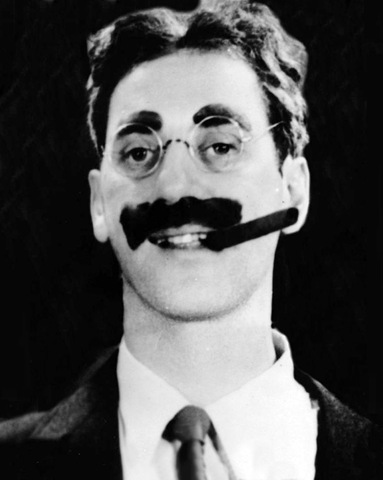
Groucho 24-7

Groucho Marx


Groucho Marx once said: “I have had a perfectly wonderful evening, but this wasn’t it.” 

He also said: “I have a mind to join a club and beat you over the head with it.”

Finally: “I find television very educating. Every time somebody turns on the set, I go into the other room and read a book.”

It occurs to me that the spectacle of Barack Obama meeting with GOP Representatives can be summarized by Trinitarian Groucho. The GOP with its Tea Party cathexis is both a club joined and a TV centric design and both dynamics reflect a willingness–a giddiness really–one that abjures books or important ideas.

The Tea Party crowd believes that government spending is evil. But they don’t seem to think that waging two wars without paying for them is a problem. Its all that other stuff they don’t like.

Groucho again: “Humor is reason gone mad.”

If you parse the GOP’s vision for America, which is the Tea Party’s vision (though you mustn’t call it that, for “vision” is an intellectual sounding word–call it common sense…) the whole idea is to turn America into a vast aggregation of very very poor people and a select group of immensely wealthy folks who will live in gated communities. The poor, the former middle class, will clean John Boehner’s swimming pool.

If the poor and the unraveling middle class now have a three legged stool the Tea Party types feel they ought to have no stool at all; not even a crutch.

The GOP now plans for a nation of house cleaners, a nation without medical benefits, a nation without public transportation, a country of robust entitlements for the richest which means shaking down the poor and those who are becoming poor. This is reason gone mad and unlike Keith Olbermann I can’t laugh at Glenn Beck. The Tea Party GOP has in mind the most brutal and vicious agenda for social reconstruction imaginable. The aim is to do away with everything decent that government does to protect the social order of our nation. Meantime, books are a load of crap.

“Who are you going to believe,” said Groucho, “me or your own eyes?”

How beautiful, nay, how thrilling the delusional becomes.

The GOP believes that good jobs are not coming back and that its not the business of government to help create opportunities. Only business creates opportunities. Never mind that business hasn’t moved the yardage marker in this country since the 1970’s.

The GOP believes (as Barbara Bush rather nicely put it) that the victims of Katrina were better off living in the Astrodome than they were in their own homes.

“Why should I care about posterity? What’s posterity ever done for me?” (Groucho again.)

“Politics is the art of looking for trouble, finding it everywhere, diagnosing it incorrectly and applying the wrong remedies.” (Groucho redux.)

Thinking of Glenn Beck as an author, one is indeed reminded of Groucho:

“Practically everybody in New York has half a mind to write a book, and does.”

But withal, the Tea Party GOP isn’t funny.

Preaching cynicism about government in a time of economic collapse and yes, a time of war, is unpatriotic despite all the tri-cornered hats.

I also thought that many of the Viet Nam protests back when I was in college were essentially unpatriotic, for they spilled over into a distrust of government that was flip, ill-informed, unwashed, and designed merely to subborn good thinking.

Groucho:

“I read in the newspapers they are going to have 30 minutes of intellectual stuff on television every Monday from 7:30 to 8. to educate America. They couldn’t educate America if they started at 6:30.”

Nowadays TV is out to promote cynicism and the GOP is taking full advantage of the medium.

Talk about 24-7.


S.K.  

Of Bananafish and Holden Caulfield


The death of J.D. Salinger leads Lance Mannion to wonder if there are any writers nowadays whose books can be stolen from parents’ bookshelves by teenagers. (Lance wonders more than this for he’s no mere Manichean Mannion; the man sees beyond light and shade, he’s an adept of the gray areas.) But his basic premise is good. Books reach kids and become important to them insofar as books are in the tribal circle. T’was my dad gave me Catcher in the Rye –he had it on his bookshelf along with novels by John Updike, Rachel Carson’s Silent Spring, Truman Capote’s In Cold Blood, William Manchester’s A Thousand Days, Joseph Heller’s Catch 22, countless books really. The tribal circle…

When I think back I seem to recall that I didn’t like Holden Caulfield very much. I was, after all, a kid with a disability and I didn’t think Holden had it so bad. I saw that the narrator was shallow. How old was I? 12 I think. I was in the 6th grade. I had glasses as thick as dinner plates and I could only read with one eye by holding the book to the end of my nose. Kids made fun of me wherever I went. Holden Caulfied was a whiner.

Stay with me. I’m trying to spin two plates at once. Books matter insofar as kids find them in the tribal circle. I didn’t like Catcher in the Rye but it did something for me. In turn, I loved Catch 22 and that lead me to Mailer and Capote.

Still one does indeed wonder in these post-middlebrow times when the novel has been bumped off of TV (can you imagine Conan or Leno having a novelist on their meager shows?) just “what” would fall off mom and pop’s bookshelf and turn kids on?

Of course because I teach nonfiction two best selling books from “the fourth genre” come to mind: The Liar’s Club by Mary Karr and NIck Flynn’s Another Bullshit Night in Suck City. I can imagine these books falling into teenaged hands and lighting up the dendrites of suspicion and incipient wickedness that’s so necessary for independence. 

Now it’s a little tough. Who has taken the place of Vonnegut? Who reaches the prematurely wisened super egos of teens because the books fall from the shelves into their hands?

We ought to be worried about this. How about a stimulus plan to encourage Book of the Month Club subscriptions for the nation’s struggling middle class parents?

I’m not kidding.

Catcher in the Rye sold 250,000 new copies last year. To which I say thank God for that.

Here’s what I liked back then, oh yeah baby:

Well, when I had been dead about thirty years I begun to get a
little anxious.  Mind you, had been whizzing through space all that
time, like a comet.  LIKE a comet!  Why, Peters, I laid over the
lot of them!  Of course there warn’t any of them going my way, as a
steady thing, you know, because they travel in a long circle like
the loop of a lasso, whereas I was pointed as straight as a dart
for the Hereafter; but I happened on one every now and then that
was going my way for an hour or so, and then we had a bit of a
brush together.  But it was generally pretty one-sided, because I
sailed by them the same as if they were standing still.  An
ordinary comet don’t make more than about 200,000 miles a minute.
Of course when I came across one of that sort – like Encke’s and
Halley’s comets, for instance – it warn’t anything but just a flash
and a vanish, you see.  You couldn’t rightly call it a race.  It
was as if the comet was a gravel-train and I was a telegraph
despatch.  But after I got outside of our astronomical system, I
used to flush a comet occasionally that was something LIKE.  WE
haven’t got any such comets – ours don’t begin.  One night I was
swinging along at a good round gait, everything taut and trim, and
the wind in my favor – I judged I was going about a million miles a
minute – it might have been more, it couldn’t have been less – when
I flushed a most uncommonly big one about three points off my
starboard bow.  By his stern lights I judged he was bearing about
northeast-and-by-north-half-east.  Well, it was so near my course
that I wouldn’t throw away the chance; so I fell off a point,
steadied my helm, and went for him.  You should have heard me whiz,
and seen the electric fur fly!  In about a minute and a half I was
fringed out with an electrical nimbus that flamed around for miles
and miles and lit up all space like broad day. 


That’s of course from Mark Twain’s story “Captain Stormfield” –the Captain dies and goes to heaven only to discover that its so vapid he’d rather go to hell.

This is far better than Holden Caulfield.

Funnier too.

S.K.