The Definition

So much has left us now, fathers,
The trees we loved, first houses, music boxes,

Mothers, rains from summers of such
Freshness the children in us

Laughed—all gone
Like the age of great symphonies.

In the late afternoon
A rare bird for this region

Walked across the fence top
A blue winged teal

I’m certain.
I’d no one really to tell.

Poetry you are….

The ADA@30: “The Small Things”

Well it comes down to this: what can you do today that will be any good? One says it with hope, without avarice. I don’t say “how can I screw my neighbor?” Or: “who can I shove behind barbed wire?” My guess is you don’t say the latter things either. As for the former, I’ve no idea how you my readers start your days. Let me add it’s just a quirk of mine, one I’ve had since childhood, that I imagine the day as a clean slate and think of something good I can accomplish. It’s how I roll as a wheelchair using pal of mine says. 

I know there’s something of Pollyanna about it. Smart people are cynical, toughened like alligators, seasoned with Nietzsche and maybe some Foucault. Goodness is suspect. Why, hell, there’s no goodness at all. It’s just another fetish, a commodity, a greeting card trick. When righteous people say “Black Lives Matter” they’re affirming the good. Those who bristle at the phrase (which is more than a phrase for its a cry of the heart) are proclaiming in no uncertain terms that historically marginalized and oppressed peoples can’t proclaim “the good” for yes, the word doesn’t belong to you. “All Lives Matter” means white people will imagine goodness so people of color won’t have to bother anymore. 

Which is why I suppose I get up and say what can I do today that will be good? Disability is misunderstood, disliked, un-cherished,    treated to sufferance and hostility. I learned all this. Learned it at school. Learned it on the streets. At the university. And yes I keep getting heaping spoonfuls of ableism because as the old commercial used to say, “it’s what’s for breakfast.” (Ableism, the other white meat.) What can I do today that will be good? 

Let it be a small thing when the times are especially heavy. Write a friend in distress. Thank someone for their work. Praise those who are praiseworthy. Don’t get down into the pit of snakes who live on Twitter and Facebook and Zoom. I’ve made this mistake, made it too often, imagining my affirming flame of righteousness will change minds—but social media is not a place for the small good. Play an instrument, write from the heart that beats in your wrists, feed a lost dog. Let it be a small thing.

Lately I’ve been writing about the Americans with Disabilities Act which is thirty years old next week. There’s not much poetry in the ADA. You can find poetry in the law but not often. But of the good there is much. Make the ways straight for those with altered bodies. Let them in. Affirm they are part of the village, the school, the bus ride, the library, the media, the simple, everyday world which we call it daily life. 

Let it be a small thing that you say to your fellow employees, “hey let’s learn sign language!” Let it be a small thing, say you’ve hired a blind person, so you say “let’s listen to her.” 

Today’s good thing: let’s listen to those unlike ourselves. Even when it might make us sweat. 

Shape Shifters

Someone comes down the stairs: 

It’s Tolstoy in his horse hair pajamas. 

Clouds knock at the windows 

But of course the sleeping humans don’t hear this. 

Dawn. Chickens. Piano loosening out of tune.

Leo owns only one book in English—

Women and Temperance.

While reading he spills a drop of tea

Which burns and glints on the page.

I know all this. I was far above 

In the loft, dreaming of the place

Where in the future 

I’d live my strict joy. 

The ADA @ 30: Essay 11, “Rope-a-Dope”

Dear ADA @ 30:

You have made it possible for people with intellectual disabilities (that hoary and inelegant phrase) to live in the community. You’ve made it possible for wounded veterans returning from combat to stay in the military; made it possible for disabled students to get mainstream educations; there are so many triumphs in your corner. You’ve educated millions around the globe. Not bad my friend. And perhaps the best thing of all: you’ve withstood your enemies, done the Muhammad Ali Rope-a-Dope. Conservative courts and business interests have tried to defeat you but they failed to understand you are the American spirit. 

Dear ADA: I’m a poet. I don’t know much about the law save that I read broadly in many disciplines. Poetry is a guarantee against specialization but not an obstacle to focused curiosity. I love knowing that they composed music for surgical procedures before the age of anesthetics. While they sawed off your leg you could hear a nice quartet. I love knowing that double hydrogen bonds make DNA possible. O how sublime is the very electrolysis of life! And in terms of “the law” I like the axiom that normal people teach the rules but outliers teach the laws. You’re the Queen of the Outliers and you continue to “punch up’ as they say nowadays.

The poet in me likes it that you’ve changed the way disability is used as a matter of law. I’m thinking in this instance of Romer v. Evans, in which the US Supreme Court nullified an amendment to Colorado’s state constitution which made it legal to discriminate against homosexuals, lesbians and bi-sexual citizens in matters of employment, the receipt of social services, and the right even to claim discrimination. The Supreme Court wrote that the Colorado amendment imposed a “broad and undifferentiated disability on a single named group” and added that the impulse for the law was “inexplicable by anything but animus toward the class it affects; it lacks a rational relationship to legitimate state interests.”

OK. I’m just a poet but this is the first instance so far as I know of the Supreme Court using disability as a juridical metaphor in the service of human freedom. I may be wrong about this but I suspect I’m right. And I suspect the court’s understanding that physical embodiment can be degraded merely owing to bio political considerations was informed by the shift in consciousness brought about by you, Dear ADA. 

Oh how I love you. Let me count the ways. 

The ADA @30: Essay Ten “Dear Friend”

Dear ADA@30:

There are so many things I wish you could hear but you’re made of wood. No wait that’s not quite right. A man can talk to trees. Hell, a man can even talk to a cheese. How do you talk to a law? 

We can only talk back to laws. Even while framing a law our speech sinks into the past. The illusion is that we’re going forward.

Dear ADA: you are a zen koan. We head to the future armed only with the past. Dear ADA we may have ideals but they’re nebulous and misty as when, answering a child’s question “what do you want for Christmas” you reply “oh, just give me universal peace.” 

ADA, now that you’re thirty, our wishes are still “claggy” as the British would say. The disabled are still in the fog. 

Some say it’s your fault but I’m not one of them. It’s not your shortcoming that some say you’re an “unfunded mandate” (a phrase so omnipresent it’s like spearmint chewing gum) and which means “we’re being forced to put in a disability accessible bathroom because we’re remodeling our local MacDonald’s franchise and there are no zero interest dollars by way of  loans, no help for us from “corporate” etc. 

It’s not your fault that those who call you “Old Unfunded” are the same people who oppose  federal and state social programs of any kind. 

It’s certainly not your fault that those you’re designed to protect are deemed burdensome and inconvenient by the Chamber of Commerce. 

If you’re judged by your enemies you’re doing good work my friend.

How do you talk to a law? 

The problem is that you’re latitudinarian rather than sectarian,  you’re Jeffersonian not Hamiltonian. You come from the liberal traditions of humanism. Perhaps you’re the last gasp of the enlightenment. For all I know better times are coming but in the rowboat I can’t see what’s ahead. We keep rowing. 

Dear ADA: the disabled and their allies are rowing just as you asked us to.

Yes, your foes still think you’re a newfangled guild of St. George, some utopian trick designed to ruin our nation’s currency by putting Braille on dollar bills. 

At a famous arts colony not long ago I complimented a staff member by saying, “hey, look! You put in an elevator so the disabled can get up and down the stairs!” “Oh,” he said, “they made us do that!”  

So much for disability as inclusion. You were again “Unfunded Mandate.”

It’s not your fault the abled classes still think cripples are inconvenient. 

It’s not your fault that Erving Goffman’s “stigma” sill permeates society. 

It’s certainly not your fault that as legal scholar Mary Anne Franks puts it, the US constitution is framed on a narrative faleshood: 

“America is built on a lie. That lie inheres in its foundational text, the Constitution of the United States, which begins in the false claim to speak of and for “we the people ” even as the majority of its population – in particular black men and all women – were denied access to the most basic forms of political participation. This act of simultaneous symbolic inclusion and material exclusion has never been fully acknowledged or confronted, which is another way of saying that it has never really ended. ”

Excerpt From: Sarat, Austin. “Law and Lies.” Apple Books. 

Dear Friend, these things are not your fault. 

You make it possible for the disabled to demand symbolic and material inclusion against so many odds.

The ADA @ 30, Thinking of the Fourth of July, Long Ago….

“Your vision will become clear only when you can look into your own heart. Who looks outside, dreams; who looks inside, awakes.”

—Carl Jung

I remember the day like it was yesterday. I’m talking forty years ago when I was 17. My parents put me in a psychiatric hospital in Rochester, New York because I was literally wasting away. Our family’s good natured doctor, a general practitioner, had no idea what was wrong with me. He was a good guy whose name happened to be James Taylor which I thought was rather amusing, like your family physician could be named Frank Zappa or Duke Ellington.

I had given up eating that year. It turned out I was good at this. If I was blind in school and the target of pranks by kids or even some cruelty from teachers, well hell, I could demonstrate complete proficiency at my own disappearance. I was into the “ars moriendi”–the holy art of dying and it’s no accident I knew the term, for George Harrison had released a song called the “Art of Dying” and I listened to it repeatedly. I was drinking one up of milk a day.

Outside my head the world went on being insistent and tangled, a place of blood and feathers. My mother was a serious alcoholic who also took a myriad of pain killers, a combo that often produced violent and psychotic effects. She would break furniture, fall down flights of stairs, throw dishes and glassware at my sister and I, or lash out with her feet, kicking like a horse. In such circumstances there is no domestic life, no evening dinner with the family, no conversation to speak of. My father, a college president, lived in his own world of denial. He had plenty of work to do. The war in Viet Nam was still happening, there were protests, Kent State was in the news. Life in the house and life outside the house balanced in a seething electrolysis of panic. None of the adults in my circle appeared happy. And as a teenager with a disability I had no kinship except pot smoking with the other unaffiliated and sad kids who would let me into their circus tent. Those were the years when everyone felt like the world left to a free thinker was just a carnival sideshow tent. We smoked pot under an elevated highway: monkey boy, banana girl, bearded lady, stilt man, dog face.

After getting stoned under a bridge or behind a tomb in the cemetery I’d go home, hoping my parents were in bed. My mother was a night drinker and there was never any guarantee she’d be asleep. I had a system: I’d enter the house through a door in the basement, creep up the stairs, and listen for any signs of activity. Sometimes I’d be “outed” by our Siamese cat who heard me despite my efforts to achieve total silence. If my mother was awake she’d have those crazy eyes and the staggers. She would also be projectively paranoid, imagining that I’d been doing something demoniacal. Her rages weren’t reality based and could be dangerous. One night she stalked my younger sister with a knife. My sister and the cat hid in a locked bathroom while my mother, still holding the knife, begged her to come out.
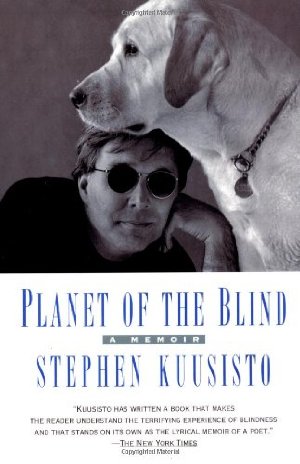
I’ve written about this time in my life once before in my memoir “Planet of the Blind” and still, today, on the 4th of July, I’m flooded with a remembrance. Outside the window of my hospital room at the psychiatric facility was a flagpole. Boy scouts would come and raise and lower the flag.

I could just make them out with my dim vision: perfect lads, Norman Rockwell boys folding the flag like the honor guard at President Kennedy’s grave. And there I was on the nut house, all of 98 pounds, my spectacles thick as dishes, my body so cold I had to sleep under an electric blanket set to the highest temperature. I was the final thing in the sideshow: a blind, stick boy, fit only to be locked away. Not a boy scout.
I have to tell you: to this very day the 4th of July gives me the creeps. As Charles Bukowski might say: it’s a day for amateur drunks. But it’s also a day of excessive boy scouting, a role playing exercise wherein everyone salutes and marches up and down secure that the collective hubris of dressed up jingoism will demonstrate both loyalty to American values and also belonging to those values.
But what if the country is violent, intolerant, with undefended public education and impoverished social services? You see my problem? I survived my starvation period through multiple factors of luck and personal growth. But America is still trying to create more kids like my 17 year old self. I get the shivers just thinking about it.

Here are the things I had to learn:

How to stop hating myself.
How to forgive my parents.
How to eat.
How to believe in social progress.

Here are some of the things that have helped along the way, offered in no particular order:

Archetypal psychology and the work of Carl Jung, Marie Louise von Franz, and James Hillman. Walt Whitman’s “Leaves of Grass’. Poetry by a vast number of writers: Pablo Neruda, Federico Garcia Lorca, W.S. Merwin, Adrienne Rich, Audre Lorde, Robert Bly, Tomas Transtromer, Harry Martinson, Kenneth Rexroth, Gary Snyder, Emily Dickinson, Edith Sodergran, Pentti Saarikoski, W.H. Auden, Gregory Orr. I suppose the list is too long to go on. I think Gregory Orr’s book “Poetry as Survival” is important reading even if you’re not a student of poetry.

By my late thirties I saw that comparative suffering is a loser’s game. I learned never to say, “You don’t know what it’s like to be me” because even if it’s true, the assertion never opens a door. I learned by reading Helen Keller: “When one door of happiness closes, another opens; but often we look so long at the closed door that we do not see the one which has been opened for us.”

Through Al Anon I learned to stop trying to fix my mother.

Forgiveness is the hardest thing. I learned to forgive my parents. They were weak and wounded people who were utterly unsuited to parenthood. Their lives are not my destiny.

But I still can’t stand the 4th of July. I still hear that squeaking pulley and see those laughing boy scouts. We still have too many smug, privileged “plastic people” (as Frank Zappa would say) running around and crowing about how good and virtuous we are. I’m still not convinced.

Thirty for Thirty on the ADA: “The Dumpster”

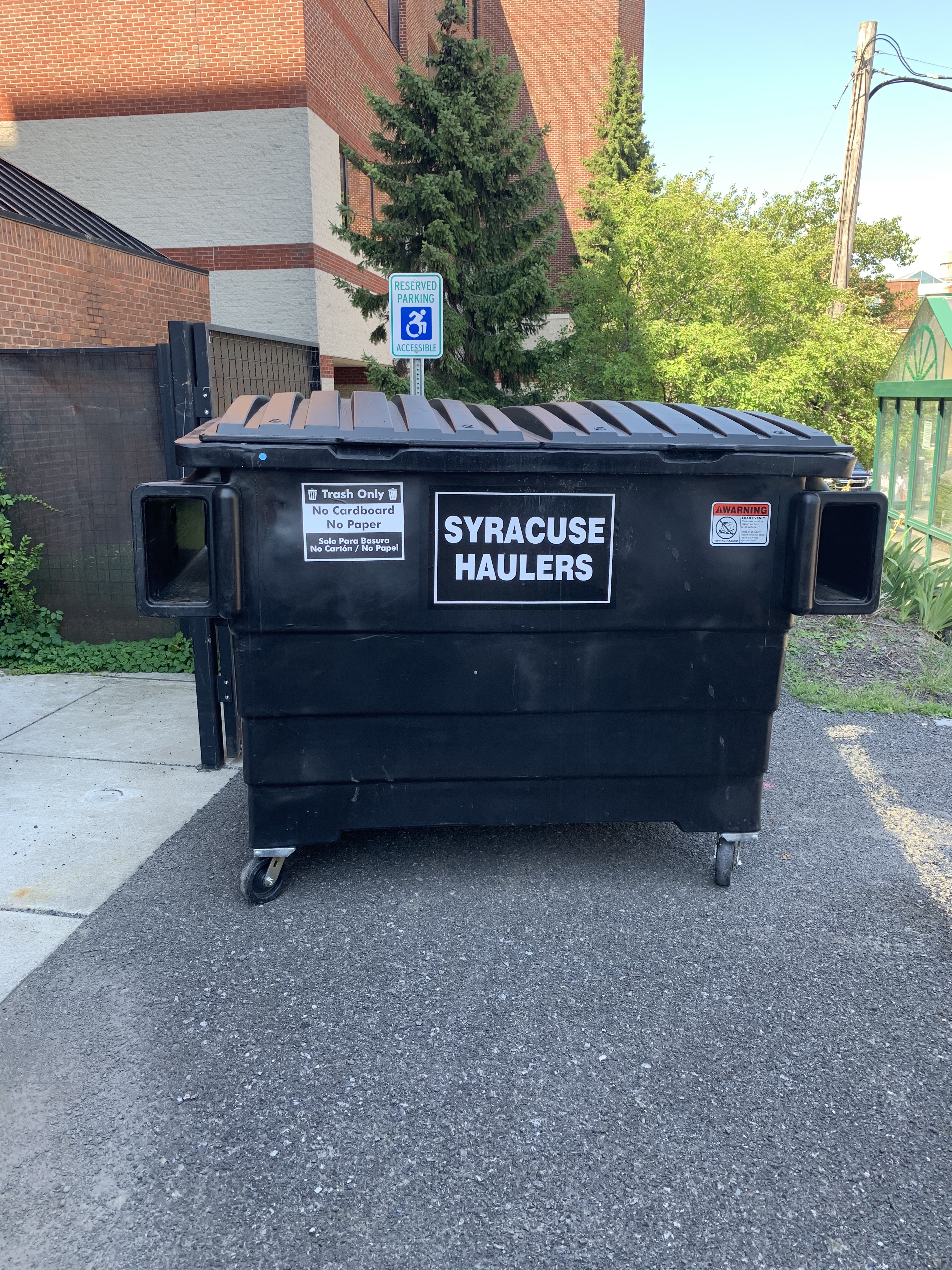
It is perhaps ironic when a blind person says a picture is worth 1000 words. I studied poetry in graduate school and have built my life around a deep affiliation with language. Nonetheless here is a photograph which may defy customary language. We’re talking about the Americans with disabilities act at 30. This photo shows a large trash dumpster outside the central administration building of Syracuse University. The dumpster is located in a disability parking spot.

If I told you this is a rare occurrence at Syracuse University I’d be having you on. I have more than once complained about obstacles blocking crosswalks, dumpsters in parking spaces, retrofitted auditoriums without spaces for wheelchairs, inaccessible software. Despite this the problems repeat.

How is it that 30 years after the Americans With Disabilities Act this shit continues to exist not just on college campuses but in every element of the public sector?

It’s because the ADA is imagined as something for “other people“ and therefore it’s fit to be ignored.

We’re talking about white privilege as we should. Able bodied privilege comes from the same family. Inconvenience as deliberate action is never innocent.

Thirty for Thirty on The ADA: “Masks”

As we near the thirtieth anniversary of the Americans with Disabilities Act I’ve decided to post thirty short essays about the law, the anniversary, and the cultural impact of #ADA @30. I’m doing this as a disabled person who’s lived half his life before the ADA. I’m reflecting on the “before and after” of the law.

Essay Nine: “Masks”

The American writer William Gass once wrote “culture has completed its work when everything is a sign.” It’s an ominous statement if, as I do, you believe culture moves like a river and is never still. Progress rides on currents. Still I’ll take Gass at his intended word—small “c” culture demands petrifaction, signs to rivet the mind and stop all thinking. Gass was warning us and his employment of culture has invisible quotation marks. One may also fairly say this about disability signs. They circumscribe the disabled, are sometimes a matter of envy among able bodied people who resent our perceived privileges, and though our signs are liberating, they can entrap us—they’re outdated the moment we post them, they don’t represent real humans. And who is really disabled anyway? It’s a 19th century word. It’s as outdated as antimacassars on horsehair chairs.

The ADA @ 30 cannot know this. It’s a living law but not your disabled neighbor. That the very word disability needs to be retired is unquestionable even as perhaps, the opinion may not be universally popular. We the disabled have fought too hard for our place at the table. We’ve fought too hard for our dignity and our sense of inclusion. Giving away the disability word would be foolish. Even a kind of defeat.

But one thinks of Willian Gass. Disability is an ossified sign and the public that imagines itself without disability (a fantasy if ever there was one….like believing in the tooth fairy) takes it to mean lack of capacity. The ADA @ 30 cannot fix this but its a real problem. The employer who turns away disabled job applicants believes culture has completed its work—thinks disability means lack of intelligence, stamina, gumption, power, potential, on and on it goes.

We change the universal wheelchair logo to make the wheelchair look more mobile, even a bit jazzy. I like it. Every wheelchair user I’ve ever known was both mobile and jazzy. This is true of blind folks whether they travel with a cane or a dog; true of the deaf who are poets of the vernacular and the sublime, sometimes making the the same thing. It’s true of my autist friends. They all know what Emily Dickinson meant when she said poetry makes the top of her head fly off. Autists move in spaces even NASA doesn’t know about.

Disability activists have claimed the world cripple to offset the cultural bone yard of the “d” word. As the late Nancy Mairs wrote” “as a cripple I swagger.” I’ve always liked this. I also admire the idea of “crippling” as a troubling of normal-think. Disabled lives are inventive lives; we are indeed “troubling” to normal people but we offer tons of imagination. Siri came from the blind and not your business as usual dudes.

I’ll take cripple over disability but main street still doesn’t see it. We need an expanded word for citizen as Black Lives Matter tries to tell us, as the Me Too Movement tries to tell us. I’m not abled or disabled, I’m a citizen, equal to you and you.

I like universal citizen.

This means I’m imagining citizenship as achievement, accomplishment, capacity.

Now I’ve a theory of sorts. Lost in the American culture war over wearing masks in a pandemic—lost in all the back flips from the right—lost in the arguments (such as they are) about the freedom to not wear a mask, the liberation from government control, the “don’t tread on me” flag waving—lost in all of this is a fundamental ableism, a sign, a William Gass irony. Masks make people look ill; appear disabled; resemble second class citizens. This is primitive ableist exceptionalism smothering science and common sense.

The disabled know all about it. I remember the cab driver in New York City who told me I was obviously a victim of voodoo. How else to explain blindness?

The cripples know we appear sinister. And the maskless believe they’ll be stuck forever in the land of broken toys if they succumb and do something that would save their lives.

Thirty for Thirty on the ADA” “Maybe Tomorrow”

As we near the thirtieth anniversary of the Americans with Disabilities Act I’ve decided to post thirty short essays about the law, the anniversary, and the cultural impact of #ADA @30. I’m doing this as a disabled person who’s lived half his life before the ADA. I’m reflecting on the “before and after” of the law.

Essay Eight: “Maybe Tomorrow”

Disability is everywhere once you learn to look for it. Elvis Presley had continuous high grade pain the last ten years of his life. Samuel Johnson was legally blind, suffered from seizures, and may well have had a variant of Tourette’s Syndrome. The people in my neighborhood are touched by disablement. Some show it. Others do not. Normalcy, the belief in it, the animadversion to live it or else is the most destructive fiction in the world.

What does it avail me to say so? And why do I keep saying it?

In her excellent book The Contours of Ableism (an elegant title I think) Fiona Kumari Campbell imagines the structural and attitudinal dispositions against the disabled as residing within a telos or set of illusions that maintain the non-disabled identity. When I write against disability discrimination and the privilege indexes of ableism I’m engaging in the work of all disabled activists by asserting the truth of the matter:

“Ableism refers to: a network of beliefs, processes and practices that produces a particular kind of self and body (the corporeal standard) that is projected as the perfect, species-typical and therefore essential and fully human. Disability then is cast as a diminished state of being human.”

So if there are so many disabled people around why does compulsory normalization still rule the roost? The contours of ableism are protean rather than strictly geometric. Fiona Campbell writes:

“Whether it be the ‘species typical body’ (in science), the ‘normative citizen’ (in political theory), the ‘reasonable man’ (in law), all these signifiers point to a fabrication that reaches into the very soul that sweeps us into life and as such is the outcome and instrument of a political constitution: a hostage of the body.”

One of the interesting things about ableism is that whatever form it takes it occupies the future perfect. There will be time enough to make things right for the non-normals but not today. One may fair say “not today” is the motto of the thing. Non hodie in Latin. Picture a flag bearing the image of an indolent house cat. Not today will we question our assumptions about the majority of bodies on the planet. Ableism also refrains from saying “maybe tomorrow.”

As we contemplate the ADA @ 30 this is its signature, the stitching that holds the book together: “maybe tomorrow” has been retired.

We don’t say “maybe tomorrow” your disabled child can go to school.
Don’t say “maybe tomorrow” you can vote, go to a football game, go shopping.
We don’t say “you can’t attend college, not today…”
The ADA put a stake through maybe tomorrow.

This is in fact what people who hate the ADA are always most worked up about. They wanted their “maybe tomorrow” to last forever. Rather than see disabled customers and their friends and families in their shops and restaurants, small business owners banded together and cried foul—lead most notably by Clint Eastwood—we don’t need no stinkin’ ramps or accessible bathrooms in our tony little “shoppes”—sure the disabled matter, but not today, not now, not thirty years after the ADA, please. I wish I was joking. The Chamber of Commerce and its associated lobbyists have been brutal opponents of making commercial spaces accessible. Not long ago Dominos Pizza argued they didn’t have to make their website accessible to the blind. Not today. Not tomorrow. Perhaps some day. Dominos lost their case in court. They spent more fighting the blind and the ADA then it would have cost them to make a stinking website and app blind friendly. Their position was driven by raw ableism.

So the ADA says “maybe tomorrow’ has been retired.

Like racism, ableism depends on its ugly status quo. The ableist says, “I liked it when the disabled people knew their places.”

I know all the problems with the ADA. But it retired “maybe tomorrow” even though our opponents still wave it around like a discredited flag.