The morning was green and my heart was green…

Shall I say Wordsworth—
Skiff of mind in the shallows
All those minnows bright as dimes…

O past tense, call the goddess
We’ll stop here
Step from the boat
Walk across the lilies.

**

Passing houses in any neighborhood—“that looks like my boyhood home….”

It was said of Dante “no other poet knew how to praise or blame with such excellence….” (Was it Benvenuto?)

I walk past houses….praise and blame the memories….

**

“Love insists the loved loves back” (Dante)

Love this moment.

More About the Semblance State

Yesterday I wrote about “the semblance state”—the predicament of this nation, these United States, where seeming competence has taken the place of governance. I gave no quarter to the Republicans or the Democrats. Both parties spent the last forty years greasing the engines of profits over vision, eschewing long term plans, caring not a whit about the average citizen (who we once called middle class but who’s now fallen from the wheel of fortune into the soupy suspension of the new poverty: both parties share the blame.) In the semblance state hardly anyone shoulders responsibility. There’s only pathos, raw anger directed at whoever doesn’t look like you. In this way the GOP and the Democrats (and their splinters) are un-American. Even the IWW believed in communitarian principles.

In her excellent book “American Enlightenments” Caroline Winterer reminds us that 18th century Americans held a different view of happiness than the self-help individualized notion most people cling to today. She writes:

“The happiness of humanity. Crèvecoeur’s words—and Thomas Jefferson’s far more famous ones in the Declaration of Independence, “Life, Liberty, and the pursuit of Happiness”—remind us that the pursuit of happiness was one of the principal quests of enlightened people. But happiness meant something different in the eighteenth century from its meaning today. In our era, an industry of self-help books reminds us that modern happiness is an emotional state of self-fulfillment and personal well-being. Eighteenth-century people would have been puzzled by our narrow definition. For them, happiness first of all had expansive, public meanings. People at that time often spoke of a happy people and a happy society. A society was happy when its people enjoyed the security, stability, and peace that allowed them to prosper. The purpose of government was to create public or social happiness by shielding the state from foreign enemies and internal threats. The opposite of public happiness was not sorrow but anarchy or tyranny. Educated leaders would be the architects of the good government that led to a happy society.”

Watching Donald Trump ignore the greatest public health crisis in history reveals the petty tyranny of a self-help mind which holds that successful people eschew any engagement with social happiness and indeed, must hate government itself. In the semblance state where most individuals believe they’re victims and that malign others are getting more than their fair share well, the happy society is not only inadmissible, it should be despised. This is why Trump spent Mothers Day sending over a hundred vitriolic, childish, toxic “tweets” while ignoring the climbing death rates in the US.

The Semblance State

America is neither left or right, neither a nation of corporate responsibility or one that fully embraces fascism. It is a semblance state—a country wherein appearing to be a developed Western democracy is deemed all that’s necessary. In this reality TV no man’s land the dignity of the individual has been painted over with angry appeals to emotion alone, what the Greeks called pathos. This is why Donald Trump is not compelled to do anything about the Coronavirus pandemic, in the semblance state its enough to incite emotions and imagine everything can go back to business as usual. Fakery has been both profitable and ubiquitous since Reagan.

The superannuated Democrats don’t get a pass either. Arguing the banks or pharmaceutical companies are the bogey men behind the decline of the nation’s middle class is also pathos, a straw man appeal to distrust bigness itself when the more nuanced and useful position that the economy needs a dose of Teddy Roosevelt’s conservative regulation is lost. The semblance state is “emo” 24-7. It’s a tricked out supersonic laser show of induced suspicions, gratifying hatreds, phony culture wars with hot rage as an end in itself. When Barack Obama bailed out General Motors and Chrysler he let them close small dealerships, not exactly the “new new deal.” It was just another day in the semblance state’s “business as usual” ethos.

Rick Perlstein’s review
in The Nation of Nicholas Lemann’s new book, “Transaction Man: The Rise of the Deal and the Decline of the American Dream” contains an illustrative anecdote—Robert Reich, Bill Clinton’s Secretory of Labor gets called in to the Treasury Department by Robert Rubin who scolds him for using the phrase “corporate responsibility” in s speech. In the semblance state all that’s necessary is to appear to be profitable. In other words, forget the little car dealer. That the Democrats got their comeuppance for embracing the semblance state is without question. The rightward embrace of appearance over substance is less benign and as we can see from the Trump stampede to reopen the economy by shoving unprotected workers into dangerous workplaces, appearance over conscience is still fully in force.

Dear Life and the GOP

In her excellent book “Dear Life: Caring for the Elderly” Karen Hitchcock writes: “If we are all just economic units who lift or lean, then very little is “lost” when a nursing home resident or anyone getting on in their years dies prematurely. In fact money might be saved – one less nursing-home bed to fund, and the kids can finally get their hands on the house.”

This describes the GOP’s stampede to re-open the American economy without healthcare, testing, oversight, and social justice. Think about Donald Trump, mask-less last week while loudspeakers played Paul McCartney’s Bond theme “Live and Let Die.” (I thought, perhaps they can do a mix of McCartney with Shirley Bassey’s “Goldfinger?”)

Like all disabled I’ve lived the effects of symbolic reductions owing to social constructions of economy and its Darwinisms. Despite what I may be able to do or can do, my blindness sails ahead of my life like the carved figurehead at the bow of a ship.

I’m one of the millions the new GOP believes is worth an early grave.

Remember the quaint old days when Barack Obama was trying to create a Romney style health care plan and Chuck Grassley said if the plan was passed it would lead to “death panels” and these in turn would ‘un-plug grandma.”? Remember? I do. Well it’s way beyond Grandma now kiddies—if you’re not rich they want you to step up and offer to die behind the counter in the dry cleaning store. Hurry up! If you drop dead more of us can get our hands on the house!

I haven’t heard Chuck Grassley speaking up. What’s the matter Chuck? Your home state of Iowa is pushing innocent people back to work with absolute cruelty and no public health plans.

As Lou Reed once put it: “Let’s get ‘em out on the dirty boulevard.”

At Five, in the Attic

It was the age of high fidelity and there I was in the attic with a victrola. How odd it was. Its needle like the proboscis of an insect. The platter covered with green baize, as if you might throw down poker chips instead of a record. It was most certainly a gambler’s machine. I’d put the needle down on the fast spinning disc and hear something uncanny…arias and folk songs sung by dead people. Gambling, ghosts, the wind up mechanism with its baleful crank.

The Party

We are at a party that doesn’t love us—the line is Transtromer’s. Life after life we say it. We whisper it in the Prado or in the hills above Naples where the oracle knew forsakenness. We’re at a party. Outside, Basho’s broken willow. The Cumaean Sibyl puts her tongue to the oak leaves. Numerals of loneliness scatter in the grass.

Down to the Sea in Ships

It is not probable or likely we will see one another again, words in every sailor’s throat, lord thy sea is so vast, winter rain at mid ocean…I think human kind learned vowels on water, Jung’s mother picked up her gutturals in storms far from land. Blind as as I am I’ve played a game all my life, stealing out by night and rowing across dark water.

Kent State

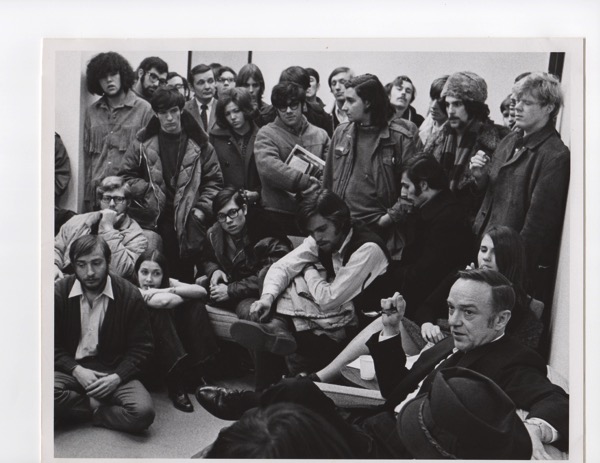
I was fifteen when the Kent State shootings happened. My father was a college president so I was fully aware of what was going down. My dad said the governor of Ohio had blood on his hands, that he’d pitted kids against kids—national guard vs. college students. My father said James Rhodes should have known better. “But didn’t students burn down the ROTC building?” I asked. “Not the ones they shot today,” he said. That was one of my earliest lessons on not making groups of people into villains or victims without sufficient evidence. Here’s a photo of my dad talking with student protestors in 1969. Rather than call the police he turned their occupation of his office into a seminar on nation states, warfare, and the international economy.

Kuusisto SUNY Albany

Trump and Brigadoon

In the story of Brigadoon people are enchanted in a mythic village, a place of love outside of time and customary space. There are hundreds of variants to the story and of course there’s Lerner and Loewe. Heck there’s even a Star Trek version.

Donald Trump’s administration is a hateful brigadoon—a place where neo-nazis like Steven Miller and fascist wannabes like Mike Pompeo strut and mouth loud racist nonsense about all “those people” who struggle outside their bubble. You know, the majority of the world.

I spent about fifteen minutes this morning trying to imagine the right name for Trump’s “doon” and I’ve come up with “Bigotdoon” which seems about right.

Of course it’s more than a game. Steven Miller pushes the toxic idea that foreigners bring diseases to the United States and for proof he uses caged children (denied medical care) as his proof.

In Bigotdoon Trump’s insiders live in their bunkers, the rest of us will get to die in droves.

If I live long enough maybe I’ll get to see the Broadway version.