Ubu Ableism

ubuTheater of the Absurd...

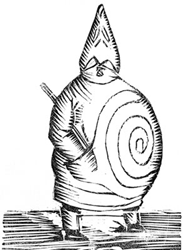
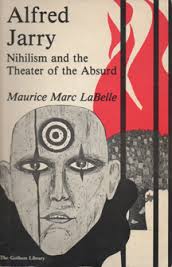
The image on the left above is a sketch by Afred Jarry of Ubu Roi. The book cover on the right is from Maurice Marc LaBelle’s excellent study of the Theater of the Absurd. As a poet who happens to have a disability (this, in the vein of: as a writer who has green eyes, since its both a differentiating feature, and, simultaneously of little provenance, save there are some who think witches are most likely to have green eyes…a dilemma for some of us…) ahem, yes, as a poet with a disability I always bounce off the frontal carapace of Ubu-ableism, (you have to hand it to me, that was a strikingly coagulated sentence.)

Ubu-ableism differs from your run of the mill ableism. The latter is simple. It says, “there are places for these people.” ROM ableism is nothing more than rehabilitation sequestration. It survives everywhere, from the University of Iowa where the office of disability services is hidden in the basement of a dormitory and can only be reached by elevator. Or at Syracuse University where the office of disability services is on the top floor of a building and can only be reached by elevator. In the event of fire you must imagine there will be especially competent emergency personnel who are remarkably trained, who will especially save you, if you’re one of those disabled people, who only wanted to arrange some extra time to take a printed test. And now you’re in an emergency where you can’t roll out the door. Imagine. In any event, ROM ableism is essentially institutional thinking. Certainly the real estate is cheaper in the basement or on the top floor of an underutilized building. Come on, you wouldn’t want to put disability services smack dab in the center of your campus. People might see. They might think you don’t have a good school. I’m not wrong to say this. If you believe in your university and believe that students with disabilities are a source of excellence, than you’ll put your office of disability student services at the center of campus, as they did long ago at UC Berkeley.

Ubu-ableism is enhanced discrimination. It works like this: Ubu is in charge. He is (or she is) only concerned with greedy self-justification. Think of Ubu as Donald Trump wearing a military outfit.

Ubu thinks that the Americans with Disabilities Act is an unfunded mandate.

He thinks that the disabled are not “us” but those people.

He ardently believes they possess insufficient value in support of his quest for more goodies.

He is never shy about saying they should go away.

He sometimes runs academic conferences.

Sometimes he runs a chain of restaurants or a division of the Veterans Administration.

He advises on political campaigns.

He can be a pretend liberal like Ira Glass.

He’s certainly on the faculty of many universities.

His smile and his sneer are identical.

He calls for the end of social security.

Or she.
 

Alice Dreger, Academic Freedom, Northwestern University, and Borges

Academic freedom is always under attack in the US and abroad. One might conceivably write a joke about the subject which would end, “Oh, so it’s an old story.” Years ago I heard the Argentine poet Jorge Luis Borges confound a moist and utterly cerebral undergraduate at Cornell University—the occasion, a “symposium” on the work of Vladimir Nabokov; the poor kid with his ball cap backwards—by saying, “what about Nabokov?” Borges had been the “keynote” speaker, the star, who was expected (or so one imagined) to close the proceedings in Ithaca with a tight, eloquent, “proof” on the Nabokovian Éminence grise. Instead he spoke for fifteen minutes about play as the core ingredient of imagination. He alluded to card tricks. And never once did he mention the author of “Lolita”. He stopped. That is, he said something about  playfulness and stopped. He stopped like an old fashioned gramophone record. Borges’ needle had struck the paper label. There was wide silence. And it was long. There were perhaps 300 people in the auditorium. No one moved and no one spoke.

There were some in that room who must have thought Borges was having them on—a reflex at Cornell where the institution’s super-ego always imagines they’re not quite as good as the rest of the Ivy League. Borges must have been making fun of the assembly. (He was.) Or he may have been delivering an elementary sermon on inventiveness which true academics certainly didn’t feel they needed to hear. (He was.) Surely some of the faculty thought Borges was senescent. Ableism works that way. Perhaps the blind poet was out of his depth. But as I say, the silence of the crowd was substantial. I liked it. It was a Victorian silence, the absence of words was balanced on a tight line of epistemic bifurcation. One one side was the serious purpose inherent—Nabokov with a monumental Czarist “N”; on the other, a scurrilous Borgesian joke.

I was fresh back from a Fulbright year in Helsinki where I’d been studying the work of Pentti Saarikoski, A Finnish poet who many now consider to be the first truly post-modern writer. Saarikoski studied Greek and Latin, then Ezra Pound, James Joyce, and Karl Marx—and perhaps not in that order but it doesn’t matter. What matters is the play that held his many influences together, and the principle was Heraclitus. Logos resists polarities. In any event I enjoyed the scholastic silence in that hot auditorium.

Then the kid said: “But what about Nabokov?” And Borges said: “Who is he?” “Well,” said the student, “you know, he wrote Lolita?” (By the mid-eighties American students everywhere had adopted that mannerism whereby all assertions must end with question marks—the aim, presumably, either to avoid being wrong, or to never offend anyone with a firm position—god knows.

“Who is Lolita?” Borges asked.

“Well you know,” said the student, “it’s the story of a teenaged girl maybe she’s 13, and she has an affair with a disreputable older man…?”

“Ah,” said Borges, “so it’s an old story.”

That was it for Nabokov. The show was over. A more perfect tribute to the master could not have been delivered.

Let’s be clear: freedom in the realm of inquiry is always a matter of playful risk. It can never be a matter of public relations.

I’m in mind of these things because this morning I read that Professor Alice Dreger, one of this nation’s pre-eminent scholars in the Medical Humanities has resigned her position at Northwestern University because the university has allowed its journal in medical ethics to become a vehicle for PR as opposed to free inquiry. You can read her story here.

It is an old story. Alice Dreger is principled and brave. I admire her.

I solemnly renounce Northwestern University’s medical school and its proprietary censorship.

I Have to Write Fast

I have to write fast. I’m theorizing extramundane fantasies. For instance: starlight takes shape of man, then decides this was a mistake, goes back to stars. True story if you’re Christian, I suppose.

Writing fast. People on Facebook still argue “who was better, the Beatles of Stones?” Aging Victorian Baby Boomers. Ugh. Who was better, Jefferson or Hamilton? Ben Franklin of course.

Dang. Need to read some Robert Browning. It’s been too long. Hey, Uncle Ez.

Jumping on wholly imagined trampoline for my friend Ralph who has a real one and isn’t feeling well.

when you open the book of life

if I hear my name

do I get to go look at it?

–Niilo Rauhala

translated from the Finnish by SK

Walking Song

A walking song. Hey feet, hey hands, hey hair, hey collar bone, just be you, and trust me, the crows won’t eat us, not today.

**

Drinking coffee. Dogs look for rabbits through big solarium windows.

**

Summer was short

We went to retrace our steps

At the edge of a sweet field

A black river took summer away

We dropped our walking

Prayed for the trees still budding

–Niilo Rauhala, translated from the Finnish by SK

**

Immanence and impermanence–my brothers. I think hard about you. Two crickets outside. Water falls on my wrist bone when I wash a cup.

**

Sometimes I talk too much. At other times I say nothing, drink water from a glass, move books from one table to another.

**

“Life is available only in the present moment.”

—Thich Nhat Hahn

Reprise: walking song…


Of Disability and Proust

I threw my back out this afternoon. How many times have I done this? And how many times have I had to say it? My back IS my blindness; tension is deep in my muscles. Not seeing produces headaches, aches in the supraspinatus, brings on foul moods. Now I can barely tie my shoes.

When you have a disability, whether visible or invisible, sympathetic effects happen. One gets used to it. The “it” a ratcheting down of the day. How many afternoons did I spend as a child, crippled by tension headaches, hearing others play outside? The gone days are familiar to disabled folks.

In grade school, junior high, and high school I used to have to go to the nurse’s office to lie down. The surplus military blankets were so entirely familiar that I can smell them to this day.

Odor of backaches long remembered.

Ubu Trump

Sounds like Trump?

“The central character is notorious for his infantile engagement with his world. Ubu inhabits a domain of greedy self-gratification.”

—Jane Taylor on Ubu Roi


ubu

Alfred Jarry’s woodcut of Ubu Roi…

**

Watching the spectacle of Donald trump one is reminded of the opening of Neil Postman’s book Amusing Ourselves to Death: 

“We were keeping our eye on 1984. When the year came and the prophecy didn’t, thoughtful Americans sang softly in praise of themselves. The roots of liberal democracy had held. Wherever else the terror had happened, we, at least, had not been visited by Orwellian nightmares.

But we had forgotten that alongside Orwell‘s dark vision, there was another – slightly older, slightly less well known, equally chilling: Aldous Huxley‘s Brave New World. Contrary to common belief even among the educated, Huxley and Orwell did not prophesy the same thing. Orwell warns that we will be overcome by an externally imposed oppression. But in Huxley‘s vision, no Big Brother is required to deprive people of their autonomy, maturity and history. As he saw it, people will come to love their oppression, to adore the technologies that undo their capacities to think.

What Orwell feared were those who would ban books. What Huxley feared was that there would be no reason to ban a book, for there would be no one who wanted to read one. Orwell feared those who would deprive us of information. Huxley feared those who would give us so much that we would be reduced to passivity and egoism. Orwell feared that the truth would be concealed from us. Huxley feared the truth would be drowned in a sea of irrelevance. Orwell feared we would become a captive culture. Huxley feared we would become a trivial culture, preoccupied with some equivalent of the feelies, the orgy porgy, and the centrifugal bumblepuppy. As Huxley remarked in Brave New World Revisited, the civil libertarians and rationalists who are ever on the alert to oppose tyranny “failed to take into account man’s almost infinite appetite for distractions.” In 1984, Orwell added, people are controlled by inflicting pain. In Brave New World, they are controlled by inflicting pleasure. In short, Orwell feared that what we fear will ruin us. Huxley feared that what we desire will ruin us. This book is about the possibility that Huxley, not Orwell, was right.”

**

America is now fully a cartoon culture. We have cartoon families, cartoon immigrants, stick figure women, logos for cripples, cartoon news shows, and of course, the cartoon web.

In a cartoon society issues of oppression—the forces of oppression—no longer need to correct and punish deviants, for “these people” are fully written off like Goebbel’s schoolbook cartoony jews.

Everyone is a cartoon.

And because people know it, even the least literate, they suspect they are the victims of a joke.

This is Donald Trumps signature line. That America is a joke.

Building a wall to keep out the Mexican hordes is both a Fascist party line and a crowd pleaser. Just watch!  They won’t be laughing at our wall!


I Love the Poems of Marvin Bell

I am writing fast. I love the poems of Marvin Bell. Here is one:

Mars Being Red

Being red is the color of a white sun where it lingers

on an arm. Color of time lost in sparks, of space lost

inside dance. Red of walks by the railroad in the flush

of youth, while our steps released the squeaks

of shoots reaching for the light. Scarlet of sin, crimson

of fresh blood, ruby and garnet of the jewel bed,

early sunshine, vestiges of the late sun as it turns

green and disappears. Be calm. Do not give in

to the rabid red throat of age. In a red world, imprint

the valentine and blush of romance for the dark.

It has come. You will not be this quick-to-redden

forever. You will be green again, again and again.

I am writing fast. I am lost like the dust motes in the Czarist cafe. Where as a boy I watched old Russian exiles play chess. Helsinki. Long ago now. And I too fight the red throat. Move my knight. Push the akimbo upward “L” of imagined fortune. Everything in that cafe was made crystal. The tall glasses of tea; the serving women; tables and chairs. Only the old chess players were flesh. Oh, and me, and my father, 1958. And the sky so grey, as it is in Finland, grey as a horse lying down in a winter field.

I am writing fast. I love the poems of Marvin Bell.


No More Poetry Industrial Complex, Just an Earthenware Jug

How long before the shadow (Jungian) lays down its ophthalmic devices? How long before envy sleeps in the tall grass under the Asian maple with its thirty goddess branches?

At 60 I’m tired of covetousness. Sweet Jesus, I’m more than tired, I’m sick of it.


Poetry in America is now a business. It’s tempting to call it a minor business but this reassuring distinction is hard to prove as colleges and universities spend plenty on creative writing and the dollars are not transparent.

Alongside the business model of poetry comes the Althusserian battle for provenance. “In the battle that is philosophy all the techniques of war, including looting and camouflage, are permissible.” (See: Althusser, Louis, Philosophy and the Spontaneous Philosophy of the Scientists & Other Essays)

Althusser drank a cocktail squeezed from the juices of Marx and Machiavelli. Imagine drinking goats milk and iodine. But polemicists occasionally tell the truth. Nowadays poetry is provenance.

You may argue it was always so, picturing a moist Lord Smallnut, his gouty wife, crumbs down his ascot, paying off Dryden but in those days “po-biz” was a cottage industry. Nowadays the buildings are tall, the window glass is essentially opaque.

Once, in Chicago at the national conference of the AWP (Associated Writing Programs) I tripped over an upturned carpet and fell down. My guide dog stood beside me, worried. As God is my witness, several poets walked half around, half over me, eager to get to the good seats.

That, as they say, was a defining moment.

“Without claiming to be exhaustive, I maintain that every philosophy reproduces within itself, in one way or another, the conflict in which it finds itself compromised and caught up in the outside world.” (Althusser)

Kenneth Rexroth: “Bohemia is a commune in which the Revolution is over and everyone is a member of the aristocracy.”

Pass me the sweet earthenware jug,

Made of the earth that bore me,

The earth that someday I shall bear.

—Kenneth Rexroth


Notebook from the Arts Colony


I dreamt last night of a friend who I insulted almost twenty years ago. We haven’t spoken since. He was trying to sell me a shirt. That’s how the unconscious works. There’s plenty of suppressed rage in the haberdashery. Other things happened and other people appeared. At one point I was wearing a turtle shell, preparing to advertise something on a Manhattan street. I was worried about my guide dog. Who would look after her while I wandered, disguised as a turtle? A charming policeman of the unconscious said he’d look after my dog. I began crying because he led my dog away.

I thought of my friend Simi, who is a disability rights activist in New York, and a wheel chair user–thought she’d know what to do. I mean, how do you get out of a turtle suit and get your dog back in the city of the Id?

**

I had dinner last night with Syrian film maker Nabil Maleh. We talked about the torrential deaths in his homeland. We discussed the strange, introverted smugness of many American artists–hipster culture is essentially apolitical, ironic, drugged on its own fashion statements. When you’ve been in the middle of genocide, arriving in the salon of easy post-MFA satisfactions is hard. We talked about it. I spoke of Poets Against War, about the 10% of artists in the US who think about human rights. It’s a small percentage. We drank some wine from Argentina. We both hate Ronald Reagan. We both have the hope that John Kerry will stir international outrage over Syria. “My country has been destroyed,” he said.

**

I gave a reading a few nights ago from my new collection of poems Letters to Borges. Later a composer said to me, “I like how simple you make the hard things sound.” That is the difficult thing. Simplicity. And the other hard thing is the politics. As Tomas Transtromer says of his own poetry: “And the people who buy and sell others, and who believe that everyone can be bought, don’t find themselves here.”

**

The shirt in my dream was from my childhood. It had dreadful stripes. I wore it in the hospital, blind child, alone in a ward. The damned thing came back last night. You can count on the Id.

Dog, Man, Soul, More Soul

Here comes my guide dog, head tilted, ears up. I know this even though she’s too far away to see. How do I know this? Because dogs stand between silence and words and their curiosity is always manifest. Dogs always say, “take nothing for your journey, travel light.” When a dog says “nothing” she means the absence of burdensome expectations.

Of course they say other things too. On the matter of expectation they have a robust familiarity. But no demand. That is their difference. For instance, in olfactory terms, a dog may say: “out here will be odors of live things, and a few dead things too.” But crossing the threshold expectation is missing—smell what comes, that’s the ticket.

I try to think of myself as a dog-man. The Dog-man is different from the man he used to be. He loves the moon, wind, old friends met by chance. He forgets his enemies though their smell reminds him to be cautious when necessary. You can count on the nose.

Another way to say it: dogs don’t worry about the soul, they just live it as the peaches live their fuzzy skins.

A lot of people say dogs make us human and who would sensibly argue the point? Those who work alone, hour after hour, know the good company of dogs. The bereaved who’ve survived scenes of great violence are reminded of unambiguous good when therapy dogs arrive and nuzzle. The shadow of a life grows small before the light of dogs. Dog lovers have always known how canines complete their lives and nowadays theorists like Brian Hare (who coined the word “dogology”) argue dogs possess empathy which they share in abundance with their human partners. We know dogs are smarter than we’ve previously imagined.

For the blind none of these ideas seems very surprising. Blindness, on a primary level, means living at one remove from the world, no matter how successful you are. A guide dog is not merely a helper in traffic, but an animal friend, close to the earth, beautiful, familiar, resilient, and strong. One can add confidence to empathy–a dog’s reliable faith can be shared with anyone, but especially the blind. Paired with a guide dog a blind person is back in the world, or, as was the case for me, is in the world for the first time.

Let us walk.