Disability, Pollyanna, and Job, or How I Wake Up

Each day I wake and stretch my arms. The stretch is almost the first thing I accomplish. I do not take it for granted. I’ve too many friends whose disabilities prevent even this. And so I stretch and silently express my gratitude. I am not Pollyanna. Nor am I essentialist. I’m certainly not capable of writing like Eleanor Porter, whose narrative prosthesis subjected her dear girl to a disability a la God to Job, testing her famous character’s prominent optimism. As I’ve written many times: disability isn’t a test of identity or ethos. But it is a test of something, and you, as the cripple, get to be the examiner and supplicant. I do not like my blindness. I do not like green eggs and ham. I do like the bluejays. And I like my morning calisthenics. In this way, precisely, I’m like you, you non-disabled thing you, for I’m engaged in the pursuit of happiness. My pursuit may have a few more rules than yours. Or, obversely, I may know the rules you don’t.

I’m Pollyanna with a difference. It’s not my job to prove anything. If the world is filled with cruel men, women, and children, then let it be. Performative optimism gets you nowhere because in the real world, (every place that is not Beldingsville, Vermont) the locals will never see your optimism as fettshcrift largely because of what Carl Jung called “the shadow”. Unhappy people will take your cheer for odious tooting. Now, back to Job via Jung—or, why Job isn’t Pollyanna—Job’s suffering is so entirely and only in the sight of God (don’t forget, Job’s neighbors disappear early) that only God can reckon what human suffering means. In Jung’s view, God undergoes transference, and feels the soul of his creation, a thing so profound that it leads to the appearance of Jesus.

There has not been a Pollyanna Jesus. There have been many poster children. There continue to be unhappy people. Very few of them deserve their sufferings. Job is all of us. Which leads me back to gratitude. I stretch my arms. I’ve accomplished this. It is a small gratitude. It gives birth to others. It is a small thing I know. I live this way. It is a small thing I know.
Mr. Lincoln, I’m Sad This Morning

Disability can be found everywhere in history once you learn to look for it. President Lincoln’s depression lead him to abandon the White House for several days. When he returned he unveiled the Emancipation Proclamation to his startled cabinet.

Lincoln’s moodiness allowed him to reflect on the value of life and on what was right. That’s Lincoln’s story. Not all who are bi-polar have the moral qualities of Lincoln. And not all depressed people ask themselves what the nature of suffering can teach them. Yet after a certain age one finds this caste of mind is important. What does it mean to feel my heart is ripped out and is now under my shoe? The proper tears, those mixed with luck, tell us to walk for a time because weeping can be a map. Maps, all maps, are born of agonies. One sees disability wisdoms are not often or probable in textbooks. Look for the stains at the paper’s edges.

As a poet I like the margins.

There are so many minutes for which no proper names exist. Deep in the night I carved my name on a seed. Now I’ve awakened outside the broken temple.

Mr. Lincoln I am sad this morning.

I’m thinking of these lines by Cesar Vallejo, the great Peruvian poet:

“There are blows in life so violent—I can’t answer!

Blows as if from the hatred of God; as if before them,

the deep waters of everything lived through

were backed up in the soul … I can’t answer!”

(translated by Robert Bly)

Oh I can’t answer but I’m searching the corrugated quick of the page.

Mr. Lincoln…


Why I’m Voting for John Adams

His Most Serene Highness, the President of the United States…

In their wonderful book “Washington’s Circle” David S. Heidler and Jeanne T. Heidler characterize the maiden voyage of the US Senate:

“In the new constitutional government’s first days, the Senate argued at length about appropriate titles for officials, particularly for George Washington. Makeshift titles for the president had popped up in print in various places, some of them–such as “his Most Serene Highness”–distasteful for a republic at its outset. 1 John Adams regarded this matter as something he could sink his teeth into, and he ultimately made a fool of himself by insisting that lofty titles were necessary for the president, vice president, and senators. At this early stage, the men in the Senate were prepared to be charitable, even to the point of reckoning Adams’s idea as a mark of his concern for the new government’s prestige. A majority agreed on “His Highness, the President of the United States of America, and Protector of the Rights of the Same.” Some senators, however, thought the episode confirmed what they already knew about Adams. The plump little man became a comic figure whose concern for titles was lampooned with one reserved especially for him in cloakroom conversations: “His Rotundity.” 2

If you are sentimental about government you believe in a “golden age” of conscientious discourse. The cloakroom conversations in the Senate was always coarse, especially concerning the inflated rhetoric of others.

In our time we recall Sen. Arlen Specter as “Snarlin’ Arlen”.

“Senator: a person who makes laws in Washington when not doing time.” (Mark Twain)

Poor John Adams, who believed a good name resided in the name.

Now I grew up in the age of the Imperial Presidency and so did you. There are three political liabilities of the IP:

  1. A belief in his most serene highness.
  2. A belief in his ability to protect our rights.
  3. A belief in his military infallibility.

**

The last two “serene highnesses” have instigated a systematic killing of civilians.

They have suborned our right to privacy and free inquiry.

They have employed the military without transparency or clear objectives.

Right about now I’d welcome “His Rotundity”.

Adams had his faults, but a lack of accountability was not one of them.

I’m voting for John Adams.


What a Dog Can Do

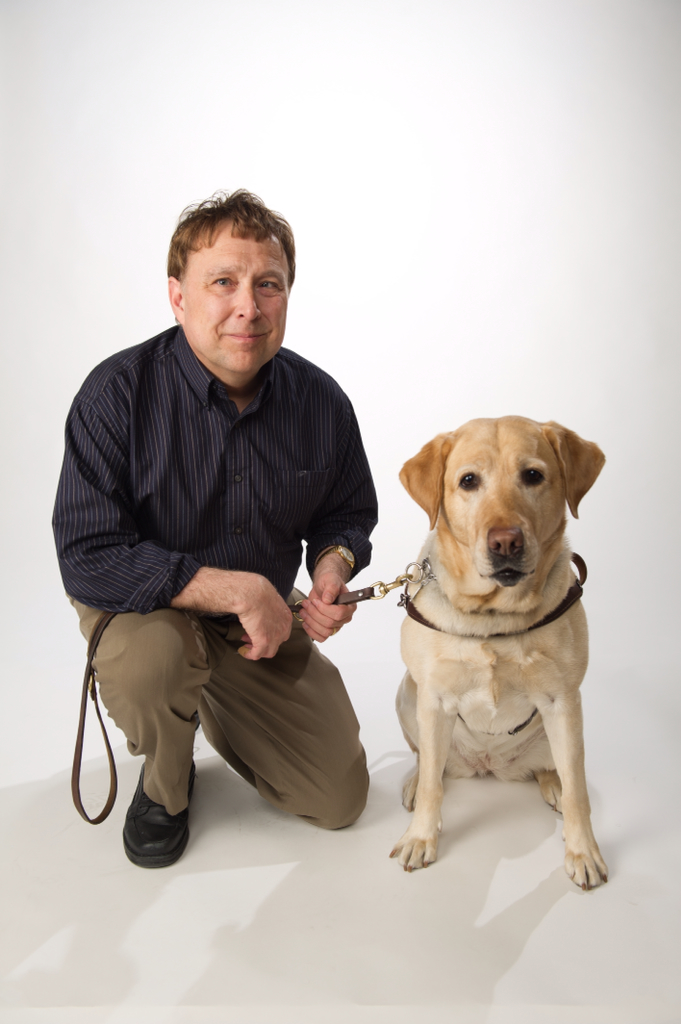
So I’m writing a book about my decade spent with “Corky” my first guide dog. When you live with a dog every day and travel everywhere with her you ask yourself questions.

I thought she was heroic. She thought I was hopeless. Question one: “what was Corky really thinking while guiding me?”

I could only surmise what was in her head. This would become a habit.

I imagined the exercise of man-to-canine dialogue was good for the mind. If you play the game properly it means you’re tough minded. For instance, a man thinks his dog is always looking out for him—she’s valiant, non-distractible. This isn’t entirely correct but he chooses to believe it. He needs to think it. After all he has his insecurities.

But he also knew his dog was a dog.

And so, walking in strange cities I thought about my investment in ideas about Corky versus Corky’s likely thoughts.

She watched cars. We were in Wichita, Kansas. I said “forward” and she didn’t budge.

A bus roared past and then a truck.

How had I not heard them?

She’d done her job—had stopped at a curb and had scanned all movement.

I was thinking about all the summers that might remain. How long might I live? What oceans had I yet to swim in?

Oh heroic dog! Who’d saved me! She was “Lassie” and “Rin Tin Tin” rolled into one.

We walked a few blocks and entered Wichita’s Botanical Garden and I asked Corky directly if she felt like Rin Tin Lassie. She wasn’t paying attention to me.

“She’s watching butterflies,” said a woman. “You’re talking to her, and she’s got butterflies on the brain!”

She had a smoker’s laugh, big and phlegmy.

“We have a lot of butterflies here,” she said. “This is the “Butterfly Garden”.”

“Ah,” I said. Smoker woman went away.

“Butterflies and trucks,” I thought, “are equally compelling in a dog’s eyes.”

A bright flash of color. Each appears at the margins of vision. Both warrant full attention. They create amplitude—both ends of the motion spectrum are the same.

“Dogs aren’t heroic,” I thought. “but they are alert, quick, and certain.”

Dogs say: “That’s motion and it’s mine.”

Sitting there amid the Wichita butterflies I saw that it takes some bravery to understand your dog’s view of things.

Once you understand this there’s a purity to it.

A dog sees all the dizzying, big eyed sparks of dailiness.

And doesn’t worry about it.


Why I Stand with PEN

IMG_0033.JPG


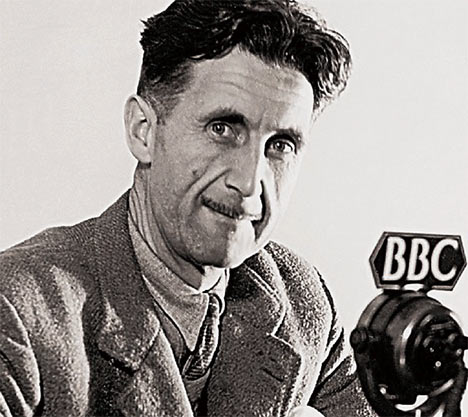
Above is a photograph of George Orwell speaking into a BBC radio microphone.


George Orwell wasn’t the first writer to declare the personal pronoun had been thoroughly infested. He was the first to give the infestation a Linnean system.

He was the last true figure of the Enlightenment.

He wrote: “Journalism is printing what someone else does not want printed, everything else is public relations.”

The recent flap over PEN America’s decision to give the French humor magazine  “Charlie Hebdo” an award for courageousness requires a dab of Orwell for journalism isn’t “taste” and it may also lack nuance.

The writers arguing against the Hebdo award (so I’ll call it, as every award deserves its own name) rightly point out the effects of lampooning Muslim belief—Hebdo’s satire is overtly scornful and in a world where Islamic refugees struggle without human rights, giving satirists a courage award feels like a sham.

But what the critics want, alas, is what Orwell would declare public relations.

Free speech isn’t tasteful.

Free speech is (as always) under attack both in the United States and around the globe.

For this reason I’m for the award.

Free speech means never being comfortable.

“The quickest way to end a war is to lose it.” (Orwell)


The TV Jingle I Can’t Get Out of My Head

It happened this morning. I was watching MSNBC when a local advertisement came on. A mortician spoke earnestly into the camera. He was wearing a Sears and Roebuck suit. He had very pink skin. And then the jingle, which was sung by an ear piercing soprano. She sang: “we’re here for you when you need us, Fettucini’s Funeral Home!” (Not their real name…I confess I’ve forgotten their true name, so aghast was I by the pitch.) What does it mean to be a funeral home professing its total readiness for my needs with a wincingly cheerful tune? According to the syntax they’re not there when I don’t need them. The advertisement was metaphysical.

Of course one should never ask what something commercial means. The answer is self-evident. The funeral business is tougher than one might think.

The plastic, hyper cheery, a-social insensitivity of the lyric was ghastly.

I tried to picture the scene: the sweating mortician and the jingle gurus sitting on naugahyde chairs, listening to saccharine songs promoting antacids and foot powders, all of them recognizing that one product is the same as another, it’s not the steak its the sizzle, and why not sell “happy” when it comes to the dark trade?

Why not indeed. And the mortician forked over his money. I imagined he had a failing business. That was the only thing I could bring myself to believe, for the opposing view was too much–that a jingle can bring in buckets of grief and cash. But experience suggests it must be so. And so I lost one more unit of innocence.


World Naked Gardening Day

Today, in case you missed it, is “World Naked Gardening Day” which is an instance of preferred abstraction, for like so many ideas it's better in the mind than next door. And yes, I have an advantage owing to vision loss–I'm safe from the prospect of Mr. and Mrs. Drupe bending low over beds of kale.

But if you live in Mendocino your day may be distracting.

Consider yourselves warned.


Faces on the Telephone

I was talking yesterday with my friend Lance Mannion via the old fashioned telephone. We weren’t Skyping or Apple Watch-ing. We imagined our respective faces and gestures. On the phone everyone is blind. We must coin a neologism for “phone nostalgia” while it’s still possible. Soon it will be impossible to speak without Dick Tracy micro-cameras. Accordingly we’ll have to observe our friends and acquaintances stretched on sofas wearing Sponge Bob Square Pants leisure wear.
In a college class recently one of my students at Syracuse said people dressed better in the United States fifty years ago. “Have you been to Wal Mart lately?” she asked. “Everyone slumps around in pajamas and horrible sweat pants.”
“Well,” I said,  “fifty years ago people dressed up because there was a general expectation you could get a job. Dress for Success meant something. Nowadays millions have given up. A new slogan might be: Why Get Dressed When You’re Depressed?”
“It’s a Sponge Bob nation,” I said.

Let us imagine our respective faces and gestures. Faces still matter.

My face has harvested black currants.
When I was five years old I danced around the house buck naked while wearing a cowboy hat. “I’m the bare cowboy!” I said. I thought this was the funniest thing on earth. That was a face.

Nothing terrifies us more than godforsaken faces. Let your face always spark.
Let it be real and alive.

Imagine this for your friend.

Imagine it for someone you don’t necessarily like.

Every face is a foreign dialect we can get to know.

Yes, I’m blind but I know your face.

I heard it on the telephone.

April and Silence

Always what happens is more than we can carry, said the old Swedish poet. Being blind I grow upward like a birch. I trust sunset. I expect it will do something for me. I think late day clouds are like humans who do not show their faces.

As the day ends I think of reconciliations and walk my beloved dog, a Labrador, who understands traffic. I daydream in the new deep of night. As a boy I harvested black currants with shears. Now I see them again, those scissors, cold among wet leaves.