Where two fears intersect, there’s disability. Its figuration is the Centaur. And so in the public’s mind crippled-ness is untamed, quick, and too much like us. Culture, social construction, these are aggregate and substitute terms for the intersection of primal fright. Disability is a social construct to be sure, but its a secondary one. In the lead, half man, half horse, is the fear of the capricious body—the one that looks like us but won’t behave.
Waiting for Mr. Milkbone
I remember circa 1962, our family’s first golden retriever, who was a sweet dog, but she hated the milk man with true animus. We decided that he must have kicked her. So we got rid of him. Now, all these years later, I realize he was probably a veteran–I think he had a limp. He likely had PTSD. All the neighborhood dogs hated him. This is likely the start of a Vonnegut-esque novel.
More lives than we perceive know of yours and mine. Don’t kid yourself, dogs hear every whisper.
Bill Knott, the Summer I was Almost Grown
“Holy still is Speech, but there is no sacred tongue, the truth may be told in all.” (Auden)
“Its lucky we don’t need “the vulgate”—for now all languages are holy.” (Kuusisto in a rambling lecture)
I spent my 18th summer playing Billie Holiday records and reading the poet Bill Knott.
I was largely friendless, recovering from a hospitalization for anorexia—I mean, really, I was returning to the world with scars and many tremblings—I’d flip the Holiday record and read, with the aid of a prodigious magnifying glass.
Bill Knott:
Poem
What language will be safe
When we lie awake all night
Saying palm words, no fingertip words
This wound searching us for a voice
Will become a fountain with rooms to let
Or a language composed of kisses and leaves
When you’ve lived long with the stripped, coded privacies of injury, you feel the transmission of these lines—the electric, recombinative flesh and syllables of lingo. Imagery depends on nouns but think of Knott’s verbs: be, lie, saying, searching… Bill Knott was orphaned young; I lived my blind-kid solitudes—God Almighty, I used to play Victrola records alone in the attic. What I loved was Knott’s “fountain” with rooms to let. Inner joy… New and promising words.
I still wonder, every day, what language will be safe?
Bill Knott:
Poetry,
you are an electric,
a magic, field—like the space
between a sleep walker’s out held arms….
There is no court rhyme or shepherds pipe for safety. And none for faith.
“If that isn’t love, it will have to do, until the real thing comes along…”
Bill Knott’s poetry collections include The Naomi Poems, Book One: Corpse and Beans(1968), Becos (1983),Outremer, winner of the Iowa Poetry Prize (1988),Laugh at the End of the World: Collected Comic Poems 1969–1999 (2000),The Unsubscriber (2004), and Stigmata Errata Etcetera (2007), a collaboration with collages by the artist Star Black. He passed away yesterday.
For My Able Bodied Friends, Only
I have a disability
and I may have more than one.
You can’t know me—
not precisely,
as I was created
a mystery
and (make no mistake)
if I’m like you,
if I resemble you at all
Its no coincidence—
Reason is unlikely.
Forgive me, I must go,
I’ve an appointment
With the Cause of Love
and its sessile undying heart.
Love who you are—
without wish, without being ready.
Dear Tim Cook: Please Hurry and Return My Books
Dear Tim Cook:
So okay, I’m a Mac user and I don’t know how many of us there really are—I’m guessing 20,000. Blindness is a “small incidence” disability in the US and though our band is relatively tiny its growing rapidly. Many blind people have switched to your products since Apple introduced its VoiceOver speech synthesis software in 2005. All of this is to the good. The stability of the Mac with its built in accessibility features makes it a natural choice for the blind in particular but also for all people with disabilities.
Imagine my surprise when I discovered last week that the latest update to Mavericks, the new Mac operating system wiped out the ability of my Mac to read iBooks. Boink. No more reading with the Mac.
At first I thought the problem was a corrupted download. So I downloaded another book. No go. I opened dozens of books and none of them worked. Rather than reading pages aloud, my VoiceOver speech synthesizer simply said, “text text text”—rather plaintively—as if the software was as mystified as I was. “At any moment,” I thought, “its going to say I’m sorry this looks like gibberish to me!”
Mr. Cook, the problem is not merely technical. I’m sure Apple can fix this. A customer relations representative has promised me there’s a fix in the works. I suspect he’s right. Apple has made a big commitment to accessibility. I trust repairs are on the way.
The larger difficulty is that no one can say when my books will be readable again and that’s a breakdown of Apple’s commitment to my particular brand of diversity. I need my books. I speak for lots of blind people who have “made the leap” and placed their trust in the Mac.
Please take the time to write to the blind in this instance. Tell us what we need to know. We’re a small group but we’re growing—not merely because blind people are on the rise (though we are, owing to the aging of the baby boomers) but because your products are proving important and a true commitment to accessibility is something more than a matter of technical skill. If our numbers were larger the folks in Cupertino would have issued statements about this snafu.
Let me put it this way: blindness isn’t hard; guessing when our solution will come, that’s a different thing.
Blind Body, Blind Song
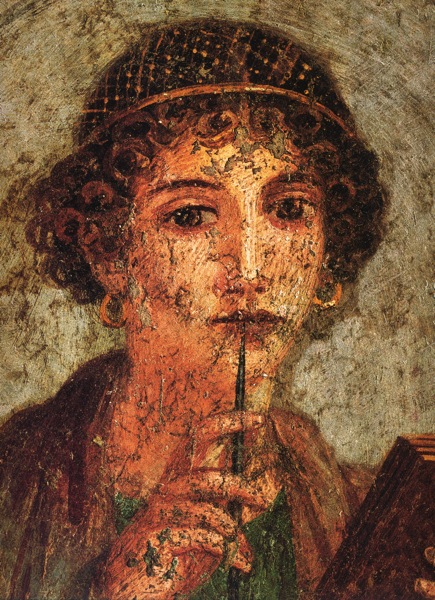
Image description:
Detail of the portrait of a young woman (so-called Sappho) with writing pen and wax tablets. The net in her hair is made of golden threads and typical for the fashion of the Neronian period. Roman fresco from Regio VI (insula occidentalis) in Pompeii.
Museo Archeologico Nazionale (Naples)
When you have a disability you’re always waiting for beauty—I don’t mean self-acceptance, that term is silly, a product of pop-psychology and tabloid TV, but something else, a fountain source, a sense of “beginning always”. The poet Olga Broumas writes:
“I give my hand to justice
Transparent fountain source at the peak
My sky is deep and unaltered
What I love is always being born
What I love is beginning always”
The best in us waits for beauty but sparks its beginnings.
So each day I go out with my guide dog, walking the operations of chance.
People with disabilities take chances.
Acceptance or non-acceptance by able bodied strangers is a thing of chance.
Parking and entrance are things of chance for my wheelchair friends; my deaf friends know they might or might not be accepted in banks or college lectures—chance and more chance, rain falling, help or no help, its a hard knock life…
As a poet I’m most interested in what Broumas calls the transparent fountain source—a figure at once neo-Platonic and Freudian. The gods and goddesses are rising; you’re about to have climax—but apprehension is clear, its never been clearer—you will be born again and again in a spirit of justice. Imagination has no value minus justice.
Blind justice is a poet. Maybe you didn’t think so. Justice whispers Greek. I give my hand to justice and look, my hand opens.
Justice and beauty propose chance—make it a “beginning always”.
The air is chilly in Syracuse. Transparent fountain source at the peak. Justice fountain, snow light, being born, walking blind, beginning always.
Talk about justice. You’ll find poetry.
Sappho:
He is a god, a man beside you,
enthralled by your talk, by your laughter.
Watching makes my heart beat fast
because seeing little I imagine much.
You put a fire in my cheeks.
Speech won’t come. My ears ring.
Blind to all others, I sweat and I stammer.
I am a trembling thing, like grass,
an inch from dying.
So poor I’ve nothing to lose,
I must gamble….
—translation by Sam Hamill
In my first book of poems, Only Bread, Only Light, I published a love poem to my first guide dog “Corky”. The poem recounts a day of walking in Manhattan, the two of us alert to the operations of chance:
“Guiding Eyes”
–Corky, a yellow Labrador
It’s been five years
Since I was paired with this dog
Who, in fact, is more than a dog—
She watches for me.
Our twin minds go walking,
And I suspect as we enter the subway
On Lexington
That we’re a kind of centaur —
Or maybe two owls
Riding the shoulders of Minerva.
The traffic squalls and plunges
At Columbus Circle,
Seethes down Broadway,
And we step out
Into the blackness
That alarmed Pascal:
The emptiness
Between stars.
I suppose we’re scarcely whole
If I think on it —
We walk on a dead branch,
Two moths still attached,
The inert day poised above us,
The walls of the canyon looming.
Did I think on it?
A blessing opens by degrees
And I must walk
Both bodily and ghostly
Down Fifth Avenue,
Increasing my devotion full much
To the postulate of arrival —
To how I love this inexhaustible dog
Who leads me
Past jackhammers
And the police barriers
Of New York.
All day snow falls
On the disorderly crowds,
It clothes Miss Corky
Until her tawny fur
Carries the milky dirt
Of ocean and stone.
The centaur gathers
What passes from our flesh
Into the heart
Of animal faith.
Meanwhile
She guides me home.
Excerpt From: Stephen Kuusisto. “Only Bread, Only Light.” iBooks. https://itun.es/us/1017I.l
Dear Tim Cook: Please Give Me Back My Books
Dear Mr. Cook:
I’m a blind computer user. I suppose when you get right down to it that’s not all I am since I’m a husband and father, a professor, a writer, a guide dog lover, and a baseball fan. But for the purposes of this blog post I’m a blind computer user. I write you here, publicly, because the latest upgrade to Apple’s Mac operating system–Mavericks 10.2.9 has a serious bug: it has wiped out the capacity of the Mac’s screen reader app (known as VoiceOver) to read iBooks.
If you’re blind and like me you’ve made the switch to Macs from PCs, this is a disaster. Over the course of the past week I’ve put in several calls to Apple support. The best I’ve heard is that engineers are aware of the bug. But no one can say when it will be fixed.
I ask you to think about all the blind people who have embraced Apple technology over the past five years ever since you introduced built in accessibility features. This bug prevents me from reading books, volumes I purchased believing in the solidity of Appke’s commitment to the blind.
Please get me my books back.
Regards,
Stephen Kuusisto
 Posted with Blogsy
Thinking of the AWP
At the Poetry Conference
He was important to himself in every weather
though he couldn’t remember why—
as there was always Yeats.
Still he was looking rather great
in Banana Republic leather.
The Able-bodied Blues
Disability is the orphan of multiculturalism. There. I’ve said it. It’s painful to do so. Painful because my politics are inclusive and I worry daily about other people’s children, children of all colors. Worry about cruelty, joblessness, violence, the prison-industrial-complex; worry about misogyny. I teach against these things. I’ve marched for gay rights. Written against the war. But now at 58, (I’ll be 59 in three weeks) I’ve grown impatient with the able-bodied pure products of America because my people, all 60 plus million of them, who are arguably the largest minority group in this nation—are still ignored by television, radio, newspapers, Hollywood, academic conferences, hotels, airlines, you name it, unless we tell an “overcoming story” in which the reality of disability is ameliorated by a Tiny Tim smile, a miraculous cure, or a two day allowance where a kid with Down Syndrome gets to be on a basket ball team. The reality of disability must always be suborned, deflected, pushed into a closet. Meantime, real disabled people are almost 80% unemployed, their food stamps and disability support services are being cut to pieces, rehabilitation programs are woeful and inadequate, accessibility guarantees required under the ADA are bypassed by a zillion businesses and institutions of higher learning. As the old song goes: “its a hard knock life, for us.”
What’s got me going this morning is that the wrongs in cripple-ville outweigh the rights and it needs to be said. Where are the able bodied progressives? Why are they not on the team? It can’t be because they think disability is “catching” can it? It can’t be some kind of religious suspicion we’re afflicted owing to divine punishment can it? It isn’t embarrassment at being seen with a wheelchair or a white cane is it? Ah, it must be plain old fashioned utilitarian philosophy: the needs of the largest group outweigh those of the minority. It hurts the big group to help the lame and the halt. No, that can’t be it, because disability is the only democratic and universal minority. The larger body politic has disabled friends and relatives. Hmmm. Well, then, it must be that in America if you’re not able bodied you’re imagined to be a slacker, a mooch, a leach.
You’re also probably some kind of faker.
I’m tired of being left out of academic conferences that have no inclusion policy.
I’m tired of visiting colleges and universities where the student disability services are hidden and where the people who run them are without competency in disability as culture—where the website is a bulwark against getting accommodations.
I’m tired of being told I can’t go into a restaurant because I have a guide dog.
Tired of crappy airline service; inaccessible taxis; bulbous headed flat footed department store detectives; police who taser bus passengers with mental illness; the Veterans Administration with its disgraceful rehabilitation services for soldiers; tired of the term “wounded warriors” as though a disability was just a “boo boo” that will go away when we pull off the “ouchless” band aid. Who was the asshole who decided “wounded warrior” was better than disability? Of course!
Wounded Warrior implies “overcoming”—that disability will just go away, that its not a life long issue. The Wounded Warrior Project should have Tiny Tim as its logo. Sorry. But a disability is permanent, its not a wound, and its going to get worse with age.
Yes, disability is the orphan of multiculturalism. Its not sexy enough for able bodied progressives despite our efforts to dress fashionably in some circles, to vamp our ramps.
You see, we’re just food stamp people with canes and wheels. Unless we smile like we’re being electrified and sing the sun will come out tomorrow.
Why are there no sections on disability at Huffington Post or the Nation?
Heaven-Friend-Dog
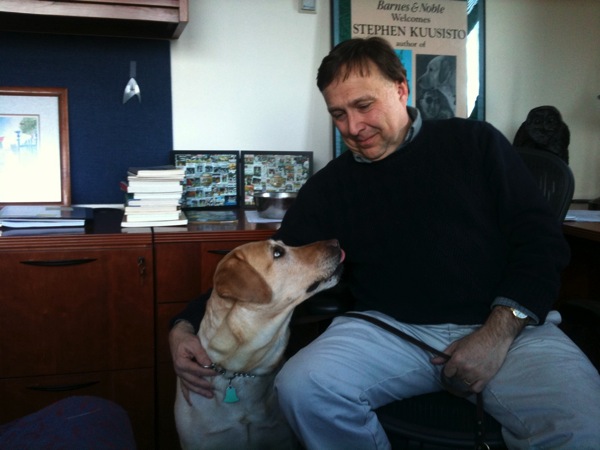
Photo of Stephen Kuusisto and his guide dog Nira, a yellow Labrador, in Kuusisto’s office at Syracuse University.
“At Twenty we find our friends for ourselves, but it takes Heaven/To find us one when we are Fifty-seven.”
—W.H. Auden
Heaven-Friend-Dog, you are vexing, for I love you in all seasons and you love me back, and all without irritable reaching and bad memories.
You’re not my therapist. I’m not your master. A guide dog and man are an occurrence. We’re a walking “happening” whether going forward or astray.
You’re vexing because a soiled man-mind needs problems, thinks irritations are consciousness and you, Heaven-Dog, know otherwise.
When we’re Fifty-seven and set “right” by doggish clarity its like being corrected by a child: “No, Daddy, that’s not what you said!”
My dog knows the better “me”—the one who lives outside the shaming culture.
That’s a friend.
Outside the shaming culture.
With Heaven-Friend-Dog I’m one of Victor Turner’s liminal figures—the Laplander who sails clear out of the fire lit circle and vanishes into the unknown. Shaman, vatic runner, knife in the air, twin invisibles riding Pegasus… Whatever we are, we’re not customary able bodied upright American walkers. Which means our motion is transgressive. We’re the very fast, and very wrong thing on the sidewalk.
But outside shaming culture we’re the right thing. And the hypnogogic sidewalk can go fuck itself.
Sidewalk with its ordinary sleep walking 9-5 walking dead. People shlepping along with their backpacks filled with computers and sad lunches…We race by, heading up a mountain of birds. It’s so good to not be you, sidewalk friend. I’m so profoundly glad to not be you.
Outside the shaming culture we don’t care about our physical difference, don’t care about Dickens and his disability sadnesses, don’t give a monkey wrench about the Brooks Brothers’ guy who sees us and thinks we’re the saddest things on earth, a blind guy and dog. It doesn’t dawn on Mr. Gray Flannel that we’ve just passed him on Pine Street in Seattle; that we’re walking three times faster; that we’re laughing.
We’re laughing, because I can laugh for my dog.
That’s a friend.
 Planet of the Blind