Inclusive Sports and the Good Will Department

My friend Bill Peace (“Bad Cripple”) takes up the issue of school sports programs which are now required to make modifications for students with disabilities following a ruling by the U.S. Department of Education’s Office of Civil Rights. 

Bill is a trenchant analyst of the odd, and often uncomfortable dynamics that accompany the issue of inclusion. He writes:


At a practical level, I cannot foresee schools being willing to spend money on adaptive sports equipment. For instance, many schools in Vermont have ski teams. Will a school be required to purchase a mono ski for students with disabilities that express a strong desire to join the ski team? A mono ski rig costs many thousands of dollars. Will a school be willing to rent a mono ski for the season? Will school districts pay to have its athletic teachers be trained in adaptive sports? The resounding answer to these questions is no. When my son attended public school I was stunned at the degree of hostility I encountered. Any request I made in terms of wheelchair access was met with a firm and not so polite no. Reasonable accommodations at the university level are equally problematic.

I too have wondered how this will be implemented since the ruling was issued. Like Bill and thousands of other people with disabilities I know first hand how little “inclusion” there really is in public schools and post-secondary institutions. People with disabilities are all too often included in classrooms or educational activities merely on sufferance. And sufferance is the polite word.

One may say it takes a constellation of nails to build a house. It takes a constellation of laws and active will to build accessibility. The former we have, the latter is still all too often in short supply.  


Technorati Tags: , , ,

Fake Service Dogs, Problem or Red Herring?

There’s a blog post over at The Bark’s website by JoAnna Lou entitled “Revisiting Fake Service Dogs” which is a follow up to an earlier post by the same author. Ms. Lou’s issue is with non-disabled people passing off their dogs as service animals, largely to bring them aboard airplanes. Service dogs fly in the cabin and can’t be put in cargo. As a guide dog handler who has flown hundreds of thousands of miles over the past 18 years, I want to weigh in on some of the contentions in Ms. Lou’s posts.

One of her assertions is that dog show people routinely cheat by passing off their pets as service dogs while traveling to dog related competitions. I have no doubt that people do this. As Ms. Lou correctly points out, the Americans with Disabilities Act does not require people with disabilities to provide documentation for service animals when accessing public places. By way of analogy ask yourself what it would be like if, as a non-disabled individual, you had to produce your Passport every time you went into a grocery store or movie theater or restaurant, or wanted to board a bus. Clearly you’d find yourself without the documentation because you changed your handbag, left your briefcase on the desk, or forgot the Passport in the pocket of your other coat. The ADA is a Civil Rights law and not a “hall pass” to the bathroom in Junior High. 

I am getting ahead of myself. But the Civil Rights aspect of service dog travel is important. I was recently in Japan where I visited the Kansai Guide Dog training school. I learned there are not equivalent access guarantees for guide dog handlers in Japan. What this means is that blind people with professionally trained guide dogs can only travel to places that will admit them on sufferance. This is precisely what the ADA’s documentation clause is designed to avoid. Your disability doesn’t have to be “proved” if its invisible; you don’t need to show them a letter from your eye doctor proclaiming your vision loss; you don’t need to tell the professor how you got PTSD; you don’t need to show your service dog’s official license to get in the door. 

Not long ago I was denied access to a tony restaurant in New York City. The doorman and the night manager wanted me to “prove” that the yellow Labrador beside me, wearing a leather harness that says “Guiding Eyes” across the back strap, was really a service dog. We had a frank conversation and I told them they were violating the law. Later the owners apologized. They offered me a free dinner but I won’t go back. I did have an ID card from Guiding Eyes for the Blind in my wallet. But the doorman is not permitted to demand this and frankly he shouldn’t be permitted to demand this. Civll Rights are “rights” and they are not conditional on having the proper paper work. 

Ms. Lou believes that legions of people are cheating the system by pretending their tricked out pets are service dogs. But if you watch enough courtroom dramas on TV you will likely notice her evidence is what they call “heresay” on “Law & Order”–which means she’s getting her information second hand. Back in 2009 she wrote:

“The legitimacy and training of service dogs has come up a lot recently, and many of the cases do not have clear solutions. But what about when someone is consciously taking advantage of the privileges granted to service dogs?

With the USDAA Cynosport World Games coming up in Scottsdale, Ariz., I’ve been talking to many of the local competitors about how they’re traveling with their dogs. Some are caravanning in their RVs and others are reluctantly putting their pups in cargo. 

One of the more seasoned competitors mentioned that while she dutifully puts her dogs in cargo, she always sees fellow competitors passing their pups off as service dogs on the plane.”

I have no doubt that Ms. Lou’s source did in fact see dog show competitors bringing dogs on an airplane by asserting they were service dogs. But what I DO doubt, is the rhetorical device whereby a general truism is asserted based on limited evidence. Usually that limited evidence is framed as a leading question–one that’s designed to trigger strong emotions. One of the best ways to do this is by asserting that someone is cheating the rest of us honest folk. The device is almost always a fallacy. Ronald Reagan’s famous stump speech about “welfare queens” was entirely made up.   

Let’s slow down. Let’s breathe. 

Are non-disabled people passing themselves off as having disabilities. Yes. Just drive to your local pharmacy and try to find a handicapped parking space. Then hang around and watch the exceptionally fit college kid come out and hop in the car that’s hogging the reserved spot. This makes your blood boil. Mine too. One of my best friends is a wheelchair user. He struggles with this issue all the time. In general terms people like to cheat. They will use disability status as a means to an end just as they’ll pretend to be working for a charity or raising money for a youth group. As all veteran cheaters know, the best gambit involves stealing from kind people. Back in the very early days of American film making one of the most popular plots involved “fake” beggars who pretended to be blind. Those early movies were little morality plays and the villain always received his due. We know of course that even today there are beggars faking disabilities. What I mean to suggest is that this idea of falsifying disability is one that is both venerable and loaded with pathos–the Greek term for ungoverned emotion. Pathos will always cloud better judgment. Or as the great Israeli poet Yehuda Amichai once wrote: “People who live in houses in fog believe the whole world is covered in fog.” 

Once you imagine the world is filled with cheaters you will see cheaters everywhere. Still, emotions aside, is it possible that Ms. Lou’s “source” who saw people bringing dogs on a plane was actually seeing dog show competitors who had invisible disabilities? This is indeed possible. Ms. Lou’s source cannot know by default that the people she saw were cheaters. And perhaps they were. But its also possible some of them weren’t. In the arena of human rights I like to side with individual and collective dignity. I don’t  want people to be required to prove their disabilities just because there’s a lurking scofflaw around the corner. Let me be more specific: I fly at least twice a month. I am not seeing large numbers of dogs on planes. In fact, 99% of the time I’m the only one with a service dog on the flight.  The sheer numbers of flight attendants who tell me they’ve never seen a guide dog before is rather telling. In truth there are only about 10,000 active guide dog teams in the United States. Guide dog teams are a very very small minority group. 

While there are no requirements that a person with a disability must produce doggy documentation there is a subtext in the ADA which states rather clearly that a service dog can be denied access to a public space if its not under firm control. One needs to think about that. If a cheater did get on an airplane with a fake service dog, he or she could still be denied a seat if the dog wasn’t really a working dog. What I’m getting at here is that fakery or not, there are controls. Perhaps they are not perfect. A person pretending to have PTSD and pretending to have a trained service dog could indeed get on an airplane. But they wouldn’t stay long if the dog had no manners. And I for one wouldn’t want to humiliate a person who actually “has” PTSD. While I respect Ms. Lou’s umbrage that dog show people may be faking that they have disabilities I’m not at all convinced this is a real epidemic. Moreover, I believe that suspicions tendered toward people with invisible disabilities do a lot more harm than the occasional dog show cheater. I think perspective is crucial in all areas of public life. 

I also think that the Bark’s decision to use a photograph of a legitimate service dog alongside Ms. Lou’s latest post is unfortunate. 

I like “The Bark” and I have written for them on occasion. Still, when writing about disability and public access I expect more than pathos. Much more. 


The MacDowell Colony: Stephen Kuusisto's Current Home Away from Home

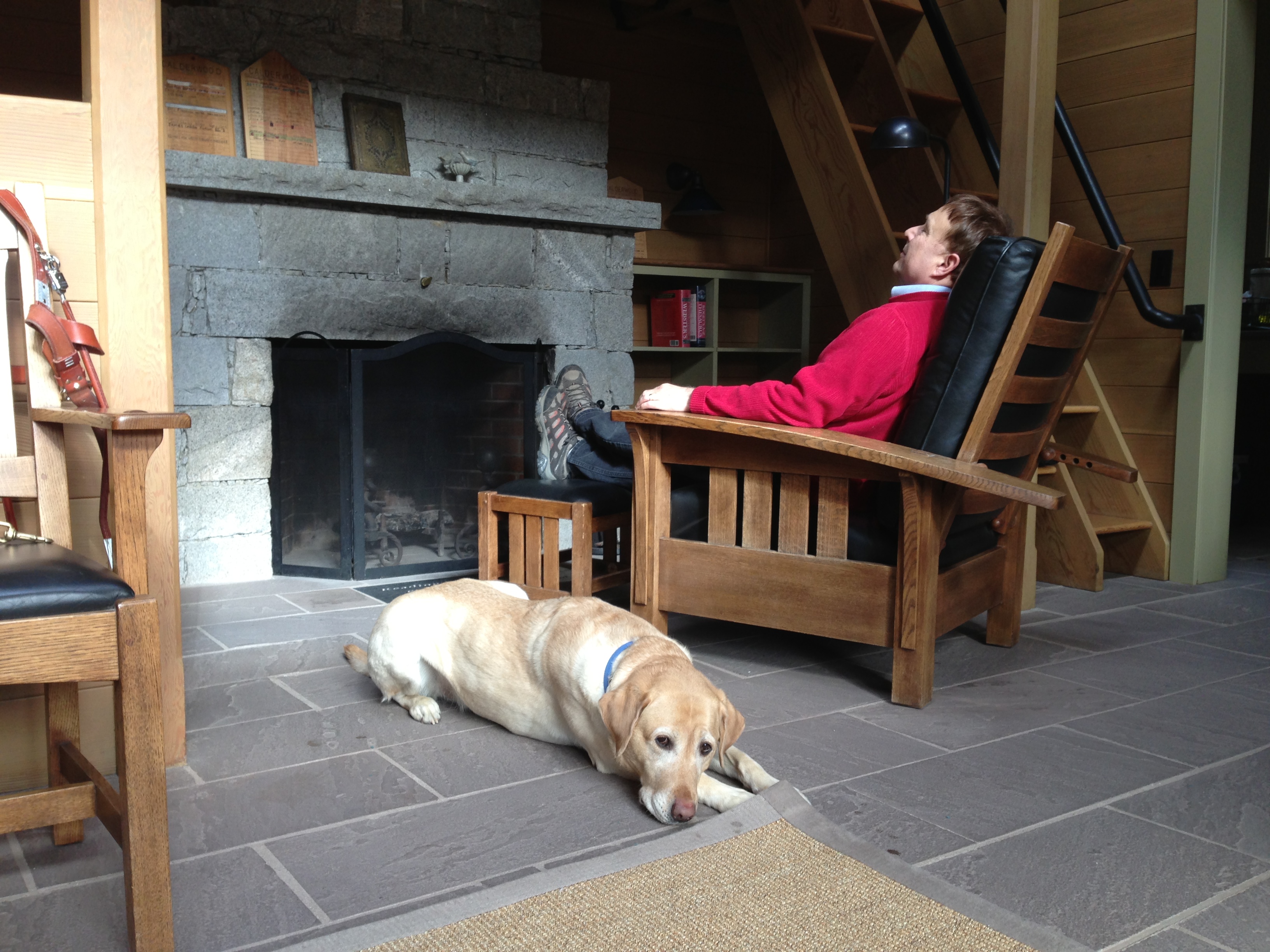
Any writer/artist lucky enough to stay at The MacDowell Colony is indeed very lucky.  Here, Steve Kuusisto and his guide dog, Nira, can do their best thinking.  Nira’s job is to provide inspiration as Steve works on his next book, tentatively titled “What a Dog Can Do”.

Steve Kuusisto and guide dog, Nira

Photo and post submitted by @ConnieKuusisto: Steve, in red sweater, is sitting in a Stickley chair in front of the fireplace in the cabin he’s staying in. His yellow Labrador guide dog, Nira, is lying on the floor by his side.

Disabilities as Ways of Knowing: A Series of Creative Writing Conversations: Part II


The Disability Experience and Poetic Verse


Reading by Poets Jim Ferris, Laurie Clements Lambeth, and Stephen Kuusisto


March 28, 2013

Reading 7:00 to 8:00 pm at Watson Theater

Reception and book signing from 8:00 to 9:00 pm at Light Work

SU Campus


Jim Ferris, Laurie Clements Lambeth and Stephen Kuusisto will be reading from a selection of their poetry, followed by a reception and book signing, for all members of the S.U. community. While this event is geared specifically to raise and support awareness among undergraduates, everyone is welcomed to participate in this exciting set of opportunities. This event will feature works from Beauty is a Verb: The New Poetry of Disability(Cinco Puntos Press) and launch Letters to Borges (Copper Canyon Press), where “best-selling memoirist Stephen Kuusisto uses the themes of travel, place, religion, music, art, and loneliness to explore the relationship between seeing, blindness, and being. In poems addressed to Jorge Luis Borges—another poet who lived with blindness—Kuusisto leverages seeing as negative capability, creating intimacy with deep imagination and uncommon perceptions” (from http://www.stephenkuusisto.com).


American Sign Language (ASL) interpretation will be provided during both the reading and the reception/book signing. Communication Access Realtime Translation (CART) will be provided during the reading.


If you require accommodations or need information on parking for this event, please contact Radell Roberts at 443-4424 or rrober02@syr.edu.


This event is made possible through the Co-Curricular Departmental Initiatives program within the Division of Student Affairs, and cosponsorship by the Disability Cultural Center, the Renée Crown University Honors Program, the Center on Human Policy, Disability Studies, the Burton Blatt Institute, the Dept. of Women’s and Gender Studies, the Lesbian, Gay, Bisexual, Transgender Resource Center, the Office of Multicultural Affairs, the Slutzker Center for International Services, the Creative Writing Program, the Disability Law and Policy Program, the Disability Student Union, the Beyond Compliance Coordinating Committee, and the Disability Law Society.


As aspects of variance and diversity, disability cultures and identities enrich the tapestry of life on and off the SU campus.

Disability Prejudice Alive And Well In The U.S.


(Al Jazeera)

January 30, 2013

SEATTLE, WASHINGTON– [Excerpt provided by Inclusion Daily Express] Often referred to as “the world’s largest minority”, persons with disabilities are accustomed to facing barriers to their participating in almost every aspect of society.

“In the case of disability, we’ve had to spend all our time and energy determining who is a member of the club, rather than if they are being discriminated against,” Joelle Brouner, Executive Director of the Washington State Rehabilitation Council told Al Jazeera.

Brouner, who experiences a major physical disability herself, works to see that a greater number of people with disabilities enter the workforce and progress in their careers.

But, like so many people with disabilities, sometimes just getting to work can pose as great a challenge. Smiling, she asked: “How do I figure out how to build a life when I have to figure out how to ride a bus?”

“In 2004, I went to New York City and there were very few wheelchair accessible cabs, and I couldn’t use the subway. ‘We don’t want more of you in the world’ is the message some of this sends to people with disabilities.”

Entire article:

Human Rights for US Disabled?

http://www.aljazeera.com/news/americas/2013/01/201312717417999561.html

The 20-Year-Old Self

By Andrea Scarpino


Lately, I’ve been thinking about my younger self, who she was, what she would say about where I am in my life these days.


She liked to think of herself as radical, that younger me. Radically vegetarian—sometimes vegan, aspiring always to veganhood—radically political, radically bodied. She found and formed new identities with each trip to the library, took as many college classes as she could to expand her knowledge, spoke often in class, visited her professor’s office hours regularly. She was passionate, full of energy and idealistic beliefs, full of desire to live her life fully. She had thousands of dreams, imagined thousands of possibilities, careers, places to live and visit. She laughed so loudly people turned to stare.


But she also believed in perfection, that maintaining a 4.0 GPA was incredibly important, that making the world a better place was only possible if she fought racism and sexism and classism and homophobia perfectly. If she never made mistakes. If she held others to the same standards to which she held herself. She thought in black and white, never shades of gray.


And she was constantly anxious, nervous. She was sick from stress, barely sleeping, quizzing herself with stacks of flashcards while she ate breakfast, walked to work. She was judgmental, lecturing her father in restaurants about his food choices, lecturing her step-mother about racism, lecturing strangers in the supermarket about their religious beliefs. In her mind, there was right and there was wrong; there was nothing in-between.


She was lovely in many ways, that younger version of me, although she never quite believed she was saying or doing or being the right thing. But she was also rigid, inflexible, unwilling to seriously dialogue with people who didn’t agree with her beliefs. Sometimes she belittled in order to prove her point.


And I feel, lately, like it’s important to remember the negatives of that younger self, not just to idealize her energy, conviction, all the truths she knew beyond a shadow of a doubt. Because the older I become, the more complicated everything seems, the more I understand the world in overlapping systems, constellations of choices with constellations of consequences desired and unintended. And sometimes I worry my younger self would have nothing but disdain for the current me. After all, I buy most of my clothes new instead of used, I drive three hours to get my hair cut, I didn’t volunteer a single minute for the last election, sometimes I wear make-up, sometimes I smile at sexist jokes instead of screaming.


When I remember only my idealistic younger self, I’m overcome with anxiety that she would think I’ve sold myself short. As a student told me recently, “Complexity is just something 30-year-olds tell themselves to make them feel better about selling out.” I laughed. And walked away. Because lately, I’m trying to be gentle with myself, the choices I’ve made, continue to make, the paths I’m choosing in a world of complexity. I’m trying to be gentle with others, too. Understand their choices, see them from many angles and possibilities. I’m trying to maintain my younger self’s enthusiasm, laughter, passionate beliefs, while moving forward with less judgment, more kindness, less right-or-wrong thinking.

Elegy


We are still here where cartoon pigs sell car insurance

And travelers comb the suburbs ringing doorbells for Christ.

Anselm, my father used to laugh, said the American Finns

should have stayed home.

Once I found a set of dentures–uppers and lowers on a road.

This cash and carry country is a slap on the back kind of place.

I’m told that light is a climb and going up one steps right out.


Ableism at the Hockey Rink

Craig Wyshynski whose online moniker is “Puck Daddy” apparently thinks that the recent ableist display by a minor league hockey coach (who imitated a shambling blind man, using a hockey stick for a cane) was “hilarious.”

I think it’s amazing how many people believe lampooning the blind is perfectly acceptable. One remembers the Saturday Night Live skits making fun of former New York Governor Paterson.

Shame on Wyshynski. Grow up “Puck Daddy”. Or don’t. But don’t pretend blind people are stupid cartoon characters Dude!