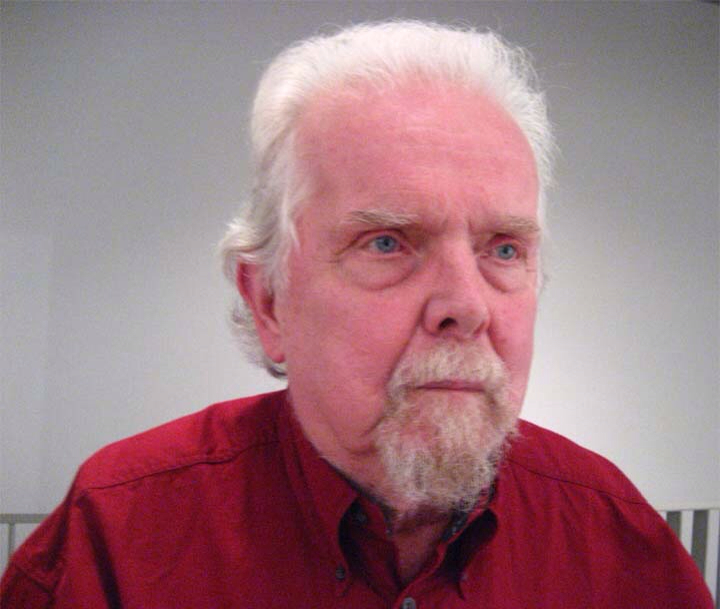
Farewell Anselm Hollo


News has reached me this morning of the death of Anselm Hollo the incomparably original and probative Finnish-American writer and translator. If sadness is custom, losing a poet is its shadow. No elegy captures shadows. Auden perhaps came closest, observing at the death of Yeats how the poet becomes his admirers. How heavy the poet’s cloak feels. I know I’m grieving with thousands of poets and readers who loved Anselm Hollo’s works and days.

I first saw Anselm in an upstate New York supermarket in 1972. I was 17, almost totally blind, anorexic, shy as hell, and just discovering poetry by way of Stephen Berg and Robert Mezey’s anthology “Naked Poetry”.

I knew who Anselm was, knew he was teaching at the local college.

There he was, walking the canned goods aisle at “Loblaw’s Grocery” with a knee length leather coat, a dizzying mane of “late Beatles” hair, giving off the dissociational fixedness of a man in multiple worlds.

I have carried this particular poet’s books with me now for over thirty years. His poems, translations and prose have been keen influences on my growth as a poet and writer. It would be easy to say my admiration for Anselm’s work is tied to my own Finnish heritage, but that’s not the case. In fact Anselm was a cultural refugee from Finland. One may imagine (as Robert Creeley did, mistakenly) that Finland is filled with outré jazzy transnational shamans, but it isn’t so. Hollo found his voice in the United States when, as a high school exchange student in Iowa in the 1950’s he heard Bill Haley and the Comets. Thereafter he found his way to cities and towns where poetry was creating new communities. In fact when I think of Anselm I always think of gatherings of poets. Yes he was Finnish but in the way of Victor Turner’s “liminal” figure, the man or woman who leaves the ritual circle of the customary culture, who travels widely, who sends back news from unknown terrain.

His translations of poems by Paavo Haavikko and Pentti Saarikoski inspired me to undertake a Fulbright year in Helsinki in 1981-82.

In my memoir Planet of the Blind I describe the dark and provincial quality of my research year in Finland. Poets wouldn’t meet with me. Scholars at the university thought contemporary poetry was beneath contemplation. Maybe things are better now as much has changed–Finland is more international both in cultural and business terms today. But whatever the case I discovered there were not tons of statically alive, multi-cultural, extroverted Anselm Hollo-like Finns walking the Esplanade in Helsinki. It was a place of sharpened introverts. Years later when Bob Creeley also ventured to Finland on a Fulbright the same discoveries befell him. He later described his year in Finland as remarkably lonely. We both found out that Anselm was a Finn in much the way John Lennon was English. Anselm Hollo is an international poet with a Finnish caraway seed under his tongue.

Hollo was the anti-laureate as Robert Archambeau wrote. I have always liked anti poesis Liked it the first time I saw it in person there among the cans of creamed corn in Geneva, New York when I was 17, weighed 102 pounds, and didn’t know how to live.

I will close with one of Anselm’s love poems, this one dedicated to Jane Daleymple, his second wife:


wind gusts changes sky from blue to white

above carpet of crabapples under the tree

flickers flicker through air


tremendous lightning strike two nights ago

gave me the flesh of the hen for half a second

then water poured from the sky


— no I’m not turning into a “nature poet”

but the little green house you built for me

does make me notice a few more things in the universe

to add to my “Notes on the Possibilities and Attractions of Existence”

and I never imagined I could be so unjealous

of my loved one’s art

even when it takes her away from me

for many evenings and mornings and nights inbetween

but o I make myself a joy of it

to see her again


“the flesh of the hen” — “la chair de poule” — goose pimples

“make myself a joy of it” — “se faire une joie de” — to look forward with pleasure


Sterilization Survivors Testify As Virginia Considers Compensating Eugenics Victims


(News & Advance)

January 29, 2013

RICHMOND, VIRGINIA– [Excerpt provided by Inclusion Daily Express] Lewis Reynolds, 85, rose slowly to his feet Monday to tell a House of Delegates subcommittee about being sterilized at the age of 13 at the Central Virginia Training Center.

The 65 people in the room fell silent as Reynolds, of Lynchburg, told the lawmakers he still loves his country despite being deprived of offspring who might have helped him cope with his advancing years.

“I’m Sergeant Reynolds, United States Marine Corps,” he said to eight members of a House Appropriations subcommittee.

“I served in Korea and Vietnam for y’all’s freedom. I couldn’t have no family,” he said, because of the misguided science of eugenics, endorsed by Virginia law from 1924 to 1979, and practiced by sterilizing about 7,500 people in its mental-health institutions.

The subcommittee was considering a bill to establish a state fund to provide $50,000 to surviving victims of the eugenics practice. Five of the victims attended the subcommittee meeting.

Entire article:

Sterilized Lynchburg residents visit House panel, which delays action

http://tinyurl.com/ide0129132a

Related:

Bill Would Compensate Virginia’s Forced Sterilization Victims (WAMU)

http://tinyurl.com/ide0129132b

Virginia’s Eugenics Legacy (Inclusion Daily Express Archives)

http://www.inclusiondaily.com/news/advocacy/vaeugenics.htm


Harkin: How One Iowa Senator Secured Civil Rights For Americans With Disabilities


(Think Progress)

January 29, 2013

WASHINGTON, DC– [Excerpt provided by Inclusion Daily Express] This past weekend, Sen. Tom Harkin (D-IA) announced he will not seek re-election in 2014, bringing an almost 40 year career in Congress to a close. But as Harkin steps aside, his legacy — particularly his work to champion increased protections for Americans living with disabilities — remains.

Twenty two years ago, President George H.W. Bush signed the Americans with Disabilities Act (ADA) and the Individuals with Disabilities Education Act (IDEA) into law. Either law would have been considered landmark civil rights legislation on its own merits — taken together, they represented nothing short of a legislative revolution for disabled and special needs Americans. And those bills were made possible by Harkin, who authored and shepherded them to overwhelming bipartisan approval.

Every handicapped spot in a parking lot, each mechanical wheelchair ramp on a public transport vehicle, and any company that employs qualified Americans with a disability, is only made possible because of the ADA. The law’s provisions — which include protections ranging from anti-workplace discrimination, to public transport and public facility accommodations, to telecommunications support for the visually and hearing impaired — have given millions of Americans the means to pursue independent livelihoods.

As one disabled American put it, “I have traveled 18,000 miles between Los Angeles and Bakersfield in an externship, and without the ADA and the Department of Transportation’s provisions, I would not have managed to remain independent and commute.”

According to one study, the percentage of disabled Americans citing public transport accommodations as a barrier to their commute dropped from 49 percent to 31 percent between 1989 and 2004.

Entire article:

How One Iowa Senator Secured Civil Rights For Americans Living With Disabilities

http://tinyurl.com/ide0129131a

Related:

Sen. Tom Harkin (D-Iowa) to retire (Washington Post)

http://tinyurl.com/ide0129131b


Micro Memoir 54


There was a book in my dream last night. As the poet Robert Bly would say, there was a pirate ship sailing through dark flowers. And so my unconscious lent me its ocean.


When I was a boy, legally blind, down on my hands and knees at the shore I’d trace the whorls and lines in sea shells, my nose so close I caught the strict scent of the underworld.


Tonight, Nick News: "How Blind Kids See the World" with Linda Ellerbee


Tonight at 8:00 pm on Nickelodeon, a show called “Out of sight: How Blind Kids See The World.”


Here’s the synopsis on their website:


If you want to make something harder, trying do it with your eyes closed.

Not easy, right?

For most of us, things get much easier when we open our eyes again.

But for some kids, a lack of sight is a challenge they have to face for the rest of their lives.

On Monday, January 28th, at 8:00 p.m. (Eastern/Pacific), kids across America will talk about living with blindness – and overcoming it.

That’s the focus of the next edition of Nick News with Linda Ellerbee.

It’s called, “Out of Sight:  How Blind Kids See the World.”

“When I lost my sight, I started to feel depressed,” a boy named Santiago says.  “I was bumping into stuff … and I felt like I couldn’t do anything anymore.”

He now knows he was wrong.

“You use your other senses,” he says.

“In middle school, kids would tease me,” says a girl named Brittany.  “They would take my pencils and hide them because they know I couldn’t see them.”

Now, though, she says, “I don’t believe being visually impaired limits me in any way.”

A girl named Xin Ju says she even sees being blind as an advantage.

“I don’t need to see something to believe in it,” she says.  “We use our hearts and our imaginations.”

And a girl named Sophie says she sees her blindness “as a blessing.”

“I can never miss what I’ve never had,” she says.  “(And) my parents have never treated me differently.”

What do all of these kids want you to know about their lives?

And how should you react if you meet a kid who can’t see?

You’ll find out the answers to those questions when you tune into Nick News with Linda Ellerbee on Monday, January 28th, at 8:00 p.m. (Eastern/Pacific), for the premiere of “Out of Sight:  How Blind Kids See the World.”

(If you live in a different time zone, check your local cable TV listings to find out when the program will be on in your area.)

Get some insight, from kids who’ve learned to live their lives without sight.

Here is the link to the site:

http://news.nick.com/01/2013/25/kids-see-through-the-challenges-of-blindness/


Audiences Flock To See Blind-Deaf Ensemble

Editor’s note: you probably couldn’t produce this in Belgium…


(Jewish Voice NY)
January 28, 2013

TEL AVIV, ISRAEL– [Excerpt provided by Inclusion Daily Express] The 11 cast members of “Not By Bread Alone” are all deaf, blind or visually impaired. And speaking of unconventional, the play begins with the cast members baking bread on stage. Throughout the play, the bread is kneaded, formed and baked, as the extraordinary storytellers convey their memories and dreams.

First, the show began running in Tel Aviv. Then, it traveled to London, where audience members gave a standing ovation to the world’s “only professional deaf-blind ensemble.” Last month, it made its US premiere at the NYU Skirball Center to equally staggering reviews.

When director Adina Tal was originally approached 14 years ago to run a two-month workshop for a deaf-blind social club, she agreed. The traveling workshop evolved into a theater company, and in 2007 the troupe moved to its permanent home, the Nalagaat Center in the old Jaffa port of Tel Aviv. “There was no other deaf-blind theater group,” said Ms. Tal, 59, president and artistic director of Nalagaat. “I always regretted that I’d been born too late to establish the state of Israel. This was a gift — a chance to invent the wheel.”

The cast presents a collection of autobiographical skits and anecdotes, which give captivating insights into their inner worlds. “What I find important is that whoever I meet shakes my hand, because this way, I know he exists,” said cast member Shoshana Segal.

Entire article:
Audiences Flock to See Blind-Deaf Ensemble

http://tinyurl.com/bxxcd8v
Related:
Nalagaat, Israeli Troupe of Deaf-Blind Actors (New York Times)

http://tinyurl.com/ide0128136b

US Veteran Disability Costs More Than Doubled Since 2000

(USA Today)
January 28, 2013

WASHINGTON, DC– [Excerpt provided by Inclusion Daily Express] What the nation owes each year to veterans who are disabled during service has more than doubled since 2000, rising from $14.8 billion to $39.4 billion in 2011, according to the Department of Veterans Affairs.

The toll of wars in Iraq and Afghanistan, where troops served repeatedly in combat zones, is a key contributor to escalating costs of individual disability payouts, says Allison Hickey, VA undersecretary for benefits.

“I would point first and foremost to multiple deployments,” says Hickey, a retired Air Force brigadier general. “I would call it unprecedented demand.”

The 3.4 million men and women disabled during their service — some of them having served in World War II — are about 15% of the nation’s 22.2 million veterans.

The disabled veteran population has increased 45% since 2000 and may grow sharply with a new generation who seek compensation for more ailments and are savvier than their elders about their VA rights, say Hickey and veterans advocates.

Entire article:
Veteran disability costs more than doubled since 2000

http://tinyurl.com/ide0128135

From Welfare Queens to Disability Deadbeats


Paul Krugman’s blog post entitled “From Welfare Queens to Disabled Deadbeats” relates both the realpolitik and the rhetorical irresponsibility of our age. By “realpolitik” I mean good old fashioned preservation of power. By rhetorical irresponsibility I mean the red herring that social programs are the cause of our nation’s financial woes. Krugman writes:

If you want to understand the trouble Republicans are in, one good place to start is with the obsession the right has lately developed with the rising disability rolls. The growing number of Americans receiving disability payments has, for many on the right, become a symbol of our economic and moral decay; we’re becoming a nation of malingerers.


Now I of course (speaking as a blind person) am a professional malingerer. In fact I wake up every day wanting mints on my pillow. I want all kinds of stuff. Public transportation, solid veterans benefits, affordable housing, easy access to disability friendly technology, free wheelchairs for those who don’t have fat incomes—I’m actually something more than a malingerer Senator Elephant, I’m a believer in the good, old fashioned social contract. 

I say this having once upon a time been a recipient of Social Security Disability and Food Stamps. I also lived for a time in Section 8 housing. Why? Because I lost my adjunct teaching job largely because I was advocating too noisily for disability rights at the rinky dink college where I found myself fighting discrimination against students with disabilities. The tone deafness of the Elephant Pols has much to do with something that has nothing to do with disability and social services—it has to do with finding a new underclass to kick. Krugman writes:


What strikes me, however, isn’t just the way the right is trying to turn a reasonable development into some kind of outrage; it’s the political tone-deafness.

I mean, when Reagan ranted about welfare queens driving Cadillacs, he was inventing a fake problem — but his rant resonated with angry white voters, who understood perfectly well who Reagan was targeting. But Americans on disability as moochers? That isn’t, as far as I can tell, an especially nonwhite group — and it’s a group that is surely as likely to elicit sympathy as disdain. There’s just no way it can serve the kind of political purpose the old welfare-kicking rhetoric used to perform.

The same goes, more broadly, for the whole nation of takers thing. First of all, a lot of the “taking” involves Social Security and Medicare. And even the growth in means-tested programs is largely accounted for by the Earned Income Tax Credit — which requires and rewards work — and the expansion of Medicaid/CHIP to cover more children. Again, not the greatest of political targets.

The point, I think, is that right-wing intellectuals and politicians live in a bubble in which denunciations of those bums on disability and those greedy children getting free health care are greeted with shouts of approval — but now have to deal with a country where the same remarks come across as greedy and heartless (because they are).

And I don’t think this is a problem that can be solved with a slight change in the rhetoric.


 I don’t know what kind of bubble the elephant classes are living in. I suspect its a small bubble which is of course a matter of some substantial irony. But there are lives in the balance. I urge people with disabilities to fight back: don’t become today’s Reaganite “Welfare Queens” in Washingtonian discourse. 


Technorati Tags: , ,

Can I Sit Here, Walk Here, How About Here?

Take a look at “Bad Cripple’s” take on the recent story of the waiter who defended a boy with Down Syndrome. (For a link to that story click here: http://www.nytimes.com/2013/01/26/opinion/a-child-with-down-syndrome-keeps-his-place-at-the-table.html?_r=1&)

BC’s piece incorporates his (and my) recent difficulties while dining out. Space, welcoming space is still all too provisional for people with disabilities.


All Day These Blues: Farewell Senator Harkin

All day I’ve been trying to slip the tag of these blues–the baseball analogy seems right–the blues has the ball and I’m sliding slowly and painfully into his hard touch. It takes hours to slide.

When I got up today I was rounding third, fresh from a dream where I was lost in a far city, some place in China. People kept pointing to my face, my wandering, ineffective eyes–they’d point and laugh and no one would answer my questions.

I know it was my childhood and adolescence. Since the unconscious likes novelty it threw in some strange Asian people, but they were really just the principal and students of my high school who didn’t want me in the classroom–any classroom–the irritating blind kid. How they hated my very existence. And there was the track coach who wouldn’t let me run on his team because a blind kid was a liability. He and some of the students in his circle laughed at me, demanding I return the track suit. Laughed and pointed.

I have a disability. Some days I’m running in three worlds: the open field of my imagination (where I entertain optimism), the daily hurdles of American life (where I’m prevented from riding in a taxi because of my guide dog) and the city of deep memory (where I will always be a humiliated boy who simply wanted to fit in). All of the running is difficult, sub-aquatic, and slow, horribly slow.

When I read yesterday that Senator Tom Harkin of Iowa has decided not to seek reelection after forty years of public service I felt like weeping. I was sitting on an Amtrak train on my way home to Syracuse and somewhere around Poughkeepsie I found the article with my talking iPad. I felt just then a sense of deep and profound loss for Senator Harkin has often been the only friend of Americans with disabilities in the US senate. I do not feel I’m exaggerating here. While other senators have voted for measures designed to help people with disabilities no other man or woman on Capitol Hill has been so consistent, brave, undaunted and fierce on our behalf. No one.

Earlier today when the blues caught the ball, when I was turning the corner for home, fresh from a bad dream, I wrote on Facebook that its hard to imagine who might take Senator Harkin’s place, and pointed out that liberals and neo-liberals are no better when it comes to disability than many conservatives. You can’t count on democrats. I am, for all intents and purposes, rather terrified. People with disabilities are about to lose the best friend in politics they’ve ever had.


Running in three worlds. Slow motion.