Astronaut Delivers First Sign Language Message From Space

The following excerpted article comes to us from The Inclusion Daily Express. We were thrilled to learn of this development!

S.K.

 
(MSNBC)
July 28, 2010
INTERNATIONAL SPACE STATION, OUT THERE– [Excerpt] An astronaut living in orbit has delivered the International Space Station’s first address to the deaf community.

NASA astronaut Tracy Caldwell Dyson recorded a six-minute video for deaf children to give them a glimpse of what life as an astronaut is like.

While American Sign Language (ASL) is the fourth most commonly used language in the United States, it had never before been used on the space station, NASA said in a statement.

In the video, Caldwell Dyson also discussed what inspired her, as a hearing person, to learn sign language.

Entire article:
Space station astronaut gives first sign language address

http://www.msnbc.msn.com/id/38419000/ns/technology_and_science-space/
Related:
NASA Astronaut Sends First Signed Message from Orbit (NASA)

http://www.InclusionDaily.com/news/2010/red/0728f.htm
Video of First Sign Language Message from Space (Space.com)
http://www.InclusionDaily.com/news/2010/red/0728g.htm

Ronald Reagan Tells Soviet Jokes

The clip below is of Ronald Reagan who loved to collect jokes and anecdotes. What’s interesting is that as you listen to Reagan it’s easy to see that the man’s entire world view is reflected in the jokes–that is, the jokes contain all of Reagan’s ideas about the world. Bigotry works that way. A joke walks into a bar and spots a man…


R.I.P. John Callahan

We were very sad today to learn of the passing of John Callahan the cartoonist whose wickedly unsentimental depictions of political correctness and yes, of disability have so often made the steep paths of this world into places of dark amusement. While some found his work too dark (and surely we will attest that Callahan had no sentimentality whatsoever) many of us in the disability rights community often had ourselves a good, righteous, miniature shit hemorage while laughing at his cartoons. We all remember our favorites. I always liked the one depicting two heads protruding from hooples (those boxes on wheels that cripples have famously used for centuries). One head says to the other which is obviously visually impaired: “People like you are such an inspiration to me.”  I’m posting his most famous cartoon below. It shows three cops on horseback in a desert. Before them stands an abandoned wheelchair. There’s no sight of its owner. The lead cop is saying: “Don’t worry, he won’t get far on foot.”

The poet Wallace Stevens famously remarked that the world is ugly and the people are sad. What we choose to do with this incontestable truth is one of the central questions of art. John Callahan resisted “the overcoming story”–that is, a narrative that glibly suggests we’re all made well simply by telling our stories of suffering. Callahan didn’t trust the Oprah or Disney models of narrative closure wherein suffering makes for emotional freedom. In all too many cases suffering is suffering and laughter won’t save you but it will confirm that you still have a brain in your head. Thank you Callahan. We’ll miss you brother.  


Callahan Don't Worry 


S.K.


Learning to Gaze

Emily Dickinson


By Andrea Scarpino

Marquette, Michigan


The gaze. As my computer dictionary defines, a particular perspective taken to embody certain aspects of the relationship between observer and observed. The gaze has been on my mind the last few weeks as I reread What Becomes You by Aaron Raz Link and Hilda Raz. A book in part about the gaze, when the gender that one understands oneself to be isn’t the gender of the body, isn’t the body that others see. The observer—Aaron’s mother Hilda, his family, friends, strangers—saw a female body when they looked at him. The observed—Aaron, born Sarah—saw a man.

There are many ways that the gaze can betray us. That we can look upon another body and just not get it right. This is unsettling. After my father died, people told me again and again how sick he had been—that he had died after a long illness, that I must feel some relief. But I didn’t understand my father was dying until he was dead. There were signs everywhere that other people clearly saw—years of fighting pneumonia, a series of strokes and seizures, a tracheotomy, wheelchair, old age. I can’t say I didn’t know these things—I did—but when I looked at him, I saw my father as he had always been. Then, maybe—maybe—a man living with some profound disabilities. But living with are the key words here. Not dying.

There are limits to every system of inquiry, even the most progressive or radical, even the ones that try to be the most inclusive. That’s a lesson I learned from feminism and disability studies—the male gaze or the gaze of the medical profession or the gaze of society at large doesn’t necessarily tell me anything about myself, my body, my experience of the world. And my gaze doesn’t necessarily get anything right about those I observe.

I saw my father as living with; others saw him as dying. I don’t know how he understood his own health struggles—in all honesty, I didn’t ask, assumed I knew. Aaron saw himself as male; others labeled him female. They also didn’t ask, made assumptions. Until the moment when testosterone and surgery rendered him male to the gaze. Then they made other assumptions.

I don’t know what I’m getting at here. My mother is ill. I’m worried about my step-mother. In another 5 years, all of my parents (and I have many) will be in their 70s. I’m worried that my gaze is limiting, that I can’t see them as they need or want to be seen. Because I am their child, I’m afraid I have a fixed vantage point. I’m afraid I won’t ask the right questions, will make assumptions based on who they once were, based on my belief that disability is normal, that living with disabilities is just another kind of living. That I won’t understand what their changing bodies signify until it’s too late.

But maybe that’s just the nature of the gaze. It holds as much and as little as it can. It makes mistakes. Maybe the task before me isn’t to blame the gaze, to admonish my powers of perception, but to understand its limits. Because aren’t we all living with until we aren’t any longer? Aren’t our bodies always in flux, in change?


Poet and essayist Andrea Scarpino is a frequent contributor to POTB. She lives in Marquette, Michigan. You can visit her at: www.andreascarpino.com


 

Having the Fantods Does Not Make You a Furvert

Gene Wilder with his blue blanket


The “fantods” refer to having a condition of extreme restlessness or nervousness. Huck Finn used to get the fantods and my Uncle Mert used to get them whenever clouds suddenly appeared on a summer’s afternoon. Perhaps you get them when you have to take an escalator or you see the drain at the bottom of the swimming pool. I get them whenever I hear Dick Cheney’s name.

A “furvert” is someone who is sexually aroused by furry things. One may fair surmise that a true furvert will succumb to the fantods should he or she be deprived of “Mr. Binky” but we are now out of our league and accordingly we are unprepared to make any additional statement at this time. We suspect that Donald Rumsfeld is a perfervid furvert who is susceptible to having the fantods when deprived of “Mr. Binky” but again we cannot prove the point and the entire matter may well be a state secret.   

The finest instance of a fantoded furvert is of course the scene in “The Producers” in which Gene Wilder (as Leo Bloom) is momentarily deprived of his blue blanket by Zero Mostel (as Max Bialystock). See link:


http://www.evtv1.com/player.aspx?itemnum=1447


S.K.

Poisoning Pigeons in the Park


There are such mornings, gleaming with sun in the spider webs, clouds like dazed sheep, the neighbor’s houses like Fairy Tale castles, by Jove what felicities of miasma arise before us. We step into the morn, fresh as clean linoleum and admire the works of majesty, ineffable quotidian miracles. And such admiration causes us to sing. Thank you Tom Lehrer, Thank you. We have an anthem for our day and now we can go onward and outward in fulsome praise of all the wee things that fly or crawl.


**

Though most know Tom Lehrer for his darkly lovely songs, many do not know that he invented the Jello shot. There are some gaps in cultural literacy that we hope to fill here at POTB.


S.K.    

Notes from Edward Gorey’s Elephant House

Drove over to Yarmouth Port to visit the one-time home of writer and illustrator Edward Gorey and if I was clever enough the following notes would be presented alphabetically and in rhymed couplets as an homage to one of Gorey’s most famous books, The Gashlycrumb Tinies, kind of like this:

via lancemannion.typepad.com

We love this post by Lance Mannion about the home of Edward Gorey. We love knowing that the first book Gorey ever read was "Dracula" and that he worked while kneeling on the floor.

Iowa City ADA Celebration July 24, 2010

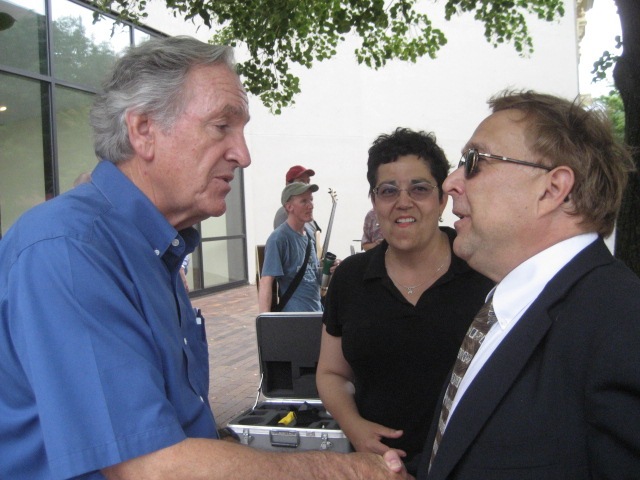
Senator Harkin and Steve Kuusisto


The photo above demonstrates that Iowa Senator Tom Harkin knows when to wear shirt sleeves and that I do not.

Senator Harkin’s abiding interest in helping people with disabilities is indeed legendary and it was an honor to have the opportunity to shake his hand. Indeed, it was an honor to hear him deliver remarks on the historical significance of the ADA, and of the ADA Restoration Act of 2008. Perhaps the most important thing the Senator shared with his Iowa City listeners was the absolute importance of continuing the fight for equitable health care and social services.

Amen to that.


S.K.