Waiting for the Toilet Installers to Arrive and Replace the Pink Toilet with a White One Department

First I should tell you that the toilet boys are subcontractors. Everyone is a subcontractor nowadays. Need a filling for your tooth? The dentist will be right back but in the meantime Dr. Squatch will be happy to take care of you. He's "board certified" in Malibu. And he knows all about pain management. Many patients prefer him to the real dentist we're told.

The toilet boys came to my house last week and replaced two commodes. Or to be more specific: the commodes and the tanks. Toilets are two part affairs, even nowadays, some 150 years after Sir Thomas Crapper first flushed his flusher for Queen Victoria. I suppose I knew this. Like you I know lots of stuff. For instance one of the early Christian saints lives inside my chimney and he occasionally blows soot into my living room to remind me of my moral obligations. But I digress.

Toilets are two part inventions and that's all you need to know. The toilet boys installed the crappers and fled.

My mistake was to tell them I was blind. If you're new to this game take some advice from me: never never tell the toilet boys you can't see. Its best to act like Al Pacino driving that Ferrari and fooling the traffic cop by pretending to look him dead in the eye. Look the toilet boys right in the eye. Tell 'em the dead crappers are upstairs. Tell 'em not to track feathers on the rug. Whatever. Just leave the blindness out of the affair.

I revealed my blindness to the toilet boys because they were doing the subcontractor fandango. Here's how it works: we're in your house and we can fix your toilets but we really don't want to fix your toilets since that necessitates actually procuring the new toilets which in turn requires us to drive to "Toilet Town" and pick up the new machines (for indeed these are machines in the proper sense) and we don't want to do this–we'd rather that "you" the customer go to "Toilet Town" while we sit here on your wonderful front porch with its inviting rocking chairs. While you're away at "Toilet Town" we will eat our breakfasts and feed the rabbit who evidently lives under your lilac bush and we'll probably tell a couple of dirty jokes.

So of course I told them that I can't drive to "Toilet Town" because I can't see, etc. etc. Oh I tell you the Toilet Boys were crestfallen. But off they went.

When they came back with many boxes I didnt' think much about it. I was busy writing some recommendation letters for former students. I have always found that you can't write a good recommendation if you're thinking about toilets. I left the installation to the professionals.

They made lots of noises. And after an hour they told me they were done. They showed me the new toilets. They invited me to flush. Everyone was happy. They took the old toilets and drove away.

Ah but never never tell them you can't see. When my wife Connie got home and checked things out we discovered that the Toilet Boys had assembled a white commode with a pink tank. Why not? The blind guy won't notice. And probably the blind guy is married to a blind woman–isn't that the way it works? She won't notice either. Who wants to make two trips in one day to "Toilet Town"? Not me. Not me either. So let's just install pinky and get the hell out of Dodge.

Of course not everything is a disability story. For the sake of broad mindedness I should assume that the toilet boys were simply incapable of reading the box or, perhaps like many sighted people they weren't using their eyes at all. (Have you ever noticed how many sighted people become completely blind in airports? It turns out that when sighted people are feeling goal oriented they lose the ability to see what's in front of them. I'll write more on this in a subsequent post.)

Or maybe the toilet boys were suffering from toilet blindness. Its like snow blindness I imagine. If you stare at too many shiny white bowls and tanks you lose the ability to see colors.

Whatever the explanation there it was: a custom assembled pink and white toilet. It looked a bit like the Cadillac that Elvis bought for his mother.

Now I'm awaiting the return of the boys. How long will I wait today? That, as they say, is anybody's guess.

S.K.   
Swimming with Borges


In the swimming pool I see my city with my arms out, head to the side…

Friend, you can’t confound me with your architectures.

When I’m under water Proteus swims just behind…

All our lives we had to imagine what was before us:

Borges once saw in Buenos Aries cuneiform doors; houses of onyx with slim windows…

This city is festive as a prayer drum; clean as a votive dish.

Lap 10 I see retractile fingers of light.

I kid you not: cities are opaque as illuminated pages.

& some days there are no true cities on dry land. 


S.K.

Zen and the Art of Disability

The poet Gary Snyder is fond of a Zen Buddhist axiom: “When chopping wood for an axe handle, the model is not far off.” I’ve probably misquoted this slightly. I’m typing from a hotel room in Washington, DC and my connection is going to run out soon and I don’t have time to look this up. When we do anything that proposes the future the perfect model is there before us if we really look. As a person with a disability this is a hard principle to keep in mind. Where is the perfect model that I might see “before me” as I cut my wood for the still abstract axe handle?

Another way to strike this note is that cutting the raw wood is so much more complicated for people with disabilities. I have spent the past two and a half days at the Kennedy Center for the Arts at the invitation of the National Endowment for the Arts as part of a large working group of artists with disabilities from across the U.S. Our goal was to think about how to help promote careers in the arts for people with disabilities–how can we richly include pwds in our nation’s cultural life? What will the next ten years bring? What are the obstacles to disability inclusion? What are the creative solutions? How can government agencies help?

I felt graced to be among so many talented artists with disabilities. And yes, I felt graced to be among so many folks from federal agencies who might or might not have disabilities but who clearly understand the cultural importance and the economic goals that are behind this creative wood chopping.

We listened and talked and held working groups. We worked hard. We talked about young people and older people.

And then I went outside.

“Outside” is still a complex and ominous affair.

A cab driver pulled up in front of the Kennedy Center and he didn’t want my guide dog in his taxi.

Outside my hotel there’s a patch of grass. I was relieving my dog there when a security guard told me to get lost–that this was federal grass and I couldn’t have my dog there.

Of course I told him to identify himself; told him to get his supervisor; etc. And ultimately the supervisor apologized.

The point is that my woodpile is harder to chop than the non-disabled person’s pile. And as I chop like hell, sweat beading on my forehead, my veins standing out, muttering an old Finnish folk song to myself (as I often do) its easy to forget or lose sight of the perfect thing you are trying to make. Arguing with a security  guard about the federal grass I could be distracted from the perfect things we are trying to make. Prior to the grass man’s appearance I was having a thought about young people and poetry. 

The Finnish poet Jarkko Laine once wrote:

How sad! Everything!

And how cheap to say it out loud!


I like those lines for their wit. I carry Gary Snyder’s lines for their evident long range wisdom.

Meantime I’m dedicating this little blog post to the federal grass man because I think he might have an invisible disability. I can’t prove it. But I’ll bet he hasn’t been encouraged much. Encouragement is the big D issue in Democracy.


S.K.  

Henry Louis Gates and Contemporary Patterns in American Diversity


I have read and reread the stories concerning the arrest of Professor Henry Louis Gates of Harvard University. By now surely everyone in the United States who gives a tinker’s damn about civil rights is aware that Professor Gates was arrested by a Boston police officer after being interrogated inside his own home, and solely because a neighbor saw Professor Gates struggling to get into his house. The neighbor reported a potential break in. What’s clear about the matter is that Dr. Gates answered the cop’s basic questions: he had identification and could prove that he lived in the house. The police officer arrested Dr. Gates because frankly Gates was angry and because he accused the cop of engaging in racist tactics.

I’ve grown to feel that the story suggests something about the state of civil rights in contemporary America that is seldom overtly described but which I think is clearly at the root of this matter. You may call my perspective a “disability studies” view if you like. My sense is that this is not a 1960’s classic African-American civil rights matter–a bald and dreadful story of racial intolerance and bigotry–instead this incident is essentially “post-racial” and by turns it has everything to do with a new kind of American hostility to erratic public emotion. You see I think its a mistake to call this a story that’s solely about race. Dr. Gates lost his temper because he was being accosted in his own house and that was indeed a form of racial profiling. He was justified in losing his cool. But what got him arrested was his evident emotional state–that fight or flee condition that Daniel Goleman has called “a neurological highjacking”. In short, Dr. Gates was arrested because he was demonstrating human emotion.

I said above that this is a disability studies perspective. We read nowadays over and over again of teens with developmental disabilities being tasered by police; of elementary school children being restrained by teachers; of orderlies in group homes watching and even abetting fights between developmentally disabled men. The tales are legion and they speak to a broad and ungoverned intolerance and disdain for the excited and turbulent emotions of human beings who have been treated poorly by authority figures.

I think the same cop who wrongly arrested Henry Gates would also wrongly arrest a developmentally disabled kid who was having trouble processing too much information at the local 7-11.

The problem is with our police forces which have very limited training in how to employ emotional intelligence. This matters because a diverse society is a more complex and surprising society than your average American cop is willing or able to suppose.


S.K.

Senator Franken Hits the Ground Running with Service Dogs


We at Planet of the Blind just received the following excerpt from Fox News.


Franken Looks to Increase Number of Service Dogs for Veterans in First Legislation

Franken wrote in an opinion published Monday in the Star Tribune that his proposed pilot program will train “a statistically significant number of dogs” for veterans living with devastating injuries sustained on the battlefield.

FOXNews.com

Monday, July 20, 2009

In his first piece of legislation as Minnesota’s junior senator, Al Franken is looking to expand the number of service dogs available to wounded veterans.

Franken wrote in an opinion published Monday in the Star Tribune that his proposed pilot program will train “a statistically significant number of dogs” to measure the benefits to veterans living with devastating injuries sustained on the battlefield. 

The dogs’ companionship, Franken said, provides invaluable health benefits — both physical and emotional — to veterans suffering from debilitating injuries and psychological disorders. The service dogs will help “reduce the suicide rate among veterans, decrease the number of hospitalizations, and lower the cost of medications and human care,” he said.

Franken’s legislation was inspired by a meeting he had last January with a wounded former Iraqi intelligence officer and his golden retriever, “Tuesday.”

“Service dogs like Tuesday can be of immense benefit to vets suffering from physical and emotional wounds,” wrote Franken.

Franken said service dogs typically cost about $20,000 to train and another $5,000 to place with a veteran — a cost that is well worth the investment, he said.

“It is my strong belief that a service dog will more than pay for itself over its life, and my bill is designed to determine the return on investment with a pilot program that provides service dogs to hundreds of veterans,” said Franken.

Click here to read more on this story from the Star Tribune.

Goodbye, Goodbye


My friend Andrea Scarpino writes below of the art of father-remembrance, a matter for which we have no true word in English and so I must hyphenate two nouns. The clock goes on with its minutes and small steeping. Tea resolves in the cup. Yet there remain days when, long after one’s father has died, you hear again that singular voice. Listen: your father who you miss laughs and unselfconsciously shares a ribald story or he tells you again about his grandfather who wrote graffiti, not on buildings but in library books. The clock goes on with its tiny minutes. The books are ineffectual. Tea resolves in the cup but I tell you the tea is very sad.

S.K.

Remembering my Father

Los Angeles

by Andrea Scarpino


My father was a child of Italian immigrants, a child of the Great Depression. He first started working when he was nine years old, rolling tobacco into cigars. On payday, he would share some of his earnings with his cousins, buying them (and himself) ice cream sodas. He loved sweets. For much of his life, he was a big man, someone who loved to eat and share food with friends. I remember him making me toast in the morning when I visited him as a child, sending me gingerbread houses whose roofs opened up to a treasure trove of cookies and candies, sending me boxes of chocolate. When I was in college, he packed me special bags of cookies and fruit he bought during his weekly shopping trip. After we had dinner each Saturday night, I returned to my own apartment with a shopping bag full of grapes, anisette cookies, carrot sticks.

He started giving me espresso when I was still a toddler. I remember him feeding me teaspoons from his cup, then laughing at the bitter faces I would make. My father loved to laugh, to exaggerate a good story for effect, to play jokes on friends. He loved to make up stories for me, about little foxes living at the end of his street, giant six foot tall rabbits, the old neighbor lady he insisted lived two doors down who would pierce my ear with a long needle for a dollar. About piranhas living in any body of water in which I wanted to swim.

And yes, he could be a grouch. He was easy to anger, and he let you know when you had made him angry. He held a grudge, he believed the worst in innocent mistakes and accidents, he could exaggerate wrongs committed against him until I wasn’t sure what to believe. But he was also brilliant, always reading, writing grants, fighting for projects he believed in. He worked harder than anyone else I’ve ever met. He knew how to get a job done, to schmooze important people, to turn up at the right time looking the part. He could be hard to live with. He made me cry. And I have missed him every day since he died two years ago.

I’ve read a lot about death and grieving since my father died, and I know some people believe in stages of grief, that after a loved one has died, we should work towards acceptance. I don’t agree. I know that my father is dead, that he isn’t coming back. But I don’t think I’ll ever accept that fact, or accept death as just another part of nature, another part of the earthly condition. Again, I know it is. I know there’s nothing any of us can do to beat death. But acceptance doesn’t seem to be the right word when faced with death or with losing a father. Sadness seems right. And anger. And holes of loss that widen and contract as the day, the moment, the second permits. Remembering seems right. Laughing and loving, even so. Checking in with the dead, even though I don’t believe in an afterlife. Checking in to say hello. I miss you. Two years without you seem like no time at all. Seem like forever.


Andrea Scarpino is the west coast Bureau Chief of POTB.

You can visit her at: www.andreascarpino.com

Higher Education's Studied Indifference to People with Disabilities Reflects the "Rehab Model" Ad Nauseum


There’s a great article over at Getting Hired dot Com about the lawsuit that’s been filed against Arizona State University by several blindness advocacy groups. The issue has to to with ASU’s decision to provide its students with the Kindle Reader as a means of accessing textbooks–and yes, the Kindle is still inaccessible to blind people. I’ll leave aside for the time being the relative technical issues involved in making the Kindle accessible for the talking points are tedious. Trust me, the Kindle can be made to talk without difficulty save for the fact that it needs a more expensive “out of the box” operating system.

ASU adopted the Kindle because it seemed easy. It seemed like a good thing. My general point (such as it is) is that higher education administrators tend to imagine that “someone else” will “take care” of “those people” who have disabilities. American higher education still imagines that the Victorian approach to disability is acceptable–that the disabled are taken care of by people who will read to them in the dark or laboriously turn their books into tape recordings or Braille.

This “rehab” model of Disability is of course the very thing that disability studies has dissected and about which we know a good deal. We know for instance that college administrators who imagine that accessibility is merely an inconvenience and that they can pass along the issue to others are ignoring the ADA and many state laws. But they do so with the built in assurance that the rehab model is acceptable. Someone else will retrofit inaccessible learning environments or physical facilities and assure accessibility for the blind or the wheelchair users or the deaf or what have you. Those “rehab people” will take care of that.

Here at my own university there’s a Victorian rehab assumption in place wherein the administration routinely fails to make restrooms accessible for people with disabilities and they claim any variety of things depending on who you talk to. One fellow tells me that the ADA doesn’t apply to the University of Iowa. Another tells me that they don’t have any money. A third tells me that the university’s philosophy is that “we’ve let you in, what more do you want?” Set against this is the old fashioned rehab model–the administrators I’ve talked to at the U of Iowa believe that disability accommodations are someone else’s issue. So of course nothing gets done. How embarrassing it is that the University of Iowa, the leading public institution in the state that is proudly represented by Senator Tom Harkin, co-author of the Americans with Disabilities Act is indifferent to making its major academic buildings accessible.

The lawsuit against Arizona State reflects the indifference of ASU’s administrators to the contemporary reality that students and staff with disabilities are no longer secondary citizens who can be told to “wait” for access. And yet the indifference of the ASU administrators is widely reflected across the U.S.. I see the same forces at work in my own back yard.


S.K. 

Blind cycling champion to lead UI's Project 3000 RAGBRAI team

University of Iowa News Release

July 17, 2009

Blind cycling champion to lead UI's Project 3000 RAGBRAI team

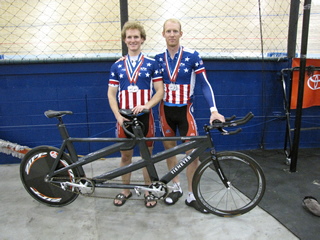
071709highrezbike
A team of a dozen cyclists — including a blind U.S. Paralympics track
cycling national champion — will pedal across Iowa next week to raise
awareness of and funds for Project 3000, a University of Iowa-based
effort seeking a cure for a rare childhood blinding eye disease.

Team
Project 3000 will ride 442 miles, from Council Bluffs to Burlington, as
part of the Register's Annual Great Bike Ride Across Iowa (RAGBRAI).
The team's inspirational leader is Clark Rachfal, a U.S. national
medalist in track cycling who has been losing his sight since childhood
and who has Leber congenital amaurosis (LCA), one of the blinding eye
diseases that Project 3000 seeks to cure. Rachfal, whose competitive
cycling activities have been supported by the Verizon Foundation and by
generous colleagues at Verizon, rides a tandem bicycle with a sighted
partner.

The mission of Project 3000 at the UI is to find and
offer genetic testing to the estimated 3,000 Americans with Leber
congenital amaurosis, which causes severe vision loss or blindness and
typically strikes during early childhood.

Genetic testing helps
confirm the diagnosis, discover the genes responsible and lead to
treatments and a cure. UI ophthalmology researchers are committed to
this approach to finding the causes, cures and eventual prevention of
LCA and — through what they learn during Project 3000 — other
blinding eye diseases. Key partners in Project 3000 include Chicago
Cubs star Derrek Lee and Boston Celtics CEO and co-owner Wyc Grousbeck,
both of whom share a desire to find treatments and a cure for LCA.

The
idea to form a RAGBRAI team to support Project 3000 originated with
Paul Rosenthal, a Washington, D.C., attorney who is chair and a
founding member of an advisory board to the UI Carver Family Center for
Macular Degeneration, of which Project 3000 is a part. The center is a
unit of the Department of Ophthalmology and Visual Sciences in the UI
Roy J. and Lucille A. Carver College of Medicine.

"I have had the
privilege over the years of dealing professionally with numerous Iowa
businesses and government officials, and as a result I have developed a
great respect for this wonderful state," said Rosenthal, who manages
the Washington, D.C., office of the law firm Kelley Drye and Warren.
"One of Iowa's, and indeed the nation's, great treasures is the Carver
Family Center for Macular Degeneration at the University of Iowa.
Because I have seen first-hand the enormous talent and dedication of
the center's scientists and staff to their mission to find the causes,
treatments, cures and preventions for inherited eye diseases, it is
only natural for me to want to express my appreciation and gratitude by
riding across the state on RAGBRAI."

As of July 17, Team Project
3000 had raised $35,000 in gifts for the LCA research and treatment
effort. Each team member set up a personal online giving page to
collect gifts from family, friends and colleagues via the University of
Iowa Foundation's Web site, http://www.givetoiowa.org.

Overall,
more than $1.5 million in gifts has been raised through the UI
Foundation for Project 3000 since the project's inception in 2006.

"We
are closing in on effective treatments for LCA, and the support created
through this RAGBRAI cycling team will bring us even closer," said
Edwin Stone, M.D., Ph.D., director of the UI Carver Family Center for
Macular Degeneration and a Howard Hughes Medical Institute
investigator. "Paul Rosenthal's efforts to bring our team together, and
Clark Rachfal's involvement, are both greatly appreciated."

For more information on the Team Project 3000 effort, or to make a gift, visit http://www.uifoundation.org/project3000/. To learn more about Project 3000, visit http://www.project3000.org. Those interested may also follow the team's progress on Twitter at Twitter@Project3000.

The
UI acknowledges the UI Foundation as the preferred channel for private
contributions that benefit all areas of the university.  For more
information about the UI Foundation, visit its web
http://www.project3000.org.

STORY SOURCE: UI Foundation, P.O. Box 4550, Iowa City, Iowa 52244-4550

CONTACTS:
Mitch Beckman, UI Foundation, 319-467-3402, mitch-beckman@uiowa.edu; or
Joseph Schmidt, UI Department of Ophthalmology and Visual Sciences at
UI Hospitals and Clinics, 319-384-8529, joe-schmidt@uiowa.edu

PHOTOS:  A high-resolution of Clark Rachfal and his tandem bike partner, Dave Swanson, is available at:
http://www.uifoundation.org/news/2009/images/jul-ragbrai-hires.jpg

A web-quality image also is available:
http://www.uifoundation.org/news/2009/images/jul-ragbrai.jpg

PHOTO
CUTLINE: U.S. Paralympic national track cycling champion Clark Rachfal
(left), who is blind, and riding partner Dave Swanson, will ride across
Iowa July 19-25 as part of Team Project 3000, which is raising
awareness and funds for a University of Iowa effort to cure Leber
congenital amaurosis, an inherited blinding eye disease.