Team Project 3000 will take off tomorrow morning to cross the state of Iowa and to raise awareness on behalf of Project 3000 and Leber congenital amaurosis.
Veterans Newsflash
We received the following summary from the VA’s Early Bird News Wire:
From today’s VA Early Bird News Summary
Soldier Suicides Down But Many Vets Diagnosed With Mental Health Disorders. The AP (7/17, Jelinek) reports, “Suicides reported among” US soldiers “have tapered off from extreme highs of early this year amid intense Army efforts to stem the deaths, but officials are not yet ready to say they have turned a corner on the problem.” On Thursday, “Army leadership said…they hope a newly launched mental health study will help identify what is causing the self-inflicted deaths and what programs are best for preventing them. Separately Thursday, other researchers reported that 37 percent of Iraq and Afghanistan veterans seeking care at Veterans Affairs clinics for the first time are being diagnosed with mental health disorders.” That figure is “higher than some other estimates of the conflicts’ toll, and researchers at the San Francisco VA Medical Center said that may be because people still in the military are more reluctant to seek care.”
The New York Times (7/17, Dao, A10, 1.06M) says the VA study “found that more than one-third of Iraq and Afghanistan war veterans who enrolled in the veterans health system after 2001 received a diagnosis of a mental health problem, most often post-traumatic stress disorder or depression.” The study, which “also found that the number of veterans found to have mental health problems rose steadily the longer they were out” of the service, “joins a growing body of research showing that the prolonged conflicts,
where many troops experience long and repeat deployments, are taking an accumulating psychological toll.”
Bloomberg News (7/17, Olmos) reports, “More than 1.6 million” US soldiers “have served since the war in Afghanistan began in 2001, many of whom have been exposed to prolonged combat and multiple tours of duty, according to the study. In an earlier, smaller study,” VA “researchers found that 25 percent” of US “veterans who sought treatment from 2001 to 2005 suffered from mental health disorders. ‘It’s fair to say that there is a striking rise in numbers’ between the earlier study and the new data published” this week, “said Karen Seal, the principal author” of the later study, which “recommended screening and early intervention programs that would target mental health problems of specific groups of soldiers, such as women and younger men.”
HealthDay (7/17, Reinberg) reports, “More than 40 percent” of the US “soldiers from the Iraq and Afghanistan wars seen at VA hospitals suffer from mental health disorders or psychosocial behavioral problems, a new study shows. Curiously, the researchers” from the San Francisco VAMC “found that most mental health diagnoses were not made in the first year that a veteran entered the VA health-care system, but several years after. This finding supports the recent move to extend VA benefits to five years of free” healthcare, “which allows VA doctors the time to detect and treat more mental illness in returning combat veterans, the researchers noted.” Their “report is published in the July 16 online edition of the American Journal of Public Health.”
The Newark (NJ) Star-Ledger (7/17, Dinges), which also notes the study, reports that almost “22 percent of the soldiers studied were suffering from post-traumatic stress disorder, or PTSD, researchers said. Another 17 percent were diagnosed with depression, 7 percent had alcohol problems and 3 percent had drug problems.” Veterans advocates “said the new study proves the importance of screening soldiers for mental health problems after they return home.” The Los Angeles Times‘ (7/16, Chong) “Booster Shots” blog also noted this week’s VA study, as did numerous local TV reports in various parts of the country, including WNEP-TV Wilkes-Barre, PA (7/16, 5:24 p.m. ET) and KERO-TV Bakersfield, CA (7/16, 5:23 p.m. PT).
Vets Suffering From PTSD Said To “Need Help In All Areas.” The Washington (DC) Examiner (7/16, Bright) interviewed Kathyrn Mustard, a licensed clinical social worker with the Veterans Affairs Medical Center in Salem, Virginia. Mustard “works in the Inpatient Psychiatric Unit,” where “she helps treat several mental illness forms,” including PTSD, a condition that many “new veterans returning from the Middle East are suffering from.” Mustard told the Examiner that such veterans “need help in all areas,” and it is “hard to gauge the level of ‘success'” in treating them “because I see the most acute patients. However I think the long term counseling tends to deal the best with symptoms from what I’ve seen.”
The WSPA-TV Greenville, SC (7/16, Coursey) website, meanwhile, said the family of 23-year-old Iraq veteran John David Chapman, who recently committed suicide, “would like to see more programs to help our veterans and for families to recognize the signs of depression.” WSPA added, “If you need help, there are resources available. The Department of Veterans Affairs Vet Center Program operates a system of counseling centers for veterans who have served in combat,” and there is one in Greenville. Just call 864-271-2711 for help.”
Nira's Big Day in Chicago: A Guide Dog's Story
The photo below was taken by my good friend Lorraine Whittington who was Johnny on the Spot when “Guiding Eyes Nira” caught sight of her reflection in “The Bean” which, in case you don’t know is an enormous polished aluminum sculpture in downtown Chicago, Illinois. In the photo you can see Nira, a yellow Labrador retriever catching her own reflection on the curvilinear surface of the bean, and you can see that she’s smiling as if to say: “Who’s that marvelous dog who looks just like me?” Its been said by thousands of writers in thousands of ways that we travel to find ourselves. And why shouldn’t this also be true for a loyal and lovely guide dog? NIra’s trip to Chicago also included a visit to Wrigley Field where she managed to disguise the fact that she’s a Red Sox fan. But she enjoyed the ambient domains surrounding the old ball park. But nothing compared with “the bean” in her estimation.

When I Was Hungry You Fed Me…When There Was a Hurricane I Was Out of Luck
Dave Reynolds over at The Inclusion Daily Express reports on recent findings that people with psychiatric disabilities were discriminated against during the evacuation efforts associated with hurricanes Katrina and Rita. Of particular note is the finding that the mentally ill were simply left out of the planning. Stigma works that way: it starts on the streets and then it prefigures the public’s mind. Urban planners are still the children of the ancient Greeks and Romans–stigma relieves us of having to think about people with psychiatric disabilities or the elderly. The greatest irony in human history is that the man who spoke most ardently against stigmatization was in turn stigmatized on a cross. Here’s an excerpt from Dave’s excellent post:
Report: People With Psychiatric Disabilities Faced Illegal Discrimination After Hurricanes
By Dave Reynolds, Inclusion Daily Express
July 14, 2006
WASHINGTON, DC–People with mental illnesses faced illegal and even deadly discrimination during evacuation, rescue, and relief phases after hurricanes Katrina and Rita hit Gulf Coast states last summer, the National Council on Disability said Friday.
In its report, entitled “The Needs of People with Psychiatric Disabilities During and After Hurricanes Katrina and Rita: Position Paper and Recommendations”, the federal agency concluded that many people with mental illnesses were mistreated, inappropriately institutionalized and incarcerated, or died because the evacuations were mismanaged.
The agency blamed the fact that people with psychiatric disabilities were not included in disaster planning or the relief and recovery efforts, along with the fact that no individual or office was responsible or had the authority to coordinate disaster management efforts for people with mental illnesses. It also said that disaster plans were “shortsighted” and that relief and recovery services were stopped far too early.
The report outlined a number of violations of the rights of evacuees with psychiatric disabilities. Many were banished from shelters and forced to stay outside. Some were sent to nursing homes or state-run psychiatric institutions, “not because they required that level of care, but because there was nowhere else to go”, or because they needed refills of medications that the shelters did not have. In Texas, some who had previously lived in the community were “evacuated” to state hospitals where they remained for many months after the storms were over.
While “special needs” shelters were made available, those tended to cater to the needs of people with physical disabilities and critical illnesses, not people with mental disabilities, it said.
NCD recommended that in the future people with psychiatric disabilities be involved in all phases of disaster planning; that there be a single office or official responsible and accountable for coordinating efforts to help people with disabilities during recovery and relief stages; that the transfer of people from group homes and psychiatric facilities be tracked and their family members be contacted; and that relief efforts continue for at least two years after the catastrophic event is over.
“In the months since the hurricanes devastated the Gulf Coast, media coverage of the hurricane survivors has waned,” wrote NCD chairperson Lex Frieden. “However, for hurricane survivors with psychiatric disabilities, the hurricanes’ destruction resulted in ‘trauma that didn’t last 24 hours, then go away . . . It goes on and on.'”
Related reports:
“The Needs Of People With Psychiatric Disabilities During And After Hurricanes Katrina And Rita: Position Paper And Recommendations” (National Council on Disability)
http://www.ncd.gov/newsroom/publications/2006/peopleneeds.htm
“Saving Lives: Including People with Disabilities In Emergency Planning” April 15, 2005 (National Council on Disability)
http://www.ncd.gov/newsroom/publications/2005/saving_lives.htm
Writing with a Dog Under my Feet
“The sub-cartesian people will drive you nuts
But hooray for those who love their mutts…”
–Ogg of Ancient Schenectady
In the initial position I should admit to being depressed. I have always been depressed. I take medication for it. I work assiduously to overcome the declivities and swells of self-contempt and I ignore the little brother named exhaustion. Some mornings I climb a ladder and climb back down with nothing to show. On occasion I can scarcely leave my house.
The dog under my feet knows all this. She knows my dreams are tuned like the caffeinated mind of Stravinsky. She sees that I am dropping spoons for the music. She gives me good news: no news; nonsense; deferral; not giving a shit…
The best news is the dog’s entire disposition. She accepts you. Doesn’t care that you are merely a botched hominid.
Outside the window in a corn field the gold finches fly up like Orphic birds on Roman tombs. Agricultural dust settles on my neighbor’s glass topped garden tables and wicker chairs.
I am lonely for my dead mother and father. I may have dreamt about them last night but I can’t remember. I hear my mother telling an irreverent story–she cursed like a longshoreman and didn’t give a rat’s ass for propriety. God how she hated poseurs. She kept a “shit list” and she never forgot who was on it. She was, of course, wildly depressed.
My dog is under my feet. I’m not wearing shoes. I rub her belly and shoulders and her long back. She snores occasionally. The warmth of her body is quick to my feet. Dogs and botched hominids warm one another. Always have.
“Anyone can talk of dying,” I tell my dog. “It’s the measure of tongue and footfall, of boats in darkness.”
My feet and my friend are simply minding their own business.
S.K.
Watching Post Viet Nam War Films "Now"
I suppose that being over fifty I should be used by now to this creeping feeling of superannuated post-post superfluity and quasi-irrelevance but just when one is foolishly imagining being on top of things–knowing for instance about The Flaw or how sexting works with robo-software–well then I do something like show some earnest late ’70’s films in a college class and yeah, just stick a fork in me for indeed the world of my young adulthood is as far from the world of today’s students as the world of sailing ships and whale bone corsets. Today in class we watched Coming Home with John Voigt and Jane Fonda and there on screen was an era of rotary telephones, black and white televisions, cars as long as ocean liners, cigarettes in every possible setting, and a collective and corrosive anger toward almost everything and everyone in the world. It was an era when the “F” bomb was not only out of the bag but it was used in common parlance as in: “Fuck the Establishment, those corporate hacks and soulless pall bearers carrying the corpse of freedom.” (For example.) While the movie has its own sadness and tragedies I found myself feeling elegiac for the easy to pronounce outrage of those days. Now, as our planet burns to death and the intersections of sex slavery, famine, war, and the globalized land grab for the last resources on earth is fully underway we’re all too polite. Way way too polite.
I feel better for saying so.
S.K.
Grandstanding with Justice
Watching day one of the confirmation hearings for Judge Sotomayor one could be forgiven for thinking (ever so briefly) of the tea party scene in Alice in Wonderland for indeed yea verily there was some contradictory obfuscatory projective nonsense flying around. My favorite bit of contradictory obfuscatory projective nonsense is the GOP’s notion that their men on the United States Supreme Court are impartial, untouched by the politics of social class, free of the desire to legislate from the bench. As one of my uncles used to say: “There’s only so much shit you can stuff back into the horse.” All I have to do is think of Antonin Scalia asserting that a man in a wheelchair can be carried up the stairs as opposed to say, making the courthouse accessible. Contempt for others is a political position and don’t you forget it Senator Pachyderm. I’m just saying…
S.K.
News Received of Shifty
From: Brent bcasey6168@yahoo.com
Sent: Friday, July 10, 2009 2:42 PM
Date: Thursday, July 9, 2009, 11:56 AM
Subject: Fw: Memorial Service: you’re invited.
Subject: Memorial Service: you’re invited.
We’re hearing a lot today about big splashy memorial services.
I want a nationwide memorial service for Darrell “Shifty” Powers.
Shifty volunteered for the airborne in WWII and served with Easy Company of the 506th Parachute Infantry Regiment, part of the 101st Airborne Infantry. If you’ve seen Band of Brothers on HBO or the History Channel, you know Shifty. His character appears in all 10 episodes, and Shifty himself is interviewed in several of them.
I met Shifty in the Philadelphia airport several years ago. I didn’t know who he was at the time. I just saw an elderly gentleman having trouble reading his ticket. I offered to help, assured him that he was at the right gate, and noticed the “Screaming Eagle”, the symbol of the 101st Airborne, on his hat.
Making conversation, I asked him if he’d been in the 101st Airborne or if his son was serving. He said quietly that he had been in the 101st. I thanked him for his service, then asked him when he served, and how many jumps he made.
Quietly and humbly, he said “Well, I guess I signed up in 1941 or so, and was in until sometime in 1945 . . . ” at which point my heart skipped.
At that point, again, very humbly, he said “I made the 5 training jumps at Toccoa, and then jumped into Normandy . . . . do you know where Normandy is?” At this point my heart stopped.
I told him yes, I know exactly where Normandy was, and I know what D-Day was. At that point he said “I also made a second jump into Holland , into Arnhem .” I was standing with a genuine war hero . . . . and then I realized that it was June, just after the anniversary of D-Day.
I asked Shifty if he was on his way back from France , and he said “Yes. And it’s real sad because these days so few of the guys are left, and those that are, lots of them can’t make the trip.” My heart was in my throat and I didn’t know what to say.
I helped Shifty get onto the plane and then realized he was back in Coach, while I was in First Class. I sent the flight attendant back to get him and said that I wanted to switch seats. When Shifty came forward, I got up out of the seat and told him I wanted him to have it, that I’d take his in coach.
He said “No, son, you enjoy that seat. Just knowing that there are still some who remember what we did and still care is enough to make an old man very happy.” His eyes were filling up as he said it. And mine are brimming up now as I write this.
Shifty died on June 17 after fighting cancer.
There was no parade.
No big event in Staples Center .
No wall to wall back to back 24×7 news coverage.
No weeping fans on television.
And that’s not right.
Let’s give Shifty his own Memorial Service, online, in our own quiet way. Please forward this email to everyone you know. Especially to the veterans.
Rest in peace, Shifty.
“A nation without heroes is nothing.”
Roberto Clemente
The Bark: The Smell’s the Thing
Folks over at The Bark noticed Steve's posts about Discovering the thrill of grass and other earthy delights with a guide dog and asked for permission to use them on their blog.
Special thanks to Lisa Wogan, Web Editor, The Bark for noticing!
Remembering Ed Freeman
We are passing along this memorial message with humility.
S.K.
**
You’re a 19-year-old kid. You’re critically wounded and dying in the jungle in the Ia Drang Valley , 11-14-1965, LZ X-ray, Vietnam . Your infantry unit is outnumbered 8-1 and the enemy fire is so intense, from 100 or 200 yards away, that your own Infantry Commander has ordered the MediVac helicopters to stop coming in.
You’re lying there, listening to the enemy machine guns, and you know you’re not getting out.. Your family is half way around the world, 12,000 miles away and you’ll never see them again. As the world starts to fade in and out, you know this is the day.
Then, over the machine gun noise, you faintly hear that sound of a helicopter and you look up to see an unarmed Huey, but it doesn’t seem real because no Medi-Vac markings are on it.
Ed Freeman is coming for you. He’s not Medi-Vac, so it’s not his job, but he’s flying his Huey down into the machine gun fire, after the Medi-Vacs were ordered not to come.
He’s coming anyway.
And he drops it in and sits there in the machine gun fire as they load 2 or 3 of you on board.
Then he flies you up and out, through the gunfire to the doctors and nurses.
And he kept coming back, 13 more times, and took about 30 of you and your buddies out, who would never have gotten out.
Medal of Honor Recipient Ed Freeman died on Wednesday, June 25th, 2009, at the age of 80, in Boise , ID. May God rest his soul.
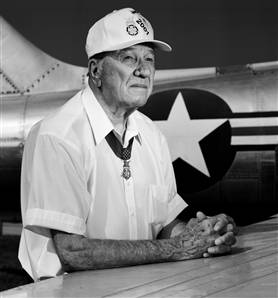
Medal of Honor Winner
Ed Freeman
Since the media didn’t give him the coverage he deserves, send this to every red-blooded American you know.
THANKS AGAIN, ED, FOR WHAT YOU DID FOR OUR COUNTRY.
RIP
 Planet of the Blind