My grandmother made thistle soup
Therefore my father ate it
According to epigenetic theory
Thistles are still working their ways
Through my unconscious
Sometimes in the night
I feel a tickle
Those white wooly hairs
Sprouting from graves
Preparation HeHe
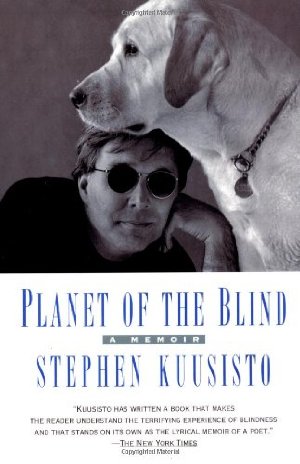
I grew up on a steep divide but it wasn’t geographical. Instead it was a ridge or chain of mountains both inside and outside me. I didn’t wish to be blind. I wanted to play baseball. And perhaps, more significantly, I wanted to be a scientist. Neither baseball or physics would happen for me. I became a poet. Compared to physics I think poetry is easy. All you have to do is step barefoot on a worm like Theodore Roethke and you’ve got a poem. Poems fall out of cupboards like a box of starch loaded with spiders.
Now I’ve said two things you’re not supposed to say. Poems are easy and I’d rather be sighted and a physicist. What did the physicist say when he found two isotopes of helium? “HeHe!”
Someone will say there are blind baseball players and blind scientists. This is true. But not when I was a child. Back then the disabled were reviled. And it’s hardly news that evil-doers in films are often deformed and disabled characters. The Bond franchise alone is flooded with crippled meanies: Dr. No’s hand, Blofeld in his power wheelchair, etc.Frankly I’ve always wanted to be an evil disabled chemist. I want to turn wine back into water at Mar a Lago or put truth serum in Preparation H.
That’s Preparation HeHe for those who’ve been following…
Dickens Again
When the Victorians read Dickens they read for plot and confirmation–they could see their world. When we read Dickens we still read for plot but less for confirmation as we think we are superior to his characters. This is a great mistake. Dickensian sins are fully our own though we’ve one extra: post-modern irony.
I’m thinking of pastiche as Frederic Jameson would say: irony that references itself. Most often it’s mediated consciousness draped with the status conferred by consumer fetishism. Dickens characters were vain or greedy but never so self absorbed they fell into anhedonia.
Most days I read like a Victorian who wants plot and confirmation but also a bit of compassion. I’m also an admirer of Cardinal Newman’s dictum: “We can believe what we choose. We are answerable for what we choose to believe.”
I’m old fashioned that way.
Of Newman I also like: "Nothing would be done at all if one waited until one could do it so well that no one could find fault with it.”
**
Dear Charles: you pushed your wife into the asylum when you were done with her. You rooted for the American Confederacy. You were silly. You thought Anton Mesmer was on to something.
**
Dear Kuusisto: and who are you? (Reader, does he get to answer? Does anyone get to answer?)
He tries: "I was half destroyed by war movies. They tried to brain wash me into thinking the good guys always won. I’d no idea that beneath Roy Rogers’ horse was the blood of indigenous people. Man was I tricked. And you can’t get your money back!"
OK. You’ve said who you aren’t but nothing more.
He tries: "I’m a human consciousness growth project lacking some essential vitamins."
That’s better.
For a Certain Friend
All morning I drink bitter coffee
And try to rescue my private dead
Plumbing rattles
I hear my mother
Inside walls
My father beneath the floor
The refrigerator hums
I can’t guess what it says
Snow
Knows plenty
But won’t tell
Keeping her pact
With nature
That hydrogen agreement
Preparing us
Spinoza and Giving Up on Contemporary Fiction…
If, like me, you admire Spinoza, you’re a problem. Here’s a spoonful:
“Those who wish to seek out the cause of miracles and to understand the things of nature as philosophers, and not to stare at them in astonishment like fools, are soon considered heretical and impious, and proclaimed as such by those whom the mob adores as the interpreters of nature and the gods. For these men know that, once ignorance is put aside, that wonderment would be taken away, which is the only means by which their authority is preserved.”
False wonderment and ignorance. The peanut butter and jelly of American society. Yum yum! Donald Trump is selling bibles! Yum yum! The mob can’t get enough. Spinoza of course understood the role of clergy in the promotion of faux miracles. If you truly believe this then you’re the problem. You’re the problem in almost every group. You’re always going to ask “what’s wrong with this story?”
Ernest Hemingway called this sensibility the “bullshit detector” and he was almost right. He meant that first rate writing uncovers or subverts falsities. But what if the dominant narrative of your age is all nonsense? Americans are intensely attracted to victimhood. Everyone is now an undeserving wretch.American fiction is, nowadays, almost entirely unreadable. Every new novel is concerned with sub-Cartesian victimhood. It is unbearable. Do you understand false wonderment? Three divorcees go to a summer house and while walking through a tangle of spider webs come to understand themselves. The interpreter of nature and the gods is Dr. Phil. Self-help tabloid fluoride is in the water.
Yum yum! I’ll get no credit for saying this. I’ll likely be attacked. And don’t read this as an attack on women writers. Men are equally caught up in the sad victim story telling industry. In fact everyone is caught by the shoelaces with this collective hive drone.
Someone recently asked me what fiction I was currently reading. I’m reading about evolution.
How many burdens do you carry daily?
How many burdens do you carry daily? If I ask myself this question I admit I don’t know the answer. It’s like asking “what should I be doing?” It’s a fool’s game.
Here’s the problem: I carry some baggage because I’m disabled. “No big deal,” says the heart (which I’m told sits reliably in the center of the chest and not to the right hand side as depicted in cartoons.)
The heart is optimistic. It knows it must be. Every pulse beat is optimism.
Now the brain is different. It’s read Duns Scotus and Neruda and Kafka and Hannah Arendt and Frederic Jameson and “Maggie: A Girl of the Streets” and at least a thousand books on disability and who knows how much gloomy nonfiction—so the brain is disposed to contrarian thinking whenever joy comes up.
Alas my brain is more than a little bit like my Finnish grandmother.
Her name was Siiri and unlike her Apple namesake she was gloomy. She couldn’t help it. She was very Lutheran and her husband was a minister during the Great Depression and they’d come to the U.S. to escape hunger and why wouldn’t you become cautionary and somber in the face of a world of gravity and scarcity?
I don’t know about you but I’ll take gloom over despair. I know about this. I have depression as well as vision loss. I ride two horses, one black and the other white. Or something like that. Maybe I’m a shark with two brains: one of appetite and the other of more appetite.
I don’t know as much about the mysteries of consciousness as I pretend.
But I know this: the burdens I carry are the burdens of others.
If the subject is disability, well, I speak up for disabled faculty, students and staff who struggle to acquire basic accommodations both in my own workplace and around the world.
Burden number one: this can make me unpopular. As with racism or misogyny or homophobia the advocate can be characterized as a malcontent almost instantly.
I’ve never completely gotten used to this. The “this” being disapprobation for speaking out against ableism.
I read as much as I can by scholars and poets of color; gay and trans writers; black writers; women writers. And yes, men. I’ve yet to find anyone who’s more deep tissue wise than Walt Whitman.
Last week I participated in a live online town hall discussion about service animals. In the Q &A period several apparently non-disabled questioners asked things phrased thusly:
“Do we have to?”
As in “OK, service animals are legally allowed to enter my space, but can’t we tell those darned blind people where they are to make their dogs relieve themselves?” Or: “OK, a child with a service dog comes to public school—do we have to help that child?” (As if being disabled requires extraordinary extra help; as if a disabled child is a burden.)
I became upset.
I said the following:
“I went to public school before the ADA. I have been told by teachers and school administrators that I’m inconvenient; or worse—that I don’t belong.”
“Frankly, I hope there’s a room in Hell for school administrators where they’ll get to sit throughout eternity with Joseph Stalin, Richard Nixon, and the man who invented the roach motel.”
Then I signed off.
I’ll never not be offended by ableism.
I’ll never sanction the winks.
Just try those questions out if you substitute race or gender or sexual orientation for disability.
How many burdens do any of us carry?
They’re much lighter when we hold them up to scrutiny.
All in the Family
And so it comes down to this—
My grandfather loved dynamite
His hobby
Blowing up his world
Houses, telegraph poles,
A neighbor’s motorboat
Even a privy
He knew his business
Now, at seventy
I see tall grasses
Of reincarnations
Boom!
Ex nihilo
Here: hold this poem
Atheists say belief is childish…
Atheists say belief is childish
The religious say atheists are childish
Children despise younger children
All demean animals
Uncle History
Keeps mum
Like Freud
He knows
To keep demons under wraps
While dinner guests
Were being polite
Darwin saw ghosts
Oh the tragedy of collision
Hegel with his rotten teeth
Everyone guilty
While supping on aspic
Loving history you love avatars…
Loving history you love avatars
It’s the joke that follows
Men who resemble clouds
Women standing in rain
Convincing, empty
At your disposal
C’mon let’s saddle
Jefferson’s horse
Wowee! Look at you go!
Uncle knows all about it
He loves escapes
Milton Hershey
The chocolate King
Selling his ticket
For the Titanic
No life recounted
Is real—okay
But one has to love something
Faces in the book-window
Look hauntingly real
Ding dong! Who;s there?
A box of masks
Nowadays I’m standing at the edge of myself…
Nowadays I’m standing at the edge of myself
Though I can’t say what it means
Kicking a fallen apple in the street
Autumn full on
Yes I don’t know my true name
A small boy looks at me
From his yard
Both of us silent
 Planet of the Blind