Yesterday I wrote on this blog that there are tons of non-disabled faculty teaching in disability related fields in higher education. I don’t have statistics. But I know from my own travels over the course of the past twenty years that the able bodied are largely the owners of the disability studies shops.
Neo-liberalism has lead to faculty freezes and in turn the once projected advent of vigorous Disability Studies programs at American Universities hasn’t happened. Where programs have materialized the majority of faculty are the non-disabled and the cripples aren’t hired.
I’m “on” about this because as G. K. Chesterton once remarked: “A good novel tells us the truth about its hero; but a bad novel tells us the truth about its author.” Where Disability Studies is concerned we may call it a bad novel whose author is ableism mixed with cost cutting.
I should add there are very few disabled faculty teaching across the curriculum.
One may make a useful analogy as prospectus: if Women’s Studies was largely taught by old men; if African-American Studies was taught by old white men; etc.
Now truth be told, I never thought (even twenty years ago) that Dis-Studies would become a big boom. But neither did I think it would become a minor cottage industry within higher ed. Nor did I imagine that by this time we’d have so few disabled faculty in the “ranks” as they like to call it.
I wrote the following over a year ago:
I submit it’s hard to avoid growing bitter. It’s hard to feel the very apparent lack of interest in disability discrimination even from faculty who hail from other marginalized positions. No one wants to imagine disability as being intersectional. Diversity and inclusion generally doesn’t include the cripples. Because this is so, the loneliness of being disabled in the faculty ranks is considerable. Ableism is a machine for isolation and deprivation. When you say, well people of color also have disabilities people look at their watches. The great liberal fiction is that universities are welcoming. All of this came to the surface for me this morning when I read about two black professors at the University of Virginia who were denied tenure. The academy does not welcome bodies of difference and while I’m not a person of color I can say I’ve seen the discriminatory daily routines “up close and personal” and I’m getting pretty close to being worn out.
Not so long ago I was called an “ignoramus” by a fellow faculty member who was snotty to me and my white cane. I know, it’s hard to believe. Of course It is never appropriate to call anyone an ignoramus in an educational setting for the term’s antonym s are “brain “ and “genius” and its synonyms include: airhead, birdbrain, blockhead, bonehead, bubblehead, chowderhead, chucklehead, clodpoll (or clodpole), clot [British], cluck, clunk, cretin, cuddy (or cuddie) [British dialect], deadhead, dim bulb [slang], dimwit, dip, dodo, dolt, donkey, doofus [slang], dope, dork [slang], dullard, dum-dum, dumbbell, dumbhead, dummkopf, dummy, dunce, dunderhead, fathead, gander, golem, goof, goon, half-wit, hammerhead, hardhead, idiot, imbecile, jackass, know-nothing, knucklehead, lamebrain, loggerhead [chiefly dialect], loon, lump, lunkhead, meathead, mome [archaic], moron, mug [chiefly British], mutt, natural, nimrod [slang], nincompoop, ninny, ninnyhammer, nit [chiefly British], nitwit, noddy, noodle, numskull (or numbskull), oaf, pinhead, prat [British], ratbag [chiefly Australian], saphead, schlub (also shlub) [slang], schnook [slang], simpleton, stock, stupe, stupid, thickhead, turkey, woodenhead, yahoo, yo-yo…
As a disabled person I know full well what the delegitimizing effects of language can do to anyone who hails from a historically marginalized background but where disability is concerned the labeling I’ve described has a particularly specious and ugly history. Idiot, moron, half-wit, dolt, cretin are all familiar to the disabled. One would expect relief from these terms at a university. What’s particularly galling is that the subject I was discussing with the professor in question was ableism—namely that I’d said hello to him on an elevator, I, a blind man with a white cane, and he simply stared at me. No acknowledgement. When two students got on the elevator he lit up and talked breezily about how he hates snow. I followed him to his office and said that by not acknowledging a blind person he creates a social dynamic that feels off-putting and I wanted to discuss the matter. He became instantly contemptuous.
Now of course that’s because of the synonyms above. In this man’s antediluvian world view the disabled really shouldn’t be in the academy. Ableism is not only more pervasive than people generally understand its also more consistent at universities than is commonly recognized.

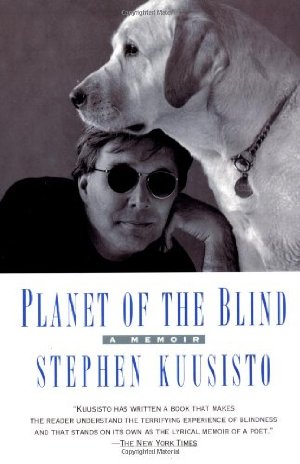
 Planet of the Blind