When I was very small I didn’t know that I’d meet people who wouldn’t like me until one day, climbing stairs with my father, my hand in his, we met an elderly Swedish woman who lived just below us and who said, “Tsk, Tsk” because I was blind. I was only four and it was winter in Helsinki, Finland. This was a foundational moment for me as such moments are for all sentient beings, its the very second we sense we’re not who we’ve met in the mirror, or having no mirror, we’re not exactly who our parents say we are. Cruelty is one way we arrive. It comes without warning like branches tapping a window. “She’s a fool,” my father said as if that solved the riddle of human embarrassment.
If you teach at the post-secondary level and care about soul (not all teaching concerns itself overtly with soulful things, nor should this be the case per se) you’re likely a stair climbing contrarian, the kind of professor who knows the Swedish dowagers both of history and the ones living next door. Knowing we’re incontestably faced with deviant personalities, people who, according to private or political history, have been rendered un-civic-minded is central to narrative literature and when properly encountered this can strengthen the ironies of compassion. I swear, as a boy I felt sorry for my grey Swedish matron. She’s still (for me) the image of absolute loneliness. The reach of dramatic irony is broad in poetry and fiction and while it’s not my intention to sound new age-y the human soul needs all the nutrients it can get. Who hurt the old Swedish woman who lived downstairs? Was it her White Russian husband who beat her and her children and then died in middle age having drunk away her dowry?
No one should have the power to steal our compassion. Books alone won’t prevent the theft but they’re the perfect anodyne for thin skinned covetousness and envy, the two conditions most prevalent in hyper-consumerist, post-industrial economies. No one’s reading John Bunyan these days but he’s worth quoting: “You have not lived today until you have done something for someone who can never repay you.” Compassion is a muscle. It’s flexible when used. Employing it we enter wider circles.
In the Age of Trump we’ll need help with compassionate climbing. I do not single out students any more than faculty or administrators—all people of conscience are rightly confused by the wide and unrelenting brutishness we’re now seeing.
Love and compassion are necessities, not luxuries, as the Dalai Lama has often said. Our survival both as individuals and communities will now depend on understanding this. Again, echoing the Dalai Lama, compassion is the radicalism of our time. It’s a radicalism that can be practiced daily. It’s also the hardest thing to put into action. “You must not hate those who do wrong or harmful things; but with compassion, you must do what you can to stop them — for they are harming themselves, as well as those who suffer from their actions.” (Dalai Lama)
Over the past few days I’ve been putting together a literary reading list for our present moment. I’ve been culling books that highlight the radicalism of what, for lack of a better term I’m calling compassionate irony. These poets, non-fictionists and fiction writers are assembled here in no discernible order—their work has come to me as I’ve walked in the public square. The public square is a steeper place now. I believe the following books are now necessities:
Viet Thanh Nguyen: The Sympathizer
James Lecesne: Absolute Brightness
Toni Morrison: Sula
Anne Finger: Elegy for a Disease
Gail Godwin: Father Melancholy’s Daughter
Colson Whitehead: The Underground Railroad
Adrienne Rich: An Atlas for the Difficult World
Jacqueline Woodson: Another Brooklyn
Kurt Vonnegut Jr: Slaughterhouse Five or The Children’s Crusade
Kwame Alexander: The Crossover
James Baldwin: Giovanni’s Room
Dorothy Allison: One or Two Things I Know for Sure
Ralph Ellison: Invisible Man
Saul Bellow: The Adventures of Augie March
Azar Nafisi: Reading Lolita in Tehran
Naguib Mahfouz: The Cairo Trilogy
Sam Hamill: Habitations
Walt Whitman: Leaves of Grass
Pema Chodron: The Places That Scare You
Kenneth Rexroth: Collected Poems
Deborah Tall: A Family of Strangers
Kwame Dawes: Duppy Conqueror: New and Selected Poems
Mark Doty: Fire to Fire
Wang Ping: The Last Communist Virgin
Robert Bly: My Sentence Was a Thousand Years of Joy
Pablo Neruda: Selected Poems
Bernard Malamud: The Stories of Bernard Malamud
Anita Desai: Clear Light of Day
John Banville: The Sea
Thomas Hardy: The Mayor of Casterbridge
John Irving: The Cider House Rules
Richard Yates: A Good School
Carl Jung: Memories, Dreams, Reflections
Paule Marshall: The Fisher King
W. H. Auden: Collected Poems
Evelyn Waugh: Brideshead Revisited
Chimamanda Ngozi Adichie: Americanah
Salman Rushdie: Midnight’s Children
Naoki Higashida: The Reason I Jump
W. B. Yeats: Collected Poems
Per Petterson: Out Stealing Horses
Magda Szabo: The Door
Tove Jansson: The Summer Book
Majgull Axelsson: April Witch
Jean-Dominique Bauby: The Diving Bell and the Butterfly
Bruno Schulz: Sanitarium Under the Sign of the Hourglass
Jerzy Ficowski: Waiting for the Dog to Sleep
Gyula Krudy: Sunflower
Chris Abani: The Secret History of Las Vegas
Binyavanga Wainaina: How to Write About Africa
Joan Didion: The Year of Magical Thinking
Carlos Fuentes: The Death of Artemio Cruz
Mo Yan: Life and Death are Wearing Me Out
The list above is my start—a syllabus of the compassionate climb. You’ll notice I’ve left Kafka off but include Bruno Schultz. Left off Camus but included Carl Jung. One prefers the early Rushdie and Thomas Hardy before he elevated his wife to sainthood. Compassion resists Aristotelian templates—it doesn’t like being talked about. Like a milk snake it shines in its own way. Compassion is more than fellow feeling or empathy—it is mercy. All the books listed here are merciful. Please, start your own lists. Share them. The literatures of compassion are necessarily shared in a university without walls.
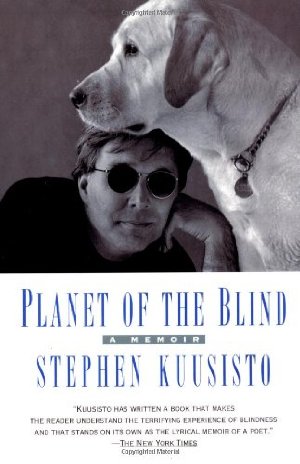

 Planet of the Blind