University of Iowa News Release
July 17, 2009
Blind cycling champion to lead UI's Project 3000 RAGBRAI team
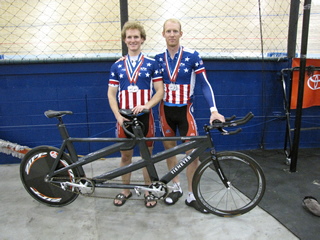
A team of a dozen cyclists — including a blind U.S. Paralympics track
cycling national champion — will pedal across Iowa next week to raise
awareness of and funds for Project 3000, a University of Iowa-based
effort seeking a cure for a rare childhood blinding eye disease.
Team
Project 3000 will ride 442 miles, from Council Bluffs to Burlington, as
part of the Register's Annual Great Bike Ride Across Iowa (RAGBRAI).
The team's inspirational leader is Clark Rachfal, a U.S. national
medalist in track cycling who has been losing his sight since childhood
and who has Leber congenital amaurosis (LCA), one of the blinding eye
diseases that Project 3000 seeks to cure. Rachfal, whose competitive
cycling activities have been supported by the Verizon Foundation and by
generous colleagues at Verizon, rides a tandem bicycle with a sighted
partner.
The mission of Project 3000 at the UI is to find and
offer genetic testing to the estimated 3,000 Americans with Leber
congenital amaurosis, which causes severe vision loss or blindness and
typically strikes during early childhood.
Genetic testing helps
confirm the diagnosis, discover the genes responsible and lead to
treatments and a cure. UI ophthalmology researchers are committed to
this approach to finding the causes, cures and eventual prevention of
LCA and — through what they learn during Project 3000 — other
blinding eye diseases. Key partners in Project 3000 include Chicago
Cubs star Derrek Lee and Boston Celtics CEO and co-owner Wyc Grousbeck,
both of whom share a desire to find treatments and a cure for LCA.
The
idea to form a RAGBRAI team to support Project 3000 originated with
Paul Rosenthal, a Washington, D.C., attorney who is chair and a
founding member of an advisory board to the UI Carver Family Center for
Macular Degeneration, of which Project 3000 is a part. The center is a
unit of the Department of Ophthalmology and Visual Sciences in the UI
Roy J. and Lucille A. Carver College of Medicine.
"I have had the
privilege over the years of dealing professionally with numerous Iowa
businesses and government officials, and as a result I have developed a
great respect for this wonderful state," said Rosenthal, who manages
the Washington, D.C., office of the law firm Kelley Drye and Warren.
"One of Iowa's, and indeed the nation's, great treasures is the Carver
Family Center for Macular Degeneration at the University of Iowa.
Because I have seen first-hand the enormous talent and dedication of
the center's scientists and staff to their mission to find the causes,
treatments, cures and preventions for inherited eye diseases, it is
only natural for me to want to express my appreciation and gratitude by
riding across the state on RAGBRAI."
As of July 17, Team Project
3000 had raised $35,000 in gifts for the LCA research and treatment
effort. Each team member set up a personal online giving page to
collect gifts from family, friends and colleagues via the University of
Iowa Foundation's Web site, http://www.givetoiowa.org.
Overall,
more than $1.5 million in gifts has been raised through the UI
Foundation for Project 3000 since the project's inception in 2006.
"We
are closing in on effective treatments for LCA, and the support created
through this RAGBRAI cycling team will bring us even closer," said
Edwin Stone, M.D., Ph.D., director of the UI Carver Family Center for
Macular Degeneration and a Howard Hughes Medical Institute
investigator. "Paul Rosenthal's efforts to bring our team together, and
Clark Rachfal's involvement, are both greatly appreciated."
For more information on the Team Project 3000 effort, or to make a gift, visit http://www.uifoundation.org/project3000/. To learn more about Project 3000, visit http://www.project3000.org. Those interested may also follow the team's progress on Twitter at Twitter@Project3000.
The
UI acknowledges the UI Foundation as the preferred channel for private
contributions that benefit all areas of the university. For more
information about the UI Foundation, visit its web
http://www.project3000.org.
STORY SOURCE: UI Foundation, P.O. Box 4550, Iowa City, Iowa 52244-4550
CONTACTS:
Mitch Beckman, UI Foundation, 319-467-3402, mitch-beckman@uiowa.edu; or
Joseph Schmidt, UI Department of Ophthalmology and Visual Sciences at
UI Hospitals and Clinics, 319-384-8529, joe-schmidt@uiowa.edu
PHOTOS: A high-resolution of Clark Rachfal and his tandem bike partner, Dave Swanson, is available at:
http://www.uifoundation.org/news/2009/images/jul-ragbrai-hires.jpg
A web-quality image also is available:
http://www.uifoundation.org/news/2009/images/jul-ragbrai.jpg
PHOTO
CUTLINE: U.S. Paralympic national track cycling champion Clark Rachfal
(left), who is blind, and riding partner Dave Swanson, will ride across
Iowa July 19-25 as part of Team Project 3000, which is raising
awareness and funds for a University of Iowa effort to cure Leber
congenital amaurosis, an inherited blinding eye disease.
 Derrek Lee of the
 Planet of the Blind

