If like me you’re disabled you’ve probably thought about being cured. As I’m blind this would mean having 20/20 vision. I don’t think about it much, but when I do I picture myself on a motorcycle, letting it rip. This is a personal version of fool’s gold.
The idea of “cure” is painful for the disabled. Medicine says we must be fixed or be seen as permanent defectives. Most of us cripples have been told we’re faulty over and over. It’s not “cure” one wants, its freedom from being flawed and suspect in the village square. If I could see and take off on a Harley I’d still remember the struggles of this disability life.
**
Jean Jacques Rousseau had a dog named Sultan who accompanied him to England when his life was threatened in France. Poor broken Rousseau with his malformed urinary tract, cloying hypochondria and hot paranoia–also poor in cash, resolutely poor in friendships. Sometimes we think we understand him–we, the descendant cripples–those who spent fortnights alone in childhood and more than once. We who occupied our attentions with flowers and seeds. Rousseau had the triple whammy: his mother died when he was very young, then his father ran away. He was forced to learn the baleful adolescent art of beseeching strangers for protection and love. He was easily tricked into churches and bedrooms. And he was easily discarded. The cripples understand this.
No wonder he discarded neo-classicism for what others would call the romantic. No wonder Shelley and Byron adored him–passions of betrayal and resolution always feel the most authentic. Rousseau’s enemies substituted “savage” for “authentic” and prided themselves for calling him “uppity” which is of course what is generally done to passionate cripples. Small wonder Rousseau took up the matter of social consent among the governed.
**
Sultan lead him into the English countryside where he seldom encountered another soul. I love knowing this. A dog can stir and extend solitary human concentration which is the reward of stigma, but you must understand it in a canine manner–pay attention to what’s here and here; not yesterday; never tomorrow; and yes, a dog looks the other way when you take from your pocket a handful of French seeds and push them into British soil.
“So here I am, all alone on this earth, with no brother, neighbour, or friend, and no company but my own. The most sociable and loving of human beings has by common consent been banished by the rest of society. In the refinement of their hatred they have continued to seek out the cruellest forms of torture for my sensitive soul, and they have brutally severed all the ties which bound me to them. ”
He was in fact disabled by malformations of his nether parts and he had profound depression. Being a liminal figure owing to these conditions he was caste out by the congealing engines of 18th century normalcies. On this the aristocrats and the bourgeoisie could agree—the salon, the atelier, the coffee houses were not places to be troubled by the inconveniences of broken embodiments. Having a troubled body meant staying away—meant the asylums and hospitals. It meant living in the poor houses. Good bodies meant public bodies. Rousseau’s solitary journeying on foot is disability journeying. He was Basho, a travel weary skeleton.
Poor Roussea! He had porphyria which lead to abdominal pain and vomiting; acute neuropathy, muscle weakness and seizures; hallucinations, anxiety, paranoia—and as if these weren’t enough he had cardiac arrhythmias. He was by turns aggressive, provocative, contrarian, and yes, he was always ill.
Today in the disability arts community we talk of disablement as epistemology. We know altered physicality and neurodiversity offer unique and valued ways of thinking. What’s different now from Rousseau’s time is that the disabled are not as easily caste aside, and though this can be done (one thinks of all the micro aggressions the disabled invariably experience even now, arguing for accessibility, making their point for inclusion and respect against structural ableism) it’s no longer possible to lock the gates of Geneva on that annoying cripple.
On the subject of micro aggressions much of the Reveries of a Solitary Walker tells of the slights and the disdain Rousseau absorbed and encountered. He was in fact an unpleasant man. I too some days am an unpleasant man. Human rights and their advocacy demand it. Seldom does progress develop for polite societies. But I’ll add also that in Rousseau’s time there was no language for depression—the term itself comes from an age when treatment and acceptance are commonly understood. Instead it was called “melancholia” and it was considered a form of madness. You don’t have to read Foucault to know what happened to the mad though why shouldn’t one recommend it? In any event Rousseau lived in an age when mental illness was believed to be a moral failing. This sub-Cartesian idea has never gone away.
I’ll let Rousseau have the last word:
“Always affected too much by things I see, and particularly by signs of pleasure or suffering, affection or dislike, I let myself be carried away by these external impressions without ever being able to avoid them other than by fleeing. A sign, a gesture or a glance from a stranger is enough to disturb my peace or calm my suffering: I am only my own master when I am alone; at all other times I am the plaything of all those around me.”
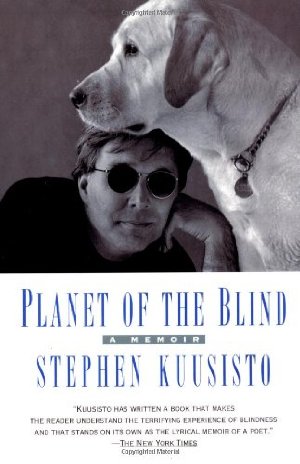

 Planet of the Blind