Blind cycling champion to lead UI's Project 3000 RAGBRAI team

University of Iowa News Release

July 17, 2009

Blind cycling champion to lead UI's Project 3000 RAGBRAI team
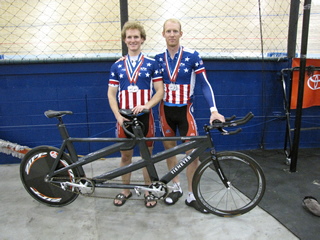
071709highrezbike
A team of a dozen cyclists — including a blind U.S. Paralympics track
cycling national champion — will pedal across Iowa next week to raise
awareness of and funds for Project 3000, a University of Iowa-based
effort seeking a cure for a rare childhood blinding eye disease.

Team
Project 3000 will ride 442 miles, from Council Bluffs to Burlington, as
part of the Register's Annual Great Bike Ride Across Iowa (RAGBRAI).
The team's inspirational leader is Clark Rachfal, a U.S. national
medalist in track cycling who has been losing his sight since childhood
and who has Leber congenital amaurosis (LCA), one of the blinding eye
diseases that Project 3000 seeks to cure. Rachfal, whose competitive
cycling activities have been supported by the Verizon Foundation and by
generous colleagues at Verizon, rides a tandem bicycle with a sighted
partner.

The mission of Project 3000 at the UI is to find and
offer genetic testing to the estimated 3,000 Americans with Leber
congenital amaurosis, which causes severe vision loss or blindness and
typically strikes during early childhood.

Genetic testing helps
confirm the diagnosis, discover the genes responsible and lead to
treatments and a cure. UI ophthalmology researchers are committed to
this approach to finding the causes, cures and eventual prevention of
LCA and — through what they learn during Project 3000 — other
blinding eye diseases. Key partners in Project 3000 include Chicago
Cubs star Derrek Lee and Boston Celtics CEO and co-owner Wyc Grousbeck,
both of whom share a desire to find treatments and a cure for LCA.

The
idea to form a RAGBRAI team to support Project 3000 originated with
Paul Rosenthal, a Washington, D.C., attorney who is chair and a
founding member of an advisory board to the UI Carver Family Center for
Macular Degeneration, of which Project 3000 is a part. The center is a
unit of the Department of Ophthalmology and Visual Sciences in the UI
Roy J. and Lucille A. Carver College of Medicine.

"I have had the
privilege over the years of dealing professionally with numerous Iowa
businesses and government officials, and as a result I have developed a
great respect for this wonderful state," said Rosenthal, who manages
the Washington, D.C., office of the law firm Kelley Drye and Warren.
"One of Iowa's, and indeed the nation's, great treasures is the Carver
Family Center for Macular Degeneration at the University of Iowa.
Because I have seen first-hand the enormous talent and dedication of
the center's scientists and staff to their mission to find the causes,
treatments, cures and preventions for inherited eye diseases, it is
only natural for me to want to express my appreciation and gratitude by
riding across the state on RAGBRAI."

As of July 17, Team Project
3000 had raised $35,000 in gifts for the LCA research and treatment
effort. Each team member set up a personal online giving page to
collect gifts from family, friends and colleagues via the University of
Iowa Foundation's Web site, http://www.givetoiowa.org.

Overall,
more than $1.5 million in gifts has been raised through the UI
Foundation for Project 3000 since the project's inception in 2006.

"We
are closing in on effective treatments for LCA, and the support created
through this RAGBRAI cycling team will bring us even closer," said
Edwin Stone, M.D., Ph.D., director of the UI Carver Family Center for
Macular Degeneration and a Howard Hughes Medical Institute
investigator. "Paul Rosenthal's efforts to bring our team together, and
Clark Rachfal's involvement, are both greatly appreciated."

For more information on the Team Project 3000 effort, or to make a gift, visit http://www.uifoundation.org/project3000/. To learn more about Project 3000, visit http://www.project3000.org. Those interested may also follow the team's progress on Twitter at Twitter@Project3000.

The
UI acknowledges the UI Foundation as the preferred channel for private
contributions that benefit all areas of the university.  For more
information about the UI Foundation, visit its web
http://www.project3000.org.

STORY SOURCE: UI Foundation, P.O. Box 4550, Iowa City, Iowa 52244-4550

CONTACTS:
Mitch Beckman, UI Foundation, 319-467-3402, mitch-beckman@uiowa.edu; or
Joseph Schmidt, UI Department of Ophthalmology and Visual Sciences at
UI Hospitals and Clinics, 319-384-8529, joe-schmidt@uiowa.edu

PHOTOS:  A high-resolution of Clark Rachfal and his tandem bike partner, Dave Swanson, is available at:
http://www.uifoundation.org/news/2009/images/jul-ragbrai-hires.jpg

A web-quality image also is available:
http://www.uifoundation.org/news/2009/images/jul-ragbrai.jpg

PHOTO
CUTLINE: U.S. Paralympic national track cycling champion Clark Rachfal
(left), who is blind, and riding partner Dave Swanson, will ride across
Iowa July 19-25 as part of Team Project 3000, which is raising
awareness and funds for a University of Iowa effort to cure Leber
congenital amaurosis, an inherited blinding eye disease.

RAGBRAI for a cause: Project 3000 Seeks Cure for LCA

Dear Friends,

You can help us find a cure for blind children!

Chicago Cubs star Derrek Lee and Boston Celtics CEO and co-owner
Wyc Grousbeck — in partnership with the John and Marcia Carver
Nonprofit Genetic Testing Laboratory at The University of Iowa
— are
combining their talents and energies to eradicate an inherited form of
blindness that has touched both of their families, Leber congenital
amaurosis or LCA. They call their effort Project 3000 because a central
part of their plan is to find every man, woman, and child affected with
LCA in the United States — about 3,000 people.

I will be riding my bicycle 475 miles across the state of Iowa
July 19-25, along with several other friends and supporters of Project
3000, as part of RAGBRAI, the Register's Annual Great Bike Ride Across
Iowa. To give some additional meaning and purpose to
a ride that is sure to be fun, the cyclists on Team Project 3000 and I
invite you to support the crucial work of Project 3000 at The
University of Iowa.

Feel free to make a gift of any amount you wish. If you would like
to make a per-mile-ridden gift, please take the amount per mile you
wish to give and multiply that times 475 (the number of miles I plan
ride) to get your gift amount.

I would offer an option for you to give by the pound (mine–on the
hoof), but that may prove to be too expensive for some of you. Instead,
as an extra incentive to give, I will provide prizes to those who guess
my weight at the end of the ride (after the celebratory beer and wine).

Also, I plan to do a blog or some other way to communicate about
the ride (I may be a twit, but right now I don't Twitter), so I will
keep you posted on this idea. If you want me to keep you updated,
please contact me at my email address: prosenthal@kelleydrye.com.

Thanks,

Paul

With just a few clicks of your mouse, please make a gift today to help fund Project 3000.

Simply
fill in the secure online gift form , and I will receive
notification of your gift. Your contribution will be put right to work
to help us with Project 3000. The University of Iowa Foundation (the
preferred channel for private support for Project 3000) will send a
receipt. ALL gifts will be used to support Project 3000.

Learn more about Project 3000 at www.carverlab.org/project3000/.

Thank you very much for your gift. Together, there is something you can do to provide HOPE.


Total Raised: $16,850.00

Big Ten Network Supports Project 3000

Logo: Project 3000Derrek Lee of the Chicago Cubs and Wyc Grousbeck of the Boston Celtics share an uncommon bond.  Each has a child with a rare genetic eye disease called Leber’s congenital amaurosis, otherwise known as LCA.  Rare as this condition is, these two devoted fathers would probably not be aware of their similar experiences were it not for the efforts of Dr. Edwin Stone and his research team at the University of Iowa’s John and Marcia Carver Nonprofit Genetic Testing Laboratory.  In their view, it is Dr. Stone who represents hope for the future of their children, and others like them.  It is Dr. Stone’s powerful message that "there is something we can do" that has inspired the Lee and Grousbeck families to combine their talents and their resources to support the research that is currently being done.

The
initiative spearheaded by Derrek Lee and Wyc Grousbeck is known as Project 3000, named as such to reflect the estimated 3000 people in the United States living with LCA.  One of the major goals of this ambitious effort is to find, and test, these 3000 people in order to advance the research.  Research points to hope in terms of treatment and a possible cure, not only for LCA, but for other inherited eye diseases as well.

An informational video, produced to raise awareness and help spread the word, has been aired on the Big Ten Network.  It has also been made available for viewing here.

To Learn More visit:

Derrek Lee’s 1st Touch Foundation
Project 3000: Believe the Unseen

UI contributes to gene therapy breakthrough for blinding eye disease

University of Iowa News Release

April 28, 2008

UI contributes to gene therapy breakthrough for blinding eye disease 

Researchers
at the University of Iowa played a key role in a landmark gene therapy
breakthrough reported Sunday, April 27, in an online article in the New
England Journal of Medicine. 

The study reported
improvement in vision following gene transfer to the retina in three
patients with an inherited form of blindness known as Leber congenital
amaurosis or LCA. The study was carried out at the Children’s Hospital
of Philadelphia by an international team led by the University of
Pennsylvania, the Children’s Hospital of Philadelphia, the Second
University of Naples and the Telethon Institute of Genetics and
Medicine (both in Italy), the UI and several other American
institutions. 

This is the first report of successful gene
therapy of an inherited eye disease in humans. Although the patients
have not achieved normal eyesight, the preliminary results set the
stage for further studies of an innovative treatment for LCA and
possibly other retinal diseases. Patients’ vision improved from
detecting hand movements to reading lines on an eye chart. 

Edwin
Stone, M.D., Ph.D., UI professor of ophthalmology and visual sciences
and a Howard Hughes Medical Institute investigator, led the genetic
testing portion of the study. Stone’s group developed a method for
distinguishing disease-causing mutations from benign genetic variants,
and this method was used to choose the patients who were treated in the
gene therapy study. The Iowa group also developed a highly efficient
nonprofit testing strategy that has allowed genetic testing for LCA to
be offered on a national scale. 

"This is a very exciting
day for everyone involved in caring for patients with inherited eye
disease," Stone said. "We are very pleased that the Carver Lab at the
University of Iowa was able to contribute to this important step
forward." 

Among those recognizing the breakthrough were
John and Marcia Carver, members of the family who donated $10 million
in 2005 to create and name the John and Marcia Carver Nonprofit Genetic
Testing Laboratory and the associated Carver Family Center for Macular
Degeneration at the UI. "We were very happy to hear of this
extraordinary scientific result and excited that the Carver Lab had an
important hand in it," John Carver said. 

The UI is also home to Project 3000 (http://www.project3000.org),
a philanthropically supported grassroots effort to find all 3,000
people in the United States affected with LCA and to offer them a
genetic test whether or not they have insurance coverage to pay for it. 

Project
3000 was created in 2006 by Stone, Derrek Lee, who is first baseman of
the Chicago Cubs, and Wyc Grousbeck, who is co-owner and CEO of the
Boston Celtics. Lee and Grousbeck have children affected with LCA.

Continue reading “UI contributes to gene therapy breakthrough for blinding eye disease”

Merging Hunanities with Medicine

Professor making University of Iowa community look at disabilities in new ways: an article in the Iowa City Press Citizen, Wednesday, April 16, 2008 by Brian Morelli.

"People with disabilities often are labeled either as a social problem
or a medical problem, University of Iowa professor Stephen Kuusisto
said…"

(Click the link above to to proceed to the article.)

~ Connie

Project 3000

My mornings are usually hectic just as yours must be. Coffee? Stain on your shirt? Hurry. Oh hurry please.

Not too long ago I had the good fortune to talk with "Insight Radio" in Scotland. This is a radio channel that offers programming about blindness and low vision to listeners in the UK.

I found myself sipping coffee in the early Iowa dawn and talking about denial. Lots of people who have disabilities struggle to admit their physical differences and that’s an old story.

I said that the way to beat denial is to admit that you desire a larger life.

I learned to be a cane traveler and a guide dog traveler precisely because I wanted to see what might lie beyond the next hill.

Lots of blind folks will tell you the same story.

It was a good interview.

Lo! And then I opened my e-mail and discovered this story about "Project 3000"–a research initiative that’s underway here at the University of Iowa under the direction of my friend and colleague, Dr. Edwin Stone.

You can visit the story in this issue of USA TODAY, and as a supporter of Project 3000, I wish you
would.*  

There are a thousand ironies concerning disability. For instance: one may well decide to live without thinking about being "cured". This is an important position because one can get stuck on a medical model merry-go-round of doctor visits and  depressive subjectivity.

Continue reading “Project 3000”