
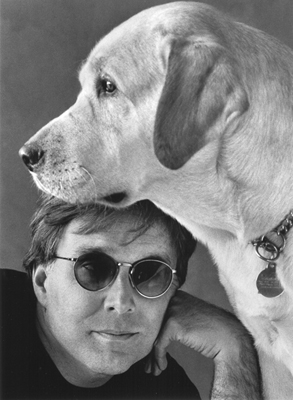
I’ve been blind all my life and have traveled with guide dogs at my side for the past thirty years. Since guide dogs are trained to watch for traffic and take evasive maneuvers to avoid danger, my dogs have opened up limitless horizons for me, enabling me to travel across the globe. And I have: from Helsinki to Milan; San Francisco to Miami. But there are places I can’t go despite laws which say I can—for even though service dogs are permitted everywhere the public goes, taxi cabs and ride share services often discriminate against me.
There are very few service dogs in the United States. The number is likely somewhere around 30,000 when one includes dogs trained to assist with all kinds of disabilities and not just blindness. The odds of meeting a service dog team are not high. I like to say we’re the few, the proud, the canine-human equivalent of the Marines. We’re exceptionally trained. How many times have I been in a restaurant with my dog lying still under the table only to have other customers remark with pleasure and admiration when we get up to leave. They say: “I didn’t know there was a dog under there! That’s amazing!” A service dog is not just polite, it knows how to be an ambassador for the distinction of working dogs everywhere.
So wha’t with the cabs and ride shares? The drivers pull up, see the guide dog and drive away. Or they roll down their windows and complain loudly that they won’t take a dog. When I say its a guide dog and its allowed in their vehicle by law, well, you guessed it, they drive away. This has happened to me dozens of times over the years. Sometimes I ask a stranger on the sidewalk to flag me a cab and open the door and then I jump in. Sometimes I report the ride share driver to the head office. But nothing stops the discrimination.
Wheelchair users also face ride refusals. This has lead me to understand that the problem isn’t the dog at all. It’s the stigma associated with disability. In his famous book “Stigma: Notes on the Management of Spoiled Identity” Erving Goffman reminds us that deviant physicality has a long history: “The Greeks, who were apparently strong on visual aids, originated the term stigma to refer to bodily signs designed to expose something unusual and bad about the moral status of the signifier. The signs were cut or burnt into the body and advertised that the bearer was a slave, a criminal, or a traitor—a blemished person, ritually polluted, to be avoided, especially in public places. Later, in Christian times, two layers of metaphor were added to the term: the first referred to bodily signs of holy grace that took the form of eruptive blossoms on the skin; the second, a medical allusion to this religious allusion, referred to bodily signs of physical disorder. Today the term is widely used in something like the original literal sense, but is applied more to the disgrace itself than to the bodily evidence of it.”
People like me represent signs of physical disorder and even though our dogs are cute we’re to be avoided. I’ve come to realize its not the dog that’s the problem its my own physical presence. Yes, I now believe the drivers who refuse me would happily take the dog and leave me behind.


 Planet of the Blind