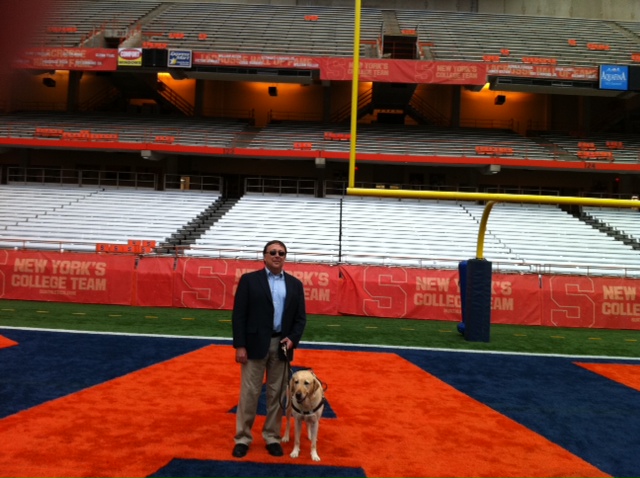
Farewell to Fred Fay

The following comes to us via http://www.InclusionDaily.com/

Disability Rights Pioneer Fred Fay Dies At Age 66
(Concord Patch)
August 22, 2011

CONCORD, MASSACHUSETTS– [Excerpt] Twenty years ago I learned to refuse to play Scrabble with Fred Fay.

Fred knew all the two-letter words and was shameless about using them. Fred would clean the clock of anyone who took him on. And he did this while lying on his motorized wheel-bed, talking and smiling malevolently through a mirror tilted so he could see you and the board. He was a relentless competitor and that spirit led him to become one of the prime movers in the disability rights movement in the United States.

From the White House to national organizations for people with disabilities, he received praise, honors and esteem.

Fred died Saturday morning at the Main Street home he shared for 30 years with his beloved Trish Irons. And although he lived below the radar in Concord, he was a super star in the disability community throughout the United States.

An accomplished gymnast as a youth, Fred fell from a trapeze when he was 16 and lost the use of his legs. After a rough period of adjustment he built up muscles in his arms so that he could fold up his wheelchair, get into a car and drive. At home in D.C. Fred found “every single curb was like a Berlin Wall telling me that I was not welcome to travel farther than a block.”

Entire article:
Disability Policy Advocate Remembered
http://concord.patch.com/articles/disability-policy-advocate-remembered

ATMs Must Be Upgraded By March 2012 Deadline


(Omaha World-Herald)
August 19, 2011

OMAHA, NEBRASKA– [Excerpt provided by Inclusion Daily Express] Banks, credit unions and independent ATM operators are hustling to meet a March 2012 deadline to make their machines — more than 400,000 nationally, 3,400 in Nebraska and about 2,000 in Iowa — accessible to people who are blind or have low vision. 

New rules, six years in the making under the Americans with Disabilities Act, mean millions of dollars spent on new or upgraded machines. They also mean the ubiquitous automated teller machines that spit out cash will be accessible to thousands more people who have problems seeing the buttons and screens. 

"It allows the blind to visually impaired person to be able to enter all their card numbers and information without having the assistance of somebody else," said Robert Spangler of Vinton, Iowa, president of the Iowa Council of the United Blind. "It's a privacy issue. How would you like to drive up to an ATM and give somebody the information to do it for you? What's good for one is good for all of us."

Those with partial sight may be able to see parts of an ATM, he said, "but your field of vision may be reduced or it takes you a lot longer to read the stuff that's on the screen."

Arguments over the need for the federal accessibility standards are long over, although until February of this year some banks thought the new rules might not apply to their existing machines.

Entire article:
New ATM rules aim to aid visually impaired 

http://www.omaha.com/article/20110815/LIVEWELL03/708159899/1161


On Taking Up Space

By Angel Lemke

Just a few days after I met her, Andrea overheard me apologizing to a classmate for taking up too much space; I had sprawled my books and other academic paraphernalia across a couple desks while working on something between classes. “Don’t apologize for that; women apologize for taking up space too often.” If I didn’t know I liked her before that, I definitely knew then.

It also stuck with me, though, because it seemed kind of funny, her telling me to be comfortable taking up space. For one thing, I probably have 200 pounds on her. I take up a lot more space just by walking in the room. For another, I self-identify as a butch. No matter how many varieties of butch I meet, no matter how expansive a definition I might give (see the title essay in S. Bear Bergmann’s Butch is a Noun for my favorite), I feel I can say confidently that butches take up space. Some of us swagger more than others, but demureness is not really in our line. Part of inhabiting my body authentically demands that I take up space in ways that, we are told, are decidedly not feminine.

But on this International Butch Appreciation Day – that is, according to Facebook holidays – I am struck by how difficult I find it to take up space.

About a month ago, my moving plans fell through, and too late for me to renew the lease on my apartment of the last four years. The fallout is that for at least the next couple months, I live an itinerant existence, depending on, as they say, the kindness of strangers…well, actually good friends and my grandma.

I find it deeply unsettling, being in other people’s spaces so much.

I was in a long-distance relationship a few years back; I used to fly from Columbus to LA with a supply of towels for the week in tow because I didn’t want to leave a single piece of laundry behind. After we broke up, this became a symbol of the relationship’s dysfunction, the unnecessary and costly lengths which I would go to in order to avoid disturbing her. When she left Columbus after a visit, my place would be wrecked, the mark of her presence everywhere, dirty dishes, rifled drawers, packaging from purchases, boxes to be mailed back to LA to meet her. When I left her place, you couldn’t tell anyone had been there. I was fastidious, memorizing where on the kitchen window ledge her olive oil bottle rested, drying off the shower curtain with the towels I’d brought along. I would not let myself be accused of being an inconvenience. I would take up as little space as possible.

But I learned that behavior before she came along. I have known for a long time that to be loved one must not be too much trouble.

And this has something to do with butchness for me, as well. In conversation with another butch about a fierce, room-filling femme, my interlocutor says, “She says I don’t talk enough.”
“Yeah, she used to say that to me, too.”

“Yeah, but I think that’s part of who we [meaning butches and bois] are.”

We sit back and bask in the presence of girls who take up space. We swagger to our seats when we do it, and we do not cross our legs, but they are the show and we are the spectators. The theater is theirs; our seats are rented.

Or as that butch said later in that same conversation, “It’s her world; we just live in it.”

(Side note, lest I be mistaken in my focus on butches: there’s nothing I like better than a femme who fills up the room with bravado and laughter. Take up space, ladies, in every way you can. See also, Ivan Coyote on youtube.)

In this “housing crisis” of mine, the hardest part has been that I’ve been told by some loved ones that there’s no room for me, that my presence is too much for them, that I take up too much space. You’d think I’d be angry about that, but the truth is, a big part of me believes them. Part of me thinks that taking up any space at all is too much.

I spent the night at a friend’s place last night, a friend who offered her home the moment she knew about my situation, and for more than just the here-and-there night of crashing that I’m willing, reluctantly, to take her up on, even though her place is small and my staying required the moving of a piece of furniture into storage.

She had to offer at least three times before I even considered taking her up on it. Every friend who’s offered shelter has had to do so in the face of my most apologetic, insecure self, repeatedly asking, “Are you sure you don’t mind? Really, you can say no. Really, it’s okay.”

But today, in honor of my brethren butches and my sister femmes, I’m going to try—really try—to just say “Thank you” and feel lucky in the knowing that the space my friends offer is there for me to take up.

Writer and activist Angel Lemke is a welcome contributor to POTB.

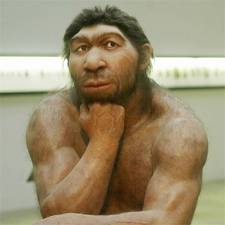
Getting in Touch with My Neanderthal Man

Neanderthal Man

All you have to do is move! 


I have moved many times in my adult life–college, graduate school, then of course the serious moving of the grownup–moves involving kids and school districts, moves requiring much larger determinations than whether you're within walking distance of the beer store. This morning, lying awake in my tangled sheets I tried counting the number of moves I've made and came up with 25 and this doesn't count the times when I moved back in with my parents briefly between rounds of graduate school. So I'm 56 and if you do the arithmetic this means I've moved once every 2.3 years. That's nothing of course compared to the hyper-nomadic experiences of many Americans, I know, but still, that's a lot of shoving and hauling of book boxes and wrinkled clothing.


If you're visually impaired moving is a deeply primitive experience. I crawl on my hands and knees locating electrical sockets, treating the holes like Braille, fingering them to see where the ground plug goes. I walk around the nearly empty new house (furniture won't come for at least two weeks) and touch the walls and turn the door knobs, amazed that I have a house–I mean really, think about it, a guy like me, vaguely atavistic, half in touch with his ancestors via wooly dreaming, here I am, walking around the echoing rooms like some kind of animal who has gotten indoors. "It's a house!" I tell myself. "It's a damned house!"


Then I try to familiarize myself with its myriad eclectic odditities–its wall switches that seem to do nothing, it's electrical box in the basement, it's weird bequeathed stuff, the pool table without usable cues, the gigantic desk that was obviously too heavy to carry away–a desk with more drawers than John F. Kennedy's desk…I'm enthralled and lost among things.


But it's not the wonder of newness that puts me in mind of my Neanderthal man–it's this desire to weep. Too much is new right now. I simply want my sticks and fire and instead I have this Rococo unfamiliar diamond studded strangeness all about me. Last night I almost sat down in the big, empty living room and wept for the sheer bigness of strangeness but my guide dog Nira walked in with her bone and jabbed it into my chest and I had to postpone my vatic whaling for a time.


Moving is good. I wouldn't have done it so many times were this not so. But I'm hairier today and I need a chiropractor big time because my posture is strange.


S.K.  

BBC E-mail: US military invents 'bigger bang'

What will history say?

According to navy researchers, recent tests have shown that the HDRMs are durable and significantly enhance the explosive effect. They increase the chances of what the military scientists term a “catastrophic kill”.

I saw this story on the BBC News iPhone App and thought you should see it.

** US military invents ‘bigger bang’ **
The US Office of Naval research says that it has successfully tested a new type of explosive material that can dramatically increase the impact of weapons.
< http://www.bbc.co.uk/news/science-environment-14581097 >

** BBC Daily E-mail **
Choose the news and sport headlines you want – when you want them, all in one daily e-mail
< http://www.bbc.co.uk/email >

** Disclaimer **
The BBC is not responsible for the content of this e-mail, and anything written in this e-mail does not necessarily reflect the BBC’s views or opinions. Please note that neither the e-mail address nor name of the sender have been verified.

Sent from my iPhone

Couple Angered Over 9-Year-Old's Handcuffing

Couple Angered Over 9-Year-Old’s Handcuffing
(Denver Post)
August 17, 2011

DENVER, COLORADO– [Excerpt provided by Inclusion Daily Express] Donald and Raiko Johnson detest what happened to their son.

They still do not understand it fully, yet they came to me to speak out about it, to maybe prevent another autistic or special-needs child from also ending up in handcuffs.

The Johnsons’ son, the oldest of their three, is 9 years old. He was born prematurely at 26 weeks, and in 2009 was diagnosed with autism.

Denver police ultimately decided to place him on a 72-hour psychiatric hold, and transported the boy, his hands cuffed behind his back, to Children’s Hospital Colorado.

When Donald and Raiko Johnson arrived, attendants were attempting to take their son’s blood pressure, but they couldn’t get a reading.

“It wouldn’t register because his hands were restrained so tightly behind his back,” Raiko Johnson explained.

Entire article:
Johnson: Parents concerned by handcuffing of autistic boy
http://www.denverpost.com/billjohnson/ci_18696227

Caring About Your Educational Privileges

It is an odd thing that many young people are being told that higher education is possibly irrelevent at the very moment Americans need to pull up their collective boots and work harder than ever before. This is a historical moment that calls for gumption, wit, brains, and what we used to call "Mother Courage". My own people, the Finns call it "Sisu"–a word that combines stamina and fierce determination. In any event I was put in mind of the aforementioned oddity when I read today a headline over at NPR that says only 1 in 4 American high school students is ready for college at graduation. This is a story that doesn't seem to go away. 

I am not a Ph.D. in Education and I'm not a policy wonk. I like to think of myself as a citizen educator–an academic with a passion for ideas and teaching. Like all university faculty who care about teaching I like to think of myself as having a young spirit–a contrarian's spirit, for the thing that scholars and young people share is the desire to ask why and how circumstances happen. Accordingly it seems to me that the NPR headline signifies that young people in American high schools are being bleached of their curiosities. This in the age of intellectual explosion! In a time when post-molecular medicine is locating the genes that cause hereditary blindness and when ophthalmologists can look forward to a near future when certain kinds of eye disease are a thing of the past. These are tremendously exciting times. One may fair surmise that if young people are not experiencing curiosity in this, the most electrifying age in the history of ideas, then perhaps our nation's academies aren't getting their stories "out enough" as they say in the vernacular. 

I'd hazard that these United States could use a Works Progress Administration for the dissemination of remarkable ideas for young people. Again, as they say in the vernacular, "I'm just sayin'"


S.K.