Help! I Can't Get the Dick Van Dyke Theme Song Out of My Head!

Yesterday on the Today Show, Matt Lauer interviewed actor-comedian Dick Van Dyke who has published a new memoir. It was a lovely interview and it brought back a lot of sweet memories of Van Dyke's famous sitcom as well as his delightful role in the Disney film "Mary Poppins". But then, Lordy! they reprised the theme music from the sitcom and Mr. Van Dyke sang the actual words to the song–words written by comedian Mory Amsterdam. Okay, lovely also. But now the song is in my head like a memorized telephone number when you're a kid. It goes on and on. I'm struggling, I tell you. I'm starting to weep like a man slicing onions. I'll confess to almost anything. I wonder if they use this trick at Gitmo?

S.K.

Human Rights in Uganda

The following news (announced by the BBC) that Kasha Nabagesera has been recognized for her extraordinary courage in the fight against homophobia in Uganda is deeply heartening. Let us pray for her safety and her continued success. Human rights are only as provisional as our dreams.

S.K.

Ugandan gay activist wins award

Ms Nabagesera has been physically attacked for her broadcasts arguing against homophobia
Ugandan gay activist Kasha Jacqueline Nabagesera has been given the prestigious Martin Ennals rights award.

The 10 organisations which make up the award jury said she was courageous and faced harassment because of her work.

Homosexual acts are illegal in Uganda, and can be punished by long jail terms.

In January, her colleague David Kato was murdered not long after suing a paper that outed them both as gay. Police denied the killing was because of his sexuality.

Three months before the murder, Uganda’s Rolling Stone newspaper published the photographs of several people it said were gay, including activist Mr Kato, with the headline “Hang them.”

The name of Ms Nabagesera, the founder of gay rights organisation Freedom and Roam Uganda, also appeared on the list.

‘Rare courage’

The Geneva-based award jury said Ms Nabagesera had appeared on national television and issued press statements on behalf of Uganda’s gay community.

However, because of threats and harassment she now shifted “from house to house, afraid to stay long in the same place”, their statement said.

“[She is] an exceptional woman of a rare courage, fighting under death threat for human dignity and the rights of homosexuals and marginalised people in Africa,” jury chairman Hans Thoolen said.

In October 2009, an MP introduced a bill that proposed increasing the penalties in Uganda for homosexual acts from 14 years in prison to life.

It also proposed the death penalty for a new offence of “aggravated homosexuality” – defined as when one of the participants is a minor, HIV-positive, disabled or a “serial offender”.

The Anti-Homosexuality Bill is yet to be formally debated by the Ugandan parliament.

The Martin Ennals Award for Human Rights Defenders is named after the late British lawyer who became the first head of the human rights organisation Amnesty International.

BBC © 2011

Everything I Know About My Father I Learned from Gay Talese

By Andrea Scarpino

Dear Gay Talese,

I just finished Unto the Sons. Yes, I had to renew it from the library twice and then kept it four days past the final due date. But here’s why: I read slower and slower towards the end, trying to stay as long as possible in your words, trying to keep your voice a little longer in my head. Even as my 25-cent daily overdue fine accumulated, I wanted stay in your world.

Because you sound so much like my father. Or more exactly, you sound like you could explain my father. Maybe because my parents had me later in life—my father was 45 when I was born—I’ve always felt they are a mystery, a complex puzzle I have to parse. My father had a successful career by the time I came around, had long-established friendships and rivalries, traditions and ways of doing things. We didn’t “grow up” together like I’ve heard some people describe their relationship with their parents. My father knew who he was by the time I was born, and while he seemed happy to have me along, it was always clear to me that I was his child and not his friend, that I had to do what I was told, that there were right ways and wrong ways of doing things, that there were questions I could never ask him.

And he puzzled me. His patriotism puzzled me, the fact that he always wore American flag pins on his suit lapels. The fact that he always wore suits—even when mowing the lawn or doing heavy housework, he wore old suit pants. That he wouldn’t admit to being Italian—even with a name like Pasquale, he’d insist he was “American” unless really pushed. Then he would finally admit to being “of Italian extraction.” The only Italian I ever heard him speak were imperatives like basta! and avanti!

But now, I feel like I’m beginning to understand. My father was born the same month and year as you were, Gay, born to immigrant parents like your own who heard the same Italian slurs your parents heard. I understand now how hard World War II was on my father’s family—immigrants to a country at war with their homeland. Immigrants who still had relatives in Italy, now their sworn enemy. How does a child make sense of that? How does a child make sense of an opinion poll in the 1940s that found Italians were “the most undesirable immigrant group in the United States”? No wonder my father didn’t want to claim his heritage. No wonder he always wanted to look his best. No wonder he always worked harder than anyone else, became enraged so quickly when he sensed disrespect.

And I never before understood Calabria, its centuries of oppression, its poverty. The pressure my grandfather must have felt to succeed in America so he would be able to send money home, to support family who couldn’t leave. The pressure that spread to a young son who would spend his life trying to take care of his family.

Which is all to say thank you. For giving me your own father’s story and through it, the story of Italy, of the south, of Italian immigrants to this country. For giving me a sense of my own father, my own family’s journey. For giving me Unto the Sons.

Poet and essayist Andrea Scarpino is a frequent contributor to POTB.

From the White House Disability Group

Please circulate these announcements that again demonstrate this administration’s commitment to enforcing and protecting the civil rights of people with disabilities.

1. JUSTICE DEPARTMENT REACHES ADA SETTLEMENT TO MAKE LAW SCHOOL APPLICATION PROCESSES ACCESSIBLE TO BLIND APPLICANTS

Agreement also reached with Atlanta’s John Marshall Law School

WASHINGTON – The Justice Department announced today its participation in two related settlement agreements involving the accessibility of the Law School Admission Council’s (LSAC) online application service, which is used by law schools nationwide for their application processes. As a result of these agreements, LSAC’s online application service, and the online application process of the nation’s law schools, will be accessible to individuals who are blind.

Under the first agreement, which resolves a lawsuit filed against LSAC by the National Federation of the Blind, LSAC will take critical steps to ensure that its online application website, http://www.lsac.org, will be fully accessible to individuals who use screen readers by the beginning of the fall 2012 application cycle. Application through the LSAC website offers several convenient features to applicants—including LSAC’s “Common Information Form;” bundling of applications into the required LSAC Credential Assembly Service, which eliminates the need to obtain multiple transcripts, letters of recommendations and evaluations for applicants to more than one school; and online payment of the application fee. The department is a signatory to this agreement, which signifies that the steps the LSAC will undertake for its website will satisfy, in part, the law schools’ obligations under the Americans with Disabilities Act (ADA) to make their application processes equally accessible to individuals who are blind.

The second agreement is between the department and Atlanta’s John Marshall Law School. It requires the law school to modify its own website to notify potential applicants of a process they may use to apply to the law school until the LSAC electronic application process has been made fully accessible. Specifically, the notice will state that LSAC currently provides telephone assistance free of charge to individuals completing applications. The law school will also post current policies of non-discrimination on the basis of disability on its application website. Finally, the law school will cease using the LSAC electronic application process for the fall 2012 application cycle if the LSAC website is not fully accessible under the terms reached in the agreement involving the National Federation of the Blind (NFB), LSAC and the department. The agreement is the result of an investigation following a complaint from the NFB about the school’s use of the LSAC website. The department is working with other law schools to reach similar agreements.

“Increased use of the Internet or other electronic technologies may enhance convenience for law schools and applicants alike, but the rights of individuals with disabilities may not be violated in the process,” said Thomas E. Perez, Assistant Attorney General for the Civil Rights Division. “In this case, blind students were denied an equal opportunity to apply to law school. The ADA requires equal access to educational opportunities, and the Civil Rights Division is committed to vigorous enforcement of the ADA.”

In passing the ADA and the recent ADA Amendments Act, Congress found that individuals with disabilities were uniquely disadvantaged in critical areas, including education. The ADA prohibits discrimination on the basis of disability by public accommodations and covers discrimination by private educational facilities, including law schools and other post-graduate institutions. Those interested in seeking information about ADA rights and responsibilities may access the department’s ADA website at http://www.ada.gov or call the Justice Department’s toll-free ADA Information Line at (800) 514-0301 or (800) 514-0383 (TDD). For the full agreements, visit http://www.ada.gov/LSAC.htm and http://www.ada.gov/john-marshall-lawsch.htm.

2. JUSTICE DEPARTMENT SIGNS AGREEMENT WITH THE CITY OF INDEPENDENCE, KANSAS, TO ENSURE CIVIL ACCESS FOR PEOPLE WITH DISABILITIES

WASHINGTON – The Justice Department today announced an agreement with the city of Independence, Kan., to improve access to all aspects of civic life for people with disabilities. The agreement was reached under Project Civic Access (PCA), the department’s wide-ranging initiative to ensure that cities, towns and counties throughout the country comply with the Americans with Disabilities Act (ADA).

“Individuals with disabilities must have the opportunity to participate in local government programs, services and activities on an equal basis with their neighbors,” said Thomas E. Perez, Assistant Attorney General for the Civil Rights Division. “We applaud Independence officials for their commitment to improving access for all residents and visitors with disabilities to the full range of city programs and facilities, including the zoo, library, aquatic center and city hall.”

“I hope Kansans will take note of this settlement,” said Barry Grissom, U.S. Attorney for the District of Kansas. “It is time to recognize the right of Americans with disabilities to the care and services they need.”

PCA was initiated to ensure that persons with disabilities have an equal opportunity to participate in civic life, a fundamental part of American society. As part of the PCA initiative, Justice Department investigators, attorneys and architects survey state and local government facilities, services and programs.
Obama’s Papers and Human Legitimacy: It’s Human Rights, Stupid

As a person with a disability I’ve been told all my life that I don’t belong in certain settings. I wrote a book about this. Every person who hails from a historically marginalized position knows this story. As a university professor I have sought to integrate disability issues into the broader multi-cultural dynamics of diversity on campus, largely because I believe that discrimination against any one group generally creates the conditions for broader discriminatory activity. These are my views, tested over time, views qualified only to the extent that I have compassion for people who discriminate owing to insufficiencies of experience or education rather than calculation. The professor who doesn’t understand the ADA or his duties to teach in an accessible way can be excused for an initial mistake. It’s the repeated and acculturated manners of discrimination that trouble me, both in my role as an educator and as a citizen.

When I was in graduate school many years ago a professor of English told me I didn’t belong in his class because of my blindness. That professor is long dead but I remember that ugly moment as though it was yesterday. I also recall going to the chair of the department and reporting this. He in turn told me that I was a “whiner”. I then went to the campus Ombudsperson who managed to do nothing. Finally I hired an attorney and extracted a formal apology from the university. This was long before the advent of the ADA. But even today, twenty plus years since the signing of that law, students with disabilities experience similar painful expressions of faculty intolerance. Unfortunately these stories remain legion. As an educator I remain mindful of the de-legitimization of people with disabilities because I know full well that this kind of “ranking” suggests broader problems of discrimination. When a kid with an intellectual disability is told to go away it’s also easy to rationalize doing less for other students whose “difference” places challenges on traditional teaching.

Donald Trump’s demand that President Obama produce his birth certificate has logically “morphed” into his ever louder denunciation of Mr. Obama’s intellectual achievements. Both of these subjects are really the same subject—they speak to a starkly racist mind set, a racist construction of social hierarchy that resents inclusion. I have always believed that de-legitimizing an African-American president through overtly discriminatory rhetoric is the sole enterprise of the “birthers” and their circle. I’m in no way remarkable for saying this, plenty of good writers and public figures have said this all along—my only deviation from the general condemnation of the ugliness comes from my experience as a person with a disability. I too have been told to show my papers. Being asked to demonstrate your legitimacy is never a value neutral matter. As a legally blind person I’ve had to produce paper work for professors, paper work from Ophthalmologists saying I can’t see though I wear glasses. I still have to produce an ID to prove that my guide dog is a real guide dog. People with disabilities know a lot about being made into conditional citizens. In this way all people with disabilities share the experience of African-American citizens. You never know when you’re going to be devalued. But its ugly and always painful.

When I saw Donald Trump yesterday speculating about President Obama’s academic legitimacy I saw a man whose discriminatory judgments are not the products of a deficient education—they are purely a calculation. Call it what you will. I see it as blanket racism. It’s so close to ableism it gives me the shivers.


S.K.

Winter's End

By Andrea Scarpino

Marquette, the end of our first winter. Or not really the end. Last weekend, four inches of wet and heavy snow. Our car wipers froze to windshield glass, ice coated the stairs, sea gulls flew into blowing snow. But it’s spring, officially, crocuses in full bloom, daylight lasting longer and longer, more birds than I’ve seen in months, mallard ducks returned, finches. Sidewalks finally clean of salt and sand.

All in all, the winter was—well, winter. Less snow than I expected, fewer days of bitter temperatures. I’m realizing that I expected winter in Marquette to be one long blizzard, scarves wrapped around my face, endless burrowing through chest-high snow, wildlife roaming the streets in search of food. I expected it to be like the Arctic exploring books my step-father read me when I was little: I might lose fingertips, toes, the tops of my ears. I might have to save myself by building a makeshift ice shelter.

As it was, 12 feet of snow fell, but it didn’t come all at once and never seemed like that much. We cross-country skied two or three times a week, walked to the grocery store and bank, ran outside on a couple of occasions. It was winter, sometimes bleaker than I would have liked—especially February—but overall, quite manageable. Lovely, even.

The lake, for one, was beautiful. Ice formed along the waterline, moved and shifted as the wind changed direction. And icicles grew from building eaves, windowsills. Snow fell differently on different days depending on temperature, humidity, wind. Sometimes it stuck wetly to our skis, slowing down each glide, sometimes it crunched dryly underfoot, sometimes disappeared almost entirely before it reached the ground. And the trees, hushed under snow’s accumulation. Or clattering in its icy embrace. Or just bare—thick limbs leading to branches leading to whisper-thin veins. Against a blue sky, against gray.

Yes, I’m tired of layering, of leaving the house wearing two hats and tights under my pants. I’m ready to run on actual ground, ready to see the sun regularly. But everyone’s doomsday predictions turned out to be nothing at all. It was winter. Snow fell, rivers froze over, sometimes my fingers were terribly cold, sometimes I didn’t want to leave the house. But there was beauty everywhere, in the sound of the few remaining birds, in snow clinging to roof shingles and evergreens. In the way cold air against my bare face made me breathe deeply. Made me feel alive.

Poet and essayist Andrea Scarpino is a frequent contributor to POTB. You can visit her at http://www.andreascarpino.com

On Being a Mets Fan

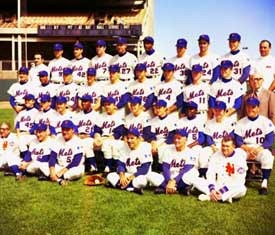
New York Mets Logo 1969 Mets Tom Seaver


If you’re one of my international readers chances are good you care nothing about baseball. I’m glad for you. I hope your life is filled with correspondingly high minded pursuits. As for me, I grew up in New Hampshire and obedient to my locale, came to love the professional sports teams in nearby Boston. I was lucky to be a fan of the Boston Celtics in their legendary “Bill Russell era” when they won 11 NBA championships. I listened to their games on our old tube radio. Really. I’m a fossil.

So how is it that I root for New York’s National League baseball team, The New York Metropolitans, who are better known by their colloquial name “the Mets”? 

Well, in 1969 the hapless Mets (who were created out of nothing in 1962) won the World Series. I was 14 years old. I found their improbable “rags to riches” story altogether compelling. They were a team of castoff players with five extraordinary young pitchers and they performed miracles. They were the Amazing Mets. The Miracle Mets. They made baseball fans out of people who had never before paid any attention to the game.

You have to understand that in 1962 the Mets lost 120 baseball games. And suddenly they were the scrappiest, grittiest, luckiest team in all of baseball. The Amazing Mets.

I was a blind kid. So of course I was caught up in the joy of the underdogs toppling baseball’s royalty. I’ve never forgotten it.

When the 1986 Mets played my beloved Boston Red Sox in the World Series I let fate determine the matter, which is to say that I told my father the Red Sox would likely blow it. Enter Bill Buckner. I still love the Red Sox. Always have.

But the Mets were pure magic the year I was 14. The album topping the charts was Abbey Road. I was a kid with very bad eyes who wore spectacles thick as padlocks on his face and who worried he’d never fit in anywhere in this world. The come from behind, utterly improbable Mets gave me a sporting thrill I’ve never experienced since. When my beloved Red Sox finally won the World Series (and then won it again three years later) they were arguably the best team going. The 69 Mets were beautifully unlikely.

And so I still root for the team from Flushing, Queens. They are now nearly bankrupt, losing with multi-million dollar players, their fan loyalty eroding. But they are the New York Mets and I wear their team regalia with ardor. They will always be my Mets.

I love you Tom Seaver, wherever you are.  


S.K.


Disability and the Spring Birds

There is no easy way to describe birds though poets have tried throughout human history. The essential reason that birds cannot be described is that we see them always as metaphors, which is a problem if what you want is the art of the bird, the essence of birdness. So we write of the bird as spirit. Even our tribal ancestors did so. A famous Ojibway poem describes feeling sorry for oneself—until the narrator announces that all the while he is being carried across the sky on great wings. We understand the bird as a symbolic coefficient of mind and wish. But Lord help you if you try to put one in words.

I was in mind of this early today when walking with my guide dog Nira, and owing to recent eye surgeries, I was able to discern a very large, startled goose corkscrew into the air from its hiding place beneath a foot bridge. All feathers and ligatures, muscle memory and atavistic spasms it was. The bird was alive and ungainly and improbable and offered the only kind of beauty I am attracted to. And of course the bird had been asleep and then it was alive like a sentient bee hive. And because I was walking and properly meditative I saw that my blindness and the bird’s unlikeliness as a figure for poetry were in fact the same thing. Poets can only write about the occasion of the bird. Even good poets must imagine a mise en scene wherein the bird is oddly remarkable, which is to say that they don’t write about the birds at all. Here is a poem by Wendell Berry that illustrates what I’m observing:


Sparrow


A sparrow is

His hunger organized.

Filled, he flies

Before he knows he’s going to.

And he dies by the same movement: filled

With himself, he goes

by the eye-quick

reflex of his flesh

out of sight,

leaving his perfect

absence without a thought.


Aha! You see my point of course. Birds are no more describable than the other imponderables which are instinctual, mysterious, accidental, risky, beyond the scope of will. In point of fact Wendell Berry’s terrific little poem about the sparrow is an accurate narrative of disabling dislocations—“eye quick”; “reflex of his flesh”; inchoate as vanishing itself.

All this because of a goose under a bridge, early morning in Iowa City.

Meantime one can only narrate disabilities by what they are as glimpses, like shadows flying through the trees.


S.K. 

Watching Spike Sit Down

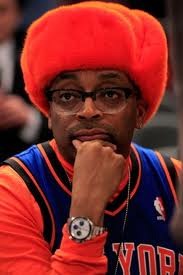
Spike Lee Wearing Knicks Gear


There may be more annoying things than the sight of Spike Lee dolled up in his New York Knicks regalia but not for me. Please note that I’m not confusing annoying with sinister. There are worse things in this world than Spike’s juvenalia. Robert Mugabe comes to mind. Or the horrible Burgundy Goliath Bird Eating Tarantula. I should add that I’m an admirer of Spike Lee’s films and his political work. But enough said. He’s irritating. And so last night’s win by the Boston Celtics over the Knicks was especially satisfying inasmuch as Spike had to sit down. Where be your gibes now, Spike? Maybe you shouldn’t bait Kevin Garnett? Taunting players on the other team can backfire.

So alright. I admit it. I’m a Celtics fan. And once in awhile I can stray from my gray library, the mordancy of my arm chair—academic pursuits, whatever takes the place of the philosophers’ stone for some old fashioned peanuts and cigar smoke. I enjoyed Kevin Garnett’s performance at the Boston Garden last night.

Schadenfreude aside, Spike Lee is a winner. His work on behalf of the city of New Orleans is admirable. We like him outside the gym.


S.K.