Anthem


I will praise my maker but not today—here in a green study

at my desk arranged like battle lines 

I’ve nature “tooth and claw” 

and two blind eyes. (I’ve more than this— 

shirts and shoes, 

my children’s clothes, 

abnormal psychology, 

doubts cast in books.)

May praise be scattered like old prayers

til it enters the wheat. May I carve 

with a penknife on a door 

whispers of my household.


May God wait in irregular shadows.


Self-Interview: A Dog Named Prospero

At Guiding Eyes 1996


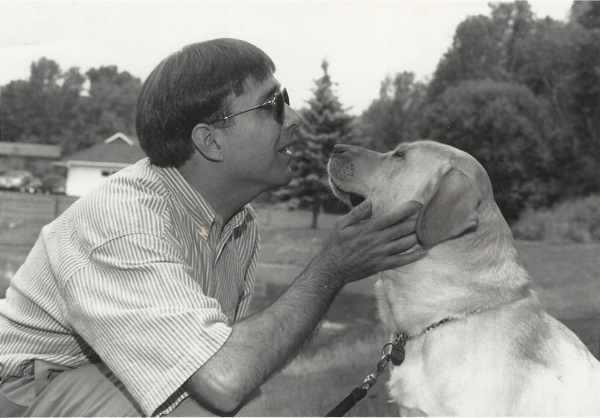
Photo of Stephen Kuusisto and his first guide dog “Corky” on the grounds of Guiding Eyes for the Blind, ca 1995


Nature with tooth and claw doesn’t love us. Nor are the affairs of nature “just”. And some 30,000 years ago dogs entered our circle and helped people by lessening the sting of nature’s cruelty. Dogs are beautiful actors. They should receive annual awards from the Academy of Motion Picture Arts and Sciences. “Best Canine Assuager of Natural Horror” goes to Benjie,” A dog says: “I love you too” and defies the script of nature. Of course horses do this, and cats, and raccoons, but dogs have studied the matter like Prospero. 


Strangers ask: “What’s your dog’s name?” as we stand at a curb, concentrating, getting ready to cross a street. This happens so often that veteran guide dog users have devised a trick: we toss out a false name. “Anastasia” I say. They look at the dog then coo,”Hello Anastasia,” and wonder why she doesn’t look at them. “Not very friendly is she?”


 “Prospero,” I say when we’re out of earshot. “Her name is Prospero.”


**


Why Prospero? He’s Shakespeare’s grand magician in “The Tempest”. He knows the book of nature inside and out.  Nature does his bidding—this is every person’s fantasy.

A dog “is” nature, and she knows it. But she’s willing to go along with our belief in lovingkindness. This is every dog’s genius. Prospero threw his book into the sea; dogs buried theirs. 


**


Nietzsche said something like “man is an animal of promise” and while this is true, we’re endlessly qualifying our nakedness, our instincts, our furtive glances. 


My guide dogs don’t care whether I’m naked or not. This is much like their immunity to blindness. Again, strangers ask: “Does your dog know you’re blind?” “No,” I say, “my dog just thinks I’m stupid.” The joke deflects the insensitivity of the question. But if I raise the emotional ante, my dog knows she must complete me. Here is a ditch. She pushes me away from it. This is easy for her because her instinct to avoid the ditch can be shared without cost. She shares. 


Ode to a Dog's Nose

A dog’s nose takes in the world like a child seeing a Cresh—animals, people, hay, friends, strangers, gifts, food, astonishment. Any dog’s nose finds semantics in the fragrant spaces before it. Up hill and down we go, the blind guy and Labrador. The man hears a radio in a passing car. The dog smells the driver’s fear stinks. The dog smells onions a block away. It goes without saying, the dog is more alive on the smelly planet than the man. 


In Graz, Austria, I opened a window in our hotel and Vidal poked his head out and scented blackbirds. He was like an old man savoring perfume with his eyes closed. Vidal’s smell-joy was palpable.  


I wrote in my notebook: Spend all day with a dog’s nose and try to imagine what’s going on in there. 


Up hill and down we went, Vidal and I. Austrian Dachshunds and their portly owners in the park. 

A woman on roller skates with her Alsatian. Dogs happy with their owners. And Vidal scented everything—uncommonly—working his snout as he’d never worked it before. His was the nose supreme. He smelled the European Turtle Doves—I’m certain he said, “We ain’t got this in New York.”—smelled the Common Cuckoo, a yellow smell, what else would it be? And the Hoopoe and Green woodpecker—they probably smelled like pepper. And Nightingales; European Robins…


I wrote in my notebook: New doors in a dog’s psyche?  Or have they always known these smells—know them from the canine genome? 


We went inside a mountain and navigated tunnels dug by the Nazis. I wondered if Vidal smelled the patina-smoke of misery still clinging to the damp stones. I wondered if there’s a half life to the odor of fear. 


Odors of vulnerability; of losses; of luck… And dogs prancing through them…


Would a dog know losses? Surely he’d smell them. One thinks of Hemingway’s description of a dry fountain giving off the odor of death. Dogs smell everything as optimism. This is one of their secrets. One remembers Helen Keller who said: 


“No pessimist every discovered the secret of the stars, or sailed to an uncharted land, or opened a new doorway for the human spirit.” 


Dog noses open new doorways.


Supporting CRPD


pastedGraphic.png


CRPD National Call 

on January 28th! 


The treaty needs your help – call the Senate back to the table NOW! 

Join us to help develop a national strategy to allow for continued negotiations on the disability treaty! 


What: CRPD Community Leadership Call  

When: Tuesday, January 28th, 1:00 PM ET 

(12:00 PM CT/10:00 AM PT)

RSVP: http://www.surveygizmo.com/s3/1251256/RSVP-for-USICD-DREDF-CRPD-Community-Teleconference


In December, Senator Corker walked out of the CRPD negotiations, much to the shock of Senators Menendez, Barrasso and McCain.


Don’t let your Senator hide behind the EXCUSES of Senator Corker’s false constitutional arguments!


Contact your Senators!


Click here to get a direct link to your Senator’s office:

 www.disabilitytreaty.org 


Tell them that you want the treaty to move forward and ask them to tell SFRC to take up the treaty negotiations once again!


 Tell them we will not give up and they should not listen to the FALSE statements given by Corker. 

We need to let the SFRC know NOW that the treaty is important to all of the world community!  They MUST hear from us! 


Emboucher poof!


NewImage


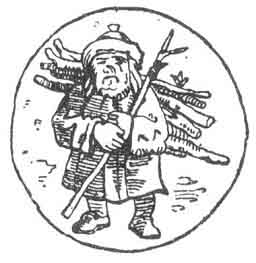
Image of the man in the moon gathering sticks.


Many European legends depict the man in the moon as an old fellow hauling a bundle of willow sticks upon his back (formed from the craters of the moon called Mare SerenitatisTranquilitatis andFoecunditatis). He carries a lantern on a forked stick (the crater Tycho), and he is accompanied by a little dog (Mare Crisium). Shakespeare used this description in Act Five of A Midsummer Night’s Dream. The actor playing Moonshine in the bumpkins’ performance of Pyramus and Thisbe is costumed exactly so.


When I was a kid my mother told me she used to think the final lines o “Silent Night” were: “Sleep in heavenly peas.”


Today in a meeting I thought I heard someone say “sawtooth reduction” but they were saying something else. 


I’m sure this person was saying something perfectly sensible like “leveraged sustainability” or “emboucher poof!” 


Meantime, post meeting, I have this mental image of a very small man with a very small saw. 


Perhaps he’s the man in the moon, the one who collects all the little sticks?


Come Back to the Five and Dime Dear Spinoza

Spinoza wanted to free God from mysticism. My friend X wants to free his wheelchair from superstition. The symbolic mind is the island we can’t escape. Ernst Cassirer mumbled into his spetzel that we’re creatures of figuration. I bang my spoon. “Yes, Ernst, but the disabled are tarred and feathered by capitalism.” “Ernst, all disabled people are malformed according to capital accumulation. The only way out involves sentimentality. Tiny Tim. Inspiration porn.”


Ableism was happy, augmenting his practice, curing people with euthanasia. “Hello, hello? Cassirer, are you still there?”


Disability Theory and Nostalgia

Some people have a penchant for nostalgia but I’m not one of them. I don’t think the past was better—any effort to frame the past is fraught with a hundred anxieties. Today is motionless, snagged in the dendrites of one or more sadnesses. Let’s return to yesteryear with a lollipop. I’ve been damaged by my education. Its a global education. A friend says, “It was better in the 1950’s” and I say, “Not if you were black, a woman, a person with a disability, a citizen ofGuatemala. Perhaps my dendrites are impaired, but they haven’t gone blank. 


Nostalgia is almost impossible for people with disabilities. “Oh for the good old days of the iron lung!” “The asylum was grand, especially the little cookies.” My childhood played out before the Americans with Disabilities Act and it was a horror show. I still harbor rancor for a famous professor at the University of Iowa who said if I was blind I shouldn’t be in his class. The year was 1984. When I went to the chair of the English department to complain I was told I was a “whiner”. You can see why I distrust nostalgia. 


But nostalgia isn’t always about the past. It can become a projective prologue, a kind of “reaction formation” as Freud would say. We project our conscious and unconscious motives not on people but on the future. We do it through the agency of cultural theory and activism and in the best sense we hope the future will be affected by our work, our troubling work. We want to break down ableism, hetero-normativity, all the isms. But often we fail to understand our visions  are utopian, Arcadian, and just as precariously balanced upon our anxieties as common nostalgia. 


This doesn’t mean activism and probative cultural scholarship is unnecessary. Far from it. It’s more vital now than at any time in history  since  we must assert human rights in an age when the split between the developing world and the post-industrial world is mediated by everything from transhumanism to cyborgian fantasy.     


That disability scholarship and activism are important is unquestionable. What I’m arguing is that what we may imagine as “the future perfect” is flawed if we’re guilty of visioning narrow or singular fantasies.


There is a split in Disability Studies between post-normativity (which is vital if we’re to imagine a human future) and life on the street (where “the disabled” are losing benefits, going homeless, and committing suicide.) 


This split as I’m calling it has a good deal to do with projective nostalgia. We ought to critique this. We should know the names of our own privileges. 


In Memory of Anselm Hollo


I went once into the labyrinth of a Helsinki library—no plan—and found a hundred books by your father. Old philosopher he was, though not “always” “old” but still, I bet he was “old” so you had to be fast and odd. 


You got yourself some wristwatch utopias right away. 


And a red piano.


**


I met a ghost in Helsinki. I was young enough to be surprised, old enough to worry. 


I was walking with Tim, our mutual friend. 


We stopped at a toy store. Six year old Pablo went inside to see the insect kites. 


It was April. There was weak afternoon sun, the sun you get in the far north. 


We lit cigarettes, I remember, and talked about poetry—Tim said something and I said something, and then I said—“I see!” And poof! There beside us was an extremely old man. 


He was agitated. His skin was thin as paper. He had a wisp of white hair on his crown which stood up. 


He looked at us, pointed, shook a bony finger and said: “Why do you say you see? You don’t see! You understand! You understand!” 


“Yes,” said Tim. “You’re right.” And Tim looked at me, and I, with my legally blind eyes looked at Tim. And then we turned back and he was gone. Quite gone. 


Tim ran up the block and looked down a perpendicular street. The man had been frail, old as the city’s bricks, and zounds! he’d appeared and disappeared in an electrostatic bolt. 


This is a true story. Inwardly I knew this event had something to do with my being profoundly blind and pretending I wasn’t. 


What a good ghost. What a fine city Helsinki really is.


**


If poetry is architecture for the odd, let us climb in the windows. 

If its music and light, let’s get the party started. 


The News From Old Finland

I didn’t want to be the rain

But it was my turn. Walked out of town.

You wanna be a shaman there’s no screwing around. 

A shaman’s soliloquy learned from his wolf. 

All relations invariant and pure.

Raining, a good time to howl. 

Wolf says don’t fool yourself. 

Rain says woods are perfectly Grecian.

Man sez its good to be a ghost in the rain in Arcadia…