Wheels

When I entered the woods alone; went in there as a boy; small, blind, very much in isolation, I invariably talked to myself. I remember saying, “Blue Jay has roller skates.” According to contemporary memory theory I shouldn’t recall this. Instead I should only recall a formative feeling over which my contemporaneous imagination inscribes it’s own ideas. But “hinx minx” I really said the Blue Jay has roller skates and I remember why. He was so loud and busy I just knew he was zooming along the branches on tiny wheels.

Now the world is filled with tiny wheels. Joy rolls. Sometimes joy falls like a leaf through space but trust me, it still rolls as if tumbles. Even when joy is darkness against your cheek, it still rolls.

Tears roll and mouths in love roll. All livelier dreams glide on wheels we’ll never be able to see.

Every human being rides their own wheels made of silver light.

I have seen a woman transform into a linden tree and I’ve seen other things as well. Blindness is no impediment to seeing things. I’ve seen autumn trees with dripping bark, reality weighing itself in a rising loaf of bread.

Wheels glimmering cold along the horizon.

Orlando, Trump, and Orwell’s Ghost

Micro totalitarianism and sexual persecution are the terms that come to mind for me as I struggle to absorb the slaughter in Orlando. The first is best represented by Donald Trump’s Brummagem—his tweet of self-congratulation announcing his brand of Islamophobia has been proven correct. The branding of hatred, commodifying it, blurting it, as if it’s face cream or Viagra is how micro totalitarianism is spread and sexual persecution is just one of its targets. Islamophobia and homophobia are equally salable in the United States, almost as easy to sell as assault weapons. From a disability studies perspective one sees that the baseline narrative of micro “t” is, among liberals, mental illness—a convenient class, abstract, ridden to death by endless episodes of Law & Order, let’s blame them for violence. Micro totalitarianism depends on persecution and it’s practitioners will cherry pick their victims according to what sells.

The shooter in Orlando may or may not have been mentally ill. He may have been warm to Islamic extremism, but at this juncture, given his apparent declaration that he supported Hezbollah, Al Qaeda, and ISIL—(which is like saying you support Stalinism, Trotsky, and Thomas Dewey) he seems more a figure of confusion, and perhaps someone with a persecution complex. He was, therefore, the perfect buyer, the proper customer for assault weaponry. Racial persecution, sexual persecution, disability persecution, religious persecution, all have in common the branding of hatred. Everyone in America is supposed to head straight over to the gun store.


Disability and Faculty Self-governance in the Age of Neoliberalism

When talking to faculty, students, and staff with disabilities who work or study at America’s colleges and universities, one quickly learns that higher education is broadly disinclined to treat disability in a concerted and efficient manner, but instead engages in widespread administrative deflection. From architectural barriers to simple pedagogical modifications colleges routinely drop the ball where equal access is concerned. So ubiquitous have these stories become one can browse the web for hours reading of school after school that has violated basic civil rights protections guaranteed by the Americans With Disabilities Act. From the University of Michigan, to Penn State to Harvard, one finds dramatic instances of disability discrimination. As a disability rights activist and professor who teaches that incorporating physical difference in the village square creates powerful opportunities and advantages I’m often asked why higher education performs so poorly. For many years I imagined these failures had simply to do with a basic financial resentment of the ADA, as one hears the widespread complaint from college administrators that it’s simply an “unfunded mandate.” The idea that barriers should be removed as a matter of civil rights is represented as a violation of libertarian principle. This seemed reasonable enough until over time I realized there’s a broader delegitimization of disability in the Ivory Tower and it’s only loosely connected to money.

In a recent interview at TruthOut Henry Giroux observes of Neoliberalism:

As a form of public pedagogy and cultural politics, neoliberalism casts all dimensions of life in terms of market rationality. One consequence is that neoliberalism legitimates a culture of cruelty and harsh competitiveness and wages a war against public values and those public spheres that contest the rule and ideology of capital. It saps the democratic foundation of solidarity, degrades collaboration, and tears up all forms of social obligation.


The past quarter century has seen the American academy shift from collaborative and democratic agreements about social obligations toward an embrace of monetized aggression. During this period the ADA has been overtly ignored by colleges of every kind. The two developments are syncretic, reflecting what Giroux rightly calls the failure to contest the rule and ideology of capital. It’s relevant to note in this context that “disability” first appeared in the mid-19th century as a term for laborers who’d been rendered unfit to work. The 20th century saw sustained advances in rehabilitation and employment services for people with disabilities, improvements which culminated in the passage of the ADA in 1990.

Neoliberal pedagogy and campus politics depend on limited faculty governance, the erosion of public debate, and the establishment of a culture of severe economic competition. Disability is re-inscribed as a 19th century problem. Accommodation services are sequestered—students are “sent” to ancillary offices for accommodations which they may or may not receive; faculty are taught nothing about pedagogy and disability; basic services like sign language interpreting or accessible technology are hard to find, and sometimes non-existent. At one liberal arts college where I recently spoke, a disabled student told me, “the disability office is hidden like an asylum.” Indeed. Disability is a drain on capital. Not because it’s an unfunded mandate but because after all is said and done, neoliberal visions of success are built as Giroux rightly says on cruelty and competitiveness.

Harvard and MIT are contesting the demands of deaf students and staff that instructional videos be captioned. Harvard’s opposition is symptomatic of the neoliberal university’s war on basic public values. In terms of governance Harvard’s resistance represents perfectly the academy’s abandonment of the principles of social obligation. But institutions only arrive at such a place when faculty are deterred from self-governance by the obligation to write endless grants and compete for provenance in the marketplace of capital ideas, when teaching and idealism are considered quaint and immaterial. In turn the civil rights of academic communities are “handled” by offices that are both physically and culturally distant from the “agora” or academic life of the campus.

The neoliberal campus relies on distention of self-governance and enforces centralized administration. Moreover it thrives on factionalism. A faction, as James Madison famously wrote in essay 10 of The Federalist Papers is a group “who are united and actuated by some common impulse of passion, or of interest, adversed to the rights of other citizens, or to the permanent and aggregate interests of the community.”

Because college faculty are often divided by competing interests and since some of these divisions reflect the complications and struggles of identity, it’s difficult to forge consensus about disability and disability rights—they seem tailor made for deflection, a problem for a specialized office. In other words, disability is often viewed by academics who are already narrowly factionalized as too difficult to embrace. As Lennard Davis notes in his book Bending Over Backwards: Disability, Dismodernism, and Other Difficult Positions:

Because disability is an amorphous identity with porous boundaries, other identity groups in the United States have had difficulty incorporating it into their goals. Previously legitimized groups such as Latinos or African Americans have been reluctant to admit disability into the multicultural arena. For example, in 1996 a disabled, white assistant professor at a historically black university found that the chair of the department and the dean of the school had recommended against tenure, saying that any analogy between disability and race was both methodologically unsound and insulting to the unique history of African Americans. For them, the categories of oppression were mutually exclusive and should not be mixed. After much public outcry from the disability community, the president of the university decided to award tenure to the assistant professor. Nevertheless, the issue of an identity defined by impairment as opposed to one defined by race or ethnicity is a sticking point for some. When some faculty members at Hunter College in New York City tried to include disability studies as part of the requirement for a multicultural curriculum, they were opposed by many of the ethnic and national groups that usually make up the progressive wing of the university. Hunter ended up deciding to omit disability from the curriculum.


From a disability studies perspective one sees how sectarian infighting among faculty concerned with categories of oppression can further the work of neoliberal administration, not by embracing the neoliberal brand of governance, but by replicating its effort to de-legitimize disability as a mainstream concern. De-legitimized disability remains in the province of non-academic offices. In turn university faculty fail to understand and embrace the nation’s largest minority. Such neglect reinforces a central fact of neoliberal administration which supports deflection where accountability is concerned and it represents rather broadly a further symptom of weakening faculty self-governance.


Me Before You, Benedict Arnold…

If disability is pictured as a thermometer one sees at the very top of the mercury scale “Courage” and at the bottom “Cowardice”—a register of willfulness or mind over matter which represents disablement as being entirely a state of mind rather than physical or neurological reality. How often does one have to endure the slogan: “the only disability is a bad attitude?”

Quite often it turns out. Courage is an easy word to bandy about. Whenever the first “c” word is used in media representations of the disabled, it’s invidious twin is suggested, as if living a crippled life is a stark affair when you roll down the street or follow your dog. You’re either heroic or you’re some kind of attitudinal traitor, a Benedict Arnold of the spirit.

Of course temporarily abled people don’t live this way. They’re not heroic in the supermarket, not cowardly when they shake their fists at drivers in front of them. The emo-thermometer is reserved solely for the cripple. I’ve lived with this fictitiousness all my life and if you’re one of my crippled readers I’m certain you have too.

Lately there’s been much consternation and outrage among disabled activists and their extended supporters about the film “Me Before You” as it depicts a paralyzed man’s decision to end his life, not merely because his disability is insupportable, but because he doesn’t want to burden the abled woman who loves him. The film is creepy, inauthentic, and ugly. What interests me however is it’s emo-thermometer reading: “Courage” becomes “Cowardice” or subsumes it in a way that suggests “the only bad attitude is a disability”—a twist that’s chilling and should alarm even the most seasoned viewers of films and television programs. Living with disability is presented in “Me Before You” as a traitorous act, a betrayal of love.

Love is presented as light while disability is dark and overshadows life. Now, ahem, life itself doesn’t work this way. In life trains arrive and depart, sunlight strikes the telephone wires, groceries are purchased, lawns are clipped—which is to say, life, living it, is, as any bird will tell you, simply a matter of the daily worm. Moreover living is essentially the hard thing, dying is easy.

This is what’s so objectionable about the film. Dying is easy. Disabled life is presented as a bad choice, a bad attitude if you will. “Me Before You” turns the standard (and already crappy) disability emo-thermometer upside down.

Ugh.


Alone, like…

I’m alone like a cabdriver who sleeps in his taxi dreaming of childhood. Red geraniums. Black currants. Sleep, invariably, is a still life for the lonely.

Last night I dreamt of my father, now long gone, who appeared beside a tall window at dusk, snow falling, and he was abosrbed, reading a book. I said, in the murmurous way of all sleepers, “that’s just as it was in life…”

Today the sun is as strong as before. We’re allotted approximately 3 billion heartbeats in this life.

Me Before You, or, It’s Life Itself Stupid

The current showing—nay, “display” (as in “public” display, as in “flogging” for the betterment of mankind) of the film “Me Before You” is more than an outpouring of murderous art, it’s a testament of sorts to neoliberalism’s incapacity to value what we used to call “the individual.” (Remember wave one Enlightenment? Remember throwing off your chains?)

The link above connects to The Guardian where a fine article by Ryan Gilbey explains the ways in which the film, based on a moist novel by JoJo Mayes spells out a message of hopelessness and euthanasia for the disabled. Many in the blogosphere have written powerful pieces about the deleterious and decadent nature of the film and the book and I recommend you read Bill Peace “Bad Cripple” here, but I’ll also quote him:

Me before you is not poignant. It is a romance novel that used disability as a plot device. It relied on one of the oldest and most destructive stereotypes associated with living with a significant disability–the assumption that death is preferable to disability. I know this because at least once or twice a year a stranger says tells me they would prefer death to using a wheelchair. Strangers have been saying this to me since I was 18 years old. As for the book addressing themes associated with life post spinal cord injury. Technically this is correct. But Will, unlike 99% of people with a spinal cord injury live on the edge of poverty. Unemployment is rampant, access to housing and mass transportation remains extremely difficult. Ableism has impacted every part of American society.   

Neoliberal, late-capitalist economies can’t imagine disability as a meaningful way of life not because paralysis or blindness or depression aren’t commonplace, but because the nature of neolib desire is made up of desire itself. In other words, neoliberalism isn’t interested in communities or the rising expectations of neighborhoods or nation states. Neoliberal desire is about abstraction—it’s pure fetishism which calls for an antiseptic world. It calls for repression wherever human beings suffer. Remember when Mitt Romney said the wire fences enclosing  Chinese factories were there to keep the envious away?

The practical aspects of disability are, if not easy to master, achievable certainly. Yet films like Me Before You invite the public to imagine that a disabled life is a burdensome thing, and too difficult to enact. Enacted life is, to put it another way, artful life. Me Before You says there’s no art to disability. In turn it says there’s no art to difficulty. The only artful life is a perfect life, an unblemished one, one that’s ultimately fictional. Lust for fictional lives ladies and gentlemen. They’re the only lives you can have.

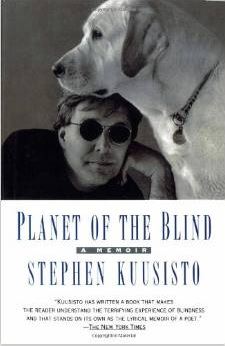
In my new memoir (forthcoming from Simon & Schuster) I talk about disabled life as an art form. The book is about my life with a guide dog named Corky. She didn’t teach me how to be blind or how to like myself—those are tasks for human beings. But she did show me how to savor a hundred moments:

Neuroscience explains the theory of embodied mind or cognition: when we look at someone we experience an internal process that mimics another’s emotional state. Empathy works this way. And along with this comes a perception that time is slowing. This feeling of slowed time helps to create social interaction between people. Owing to Corky, I believe dogs gave us this gift. Dogs slowed us by relieving us from the fight or flee pins and needles edge of merely surviving. It’s undeniable dogs have always drawn us into the here and now.

This invitation very likely induced humans to fashion what the Greeks called “oikos”—the root of ecology, but originally a term for house-holding, and family.   

Dogs taught us to see and know our surroundings and they proved one part of providence is living right. 

Oikos, here-life. 

**

“If I knew then what I know now,” I often said to her. I wasn’t without irony. The phrase is sentimental and sentimentality is a wide and very sticky subject especially where dogs are concerned. “If I knew then what I know now,” I said to her as we flew in a jet liner that, according to our captain was straight above the Grand Canyon. 

Sentimentality means my dog asked me what I meant. 

“Well,” I said as she settled her head on my knee in seat 1A aboard a Boeing 737, “well I’m reminded of Carl Jung’s remark about one of his patients—Thank Heaven he could make up his mind to be neurotic. I see now after much distress, there’s nothing faulty about blindness and I should have gotten here much sooner.” 

And Corky asked me what I meant. “Should have.” 

Dogs don’t believe in should have. They don’t take stock in it, as Huck Finn would say. 

And I quoted Allen Ginsberg to my dog: O victory forget your underwear we’re free.

**

We talk about the art of getting naked or of flower arranging, but we never speak of the art of becoming disabled. In America disability is discussed simply as rehabilitation, as if living is no more complicated than lighting a stove. 

The art of getting disabled is a necessary subject. When we look to history we find examples of this art everywhere. Disabled makers stand against loss.  They make something of difference. When traveling in France Thomas Jefferson broke his wrist. A surgeon set the break badly. A major facet of his life was changed forever.  He was forced to put aside his treasured violin. In turn he took up long, slow, leisurely horseback rides as a meditative practice. 

Blind people don’t necessarily need dogs. White cane travel is a very fine way to get around. But I say guide dog travel is an art. It’s a means toward living much as Jefferson learned to live. Moving in consort with an animal is one way to make a life. Art is mysterious. Some find a path to a certain form. Some find an unlike form. 

Thomas Jefferson sang to his horses. He was very fond of singing. Moving in consort requires it I think.

It’s hard to imagine singing to a white cane. 

I sang all kinds of things to Corky. For her the singing meant contentment. Often I went into my bad operatic mode and sang Neapolitan love songs to her. Cardilo’s “Core N’grato” was one of my repeated offenses:

Catarí, Catarí, pecché me dici

sti parole amare;

pecché me parle e ‘o core me turmiente,

Catari?


The Great Caruso I was not. I reckon the sight of a man with sunglasses singing in bad Italian to a harnessed dog may well have been amusing to many. 

**

Do you need to sing to live well? No. I’ve a great good friend who is nonspeaking. But in turn his whole body is music. 

My deaf friends sing. 

Many of my wheelchair pals are dancers. 

Several of my disabled friends are comedians. 

We crackle, zip, exhale, inhale, sport with our fingers, flap, jump, pop wheelies, and jingle with harnesses.

Resourceful life is practiced. Sometimes it is silly. Art can and often should be frivolous. With permission from curators at the Museum of Modern Art I was once allowed to spin Marcel DuChamp’s famous wheel, a bicycle fork with front wheel mounted upside-down on a wooden stool. DuChamp was a DaDaist. He made art by placing things side by side that did not formally belong together. A MOMA staff member handed me a pair of latex gloves and I pulled them on and with Corky watching beside me, I reached out and gave DuChamp’s aluminum wheel a spin. “This is the steering wheel of my life,” I thought. Frivolous motion.

I certainly know some blind folks who’d say I’m over the top talking about art in the context of service dog life and to each his own. All I know for sure is what a guide dog can do. Though the stationary wheel of your life seems forever stopped, your dog says give it a turn.


**

Disability life is life. It’s not a secondary or sub-sectioned existence. It is life. It’s life the way life is, on a day when you see the wild geese heading south and north at the same time. It’s life knowing music is cultivated time and knowing time heals nothing.