The tide of Fascist contempt (evinced by Donald Trump’s sordid campaign for the Presidency) has turned quickly to sanctioned scorn, something far worse than “blowing off steam” or simple exultation. Two days ago a hijab wearing woman was pushed down subway stairs in Manhattan; swastikas now appear everywhere from the University of Iowa’s library to a Jewish cemetery in upstate, New York. These are hate crimes. Moreover under the emerging administration they’re going to be business as usual.
I’ve been shivering. I recently experienced my own first bit of hate when a cab driver, (also the owner of the company) refused to give me a ride because of my guide dog. That refusal quickly became a matter of putting me in my place in the new “order” for he invoked Trump when I said this would become a news story, when I said I’m a writer and have written for many publications including the New York Times. “Trump is taking care of you people,” he said. He also said, “now I suppose you’re going to whine about your rights.”
In his canonical book The Rise and Fall of the Third Reich William Shirer described Hitler’s first meeting with Germany’s industrialists.
“Hitler began a long speech with a sop to the industrialists. “Private enterprise,” he said, “cannot be maintained in the age of democracy; it is conceivable only if the people have a sound idea of authority and personality… All the worldly goods we possess we owe to the struggle of the chosen… We must not forget that all the benefits of culture must be introduced more or less with an iron fist.” He promised the businessmen that he would “eliminate” the Marxists and restore the Wehrmacht (the latter was of special interest to such industries as Krupp, United Steel and I. G. Farben, which stood to gain the most from rearmament). “Now we stand before the last election,” Hitler concluded, and he promised his listeners that “regardless of the outcome, there will be no retreat.””
A sound idea of authority and personality. The struggle of the chosen—by which Hitler meant the people sitting in that room. The population at large? They’ll get what they get when we say so. Others—those who resist—will be eliminated.
Now in America it will be hard to directly eliminate opponents. Of course it will. But the broadcasting houses, the churches, the state governments, all can be turned toward the immediate work of reinforcing a narrow view of private enterprise, a slim view of acceptable citizenry, and certainly the cult of personality. My cab driver said so. He said it plainly. My people are now being taken care of by Trump.
On Sunday evening CBS ran a vicious piece about the Americans with Disabilities Act, essentially portraying it as a profound impediment to business. Lainey Feingold, a noted disability rights attorney writes at her website how 60 Minutes filmed a piece about the 25th anniversary of the ADA many months ago, a story which highlighted breakthroughs in technology and employment for the disabled. They never ran that story. Instead, Feingold writes, they ran an entirely oppositional piece:
Why would 60 Minutes decide to run a negative story about the Americans with Disabilities Act now, eighteen months after filming? Why craft a story that left out hours of film and interviews about effective ADA advocacy. There can be only one explanation. Someone at 60 Minutes wanted an anti-ADA piece to support Donald Trump’s anti-regulatory, anti-ADA, and anti-disability agenda.
When television networks air such programing they’re of course doing the work of a rightward galloping administration which already, even before it takes office is overtly engineering a collective rollback of civil rights.
Yes my people are now being “taken care of” by Mr. Trump. Except they aren’t, they’re being shoved to the side, slopped and hogwashed by complicit journalism. Anderson Cooper should be ashamed of himself, though one supposes he lives in such a perfect bubble he’s beyond social irony. Or perhaps he’s a single issue politician. Maybe.
Now you can bank on what’s to come: elimination of more voting rights, destruction of women’s rights, piece by piece, deportations and unlawful arrests, a significant boost to the school to prison pipeline, toxic water and air—the list is too long for a customary sentence in the English language.
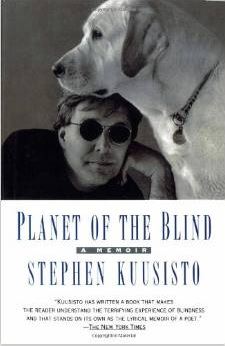
 Planet of the Blind