How to Save the Planet, or, Thoughts While Shaving

The year is ending badly for human rights and the environment and these things can't be blinked away. I tried some serious bug eyed blinking last night and it didn't work. Even Carl Jung knew there are limits to magical thinking.


The opposite of magic is just plain old perverse mischief–pissing in the shrimp dip, which is what I fear the Democratic Party has in store but it will be insufficient to the tasks ahead no matter the satisfaction.


The Dems must regain the upper hand on matters of local and regional progress. They should be reading Jay Walljasper's book “All That We Share: How to Save the Economy, the Environment, the Internet, Democracy, Our Communities, and Everything Else That Belongs to All of Us” rather than say, Joe Biden's presumptive memoirs.


This belongs to the category of morning thinking I like to call thoughts while shaving.


Well poets don’t tell the truth much…

Well poets don’t tell the truth much, too busy bathing the peacocks

Walking lonesome in the harbor, Helsinki, spices in the air—

First time I was productively isolate, singing softly

Up river or down the road, all my friends lived far away.

When I think on it now I’m still twenty three among the Baltic gulls

Humming “My Funny Valentine.”

Wind from Estonia blowing darkness against my cheek…

Looking warily at strangers, thinking:

Imagine well of me, oh, and glance just so

To say everything will be OK…

I wasn’t yet patient or experienced, but could tell it so…


The Essay Has Never Been Healthier

“Without education,” wrote Chesterton, “we are in a horrible and deadly danger of taking educated people seriously.” If you fancy a dull trudge affecting to defend the literary essay you’re in luck: see rebarbative and stodgy William Deresciewicz in the latest Atlantic. Though it’s not easy some writers can be unattractive and dull simultaneously and Deresciewicz, since his early retirement from Yale, has made a career of it.

Defending the essay is unnecessary: the art is broad, muscular, and in good health. Still Deresciewicz can’t resist. His Atlantic piece is turgid, silly, and vain but he thinks he’s guarding “the essay” from the unwashed. Accordingly he pretends to aim high while pointing his arrows low. For this there’s nothing better than fustian prose. Here’s his opening:

John D’ Agata has accomplished an impressive feat. In three thick volumes, over 13 years, he has published a series of anthologies—of the contemporary American essay, of the world essay, and now of the historical American essay—that misrepresents what the essay is and does, that falsifies its history, and that contains, among its numerous selections, very little one would reasonably classify within the genre. And all of this to wide attention and substantial acclaim (D’Agata is the director of the Nonfiction Writing Program at the University of Iowa, the most prestigious name in creative writing)—because effrontery, as everybody knows, will get you very far in American culture, and persistence in perverse opinion, further still.

Of John D’Agata we shall have more to say presently, but note straight off Deresciewicz’s three strands of bombast: false praise, (sentence one); faux incisiveness (sentence two, sophomoric as it is); and manifest sophistry (wink, wink, effrontery, as everybody knows, will get you very far…).

This is prime Deresciewicz. There’s deceit in the land and it’s occurring at the very best universities, right now, under your nose and you can trust him as he’s abandoned his suspect, icky job at Yale to be, well, a big time prevaricator—which, while you may not know it, comes from the Latin praevaricat “to walk crookedly” but of this he’ll have nothing to say.

Deresciewicz’s golden calf is his noisome antipathy to professors. It’s a living. But one thinks of Truman Capote’s assertion: “I like to talk on TV about those things that aren’t worth writing about.”

John D’Agata is a poet and essayist who earned notoriety (in the provincial way of American letters) when he wrote a book about Las Vegas wherein he uncovered the manifold ironies and tragedies of the Entertainment Capital of the World, Sin City, the City of Lights, Glitter Gulch—and neighbor to Yucca Mountain. Vegas is a vast, grim palimpsest and D’Agata aimed to reveal it with prose at once factual and impressionistic. The latter put D’Agata in the crosshairs of the Joe Friday Squad of nonfiction writers and critics—“just the facts m’am”—“this is reality we’re talkin’ ‘bout!”—“and by God don’t confuse us with colors and fancies!” In fairness to D’Agata he blends facts with fictions—the latter intended to flesh out what isn’t knowable—rendered as a matter of speculation. He tells his readers as much. Still, nonfiction is thought by some to be journalism just as journalism is imagined a stepchild of photography. “Give us facts and more facts! We’re hungry! Num num num!”

In the Vegas book D’Agata plays with chronology while telling the story of a young man’s suicide—injecting an imaginary sequence of circumstances into a verifiable and tragic incident. This was a red flag to the Joe Friday squad and the resulting brouhaha spread across both the blogosphere and whatever still passes for trenchant journals. The matter came to light when  D’Agata and his fact checker engaged in a public war of words about the relative value or the lack thereof of facts in essays and nonfiction.

In Nonfiction Land defending the impressionistic, the fanciful, the subjective is risky, though it shouldn’t be, since Montaigne, the grandfather of the essay, was a splendid writer of fancies. Essentially the essay became a delivery system for facts and factoids in the 20th century and D’Agata’s goal (one I share) has been to lend nonfiction—return it—to a high romantic (small r) sense of poetic possibility.

It’s easy to make enemies in literary circles of course, and even easier to make them if one adopts an outlier’s position, which of course John D’Agata has. One would never know from Deresewiecz scree that literary nonfiction has bloomed in our time; that richly imaginative practitioners are stretching forms; that this work is superb and not at all invidious. One is free to not like the lyric impulse in nonfiction. Taste is a matter we should never treat lightly. I for instance dislike tight little formalist poems about sexual dysfunction and accordingly I don’t believe Philip Larkin is worth a second read. This is merely taste. Mine.

Second rate writers imagine poetry or nonfiction or the novel as real estate. They have theirs. It’s all they’re interested in. I don’t remember the lines precisely, but the Israeli poet Yehuda Amichai once wrote something like: “people who live in houses in fog on the hillside think the whole world is covered in fog.” So it is with both aesthetics and politics.

The literary essay is not harmed by poetry anymore than the novel is damaged by science fiction or a cookbook by personal narrative. But in Deresewiecz’s view there’s something nasty in the woodshed. Them faculty types are once again doing something invidious over thar in the groves of academe. This is of course piffle.

Should nonfiction be factual? Of course. Should it have room for poetry and divagation? Of course. Can we imagine readers who make artful choices? Of course. Which is the problem ultimately with the Joe Friday Squad: they’re enforcers but so very refined. For the JFS crowd literary essays should always be like table settings at the Four Seasons. You’d better know which fork is which and what it’s used for—and thank god there’s an essayist who’ll tell you!

John D’Agata is febrile and wholly unapologetic in his defense of subjectivity and impressionism, arguing the essayist can in fact capture feeling and sensation in lieu of a slavish devotion to verities. “My God,” cries the Joe Friday Squad, “they’re letting inmates run the asylum!”

How easily one forgets the asylum is real estate. Over its lifespan it will have many uses.

Simple then to believe the essay is in distress; that facts in creative writing are under attack; that civilization is in danger; that something nefarious is going on at a college near you.

Deresewiecz would have his readers believe D’Agata is Typhoid Mary, infecting the libraries and bookstores of America with meretricious nonsense. The truth and indeed the scruple is, and always, more nuanced and compelling. Ronald Reagan said famously “Facts are stupid things,” but D’Agata doesn’t think so, nor do most lyric writers who work with the essay form. What marks Deresewiecz as duplicitous is his failure to make a distinction between D’Agata’s willingness to look beyond facts and the instances where D’Agata simply makes a mistake. (Much is made of D’Agata’s assertion in the forward to an essay that the USA went to the moon 18 times. “Foul!” cries Deresewiecz without acknowledging a rather simple mistake—we sent 18 men to the moon on six rockets. In the final analysis Deresewicz has published a second rate ad hominem attack rather than writing a nuanced view of D’Agata’s work or of the essay as it’s practiced in the 21st century.



Freedom for Ryan King

FOR IMMEDIATE RELEASE                     

December 12, 2016


Freedom for Ryan King


In a landmark Court victory, Ryan King won the right to direct his own life, with the support of his family, finally free after 15 years under a guardianship he never needed. When Ryan turned 18, his parents were told they had to become his guardians in order for him to receive services from the District of Columbia. Even though they had raised Ryan to be independent, believed he could make his own decisions, and had always supported him to do so, they reluctantly agreed.  But, Ryan and his family never stopped hoping that, one day, he would be legally free to make his own decisions, the same as every other citizen. Then, inspired by the “Justice for Jenny” case and the work of the Jenny Hatch Justice Project (www.JennyHatchJusticeProject.Org) and the National Resource Center for Supported Decision Making (www.SupportedDecisionMaking.Org ), partnerships between Quality Trust for Individuals with Disabilities (QT) (www.DCQualityTrust.Org) and the Burton Blatt Institute at Syracuse University (BBI) (www.BBI.Syr.Edu),  they decided to ask the Court to end Ryan’s guardianship.


Working with attorney Jonathan Martinis through a legal clinic established by QT and BBI, Ryan and his family told the Court that Ryan uses Supported Decision-Making (SDM) to make his own decisions. When people use SDM, they work with trusted friends, family members, and professionals to help them understand the situations and choices they face, so they can make their own decisions without the “need” for a guardian. They presented evidence of Ryan’s history of making decisions and directing his life using SDM, as well as research showing that people with disabilities who exercise more control over their lives – who have more self-determination – have been found to have better life outcomes. After reviewing this material and hearing from Ryan and his family, the Court terminated the guardianship.


Ryan and his family, who will be supporting him as he directs his own life, are elated by the decision. “It feels good not to be under guardianship, because I have always made my own decisions,” said Ryan King. “As a family, we are thrilled with the Court’s decision,” said Ryan’s Mother, Susie King. “We hope that this is just the beginning of Supported Decision-Making being recognized in the District of Columbia and beyond.”


“Ryan and his family demonstrate the promise and the practice of SDM,” said BBI Chairman and University Professor at Syracuse University Peter Blanck. “Research shows that, when people with disabilities, like Ryan, are given the chance to make their own decisions and control their own lives, they can lead better and richer lives.”


“Defending the right of people with disabilities to direct their own lives is a core value for our work at QT,” said QT CEO Tina M. Campanella. “QT has been proud to know and work with Ryan and his family for years, and we are so pleased with this outcome. Through his fight to restore his legal rights, Ryan is a living example of how people with disabilities make the most of their abilities.”


Contact:


Jonathan G. Martinis, BBI, 571.247.6174, JGMartin@Law.Syr.Edu


Tina M. Campanella, QT, 202.448.1450, TCampanella@DCQualityTrust.Org

Quality Trust for Individuals with Disabilities


Quality Trust’s vision is a community where everyone is respected, belongs, contributes, is valued and shapes his or her own present and future. Quality Trust’s mission is to be an independent catalyst for change in the lives of people of all ages with developmental disabilities. Quality Trust partners with people and their families so they can succeed, thrive and experience full membership in the communities they choose. Quality Trust works with individuals and family members to solve problems, identify opportunities for learning and contribution and find creative ways to minimize “differences” and make the most of each person’s abilities.


The Burton Blatt Institute


The Burton Blatt Institute (BBI) at Syracuse University mission is to advance the civic, economic, and social participation of persons with disabilities in a global society. BBI builds on the legacy of Burton Blatt, former dean of SU’s School of Education and a pioneering disability rights scholar, to better the lives of people with disabilities. BBI has offices in Syracuse, Washington, D.C., and Atlanta. Given the strong ties between one’s ability to earn income and fully participate in their communities, BBI’s work focuses on two interconnected Innovation Areas: Economic Participation and Community Participation. Through program development, research, and public policy guidance in these Innovation Areas, BBI advances the full inclusion of people with disabilities.


The National Resource Center for Supported Decision-Making


The National Resource Center for Supported Decision-Making (NRC-SDM) builds on and extends the work of Quality Trust’s Jenny Hatch Justice Project by bringing together vast and varied partners to ensure that input is obtained from all relevant stakeholder groups including older adults, people with intellectual and developmental disabilities (I/DD), family members, advocates, professionals and providers. The NRC-SDM partners bring nationally recognized expertise and leadership on SDM, representing the interests of and receiving input from thousands of older adults and people with I/DD. They have applied SDM in groundbreaking legal cases, developed evidence-based outcome measures, successfully advocated for changes in policy and practice to increase self-determination, and demonstrated SDM to be a valid, less-restrictive alternative to guardianship.


Chet Baker After Years


You didn’t need me, father, not much

though I washed your windows with vinegar—

and such a song that was

late August, the dear light

whispering in the goldenrods

and your boy

with his crooked teeth,

blind eyes,

a song or two in his heart

(aiming to be useful,

wanting to have the utility

of sons, to be of worth)

pushed a wadded rag

into mullioned corners

My Funny Valentine

on the battered radio,

crickets in the grass,

love songs everywhere.

Well, let me tell you

though its now too late,

ill favored devotion is my horn.


Thinking of Nancy Mairs

I'm so damned sorry to hear Nancy Mairs has died. Given the selfie fetish of our age I should say obligatory things about having known her or describe what she did for me (for this is the expectation in the blogosphere) but I met her only once at a noisy conference dinner and we didn't strike up a correspondence afterwards. The world sends us in different directions even when we have much in common.


Mairs was an uncompromising literary writer–a poet who wrote nonfiction out of necessity. Disability demanded it. Nietzsche was wrong. The abyss does not stare back and so what we choose to say about it frames its features. Nancy Mairs could be funny but not about this. “My God is not a handicapper general,” she famously wrote with a deft tip of her cap to Kurt Vonnegut Jr.. Laugh or cry about disabilities they are simpler than we suppose. Insert irony: relieved of mystic immanence and lived as daily life being crippled is ordinary, aggravating, clumsy, embarrassing, noisome, and beautiful. Nancy Mairs could turn being helpless on the floor into prose poetry.


She once wrote:


“Out of the new arrivals in our lives–the odd word stumbled upon in a difficult text, the handsome black stranger who bursts in one night through the cat door, the telephone call out of a friend's silence of years, the sudden greeting from the girl-child—we constantly make of ourselves our selves.”


Simple. Check the etymology of arrival. It means coming to land after a long voyage at sea.


Surprise is the only destination.


My Disability “Piece” the New York Times Didn’t Print

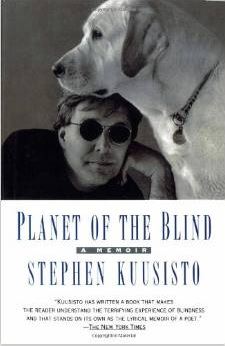
When morning comes my Labrador brings me a shoe. It’s a Nike, light as a duck, and as I slip it on it’s damp. She’s a guide dog, mine—blindness has this graceful compensation, one wakes to an eager companion. Silly to say she’s optimistic, dogs don’t need hope, not the way we do, but expectation is another thing: she knows the day. This day, will be its own reward and will not fail. She’s not silly is she? I get dressed, throw a ball cap on my head and we head into the weather.

We walk along Central Park West in a light rain. Her name is Corky. It’s a proper name for a killer whale but not precisely right for a service dog, but we’re happy in all weather—together we laugh about it because dogs can laugh and you bet the blind know it, and you bet we’re happy in the rain. We’re moving in a rich, trans-species dualism, sharing oxytocin and a walking song because singing happens when humans and animals team up. We’re also moving fast.

Strangers see us and don’t know what we’re about. Some think the dog is directing my life, taking me places as if I’m attached freight. They don’t know it doesn’t work this way. They’ve no idea the blind woman or man is the conductor, the director—we call out directions to our dogs as the blind know things. Mr. Public doesn’t necessarily understand this. The blind are in charge and their dogs are trained to navigate and make good choices. In this way we both make good decisions. The two lives you’ve just observed outside the Center for Ethical Culture are so completely in tune we put most human relationships to shame. Who would you really trust with your life and intuitions?

You might trust a dog. Working with Corky showed me I had to differentiate between human ideas and my dog’s life if was going to make a “go” of it. A blind friend told me god gave man dominion over the animals. The very thought made me shudder. Dominion conjured slavery, imprisonment, entitlement. My life and Corky’s were not in a hieratic power relation even though she’d been trained to watch for traffic and trust her judgment—even though she guided me and I set our course, practiced daily obedience—even with all this I knew she was her own being and it gave me a great sense of relief. I believe in the dignity of animals. A large part of this was knowing we were equals.

Yes dogs respect their leaders. But while this is so—working animals, whether horses, dogs, or dolphins adhere to our requests—where does the notion that domestic leadership makes us better come from? It’s the oldest narrative of all: savages vs. the civilized. We label them beasts because they’re not like us. The taxonomies of inequality are profound. I couldn’t imagine being like my blind friend who thought god had put her in charge of her dog.

We entered Central Park. Corky turned her face up to the mist. We were happy. We walked a long way and reached the boat pond. I was walking with my eyes closed. It was a late March day and the scent of fresh grass was in the wind. The sun came out. From a distance we heard boaters laughing.

Sometimes I thought of our respective hearts, man and dog, as being wrapped in delicate cloth and that walking together and exploring we were unwrapping them. A boy raced past on a skateboard. I wondered if he was unwrapping his own heart. I thought of William Blake: Mutual forgiveness of each vice/such are the gates of Paradise… 

To this one may add mutual admiration of embodiment and of our connected, intangible souls.

If I was correct and we were equal what did that mean for a fumbling human who was often possessed of poor judgments? I could take comfort in the experiment of being. Sometimes Corky made mistakes and I told her “you can’t eat that” and then, inevitably, I made mistakes and she put her body in front of me, preventing a fatal step. Who was better than whom? We were In it together.


Anderson Cooper and Sanctioned Scorn

The tide of Fascist contempt (evinced by Donald Trump’s sordid campaign for the Presidency)  has turned quickly to sanctioned scorn, something far worse than “blowing off steam” or simple exultation. Two days ago a hijab wearing woman was pushed down subway stairs in Manhattan; swastikas now appear everywhere from the University of Iowa’s library to a Jewish cemetery in upstate, New York. These are hate crimes. Moreover under the emerging administration they’re going to be business as usual.

I’ve been shivering. I recently experienced my own first bit of hate when a cab driver, (also the owner of the company) refused to give me a ride because of my guide dog. That refusal quickly became a matter of putting me in my place in the new “order” for he invoked Trump when I said this would become a news story, when I said I’m a writer and have written for many publications including the New York Times. “Trump is taking care of you people,” he said. He also said, “now I suppose you’re going to whine about your rights.”

In his canonical book The Rise and Fall of the Third Reich William Shirer described Hitler’s first meeting with Germany’s industrialists.

“Hitler began a long speech with a sop to the industrialists. “Private enterprise,” he said, “cannot be maintained in the age of democracy; it is conceivable only if the people have a sound idea of authority and personality… All the worldly goods we possess we owe to the struggle of the chosen… We must not forget that all the benefits of culture must be introduced more or less with an iron fist.” He promised the businessmen that he would “eliminate” the Marxists and restore the Wehrmacht (the latter was of special interest to such industries as Krupp, United Steel and I. G. Farben, which stood to gain the most from rearmament). “Now we stand before the last election,” Hitler concluded, and he promised his listeners that “regardless of the outcome, there will be no retreat.””

A sound idea of authority and personality. The struggle of the chosen—by which Hitler meant the people sitting in that room. The population at large? They’ll get what they get when we say so. Others—those who resist—will be eliminated.

Now in America it will be hard to directly eliminate opponents. Of course it will. But the broadcasting houses, the churches, the state governments, all can be turned toward the immediate work of reinforcing a narrow view of private enterprise, a slim view of acceptable citizenry, and certainly the cult of personality. My cab driver said so. He said it plainly. My people are now being taken care of by Trump.

On Sunday evening CBS ran a vicious piece about the Americans with Disabilities Act, essentially portraying it as a profound impediment to business. Lainey Feingold, a noted disability rights attorney writes at her website how 60 Minutes filmed a piece about the 25th anniversary of the ADA many months ago, a story which highlighted breakthroughs in technology and employment for the disabled. They never ran that story. Instead, Feingold writes, they ran an entirely oppositional piece:

Why would 60 Minutes decide to run a negative story about the Americans with Disabilities Act now, eighteen months after filming? Why craft a story that left out hours of film and interviews about effective ADA advocacy. There can be only one explanation. Someone at 60 Minutes wanted an anti-ADA piece to support Donald Trump’s anti-regulatory, anti-ADA, and anti-disability agenda.

When television networks air such programing they’re of course doing the work of a rightward galloping administration which already, even before it takes office is overtly engineering a collective rollback of civil rights.

Yes my people are now being “taken care of” by Mr. Trump. Except they aren’t, they’re being shoved to the side, slopped and hogwashed by complicit journalism. Anderson Cooper should be ashamed of himself, though one supposes he lives in such a perfect bubble he’s beyond social irony. Or perhaps he’s a single issue politician. Maybe.

Now you can bank on what’s to come: elimination of more voting rights, destruction of women’s rights, piece by piece, deportations and unlawful arrests, a significant boost to the school to prison pipeline, toxic water and air—the list is too long for a customary sentence in the English language.


Denied a Cab Ride, Grieving for Who We Are…

Tomorrow I’m heading to the University of Michigan to participate in a program on accessible publishing hosted by the UM Press and the University’s library. As a blind writer who teaches I know as much as almost anyone about how difficult it often remans to get access to books, journals, online publications, websites, software platforms—it’s a long list. So my hat is off the the folks in Ann Arbor for taking seriously the challenges of access for people with disabilities and putting together an ambitious workshop on accessibility.

In a mood of warm anticipation, packing for my trip from Syracuse to Detroit, I was wholly unprepared for the mean spirited encounter I had by phone with a cab company in Ann Arbor this afternoon. Just recounting what happened is an exercise so objectionable I’m forced to be brisk as the altercation was nasty.

I told the man who answered the phone I needed a ride from Detroit-Ft. Wayne airport to the U of Michigan. He was agreeable. Then I said I had a guide dog. He was disagreeable. He said:

“These dogs are stinky, they go to the bathroom, they’re dirty, I can’t have them.”

“Not the first time this has happened to me,” I thought.

“Guide dogs are allowed everywhere,” I said.

“I don’t care, now you’re going to tell me all about your rights,” he said. (Sneering, he was. Your rights…uttered as if I was some whiny baby.

“Well yes,” I said, “it’s a violation of state and federal laws to deny a blind person and his dog a cab ride.”

“I don’t care,” he said.

“You should care,” I said. “It will become a big story. Plus there’s a huge fine associated with this.”

“I don’t care,” he said.

“This will become a news story,” I said. “I myself write for newspapers like the New York Times…)

It’s hard to describe the effect this had on him. He began shouting that Donald Trump had won the presidency and “you people” (apparently meaning blind New York Times readers) “don’t matter anymore.”

He was absolutely vicious and crowing about how people like me don’t matter.

I said, “well, I’m going to turn you in to the Department of Justice.”

He said he didn’t care.

I hung up.

I went upstairs to tell my wife.

Five minutes later he called me back.

I answered.

He said, “I have allergies.”

He’d apparently shared his conversation with someone else. This was his effort to pull his leg out of a hole.

“It doesn’t matter, you still violated my civil rights,” I said.

He began abusing me again. Hot, geothermic mistreatment.

I hung up.

I posted his company’s name and phone number and a description of what I’d experienced on Facebook.

I didn’t know the man’s name.

He apparently received dozens of phone calls throughout the afternoon, including some from the press.

He’s now claiming victim status. He has allergies. He can’t be expected to take a passenger with a service dog.

The law is very clear on this matter. He doesn’t have to. All he has to do is find me a cab that “will” take me.

He chose contempt and mean-spirited bullying.

Some people on Facebook have messaged me to say he now regrets the matter.

Me too.

Whatever happened to saying, “hey, I know all about having a physical condition! I have one myself. I can’t help you but I’ll get you someone who can.”

Instead he went into a rebarbative snarl and wouldn’t stop.

He apparently told someone on FB that I ruined his day.

I have in fact filed a formal complaint with the Department of Justice and the Michigan Department of Civil Rights.

I’m still shaking. I want to close by saying I’ve heard promptly from the U of Michigan. They’re as upset as I am.

Is Trump’s ascendancy now a patented script?

If you hail from a historically marginalized group you know the answer.