Disability and the Radial Republic

NewImage

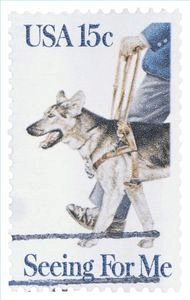
US Postage stamp honoring guide dogs, picturing Morris Frank and his pioneering American guide dog Buddy, a German Shepherd. Beneath them it says: “Seeing For Me”


I haven’t been posting on my blog lately. Sometimes the limbed life of physical difference is overwhelming and one feels a temptation to lie down in the long ditch of sadness. The largest psychiatric hospital in the United States is the Los Angeles County Jail. Veterans with disabilities  since 9/11 face extraordinary obstacles to employment. Rehabilitation services for all persons with disabilities are underfunded. 70% of the disabled remain unemployed in the US. Only one quarter of matriculating college students with disabilities actually graduates. Long standing charities like guide dog schools are experiencing a general decline in philanthropic donations—Baby Boomers and their children aren’t as generous as “The Greatest Generation” it seems. 


Meanwhile the toxic and shrill bloviating of politicians like Paul Ryan (who argue social programs are the root of America’s financial problems) helps to convince Americans that generosity and fairness are nearly unpatriotic—and would this were not so—for giving hard working and ambitious people with disabilities a shot at the American Dream ought to be deeply carved on the entablatures of our public buildings. 


What do I mean by a “radial republic”? Many things of course but principally a renewal of the social contract—our American contract which has grown stronger after every war and which has assured veterans with disabilities will be properly assisted, treated, educated, and welcomed. What do I mean by a radial republic? As we nurture disabled vets we assist all Americans with disabilities. Many people know I’m a guide dog user but I’m willing to bet that most of my readers don’t know that guide dogs (or “Seeing-Eye Dogs” as they’re sometimes called in the US in homage to North America’s first guide dog school which is named “The Seeing-Eye”) are the product of rehabilitation work in Germany at the end of WW I. 


Halfway through the First World War a German physician, Dr. Gerhard Stalling introduced a blind veteran to his pet dog. The two men were in a hospital garden when Stalling was suddenly called away. When he came back the soldier whose name is now lost, was laughing as the dog licked his hands. Stalling saw dogs might be trained to guide the blind. The war had produced an astonishing number of blind veterans. The total number of wounded from the first world war remains unknown but during the four and a half years of the conflict 230 soldiers died every hour. 11% of France’s entire population was killed. The ten month Battle of Verdun in 1916 caused over a million casualties. Chlorine and mustard gas killed nearly 90,000 troops and left one and a quarter million men permanently disabled. Blindness was a common result of gas warfare and one of John Singer Sargent’s most famous paintings (“Gassed” 1919) depicts a ragged line of soldiers, their eyes bandaged, all the men walking in a line, each man’s hand on the shoulder of the man before him—with two sighted men in the lead. The sky is yellow above a field of corpses. 


Trench warfare included working dogs. Germany employed 30,000 dogs in the field and their work was divided according to need. Sentry dogs were used on patrols. They were taught to give warning when a stranger entered a secure area. Scout dogs were also used. Their job was more refined—they accompanied soldiers on reconnaissance and had to keep quiet. They could detect the enemy at a distance of a 1000 yards, “scenting” and pointing. 


Casualty or ‘Mercy’ dogs, also known as ‘Sanitatshunde’ were trained to find wounded or dying soldiers in the heat of battle. They carried medical supplies on their backs. The wounded could use the supplies if they were able, or they could count on the Mercy Dog to wait with them as they died.


Dogs also ran long distances across battle fields carrying messages, often during artillery attacks. The heroism of working dogs was well known on all sides. The Germans employed 30,000 dogs during the war. British and French forces had approximately 20,000 dogs in the field.    


The guide dog was a consequence of war. Because dogs had proved themselves capable of miraculous work under the worst battle conditions ever seen, it was clear to Stalling war dogs could be trained to help the blind navigate post-war streets which were suddenly filled with automobiles. With a small group of military dog handlers Stalling began training dogs for blind soldiers. Old photos show trainers and veterans working with German Shepherds, all the men wearing peaked hats and long wool coats. In addition to harnesses the dogs wore tunics bearing the Red Cross logo—the insignia of the battle field “mercy” dog.   


Stallings idea captivated the public’s imagination. An official guide dog school opened in in Oldenberg in 1916. The sight of veterans and dogs working in traffic was powerful and seemed natural. In popular imagination blind people had always been accompanied by dogs: a first century mural in Roman Herculaneum depicts a blind man with his dog.  A 19th century woodcut from the United States shows a blind man from Boston being lead by a dog and crossing the Commons. Such pairings were likely the products of serendipity—the blind and their dogs forged relationships by necessity. The history of blindness is filled with sorrow. Before reforms like Social Security and organized rehabilitation services were created in the 20th century, the blind often begged for food and shelter—some played musical instruments—many wandered searching for compassion. Dogs helped ease their loneliness and offered untrained navigational assistance.    


Sometimes I like to joke by saying the guide dog is the only good thing every invented by the German Army. This may be true. But what is true is that rehabilitation programs for disabled veterans impact the broader republic. Nowadays when an autist, or a deaf person is accompanied by a trained service dog we can and should give thanks to Dr. Stalling. And in turn we should be seeking with all our Republic’s strength to carry on the difficult work of lifelong optimism that disability rehabilitation and education calls for. 


I’m not fond of the term “wounded warrior” precisely because disability isn’t a wound—it may heal in some dimensions, but in others it will always be present. A commitment to people with disabilities in general and to veterans in particular means understanding the full arc of life. The radial republic means giving people with disabilities and equal shot at education, travel, vacation, family, housing, medicine, you name it. 


Making this happen benefits all.


Unemployment unassurance

If you lose your job, it doesn’t matter how you lost it. It’s your own fault. The company went under. A Bain-like hedge fund bought it and looted it and pumped up stock prices by kicking you and half the other employees out the door. You got sick. You got injured. You used up too much time in your bosses’ opinion taking care of a sick spouse, sick kids, a new baby, elderly parents. Whine all you want. It’s your fault. Now go away, loser, and leave the rest of us winners alone to enjoy our winnings without guilt or the slightest sense of obligation.

via lancemannion.typepad.com

The incomparable Lance Mannion…

Love-Luck-Dog

Shortly after being paired with my first guide dog Corky at Guiding Eyes for the Blind I saw I was happy and that I hadn’t predicted it—and it was rich—a sweet, day long bounty.  I  felt it from the moment I woke. I felt it all day. It wasn’t a simple happiness. With Corky I now sensed something I began calling “love-luck”—“love-luck” in dog-company; love-luck and gaining confidence. Love-luck was simple; love-luck was the most complex thing I’d ever experienced. All day a dog was with me, a grand dog. I was somewhere between Eden and New Jerusalem. 

Yes I was feeling better than I’d ever felt. Buddha said: “Your work is to discover your world and then with all your heart give yourself to it.” I was giving Corky all my heart, every ounce of it. 


The trainers worked us and our days were filled with tasks. I’d never felt good in traffic and now I was crossing streets with assurance, and with an additional quality, a deep calm in the heart—“love-luck” had many angles and was with me in every hour. Giving myself to Corky meant I was more aware, more awake than I’d ever been before. It was sensational to feel awake and calm amid thundering trucks and taxicabs honking agitated horns. 


**

Awake all day and learning. It seemed there were a hundred techniques to this dog business. We learned how to enter and pass through revolving doors. Corky went on the outside—the larger side of the moving cubicle, and I learned to guard her tail from being pinched. We practiced this several times, my lovely dog in agreement, over and over again through the spinning wicket. We took baby steps, inching our way ahead, pushing the door slowly. “These will soon be replaced by wheelchair friendly doors because of the Americans with Disabilities Act,” said L. “But you need to know how to do this in case you find yourself someplace where this is the only type of door.”  “Here’s to alternative doors,” I thought. “Who invented the revolving door?” I wondered. “Some torturer—maybe the same guy who conceived of the Iron Maiden.” Later I actually looked it up, the revolving door was invented in 1888 by Theophilus Van Kannel, a Philadelphia inventor, who is reputed to have had a phobia of opening conventional doors, especially for women. Go figure. In any case, I resolved to avoid the damned things wherever I could.  


Even trips up and down escalators in a department store required careful dog handling and precise footwork. “You want to keep your dog a step behind you; turn slightly and put your knee before her—keep her from jumping ahead,” said L.

“As you near the top you’ll feel the moving hand rail become horizontal—that’s when you start should to feel with your foot for the leveling off of the steps. Now turn straight, release your dog, and tell her forward. If you do it exactly this way, she won’t pinch her toes.” 


It was a classic ballroom dance: turning, feeling with hands and toes, turning again, leading my partner, all to the rhythm of whispering metal stairs. Strangers on the adjacent “down” escalator saw a Labrador riding up and smiling. For Corky this was old hat. She seemed to actually like the escalator. Personally I’d always been vaguely afraid of them. “Love-luck” happened in small ways as well as large. We now could perform a two-fold, two-creature escalator minuet.  


**


I learned Corky would curl up tight on the floor of a car, right beneath the glove compartment in the front seat. We practiced the maneuver, man and dog, in and out of a sedan. I stepped part way in with my left leg and called her. She climbed in delicately and lay down. Then I sat, pulling my right leg in. “Its like being in a tank,” I said, though I’d never been in the military—it was cramped and awkward. “Clearly one needs to know some yoga,” I added. But Corky could ride this way if we had to. And I knew how to accomplish her positioning. Guide dog work was all about the accomplishment of daily techniques, all of them necessary if you’re brining a dog everywhere. “Yes there are techniques one needs to know for a lifetime of love,” I said to Corky when she got out of the car. 


The techniques of love are about safety, companionship, and looking out for one another wherever you may go.

And the Book Tour

By Andrea Scarpino


“My head monk asked how it was walking. I said it hurt without shoes. And he said, ‘It hurts on the foot that’s down, but the one that’s up feels really good—so focus on that one.’ And I realized that all pain and pleasure is where you put your attention.” ~Deepak Chopra

The book tour: pain and pleasure, highs and lows.


After I read my poetry at Arlington High School, where my friend Gracie was a student before she was killed, a young woman asked, “Do you think Gracie would like what you wrote about her? How do you think she would feel having you talk about her all the time?” And the honest answer is “I don’t know.” And the honest answer is, “Maybe embarrassed. Maybe angry.” Another student asked if he could read his own poetry, and he did, and I complimented the shirt he was wearing, and he said it used to be his uncle’s shirt, that his uncle had died last year.


Which is to say I felt a deep sadness being in Gracie’s school. And a deep gratitude. And a hopefulness: all these other 17-year-olds with their poetry and grief. Pleasure and pain.


Joseph-Beth Bookstore in Cincinnati. Cincinnati, where I went to college, where the low-residency program in which I have taught for nearly seven years is based. I wrote individual emails to former professors, sent a press release and reading poster to my Cincinnati colleagues, invited my Cincinnati-area relatives.


In the audience: one of my students and his son, Gracie’s aunt and cousin, a wonderful mix of friends from the Women’s Center where I used to work, my partner Zac’s parents, bookstore customers wandering by. An audience full of loving faces: pleasure. An audience absent of poets, of the people with whom I daily work: pain.


So it goes.


I read from my book. My book. To big and small audiences. To people who have studied my words carefully and people who hate poetry. To old friends. To strangers.


And it is hard, sometimes, to read these poems filled with my grief: death of my father, death of a murdered friend, death of Gracie. To stand again in that grief.


The pleasure of sharing my words with others. The pain of sharing my words with others.


And I try to focus on the positive: the student who asked me to sign his book, the first poetry he had ever purchased. The man who said the only poetry he likes more than mine is Louise Glück’s. (“You should definitely like her work more,” I replied.) My father’s former student, who told me about visiting him in the rehab center after his strokes. The friends with whom I talk writing, publishing, books, with whom I share meals, drinks.


As Gracie wrote me when she was a little girl, “Andrea, these are all the good things.”

Disability and Bio-Ethics

A week ago today I had the welcome fortune to attend a symposium at Syracuse University on bio-ethics, disability, and medicine. The event featured a keynote talk by Bill Peace with presenters Brenda Brueggemann, Barbara Farlow, and Sheri Fink. The theme of the day was, essentially, “in what manner can people with disabilities live in the age of pre-natal genetic testing, expensive medical technologies, diminishing public support for social programs, and the unvanquished shadow of eugenics?

Everyone has the right to life, liberty and security of person according the the UN. Yet the moral principle is not certain with disability. One reason for this is that medicine (broadly) cannot distinguish between the science of “curing” and the art of “healing”–a difference which appeared in the late 18th and early 19th centuries. As medical technology became more sophisticated so did the pressure to relieve patients of disablement. The inability of physicians to cure a disability meant failure rather than an opportunity. Healing means living and doing it well. People with disabilities do live beautifully and successfully, but often they do so in spite of their physicians.

I spoke two days ago at the University of Texas School of Medicine in San Antonio. My audience was composed of physicians and medical students. “The worst thing you can say to a person with a disability is, I’m sorry, there’s nothing more I can do for you.

When doctors say this, they are not healers. It’s incumbent on physicians to imagine successful lives for patients whose “condition” can’t be cured, which means they must know more about the world of rehabilitation, art, and accommodations.

I’m sorry, there’s nothing more I can do for you, is essentially mal-practice.


Self Interview, April 2

I say no one lives the way I live

But the iris interferes—dark and thin—

My way was first, I’m here…


Early morning. I’m set straight by a flower. 


**


Wings. The poets always write about wings. I prefer hooves. I’m more interested in Pegasus’ feet. 


**


Still I love a world 

where nothing is 

as it seems. 


And I love the phrase don’t kid yourself…


**


I have done a terrible thing, I have postulated a particle that cannot be detected.


—Wolfgang Pauli, on asserting the existence of neutrinos. 


**


I can’t get the old woman out of my head, she knitted sweaters, kept a crow in her shop. Can’t remember which island in the Aegean…


**


My dog wants to walk. Hello. Marvelous. 


Self-Interview, April 1, 2014


“The one I worship has more soul than other folks,” said Auden. Then he added, “than any I have met so far.” Even poets need to be accurate. For accuracy’s sake I admit I’ve met some “big soul” people but they were pick-pockets also. 


**


I will be an old man just like other old men with watery eyes. But I won’t be cheaply sentimental. For accuracy’s sake I’ll be richly sentimental. Like my dog. 


**


Here’s to the old moonlight of romance, reflected in water, the water in a cup, the cup made of tin. 


**


Here comes Lord Byron, clunk clunk. Nimble, principled, cripple. Templar “tapper” to be sure. All of Greece was his reasonable accommodation. 


**


I gotta get right with the banana clock.


**


Irony and humor, lice to the body of pain. Or not. For accuracy’s sake I admit the lice may be bigger than the body. 


**


Good morning blues, blues how do you do?

Well I’m doin’ alright, good mornin’ how are you?


You see, when you really have the blues they’ll talk back. 


**


Someone asked me about tenderness. How to find it. The recipe for empathy is written whenever and wherever dogs turn in circles before lying down. Or yesterday, my wife, came upon her horse asleep. She talked to him softly and he opened his eyes and nickered. Small joy. Shared.