Huffington Post: Dogs in the Playing Field

I’m so very pleased to mention I’ve been invited to be a guest blogger for The Huffington Post. It’s quite an honor. Below is an excerpt published yesterday, December 4. I’d be grateful if you’d visit the site and if you like the post, please feel free to share it with your social circles.  Thank you!

Dogs on the Playing Field

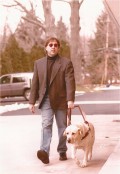
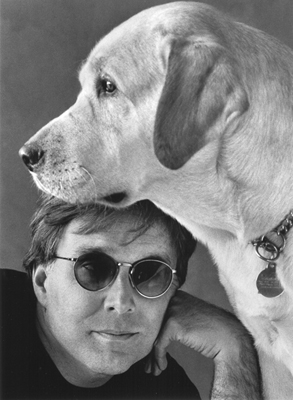
Steve Kuusisto & guide dog, Corky

No one gets a free pass to public life — “public life” — the elusive goal people with disabilities strive for. While the village square is sometimes difficult to enter often a service animal can help. In my case I travel with a guide dog, a yellow Lab named Nira who helps me in traffic. Together we race up Fifth Avenue in New York or speed through O’Hare airport in Chicago. We’re a terrific team. But even 23 years after the passage of the Americans with Disabilities Act and 70+ years since the introduction of guide dogs in the U.S. life in public isn’t always friendly. Lately it seems more unfriendly than at any time since the late 1930s when the blind had to fight for the right to enter a store or ride a public bus. What’s going on?

Read more of Dogs on the Playing Field

Dog Schmooze

Professor Stephen Kuusisto is the author of Eavesdropping: A Memoir of Blindness and Listening” and the acclaimed memoir Planet of the Blind, a New York Times “Notable Book of the Year”. His second collection of poems from Copper Canyon Press, “Letters to Borges has just been released. Listen to Steve read “Letter to Borges in His Parlor” in this fireside reading via YouTube. He is currently working on a book tentatively titled What a Dog Can Do. Steve speaks widely on diversity, disability, education, and public policy. www.stephenkuusisto.com, www.planet-of-the-blind.com

Disability News from the US Department of State

Special Advisor Heumann and Senior Advisor Kwan To Participate in a Google+ Hangout on “Going For Gold: Advancing International Disability Rights”


Special Advisor for International Rights of Persons with Disabilities Judith Heumann and Senior Advisor and former Olympic athlete Michelle Kwan will participate in a Google+ Hangout on “Going For Gold: Advancing International Disability Rights” at the Department of State at 1:00 p.m. (EST) on Thursday, December 5.


The Hangout will feature several U.S. Paralympic athletes, who will speak about the opportunities offered by international training and competition for Paralympians, as well as some of the challenges they face.


The Hangout can be viewed live on the U.S. Department of State’s Google+ page and YouTube channel. More information about the work of the Department of State’s ongoing efforts to advance the rights of persons with disabilities can be found here.


During the Hangout, live-captioning will be available at: http://www.streamtext.net/player?event=StateDeptGooglePlusHangout.


Yes, There's a Dog in My Heart…

If there’s a dog in your heart it will do you no damage. While still at Guiding Eyes I’d kept a journal—titled “Dog Man Writes to Parts of Himself”…

If there's a dog in your heart it will do no damage.

Read: Dog in Heart, an excerpt from my upcoming book, as seen on my website: StephenKuusisto.com. Then tell me, is there a dog in YOUR heart?

Professor Stephen Kuusisto is the author of Eavesdropping: A Memoir of Blindness and Listening” and the acclaimed memoir Planet of the Blind, a New York Times “Notable Book of the Year”. His second collection of poems from Copper Canyon Press, “Letters to Borges has just been released. Listen to Steve read "Letter to Borges in His Parlor" in this fireside reading via YouTube. He is currently working on a book tentatively titled What a Dog Can Do. Steve speaks widely on diversity, disability, education, and public policy. www.stephenkuusisto.com, www.planet-of-the-blind.com

Dog in Heart

If there's a dog in your heart it will do no damage.

Dog Man Writes to Parts of Himself

If there’s a dog in your heart it will do you no damage. If there’s a thistle inside you, you’re in trouble. Only weeks after getting my first guide dog, and walking freely on the ordinary streets I met the thistle hearted all around me. They were people who lived in the famine of effect—unhappy inside and projecting unwarranted hostility outside. Meeting them with a dog at my side, and a dog inside me, a protective dog of the heart, well, that was different—to say the least. Standing in line at the bank a thistle-woman caught sight of Corky and screamed quite literally: “You damned disabled with your damned dogs!” She waved her arms like she was on the flight deck of an aircraft carrier. There were three or four other customers. They all backed away. She kept shouting her wild gibberish. And Corky wagged her tail. I felt it against my left leg. She was telling me that two worlds described our rewards, we were in tandem, we were in accord.  We were a musical chord. Her tail was saying: “each lives in one, all in the other.”

So I smiled. Just smiled. I probably looked like a simpleton. But our dog heart was smiling. The woman turned and bolted out the door. Of course that’s when the other customers began speaking up. “Wow, she was really out of line!” “There must be something wrong with her!” But I had Morse Code dog heart—which was all I needed.

While still at Guiding Eyes I’d kept a journal—titled “Dog Man Writes to Parts of Himself”.

One entry read:

You were always a dog in your heart—you were forced to conclude the matter when, one morning, early, you felt a giddiness, a happenstance wakeful half-assed joy. It wasn’t the electrolysis of sex or the sticky dendritic jazz of chocolate or bourbon that marked your inner life. It was dog, dog-ness, dog all the while. You were standing at the window, still wearing your pajamas. You felt like running into the yard and rolling in snow. You didn’t care what the neighbors might think. A good snow roll in your PJs was in order. You saw that now, saw it was always “the thing”—to be a dog and sharply alive with all your senses in order. No tax forms. No darkness blotting out hope. Dogs are the darkness. Dogs are hope. You saw there was nothing more to be said about the matter.

**

I was insensibly happy. The person bearing my name had been transformed. He was lighter, like a character in fiction—the fairy tale dog man was walking, running. He didn’t have to explain himself. That was the great thing. He didn’t have to explain the convoluted gears and motors of his brain.

Professor Stephen Kuusisto is the author of Eavesdropping: A Memoir of Blindness and Listening” and the acclaimed memoir Planet of the Blind, a New York Times “Notable Book of the Year”. His second collection of poems from Copper Canyon Press, “Letters to Borges has just been released. Listen to Steve read “Letter to Borges in His Parlor” in this fireside reading via YouTube. He is currently working on a book tentatively titled What a Dog Can Do. Steve speaks widely on diversity, disability, education, and public policy. www.stephenkuusisto.com, www.planet-of-the-blind.com

Thinking of Joe Blair and the Physics of Hatred

My friend Joe Blair has written a superb post entitled “The Physics of Hatred” and he’s got me thinking about the warrens and barrel vaulting of human misery. (This is not to say I don’t customarily think of these things, but Joe has me stretching, laying out the chalk lines for a new room in my head.) Backstory: Joe is the father of a son who has autism. He and his wife Deb have lived the cold hydropathy of parents of disabled children—a tribe that’s larger than any other, and one that is customarily used to disappointments, cruelties, toxic hierarchies, and outright hostility. In this way, Joe is an expert when it comes to what we call social psychology in academic circles, and what’s called street smarts everywhere else. His post lays out, expertly, the horrid social dynamics that accompany alienation, by which I mean alienation, for the tale has much to do with late stage, post-industrial capitalism which is vicious and only teaches viciousness. You must read his post to see the emotional intelligence of a terrific writer in action. Back to my chalk lines. 

What we like to call “diversity” in the US, especially in the academy is essentially a larger and more communitarian idea, incorporating class struggle, relief for urban and rural poverty, all the global struggles for human rights. This work is the core, the foundation of what it is to be human—one may think of it as a meal for the soul. We nourish one another by our work. Its really important for North Americans to understand the complexity of nourishment as action. I love what Paolo Freire says in his famous book The Pedagogy of the Oppressed: “True generosity consists precisely in fighting to destroy the causes which nourish false charity. False charity constrains the fearful and subdued, the “rejects of life,” to extend their trembling hands. True generosity lies in striving so that these hands–whether of individuals or entire peoples–need be extended less and less in supplication, so that more and more they become human hands which work and, working, transform the world.”  So we’re talking about true nourishment. Some days you find this in poems, other days it resides in standing up for inclusive education—for classrooms where students with disabilities are educated alongside their peers. Sometimes nourishment comes from meeting blind and deaf people in Central Asia and sharing stories of struggle and hope. Lyric writing is the best place I’ve found for combining multiple strains of thought into a moving unit of political consciousness. I wrote a prose poem for my friend Bill Peace who is a disability rights advocate and a wheelchair user. The lyric brings forward several feelings and ideas at once:


Prose Poem for Bill Peace


Most days, as disabled people, we’re screwed…” (author)


Dear Bill—I’m green in my knees, green ribbed. I spent today alone with a dictionary. Sometimes I find words from the age before newsprint. Catabasis, a trip to the underworld…The Greeks understood: anger increases after death. Odysseus’ mother was the first zombie in literature, hungering for a bowl of blood in the twilight of Hades. I fear the dead are full of sorrows. Meanwhile half the houses hereabouts are crammed with sadness and the strictures of fear. To forgive is not so simple. Dictionary: discourse, utopia, harmonia…Some days words are immanent, warmer than the streets.     


So another way to look at nourishment is that it is the source of imaginative thinking as well as progressive political thought. Thank you Joe Blair. Thank you!


USICD Celebrates the International Day of Persons with Disabilities!

pastedGraphic.png


pastedGraphic_1.png

 USICD Celebrates the International Day of Persons with Disabilities!


Today, the global community celebrates the International Day of Persons with Disabilities. In the spirit of this year's theme, "Break Barriers, Open Doors: for an inclusive society and development for all", the U.S. International Council on Disabilities calls on the United States Senate to support the Convention on the Rights of Persons with Disabilities.  This international disability treaty is designed to promote dignity, human rights, and inclusion for people with disabilities worldwide.


Inspired by U.S. leadership in recognizing the rights of people with disabilities, the treaty serves as a vital framework for creating legislation and policies around the world that embrace the rights and dignity of all people with disabilities. By joining over 130 countries and ratifying this treaty, the United States has an opportunity to have a seat at the table in developing these policies, and to share our model in disability rights, the Americans with Disabilities Act, with other countries creating legislation with regard to people with disabilities.


Marca Bristo, President of the U.S. International Council on Disabilities:  "The International Day of Persons with Disabilities serves as a reminder to all of us that, though there has been much progress, we still have a long way to go towards achieving inclusion for all. Today, the American disability community stands in solidarity with the global community and the millions of people both at home and abroad who need and want the Disability Treaty to be ratified. The strength, diversity, and commitment of the community working in support of this treaty is a testament to the treaty's significance and the broad global reach it could have in breaking barriers and opening doors for people living with disabilities worldwide." 


Jill Houghton, a USICD board member and the executive director of the US Business Leadership Network (USBLN): "The International Day of Persons with Disabilities is a day for celebration not only by people with disabilities, but for everyone who supports opportunity and equality.  That is why we support U.S. ratification of the Disability Treaty.  More than 50 US member corporations have signed on to the USBLN's letter supporting ratification.  Great American companies like Coke, IBM, AT&T, Sprint and Adobe share the vision of a world where there is no discrimination against people with disabilities.  We can be sure it's a day to celebrate."


In spite of widespread support from veterans service organizations, faith, human and civil rights organizations, business, and the disability community, as well as politicians on both sides of the aisle, the treaty fell just five votes short of ratification in a controversial Senate vote last December. Now, as the Senate Foreign Relations Committee engages in renewed discussions of the treaty, the Senate has a rare second chance to do the right thing and vote YES to ratify the Disability Treaty. 


TAKE ACTION on this International Day of Persons with Disabilities! 

CLICK HERE to call your Senators


Learn more at www.disabilitytreaty.org


pastedGraphic_2.png


December 3rd is both #GivingTuesday and the International Day of Persons with Disabilities


Our community is powerful and #GivingTuesday, the national day of philanthropy, is a great time to show it through raising money and our voices. The U.S. International Council on Disabilities invites you to support our work as a leading convener and advocate for global disability issues, ideas and people.  Please support our work by making a year-end contribution.  Together with your support we come closer to realizing our vision!  Please also encourage your friends to make a donation to USICD

Thank you.


Poem for the Great Magicians, or, Marxist Mysticism Revisited

Poem for the Great Magicians


Refused entry at the bourse you turned money into birds and the birds flew to the high branches in Schlossberg and whistled and children were happy. We all come from the stingy soil. But you dear ones, helped us pace our manias under the sheltering, singing trees.