All day it trailed me, though without analogy–the name wasn’t like a wolf or a policeman, more like a pitted stone but even so this was no good. The goal of emptiness was evasive, less of natural fact, less of forest flowers, less of Orion, less. Do you know what I mean? That someone, something might reveal itself. Late in the day the lead weight that makes the clock run dropped without warning, my cold, private Emily Dickinson.
There’s an interesting piece by David Hart at the UK’s Human Rights Blog called “Eating Horse and Where Our Language Comes From” which, is, perhaps, tonally, a wee bit smug, for humans have always eaten horses and the archaic peoples of the steppes flourished by doing so–a matter that Hart finds amusing–a bit of schadenfreude for those who see the current horse meat scandal as an offense against morality.
I am mistrustful of moral outrage that erupts like sun spots, yet sufficiently sentimental about horses to abhor the news that Romanian abattoirs have been selling equine flesh as beef. The crime is misrepresentation. If eating horse is immoral than eating any animal must be–and I’ll leave that argument to others, see: http://www.bbc.co.uk/ethics/animals/using/eating_1.shtml
On the subject of morality and eating animals I’ve always been most persuaded by the virtue argument:
People who participate in a system that treats animals cruelly, and that kills animals to provide trivial pleasures to human beings, are behaving selfishly, and not as a virtuous person would.
David Hart isn’t terribly interested in the morality of animal husbandry and our eating habits–he’s more “lit up” by the fact that our ancestors both ate and rode horses at the same time they developed spoken language. You are, it would seem, both what you eat and where you go. Hart references a book by Professor David Anthony, The Horse, the Wheel, and Language, which I intend to read as soon as possible.
What’s clear is that human beings have eaten horses throughout history, often because horses were better survivors in winter than cattle. Against this one may say, rightly, that human beings will eat anything–tarantulas, worms, even each other. Eating horses may well have kept fragile humans alive in colder ages than our own. Traveling on horseback certainly intensified the need for language.
Language and cruelty are old sisters, a matter that Hart doesn’t explore. Poets have always known this. Language is not inherently virtuous. If you paint a face on a stone it will not be ethical. And I would say the horse has always been an innocent in this matter.
Disabilities as Ways of Knowing: A Series of Creative Writing Conversations: Part II
The Disability Experience and Poetic Verse
Reading by Poets Jim Ferris, Laurie Clements Lambeth, and Stephen Kuusisto
March 28, 2013
Reading 7:00 to 8:00 pm at Watson Theater
Reception and book signing from 8:00 to 9:00 pm at Light Work
SU Campus
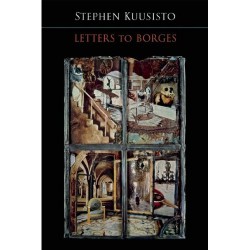
Jim Ferris, Laurie Clements Lambeth and Stephen Kuusisto will be reading from a selection of their poetry, followed by a reception and book signing, for all members of the S.U. community. While this event is geared specifically to raise and support awareness among undergraduates, everyone is welcomed to participate in this exciting set of opportunities. This event will feature works from Beauty is a Verb: The New Poetry of Disability (Cinco Puntos Press) and launch Letters to Borges (Copper Canyon Press), where “best-selling memoirist Stephen Kuusisto uses the themes of travel, place, religion, music, art, and loneliness to explore the relationship between seeing, blindness, and being. In poems addressed to Jorge Luis Borges—another poet who lived with blindness—Kuusisto leverages seeing as negative capability, creating intimacy with deep imagination and uncommon perceptions” (from http://www.stephenkuusisto.com).
American Sign Language (ASL) interpretation will be provided during both the reading and the reception/book signing. Communication Access Realtime Translation (CART) will be provided during the reading.
If you require accommodations or need information on parking for this event, please contact Radell Roberts at 443-4424 or rrober02@syr.edu.
This event is made possible through the Co-Curricular Departmental Initiatives program within the Division of Student Affairs, and cosponsorship by the Disability Cultural Center, the Renée Crown University Honors Program, the Center on Human Policy, Disability Studies, the Burton Blatt Institute, the Dept. of Women’s and Gender Studies, the Lesbian, Gay, Bisexual, Transgender Resource Center, the Office of Multicultural Affairs, the Slutzker Center for International Services, the Creative Writing Program, the Disability Law and Policy Program, the Disability Student Union, the Beyond Compliance Coordinating Committee, and the Disability Law Society.
As aspects of variance and diversity, disability cultures and identities enrich the tapestry of life on and off the SU campus.
I was intrigued by Michelle K. Wolf’s OpEd on disability rights as civil rights in the Jewish Journal . Her argument reflects a view many of us in the disability rights community hold, namely that the ADA is a civil rights law and not a singular and codified sub-contract to public life. Here is an excerpt from her piece:
Michelle K. Wolf: Disability Rights Are Civil Rights (Jewish Journal) February 15, 2013
LOS ANGELES, CALIFORNIA– [Excerpt provided by Inclusion Daily Express] As a non-profit professional in Los Angeles, I’ve worked at both Jewish and general charities. While it can sometimes be more comfortable for me to work in the Jewish community, I find myself stretching more as a person in the non-Jewish environment, especially during the casual conversations over lunch, when African-American and Latino colleagues on occasion will share painful memories of discrimination.
So, as I am busy promoting and participating as a parent disability advocate with Jewish Disabilities Awareness Month during February, I am also mindful that this is also Black History Month, I am drawn to the parallels of each group, struggling to move out of the margins to claim their rightful place in our society.
When someone makes a snap judgment of your potential ability based solely on your appearance, that hurts. When dreams are taken away from you because of stereotyping and myths, that’s cruel. And when you can’t even receive the same level of education as your peers, it makes it incredibly difficult to ever catch up.
I worry that the families touched by disabilities are spending too much energy pointing fingers and talking amongst ourselves, complaining and wishing we had a more inclusive community. It’s time to take our issue to a new level and actively enlist the support of our extended family, friends and congregants.
I have on this wee blog argued for some time that disability rights are human rights–they are inseparable. A more inclusive community means a community devoted to universal dignity and access. Dignity and access do not mean just ramps for wheelchairs and a welcoming environment for your service dog, it means unqualified reception, a broad understanding that people of difference belong. When the tragic shooting of Trayvon Martin became public news I wrote the following:
March 27, 2012
Trayvon Martin: A Disability Perspective
I know something about being “marked” as disability is always a performance. I am on the street in a conditional way: allowed or not allowed, accepted or not accepted according to the prejudices and educational attainments of others. And because I’ve been disabled since childhood I’ve lived with this dance of provisional life ever since I was small. In effect, if you have a disability, every neighborhood is a gated community.
Last week the Rev. Al Sharpton counseled Trayvon’s parents that the engines of disparagement would start soon–that Trayvon’s character would be run through the gutter. He was right. And he was properly forecasting what happens whenever a member of a historically marginalized community speaks up for “blaming the victim” is a handy way of sidestepping issues of cultural responsibility. In a way, isn’t that what “gated communities” are all about? Aren’t they simply the architectural result of cultural exceptionalism? Of course. But as a person who travels everywhere accompanied by a guide dog I know something about the architectures and the cultural languages of “the gate” –doormen, security officers, functionaries of all kinds have sized me up in the new “quasi public” spaces that constitute our contemporary town square. I too have been ovserved, followed, pointed at, and ultimately told I don’t belong by people who are ill informed and marginally empowered. Like Trayvon I am seldom in the right place. Where precisely would that place be? Would it be back in the institution for the blind, circa 1900? Would it be staying at home always?
Now the forces of revision are saying that Trayvon was a violent pot smoker. Forget that pot smokers are generally not violent and that the vast majority of teens in America have tried it–forget that it’s not a gateway drug. Forget that having been suspended from high school for minor marijuana possession isn’t an advertisement for criminal psychosis. (Didn’t we dismiss that stupid idea along with the film “Reefer Madness” some thirty years ago?) The reality here is that Trayvon is being predictably transformed from an ordinary kid into an aggressor. The evidence doesn’t support this. He was stalked and threatened and the efforts in recent days to recaste him as a crazed gangsta are predictible and laughable. But I’m not laughing. I too was an “outsider” teenager. My place in every social and public environment was always conditional. Hell, I even smoked marijuana as a form of self medication. I’m not ashamed of the kid I used to be. I’m not ashamed to count Trayvon Martin as my soul mate.
There’s a war against black men and boys in this country. There’s also a backlash against women and people with disabilities and the elderly. The forces in all these outrages are the same. The aim is to make all of the United States into a gated community. On the one side are the prisons and warehousing institutions; on the other side, the sanitized neighborhood resorts. I hear the voice: “Sorry, Sir, you can’t come in here.” In my case it’s always a security guard who doesn’t know a guide dog from an elephant. In Trayvon’s case it was a souped up self important member of a neighborhood watch who had no idea what a neighborhood really means. I think all people with disabilites know a great deal about this. I grieve for Trayvon’s family. I haven’t been able to stop thinking about him and will never forget.
Something is wrong with the moon, green music, eighth notes, no one can tell what it will be worth–so the boy in the hospital draws it under the blanket, the sliced moon that hums from deep places. And the boy thinks how soon enough the moon will make him transparent. He knows this will happen. This is disability in childhood. And the doctors keep pulling on the boy’s arms, trying to rub out the light.
Early this morning my dog found the tracks of wild turkeys in fresh snow. Vault after vault opened for her. She was standing in the blood and flowers of animal life–so distant from mine, which remains dry. The sun was hardly up. I talked to myself. Spoke dialects of early. Green words. Words to accompany my begging bowl. My dog looked off to the far end of the field. Soft wind. The branches of trees, violent and tender…
One day, mid winter, I walk on a thawed road. The packed earth wet in the sun, frozen deer tracks, long shadows of man and dog. Surrounding me all the hurdy-gurdy of the unconscious, projections of smiles, old politics, frayed understandings, ice water underfoot. In a winter melt, I meet my ghost in a birch grove. A boyhood light surrounds the trophies of mid life. Barns, houses, fence posts…
WASHINGTON, DC– [Excerpt provided by Inclusion Daily Express] In the coming weeks and months, Congress will enact sweeping reductions in federal spending, finalize the 2013 federal budget and raise the debt ceiling. The cuts that will come with these decisions are not merely numbers on a ledger; they will decimate programs that directly impact the lives of the most vulnerable among us and the ability of social service agencies to serve them.
For individuals with disabilities who are aspiring for healthy, independent lives, this is a particularly critical time. The unemployment rates we associate with the slow recovery from the Great Recession pale in comparison to the persistent lack of employment opportunities that have ever been available to the disability community. The disincentive to work inherent in our social safety net, and the inability for those relying on it to build assets, makes upward mobility even more difficult.
The growing challenge for non-profit agencies to provide home- and community-based care makes independent living for many individuals with disabilities an impossibility.
This is why dozens of advocates representing a broad range of Jewish communities, religious streams, social service providers and public policy organizations traveled to Capitol Hill on Tuesday to promote the Community First Choice (CFC) option in Medicaid and the Achieving a Better Life Experience (ABLE) Act, both of which further the goals of ensuring individuals with disabilities can lead healthy, independent lives.
Stephen Kuusisto Reads from Letters to Borges, His New Book of Poems
JUST RELEASED! Best-selling memoirist Stephen Kuusisto uses the themes of travel, place, religion, music, art, and loneliness to explore the relationship between seeing, blindness, and being. In poems addressed to Jorge Luis Borges—another poet who lived with blindness—Kuusisto leverages seeing as negative capability, creating intimacy with deep imagination and uncommon perceptions.
If you enjoyed this reading and would like to listen to several more poems from Letters to Borges, it’s easy enough to arrange. This FREE recording is yours to enjoy at your leisure, preferably from your favorite cozy chair with a cup of coffee or a nice glass of wine in hand. Simply fill in the “Join me for a cozy ‘fireside’ poetry reading…” form found to the right of this blog post or make your request below.
REVIEWS:
Seth Abramson, Poet
Kuusisto’s is a life one wants to know, detailed sparingly by a man one wants to know, inscribed in a generic form one finds oneself not merely compelled but honored to read. Letters to Borges is highly recommended for those who still find honor and beauty in both simplicity and–can it be?–actually having something to say. Read more of Seth Abramson’s reviewfrom the Huffington Post, Huff Post Books, November 2012
~~~~~~~~~~~~~~~~~~~~~~~~~~~
If we account for Kuusisto’s restricted sight, the brilliance of his verse acquires deeper resonance, for his work imagines a realm between sight and sound composed of the sensory stimuli we all know and recognize, but split, fractured, and juxtaposed to inhabit the mind’s ear of his readers, a feat unique to this truly gifted poet. — Diego Báez, Booklist Advanced Review

 Planet of the Blind


