Author: stevekuusisto
Poet, Essayist, Blogger, Journalist, Memoirist, Disability Rights Advocate, Public Speaker, Professor, Syracuse University
Susan Senator's Must Read Post
http://susansenator.com/blog/2012/01/disability-it-really-is-okay/
Don’t let anyone tell you what disability is, least of all yourself.
I’m glad that I’ve discovered Susan’s blog. I’m glad to be part of a vibrant, people first disability rights community.
I almost was in a plane crash last week. I’m still walking around and feeling glad. I’m glad for my slippers!
– Posted using BlogPress from my iPad
American Press Freedom in Jeopardy
Sweeping protests around the world made it an extremely difficult year for the media, and tested journalists as never before, the annual report into press freedom reveals.
The annual report by Reporters Without Borders has been released, showing the United States fell 27 points on the list due to the many arrests of journalists covering Occupy Wall Street protests.
The slide in the United States places it just behind Comoros and Taiwan in a group with Argentina and Romania.
Essay: My Brother’s Brother
Must needs–my brother died just hours after we were born. Twins. All my days I’ve been his brother–his brother in the minute sweeps of gravity, with clouds in my fingers, clouds in my eyes. I know everything about my brother. The shadows of night behind my ears. And this morning, early, walking, I thought I saw my brother in the branches of the lonely trees.
Essay: Half Truths
Ministers and carnival barkers, portrait painters, tour guides, each must take falsehood home at night. Think of the closets! The steamer trunks!
History, of course, is about their prying children. Baby Manfred of Ostrobothnia opens the wardrobe, finds the speech at Clermont scribbled in bird like French, just a copy of a copy, but the words of the old Pope still legible: wherever three or more are gathered in my name, I want you to kill the people just beyond the mountains…
– Posted using BlogPress from my iPad
Disability and Russian Tea
If you’ve ever had tea in Russia, or even in the Baltic states, you know the beauty of sunlight streaming through a tall glass of amber liquid, the color itself therapeutic. It’s the color of the fortune teller’s dreamscape, the color of love under layers of winter clothing; the color of “if”.
Long ago (at least 35 years ago) I heard the poet Robert Bly tell a room full of people in Rochester, NY, that Americans don’t understand grief. He recited the dark poems of Emily Dickinson and read aloud Wallace Stevens’ “Thirteen Ways of Looking at a Blackbird” –all as a means of suggesting that fidelity to the awareness of death was the true index of a poet’s success. There were murmured assents from the audience.
I was only 22 that year but I knew that Bly’s observation was as old as poetry itself. Hell, I’d read “Leviathan”: life is “solitary, poor, nasty, brutish, and short.” I thought that Bly was telling us the obvious. Even at that stage of my life I knew that owing to having a disability there were many elements of grief and of fear. As a child who was told not to speak of his disability I knew a thing or two about enforced reticence coupled with public rejection. I knew a good deal about humiliation. My adolescence had been solitary, brutish and nasty. I had been in and out of the psychiatric hospital. I had tried starving myself to death. Had tried recreational drugs. I felt that I belonged almost nowhere.
Bly was having us on. He thought we were all suburban TV watching children. He said something about The Beatles being too cheerful. He was saying we were all easily amused commodity fetishists.
I wanted to say, “You have no idea about grief!” in those days I thought anyone who could see well, who could drive a car, read an ordinary book, have some kind of job–I thought anyone fitting that description had to be on easy street. Who was this poet who was telling me I was too happy?
If you have a disability you also, very often, experience depression. I struggle, even now, as much from the latter as I do from vision loss. And accordingly, when I discovered poetry (around the very time I was in the psychiatric hospital) I found the declivities and ligaments of sorrow. I read lines by W.S. Merwin and saw how grief and gratitude work quietly and gracefully together like the parts of a bird’s wing. I read Merwin in those days as much as I could:
“back from a series of hospitals back from a mugging
after funerals we are saying thank you
after the news of the dead
whether or not we knew them we are saying thank you
in a culture up to its chin in shame
living in the stench it has chosen we are saying thank you”
The tea in the tall glass and the dying light at the end of day are as vivid to me now as they were in my early childhood sitting with my father in a Helsinki cafe. I am the boy who puts his ruined eyes right against the cup, looking for answers there.
Lucky to be Alive
So there I was, flying to Boston to hear my friend Zoe Tall Weiss and her baroque opera company. Our plane (a turbo prop Dash 80) took off from Syracuse in a driving rain. When the plane was about 7 minutes in the air the pilot came on the intercom and told us the electrical system was failing and he was turning back. We bobbed like a cork and quite literally dove for the runway. I was talking with a woman across the aisle about dogs and disability and my lovely Miss Nira kept her usual demeanor of poise mixed with quiet happiness. You could feel the collective tension of the passengers. The plane was dropping fast. I thought about all the dirty jokes I’ve told in my life and I decided that they had no relevance to what might be in store after death. It was a clarifying sense that the guilt of Christianity is blather and hog wash and I felt this without any panegyrics. Then we were on the ground. And then, as they say, it was over. And US Air had no way to get me to Boston because they said LaGuardia is 6 hours delayed owing to the rain. And so we went home. I’m still in the elastic gratitude tunnel of affirmations. Isn’t it lucky to be here? Isn’t it amazing to be able to make a turkey sandwich, drink a glass of water, admire the way winter light on a dark day is still so sustaining? It is dark and gorgeous in Syracuse and we have a little more time to know it.
Hungry in O'Hare, Krishna Krishna!
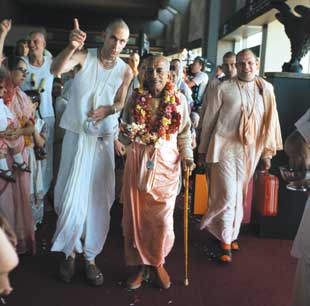
My friend Andrea Scarpino writes about being stuck in O’Hare airport in Chicago and this puts me in mind of how I was trapped there once during a blizzard. The year was 1978 and back then the airports were gathering places for wandering packs of Hare Krishna guys who followed you everywhere trying to sell you paper flowers. So there I was, trapped in O’Hare for two and a half days and trying to stay away from the Hare Krishnas who were everywhere. No food court. No food in fact. Just a vast, souless airport, weary passengers, and the minions of Krishna pushing trinkets. And so yes, finally, trapped by a man in a robe, a man who had a coffee can for making change strapped to his waist, and who had a fistful of paper flowers, I bought a flower, and yes, I ate it. Right in front of him. Those were the days. Those were the days.
White House Appointee Ari Ne’eman on the Power of Autistic Community
See full story: http://blogs.plos.org/neurotribes/2011/11/01/white-house-appointee-ari-neeman-on-the-power-of-autistic-community/
POTB is a follower of ASAN and a fan of Ari Ne'eman's work. Visit this great article for a good look at the visionary thinking that comes from the movement of neuroatypical thinking.
SK
6 Ways of Looking at O’Hare
By Andrea Scarpino
- From below: people rushing, running, bumping into you with roller bags and overstuffed purses. Disembodied announcements, ceaseless—unattended luggage will be destroyed, do not accept items, shoes left at security, church services, now boarding, final boarding. Golf carts trying to maneuver the crowds by beeping their horns incessantly. Sobbing babies. Somewhere: an inconsolable cat, howling.
- From above: rooftop garden. Tall plastic columns of plants under fluorescent lights—green onions, chives, habanero chilis, green peppers, salad greens, basil, edible flowers. The calm of it—rectangle of color, water rushing into the planters each hour, heat from artificial suns. Large windows: gray sky, blowing snow. And a garden, growing.
- In hunger. Frontera: fresh tortas and homemade salsa, Greek yogurt bar, salads with creamy dressing and avocado. Wolfgang Puck: roasted beet salad, wood-fired pizza with fresh mozzarella. Cappuccinos on every corner. Carefully brewed Argo tea. Frozen yogurt with chocolate sprinkles.
- In kindness: the gate agent who searches for other flights when yours has been cancelled, the server who lets you sit most of the afternoon ordering nothing but Diet Coke, the security agent who pats you down, how she nods, “I don’t blame you. I wouldn’t go through those machines either.”
- In exasperation: flights cancelled 30 minutes before they’re due to take-off. Mixed messages: you’ll have to call the 1-800 number; you’ll have to speak to the gate agent. Bathrooms miles down the hall from where you’re sitting. The cab driver who swears non-stop and charges you double to drive you 8 minutes down the highway.
- In kindness: your partner and friend who search online for a hotel while you’re still standing in line at the gate of your cancelled flight, who research rental cars, who offer to drive six hours to pick you up. The friend who knows you’re stuck, finds your hotel online, and calls the bar to order two shots, brought to your room by room service. You’re angry, annoyed, watching stupid television, watching people do stupid things on television, and there’s a knock at your door. You open it: two shots of whipped-cream topped alcohol on a silver tray. A smiling room-service man. You sit in your overstuffed bed with your drinks and sip them joyfully.
Poet and essayist Andrea Scarpino is a frequent contributor to POTB. You can visit her at:
 Planet of the Blind