Space

By Andrea Scarpino


“In the many thousand daily choices we make, we create ourselves and the voice with which we speak and work.” ~Carolyn Forché

Last week, Angel posted a piece about taking up space, and I’ve been thinking about her writing ever since, about what it means to take up space, about whose space is privileged, whose space obscured.

As a child and teenager with a physical disability, I often felt I was taking up too much space. My crutches took up space, were always falling over in a racket or balanced awkwardly against a wall. I took up too much family space—too much family life was organized around my doctors’ appointments, trips to the hospital. I often felt like a burden, like my mere presence overwhelmed everything.

And then there was my loud voice, laughter, my wild hair. I spent years trying to mimic how other young women spoke and looked and moved. Years blow-drying straight my hair, repeating in my head my mother’s mantra to “lower your voice.” And then in college, I started watching men. How they sit with their legs wide apart, how they take lengthy strides when they walk. How they assume their presence is wanted, is warranted. How they enter a room and expect to be seen. Now this is, of course, a generalization—not all men are adamant space-taker-uppers. But reading feminism, watching men move through the world, taught me that I deserved to take up some space, to make room for myself. That I was doing myself a disservice by self-silencing.

So I cut my hair super short so I wouldn’t worry about its wildness. I decided not to be embarrassed when I noticed people in restaurants turning to stare at my loud talking. When someone said they could hear me from across the street, from down an elevator shaft, they could hear my voice echoing through a building, I decided to take that as a compliment. Slowly, I realized it’s more fun to take up space, that it’s a drag to constantly apologize.

I was at a conference two weeks ago and was “shushed” four different times by four different women who thought I was speaking too loudly. Each time, I smiled. Waved my hand politely. And continued speaking just the same. I felt grateful I have a voice. Grateful to take up space. Grateful I didn’t dissolve in shame over someone else’s idea of how much space I deserve. Grateful to finally feel brazen with my life.


Andrea Scarpino is a poet and essayist and a frequent contributor to POTB. You can visit her at: http://www.andreascarpino.com


We linked the other day to an article by Janet Beyer about the life and work of Fred Fay of Concord, Mass. We neglected to point our her authorship though if you followed the link you'd have found it. We correct the omission.
SK

My Remarks Today at Syracuse University's Opening Convocation

Hello. Since my background is in creative writing I want to tell you a story. This one happens to be true though not all stories are honest representations of facts. This is one of the things you will grapple with as a student at Syracuse University–critical thinking requires us to see that not all stories fully represent the facts. But I swear this small personal narrative is true. 


I lost some friends on September 11, 2001. All of them were working in the World Trade towers when the planes struck. At the time I was a professor at The Ohio State University in Columbus, Ohio. I was scheduled to fly the very next day to New York to conduct a poetry workshop for teenagers. As you remember, all flights in the US were grounded indefinitely.  Like so many others I stayed home and grieved and tried to imagine the human consequences of what had happened. 


When about a week later I was finally able to fly to New York I called a cab for the airport. This is the part of the story we in the writer’s trade like to call the “meanwhile, back at the ranch gambit”–I need to give you some back story. Remember, there’s a taxi coming. 


In the mid 1990’s I was the director of student services at Guiding Eyes for the Blind, one of the nation’s premier training centers for guide dogs. They’re located just outside  New York City and they provide impeccably trained dogs for blind people all over the world. One thing I discovered is that many cab drivers in New York City didn’t like picking up blind people with guide dogs. Some cabbies didn’t like the dogs, or they didn’t like the hassle. This made me quite angry and I immediately started working  with Mayor Giuliani’s office to change the laws governing taxi access for people with disabilities. The fines for refusing rides went up and the education process for drivers was improved. Believe it or not, things are better nowadays. They’re not perfect, but they’re better than they used to be. 


So there I was waiting for a taxi on the first day the airlines were flying again. I was feeling jumpy like everyone boarding a plane that morning. Would I get where I was going? Would everything be okay? Then the taxi appeared.


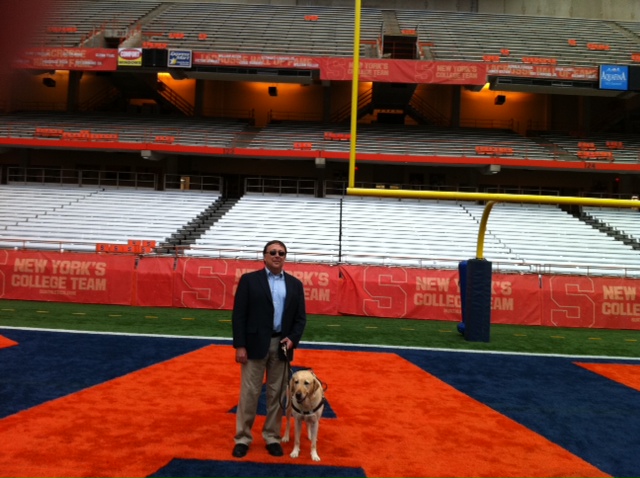
Picture me with a guide dog and a rolling suitcase making my way to the car. Picture me getting in with a large yellow Labrador, settling her on the floor behind the front seat, squeezing in with my stuff, feeling the awkwardness of my disability the whole time. No matter how much you travel, if you’re a person with a disability you know all about the awkwardness factor. All too often you don’t fit into the spaces allotted to you–toilets, airplane seats, stadium seating, taxicabs…


I told the driver I wanted to go to the airport. He didn’t say a word. He just pulled his cab into the street and drove. I thought that he probably didn’t like me, or he didn’t like having the dog in his cab–either way it’s the same thing. I was having a flashback to my New York advocacy days. Here was another inhospitable cab driver. I took his silence for hostility. 


Now you have to understand that I’m a big talker. I’m an extrovert. I like people. When you’re visually impaired this is an advantage. I talk all the time with total strangers. Many have helped me. Several of those strangers have become friends. Accordingly, the silence of the cab driver was all too easy for me to misinterpret. I firmly decided that he didn’t like me. 


Then something wonderful and strange happened. I’d been reading a book by Daniel Goleman called “Emotional Intelligence”. In his book, Goleman, argues that it’s not your IQ that matters when determining your potential success in life, it’s your emotional intelligence–how much creative and interpretive flexibility you can engage in your work and your relationships. He argues that human beings are genetically engineered through our evolution to either fight or flee when we’re presented with any circumstance that surprises us. He cites “road rage” as an example: we imagine that the person driving badly is our enemy. We become enraged. We take it personally. Goleman argues that once this rage occurs we’re victims of what he calls a “neurological hijacking” –in effect we’ve become primitive thinkers, emotionally unintelligent and incapable of thought. He suggests that we try to imagine ourselves as being outside of the conflict we find ourselves in, to see our circumstances as part of a dramatic presentation. See yourself as a character on a stage. Imagine that there’s something more going on than you presently realize. Slow down your impulsive response and use your imaginative skills. 


So not seeing well I began to listen, sitting in the back of that taxi. 


I thought, “What if this man’s silence isn’t about me?” 


Then I noticed the music coming from the radio. Someone was singing lines from the Koran, singing them with the kind of sweet, uptempo joy one hears in Jamaican Reggae. So I really began to listen. The arrangement had a wonderful horn section and behind the horns, an eccentric but lively beat. The effect was uplifting, life giving, and I found myself suddenly exclaiming: “Wow! That sounds like Pakistani Bob Marley!” 


“Oh God!” I thought. “What have I done? I’ve just made a perfect fool of myself!”


Have you ever heard jubilant relief in a man’s voice? It’s an unforgettable timbre, like water falling in Kyoto. The driver said: “You’re right! He is the Bob Marley of Pakistan! That is where I’m from! How did you know it was from Pakistan?”


I said I was a literature professor, that I had read the Koran and the music was absolutely life affirming. 


Suddenly I was in a different story than the one I’d imagined. My driver told me that no one had spoken with him in public since 9-11. Not a soul. I was the first man to say anything to him beyond muttered directions. And by God I knew something about his culture.  I was sharing my joy upon hearing the music–his music–the music that had gotten him through so many difficult hours. 


I direct the Renee Crown University Honors Program at Syracuse University. As you start your journey here I urge you to remain open and curious about your fellow students, your faculty, and the staff you meet every day. Curiosity is the core of emotional intelligence and it’s the best building block for success, not only in the classroom but in every thing you will ever do. Let your SU experience be your entry into worlds of inquiry and of surprises. 


Stephen Kuusisto


Farewell to Fred Fay

The following comes to us via http://www.InclusionDaily.com/

Disability Rights Pioneer Fred Fay Dies At Age 66
(Concord Patch)
August 22, 2011

CONCORD, MASSACHUSETTS– [Excerpt] Twenty years ago I learned to refuse to play Scrabble with Fred Fay.

Fred knew all the two-letter words and was shameless about using them. Fred would clean the clock of anyone who took him on. And he did this while lying on his motorized wheel-bed, talking and smiling malevolently through a mirror tilted so he could see you and the board. He was a relentless competitor and that spirit led him to become one of the prime movers in the disability rights movement in the United States.

From the White House to national organizations for people with disabilities, he received praise, honors and esteem.

Fred died Saturday morning at the Main Street home he shared for 30 years with his beloved Trish Irons. And although he lived below the radar in Concord, he was a super star in the disability community throughout the United States.

An accomplished gymnast as a youth, Fred fell from a trapeze when he was 16 and lost the use of his legs. After a rough period of adjustment he built up muscles in his arms so that he could fold up his wheelchair, get into a car and drive. At home in D.C. Fred found “every single curb was like a Berlin Wall telling me that I was not welcome to travel farther than a block.”

Entire article:
Disability Policy Advocate Remembered
http://concord.patch.com/articles/disability-policy-advocate-remembered

ATMs Must Be Upgraded By March 2012 Deadline


(Omaha World-Herald)
August 19, 2011

OMAHA, NEBRASKA– [Excerpt provided by Inclusion Daily Express] Banks, credit unions and independent ATM operators are hustling to meet a March 2012 deadline to make their machines — more than 400,000 nationally, 3,400 in Nebraska and about 2,000 in Iowa — accessible to people who are blind or have low vision. 

New rules, six years in the making under the Americans with Disabilities Act, mean millions of dollars spent on new or upgraded machines. They also mean the ubiquitous automated teller machines that spit out cash will be accessible to thousands more people who have problems seeing the buttons and screens. 

"It allows the blind to visually impaired person to be able to enter all their card numbers and information without having the assistance of somebody else," said Robert Spangler of Vinton, Iowa, president of the Iowa Council of the United Blind. "It's a privacy issue. How would you like to drive up to an ATM and give somebody the information to do it for you? What's good for one is good for all of us."

Those with partial sight may be able to see parts of an ATM, he said, "but your field of vision may be reduced or it takes you a lot longer to read the stuff that's on the screen."

Arguments over the need for the federal accessibility standards are long over, although until February of this year some banks thought the new rules might not apply to their existing machines.

Entire article:
New ATM rules aim to aid visually impaired 

http://www.omaha.com/article/20110815/LIVEWELL03/708159899/1161


On Taking Up Space

By Angel Lemke

Just a few days after I met her, Andrea overheard me apologizing to a classmate for taking up too much space; I had sprawled my books and other academic paraphernalia across a couple desks while working on something between classes. “Don’t apologize for that; women apologize for taking up space too often.” If I didn’t know I liked her before that, I definitely knew then.

It also stuck with me, though, because it seemed kind of funny, her telling me to be comfortable taking up space. For one thing, I probably have 200 pounds on her. I take up a lot more space just by walking in the room. For another, I self-identify as a butch. No matter how many varieties of butch I meet, no matter how expansive a definition I might give (see the title essay in S. Bear Bergmann’s Butch is a Noun for my favorite), I feel I can say confidently that butches take up space. Some of us swagger more than others, but demureness is not really in our line. Part of inhabiting my body authentically demands that I take up space in ways that, we are told, are decidedly not feminine.

But on this International Butch Appreciation Day – that is, according to Facebook holidays – I am struck by how difficult I find it to take up space.

About a month ago, my moving plans fell through, and too late for me to renew the lease on my apartment of the last four years. The fallout is that for at least the next couple months, I live an itinerant existence, depending on, as they say, the kindness of strangers…well, actually good friends and my grandma.

I find it deeply unsettling, being in other people’s spaces so much.

I was in a long-distance relationship a few years back; I used to fly from Columbus to LA with a supply of towels for the week in tow because I didn’t want to leave a single piece of laundry behind. After we broke up, this became a symbol of the relationship’s dysfunction, the unnecessary and costly lengths which I would go to in order to avoid disturbing her. When she left Columbus after a visit, my place would be wrecked, the mark of her presence everywhere, dirty dishes, rifled drawers, packaging from purchases, boxes to be mailed back to LA to meet her. When I left her place, you couldn’t tell anyone had been there. I was fastidious, memorizing where on the kitchen window ledge her olive oil bottle rested, drying off the shower curtain with the towels I’d brought along. I would not let myself be accused of being an inconvenience. I would take up as little space as possible.

But I learned that behavior before she came along. I have known for a long time that to be loved one must not be too much trouble.

And this has something to do with butchness for me, as well. In conversation with another butch about a fierce, room-filling femme, my interlocutor says, “She says I don’t talk enough.”
“Yeah, she used to say that to me, too.”

“Yeah, but I think that’s part of who we [meaning butches and bois] are.”

We sit back and bask in the presence of girls who take up space. We swagger to our seats when we do it, and we do not cross our legs, but they are the show and we are the spectators. The theater is theirs; our seats are rented.

Or as that butch said later in that same conversation, “It’s her world; we just live in it.”

(Side note, lest I be mistaken in my focus on butches: there’s nothing I like better than a femme who fills up the room with bravado and laughter. Take up space, ladies, in every way you can. See also, Ivan Coyote on youtube.)

In this “housing crisis” of mine, the hardest part has been that I’ve been told by some loved ones that there’s no room for me, that my presence is too much for them, that I take up too much space. You’d think I’d be angry about that, but the truth is, a big part of me believes them. Part of me thinks that taking up any space at all is too much.

I spent the night at a friend’s place last night, a friend who offered her home the moment she knew about my situation, and for more than just the here-and-there night of crashing that I’m willing, reluctantly, to take her up on, even though her place is small and my staying required the moving of a piece of furniture into storage.

She had to offer at least three times before I even considered taking her up on it. Every friend who’s offered shelter has had to do so in the face of my most apologetic, insecure self, repeatedly asking, “Are you sure you don’t mind? Really, you can say no. Really, it’s okay.”

But today, in honor of my brethren butches and my sister femmes, I’m going to try—really try—to just say “Thank you” and feel lucky in the knowing that the space my friends offer is there for me to take up.

Writer and activist Angel Lemke is a welcome contributor to POTB.

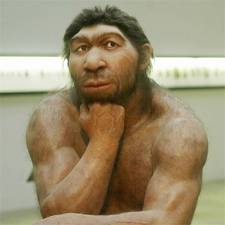
Getting in Touch with My Neanderthal Man

Neanderthal Man

All you have to do is move! 


I have moved many times in my adult life–college, graduate school, then of course the serious moving of the grownup–moves involving kids and school districts, moves requiring much larger determinations than whether you're within walking distance of the beer store. This morning, lying awake in my tangled sheets I tried counting the number of moves I've made and came up with 25 and this doesn't count the times when I moved back in with my parents briefly between rounds of graduate school. So I'm 56 and if you do the arithmetic this means I've moved once every 2.3 years. That's nothing of course compared to the hyper-nomadic experiences of many Americans, I know, but still, that's a lot of shoving and hauling of book boxes and wrinkled clothing.


If you're visually impaired moving is a deeply primitive experience. I crawl on my hands and knees locating electrical sockets, treating the holes like Braille, fingering them to see where the ground plug goes. I walk around the nearly empty new house (furniture won't come for at least two weeks) and touch the walls and turn the door knobs, amazed that I have a house–I mean really, think about it, a guy like me, vaguely atavistic, half in touch with his ancestors via wooly dreaming, here I am, walking around the echoing rooms like some kind of animal who has gotten indoors. "It's a house!" I tell myself. "It's a damned house!"


Then I try to familiarize myself with its myriad eclectic odditities–its wall switches that seem to do nothing, it's electrical box in the basement, it's weird bequeathed stuff, the pool table without usable cues, the gigantic desk that was obviously too heavy to carry away–a desk with more drawers than John F. Kennedy's desk…I'm enthralled and lost among things.


But it's not the wonder of newness that puts me in mind of my Neanderthal man–it's this desire to weep. Too much is new right now. I simply want my sticks and fire and instead I have this Rococo unfamiliar diamond studded strangeness all about me. Last night I almost sat down in the big, empty living room and wept for the sheer bigness of strangeness but my guide dog Nira walked in with her bone and jabbed it into my chest and I had to postpone my vatic whaling for a time.


Moving is good. I wouldn't have done it so many times were this not so. But I'm hairier today and I need a chiropractor big time because my posture is strange.


S.K.