Couple Angered Over 9-Year-Old's Handcuffing

Couple Angered Over 9-Year-Old’s Handcuffing
(Denver Post)
August 17, 2011

DENVER, COLORADO– [Excerpt provided by Inclusion Daily Express] Donald and Raiko Johnson detest what happened to their son.

They still do not understand it fully, yet they came to me to speak out about it, to maybe prevent another autistic or special-needs child from also ending up in handcuffs.

The Johnsons’ son, the oldest of their three, is 9 years old. He was born prematurely at 26 weeks, and in 2009 was diagnosed with autism.

Denver police ultimately decided to place him on a 72-hour psychiatric hold, and transported the boy, his hands cuffed behind his back, to Children’s Hospital Colorado.

When Donald and Raiko Johnson arrived, attendants were attempting to take their son’s blood pressure, but they couldn’t get a reading.

“It wouldn’t register because his hands were restrained so tightly behind his back,” Raiko Johnson explained.

Entire article:
Johnson: Parents concerned by handcuffing of autistic boy
http://www.denverpost.com/billjohnson/ci_18696227

Caring About Your Educational Privileges

It is an odd thing that many young people are being told that higher education is possibly irrelevent at the very moment Americans need to pull up their collective boots and work harder than ever before. This is a historical moment that calls for gumption, wit, brains, and what we used to call "Mother Courage". My own people, the Finns call it "Sisu"–a word that combines stamina and fierce determination. In any event I was put in mind of the aforementioned oddity when I read today a headline over at NPR that says only 1 in 4 American high school students is ready for college at graduation. This is a story that doesn't seem to go away. 

I am not a Ph.D. in Education and I'm not a policy wonk. I like to think of myself as a citizen educator–an academic with a passion for ideas and teaching. Like all university faculty who care about teaching I like to think of myself as having a young spirit–a contrarian's spirit, for the thing that scholars and young people share is the desire to ask why and how circumstances happen. Accordingly it seems to me that the NPR headline signifies that young people in American high schools are being bleached of their curiosities. This in the age of intellectual explosion! In a time when post-molecular medicine is locating the genes that cause hereditary blindness and when ophthalmologists can look forward to a near future when certain kinds of eye disease are a thing of the past. These are tremendously exciting times. One may fair surmise that if young people are not experiencing curiosity in this, the most electrifying age in the history of ideas, then perhaps our nation's academies aren't getting their stories "out enough" as they say in the vernacular. 

I'd hazard that these United States could use a Works Progress Administration for the dissemination of remarkable ideas for young people. Again, as they say in the vernacular, "I'm just sayin'"


S.K.


Return of Scary White Thing

Images-1 Images-2


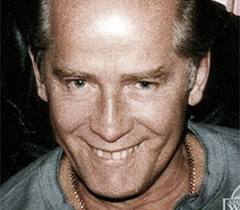
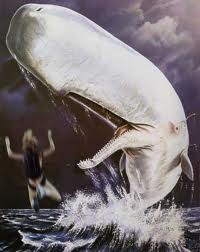
There's no doubt that Whitey Bulger is the scariest big white thing since Moby Dick. Whitey is way scarier than that big white spider in Robert Frost's poem. Heck, he's even scarier than Kate Smith when you get right down to it. 


One day, playing a cerebral game with a pal, I said that you could reduce Melville's signautre novel to one line: "Always remember what's under the boat." The FBI might have done well with that proviso?


S.K. 

Cyborg Fancy

The story of young Matthew James who has recently received a high tech prosthetic hand is a reminder that the human body's natural place as the determinant of "normality" is changing in our time. As a guy with two fake lenses in his eyes I can admire this story with visual magnification and report that this is one cool hand!  

"What do you do if you want to upgrade your pathetic meatsack of a body and become a cyborg? If you're Matthew James, a 14-year-old from Britain's Berkshire, you write a letter and end up with a bionic hand.

Born without a left hand, James became enamored of the i-Limb Pulse from Scotland's Touch Bionics, but his family couldn't afford the roughly $48,000 price tag.

After the head of Formula One racing team Mercedes GP Petronas visited his school, James got up the chutzpah to write a letter to the organization's Ross Brawn asking for help in getting an i-Limb Pulse. He suggested the team sponsor what would be a cybernetic part of his body.

Brawn agreed to help, but struck a technology-sharing deal with Touch Bionics in which most of the fee would be waived. Now James has a new hand."

See Full Story: 

Read more: http://news.cnet.com/8301-17938_105-20092565-1/teen-suddenly-much-cooler-with-new-bionic-hand/#ixzz1V98aFmhr


Does Hand Writing Matter?

Not long ago I was trying out some of the new hand writing applications for the IPad. There are several to choose from and while they all seem to have some promise, most of them tend to reduce one's writing to a kind of scrawl–just the way those supermarket credit card machines can ruin your signature. I was joking about this with a friend the other day and I said: "Well,  there goes the Palmer Method!" We're both mid fifties-ish guys who can remember being drilled in cursive writing way back in the first grade. So technology will probably finish off anything that resembles hand writing but now there's news that today's young celebrities can't write at all.


http://www.cnn.com/2011/LIVING/08/10/handwriting.horror/index.html?eref=mrss_igoogle_cnn


S.K. 

A Victory for the Visually Impaired

I have been following this story closely. My dismay at the foot dragging by the law board examiners and ACT regarding the provision of assistive technology for a blind law student is now moderately relived. Shame on ACT. 


S.K.


Law Student Wins Federal Case Against Testing Examiners
(Forbes)
August 9, 2011

BURLINGTON, VERMONT– [Excerpt provided by Inclusion Daily Express] Deanna Jones, a third-year law student who's legally blind and learning disabled, has won her first big court case: her own. 

Jones sued the National Conference of Bar Examiners in July, accusing it of violating the Americans With Disabilities Act by refusing to let her take a key legal ethics exam using a computer with screen access software that she has used to read in college and in law school. 

Armed with a federal judge's order, she was able to take the test Friday, closely watched by a proctor, test supervisor and someone from the ACT, Inc. testing company, she said. 

Jones, who attends Vermont Law School with hopes of practicing disability law, needs the Multistate Professional Responsibility Exam to practice in Vermont. The NCBE fought her request and plans to appeal, saying the security of its pencil-and-paper test could be jeopardized if taken electronically. The organization had offered instead to have someone read the test to Jones, to let her take the test in Braille, in enlarged print, and use an audio CD. 

But a judge ruled Tuesday that the examiners had to provide her a laptop equipped with the special software.

Entire article:
Legally blind Vt. law student wins 1st big case

http://tinyurl.com/4yxhcet
Related:
Law student takes home a win in her own federal case (WCAX)

http://tinyurl.com/3owgd6n