

Long Time, American Blues


No one wants to hear your shit—but remember that day in Helsinki when the kid (still a teenager) thought you were personally responsible for Viet Nam? (You told him you were.)

Or remember thinking there’d be a day for standing up straight with your head clear, liberated at last?

Look! I am pushing a large, black wool ball down a dark corridor!

This is a dance for the poets in my nation. (The poets with their green suspenders, cartoon flash lights and customized angels…)

Your head clear, liberated at last…

Poetry is not being renewed. I hate to sound like Kenneth Rexroth but have you noticed they’re killing all the young people?

My lines limp rather much the way the blues always do.

Remember thinking you’d live to achieve a double minded smile?


S.K.

You Can Never Have Too Many Philosophers with Your Dinner

rubens_four_philosophers Zen Monk with Knap Sack


The following post comes to us from our west coast bureau chief who is moving (gulp!) to Marquette, Michigan where her partner Zac has taken a job in the university’s philosophy department. Andrea Scarpino will now be our rust belt correspondent. Oy! Watch out Jim Harrison! There’s a new poet in them thar parts!


S.K.


First Impressions (four days apartment hunting in Marquette)

The Apartment (we didn’t rent)

Up a set of rusting iron stairs dubiously tacked to an outside wall of the brick building, the door to the apartment was locked with a push-button key code. The landlord had told us the key code so that we could look inside the apartment, but the code wasn’t working. The door was still locked. Finally, the landlord called and told us we could walk through the hair salon on the other side of the street in order to access the apartment. So we did: through the back door of the hair salon, the apartment unfolded, an old office space with industrial carpet and one long hallway off of which each room opened with a glass-inset door. Former tenants had duct taped flattened cardboard boxes over the panes of glass for some privacy. The kitchen: a plywood table (counter space), and a large plastic industrial tub sitting on cement blocks (the sink). On the way out through the door to the hair salon, Zac noticed the apartment and the salon seemed to share the same bathroom.

The Apartment (we did rent)

Downtown, the top floor of a three-story building, wood floors, nice woodwork, big open windows. Three bedrooms, an airy living room. The building currently seems to have roof shingles for siding, but the landlord has big plans for an overhaul, and we’ll be just a few buildings down from a grocery co-op, bakery, Mediterranean restaurant, coffee shop that roasts its own beans.

Snow

Wikipedia says Marquette receives 144 inches of snow annually. Our first day in Marquette, a sign said 200 inches and a resident told us 240. Day two, we were told 280. Our last day, Zac’s mission was to get someone to tell us 300 inches. Late into our last night, a retired philosophy professor leaned over and said, Some years, I think we get 300 inches of snow.

Gossip

We stopped in the local department store to look at its winter clothing offerings. The owner introduced himself to us, as did a salesperson with whom we spoke for a while, told him we were moving into town, talked about California. Then we continued on our walk. A few buildings down, we stopped into a bank with beautiful architecture. As we strolled the inside looking at metal work and gold light fixtures, a man’s voice said, They’re moving here from Los Angeles. The salesman from the department store stood talking with the bank tellers, pointed at us. We smiled sheepishly. They waved.

The Philosophers

Our last night in town, after finally securing an apartment and going for a lovely hike, we decided to have a drink and some dinner at the oldest hotel in Marquette. The top floor is a bar with glass windows that overlook Lake Superior. A storm moved in rustling the trees below. I drank a martini, the bar’s specialty. And then, the retiring philosopher whom Zac is replacing walked in with his wife. We chatted, invited them to join us for dinner. An hour later, another retiring philosopher walked in with his wife for an after-dinner drink. We pulled up two more chairs, laughed at the coincidence. An hour later, a philosopher who will be Zac’s colleague walked in by herself, joined us for a drink. And then, a few minutes later, a philosopher who retired last year, also walked in, pulled up a chair.

Sources, No Friends, Got the Tee Shirt


British telephone booth


In a coffee joint in Vermont the kid behind the counter wore a black tee shirt that said: “We Don’t Have Friends, We Have Sources”.  I didn’t ask him about it. I suspected he wanted me to. There are people who button their jackets askew on purpose. There are people who deliberately drive with one headlight off. I don’t care for such people. They have always seemed loopy to me, like a turtle tied by one leg and hanging from a branch.

Exchanging friends for sources is however a thing any one of us can do. Tyrants always do it, news reporters must do it. Office gossips and Tweeters can’t help themselves.

If you trade in your friends for sources you are no longer responsible for the feelings of others. You become an accomplice to something darker than your own ennui. You allow yourself to feel independent of the human mess.

I suppose that at bottom I’m the type of man who distrusts general distrust. Cultivated misanthropy is like a photograph poorly altered. The effect doesn’t stand up. It takes too much work to admit the thing.

If you can’t have friends get a turtle.

Even J. Edgar Hoover had a dog.

Even Hoover had Clyde Tolson.

Friends may make modest demands but sources will blackmail you.


S.K.

More About Teaching College in the Reagan Years


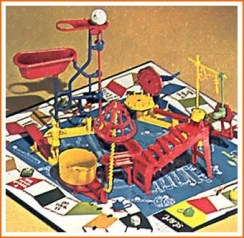
Image of Rube Goldberg's Mousetrap Ronald Reagan Making the Gesture of a Village Idiot hamburger

Those of us who were starting our college teaching careers in the early 1980’s were flummoxed by the apparent embrace of ideology over fact by so many young people.

In yesterday’s post about young Reaganistas I mentioned that my generation of baby boomers couldn’t understand young people who were seemingly immune to social justice. The Reagan kids with their greased back hair and cheap suits had almost overnight been inoculated against complexity, but by what?  Those of us who were starting our college teaching careers in the early 1980’s were flummoxed by the apparent embrace of ideology over fact by so many kids. If, like me, you were entering a college classroom to teach in 1983 and you were, say, twenty eight years old, you imagined that you had a passport to youthfulness, that you could still enter the land of people who were 18-22 years old.

Reagan’s America was not the land of social justice and investigative journalism that I had imagined was essential–would always be essential to Americanism. The tribe of teaching assistants and junior professors that I worked with were universally stumped by a new and youthful indifference to critical thinking. Some of those kids at those little one armed desks were only six years younger than I was and they had adopted the view that history was bunk. “America first” was their easy neo-Horatian chestnut and they saw no reason to think any harder. “Consciousness is painful” we would tell them, echoing Carl Jung. They stared back like underwater asparagus plants. No one had to say it. “Who wants pain?”


Want Some Pain, Scarecrow?

syringe


I remember trying to teach Christopher Dicky’s memoir With the Contras in a course on new journalism. My aim (as I recall it some 23 years later) was to show students there were books that descended from the oevre of Tom Wolfe and Hunter S. Thompson–smart, investigative narratives that took readers behind headlines and propaganda. (We also read James Baldwin and Mark Mathabane.)

Dickey, who spent considerable time with the contras (who I still won’t capitalize) reveals the inhuman realities of covert warfare in a poor country. In the book’s opening pages he quotes Ronald Reagan “the great communicator” who said famously that the contras were “the moral equivalent of the founding fathers“.

“Who,” I asked “were the founding fathers?” Silence. Projective passive belligerence. I was interrogating Reagan and asking students to be complicit. Who were the founding fathers?


Name a Founding Father, Any Founding Father


carrot-and-stick  


“I will concede,” I said, “that all of you know who the founding fathers were.” “What is the irony behind the placement of this quotation?”

I just couldn’t leave well enough alone.

There was more silence.

I quoted Schopenhauer: “Clio, the muse of history, is as thoroughly infected with lies as a street whore with syphilis.”

One guy in the back actually laughed.

I left the room.

 

Don-Quixote-Windmill  

Amusing Ourselves to Death


How had so many young people been inoculated against complexity? And how had this happened so quickly? Junior faculty types gathered over beers and talked about Neil Postman’s book Amusing Ourselves to Death. Our students represented the second full generation of television watching American zombies and we divided the baby boomers into those who watched “some” TV and those who, coming of age in the late 60’s and 70’s watched enormous amounts of it. I recall one sweet, misguided professor opining that the college should ban TV from dormitories.

Of course the 60’s and 70’s were terrible. Who wouldn’t want to feel better? Who wants to be a cultural harridan, witchily proclaiming the failings of the nation? What a trap to be in, to be arguing for critical thinking to a generation that saw it as either hopeless or quaint!

With our books and bibliographies we were as odd to these students as tin smiths or wheelwrights.

Just as “relevance” came under attack in the 60’s content was now suspect for surely the purpose of an American life was to feel good. In the Reagan era we were losing what Neil Postman described as “the transcendent spiritual idea that gives clarity and purpose to education.”

We wanted to argue that the transcendent and spiritual idea was discernment or thinking itself. That’s a hard sell to a group of people who were collectively (and by means of wholesale disinterest) echoing Reagan’s famous utterance: “facts are stupid things”.

(Reagan was of course attempting to quote John Adams observation that facts are stubborn things.)


“What does an actor know about politics?” –Reagan criticizing Ed Asner for opposing American foreign policy.

 

satan_ronnie


There’s no profit in antagonizing people who are avowedly anti-intellectual. We saw that, those of us who were commencing our teaching careers in higher education in the Reagan years. It is possible to teach people who possess no curiosity or enthusiasm for education. One has to hunker down in a deliberative and systemic delivery of information. The operative analogy is the planting of seeds. The operative standard is Orphan Annie: “The sun will come out tomorrow.”

Meanwhile, today, wasting a perfectly good Sunday reliving those years I’m buoyed by these “Top 20” Republican quotes (as seen at Daily Kos):


TOP 20 ALL-TIME STUPID REPUBLICAN QUOTES

20. The implication that there was something wrong with the war plan is amusing.” —Defense Secretary Donald Rumsfeld, on criticism of his management of the Iraq war

19. If you’ve seen one city slum, you’ve seen them all.– Spiro Agnew

18. A good many things creep around in the dark besides Santa Claus.–” Herbert Hoover, US President

17.“I like the color red because it’s a fire. And I see myself as always being on fire.” —California Governor Arnold Schwarzenegger

16. Capital punishment is our way of demonstrating the sanctity of life.”– Orrin Hatch

15. It’s like the neighborhood I would have grown up in, I think, if I had have grown up here.” —Alan Keyes, on the Chicago neighborhood he chose to rent in after moving to the state to run for the U.S. Senate

14. If you think the United States has stood still, who would have built the largest shopping center in the world?– Richard M. Nixon

13. It may come as a shock to you who live out in the real world, but occasionally we do something up here. Not often, I admit, but sometimes. For example, I think the House has passed National Peach Month so far this year and we expect to act on it soon.” —Senate Majority Leader (and Presidential candidate) Robert Dole of Kansas in 1982

12.“If Lincoln were alive today, he’d be turning over in his grave.—Gerald Ford (on Nixon and Watergate)

11.The Democrats just want to ram it down my ear with a victory—George Herbert Walker Bush

10. Any lady who is first lady likes being first lady. They may say they don’t like but from my experience I know they like it.– Richard Nixon

9. Isn’t that the ultimate homeland security, standing up and defending marriage?” —Sen. Rick Santorum

8.These are not bad people. All they are concerned about is to see that their sweet little girls are not required to sit in school alongside some big overgrown Negroes. President Eisenhower commenting on racial segregationalists after the Brown vs. Board of Ed decision.

7. “For every fatal shooting, there were roughly three nonfatal shootings. And, folks, this is unacceptable in America. It’s just unacceptable, and we’re going to do something about it” —President George W. Bush

6. The Holocaust was an obscene period in our nation’s history. I mean in this century’s history. But I didn’t live in this century.” Vice President Dan Quayle

5. “President Washington, President Lincoln, President Wilson, President Roosevelt have all authorized electronic surveillance on a far broader scale.”–Attorney General Alberto Gonzalez, testifying before Congress
(Quick! Somebody phone Al Gonzalez and tell him there were no phones or electricity during the Washington and Lincoln administrations)

4. I feel the best way to ensure Americans’ freedom is to tighten restrictions on that freedom in any way possible. Only through wiretaps, illegal searches and seizures, unfettered government intrusion, a controlled media and a complete crackdown on free speech can we ensure the liberties of all people.” — Attorney General John Ashcroft

3. I think gay marriage is something that should be between a man and a woman” — Arnold Schwarzenegger

2. “What a terrible thing to have lost one’s mind. Or not to have a mind at all. How true that is.”- Vice  President Dan Quayle

1. Hmmm, uhh, hah — ummm — I, the answer is — I haven’t really thought of it that way, heh, heh. Heh. Here’s how I think of it. Ummm — heh heh. First I’ve heard of that, by the way, I, ah — uhh — the, uhh — I, I guess I’m more of a practical fella. Uhh. I vowed after September the 11th that I would do everything I could to protect the American people. And, uhh — my attitude, of course, was affected by the attacks.ha ha …ummm Let me see… I knew we were at a war. I knew that the enemy, obviously, had to be sophisticated, and lethal, to fly hijacked airplanes, uhh, into — facilities that would, we would, killing thousands of people, innocent people, doin’ nothing, just sittin’ there goin’ to work.”–President George W Bush, after being asked if the war in Iraq and the rise of terrorism are signs of the apocalypse


S.K.


Reagan and the Latter-Day Baby Boomers

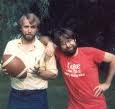
In a post entitled “The Best Years of Our Lives: What Hath Reagan Wrought” the redoubtable Lance Mannion writes about coming of age in the era of Ronald Reagan’s presidency. Mannion argues that today’s Washington apparatchiks grew up thinking that Reagan was the first successful president–not merely in their green lives, but “ever”–for President Reagan made our nation and its latter day baby boomers feel good. The Mannion take is that there are multiple grim ironies contained within such temporizing and it is not my place to recount them here. Read Lance. But what got me thinking on this rainy morning in Iowa City is just how different my “take” was on Reagan’s ascendancy, though I was comparatively young in those days. (I was 25 years old in 1980). Here is a photograph taken in Iowa City of Lance Mannion and yours truly, circa 1983 lest you doubt my former youth. (I’m the one wearing the Coca-Cola tee shirt which, as I recall, made some kind of pun about cocaine, but that was long ago and memory fails.) But of course memory doesn’t fail.


Lance Mannion and Steve Kuusisto in Iowa City circa 1983

But Of Course Memory Doesn’t Fail: Mannion and Kuusisto in Iowa City in the Reagan Years

On the night Reagan was elected in November of 1980 I drank nearly a whole fifth of Jim Beam and as the news was confirmed on TV I fell into my friend Jim Crenner’s fireplace. Jim is a poet and a remarkable one at that. As the Reaganites were bellowing on CBS I began tossing ashes over my head and proclaiming that the end of civilization was at hand. Jim of course tried to take the long view, a democratic one, to whit: nothing much changes regardless of the executive branch, really, nothing much had happened. (Paraphrase mine.) But I was having none of it. I stumbled from Crenner’s house saying that a wholesale attack on the vulnerable was about to occur. I should say that it wasn’t prescience put me in mind of that view, nor was it the whiskey. My father was a political scientist and he had been tutoring me on Reagan’s heartless and vindictive version of Goldwater-ism. Reagan was out to destroy the New Deal and to create a vast, unemployed and uninsured underclass. As I lurched from Jim’s house I knew that this was precisely what Reagan would do. 

I belonged to the first generation of baby boomers rather than the second. Boomers can be divided roughly into to camps: those born before 1958 and those born after. The fifties boomers grew up in the sixties for better or worse. They saw JFK and Malcolm X and Martin Luther KIng Jr. and Bobby die. As a pre-sixties boomer  I did not embrace the “morning in America” sentimentality that many young people were prey to as the Reagan era unfolded. I saw that you had to be born after 1962 to be sufficiently detached from the lessons of LBJ and Watergate.  


Steve Kuusisto Posing as Marty Feldman  Pekka Tarkka's biography of Saarikoski book cover

How I Spent the Reagan Years

The first thing I did after Reagan’s election was to leave the country. I went to Finland on a Fulbright Scholarship and spent most of my time in Helsinki reading the poetry of Pentti Saarikoski. Saarikoski, who died young from the effects of alcoholism was a trenchant observer of the cold war and geo-politics and he could infuse these forces into personal lyrics of great beauty. Some have described Saarikoski as the first post-modern writer. I will simply say that he saved me from the acrid stink of Reaganism with its covert operations in Nicaragua (with the sponsored burning of orphanages) or the eminent falsehoods about the military buildup in the Soviet Union (which couldn’t find double “A” batteries for its flashlights much less “threaten” the west and which would have collapsed without our feeding the already bloated U.S. military-industrial complex).

(Late in his life my dad observed that it wasn’t Reagan who brought down the Soviet Union, it was The Beatles.)

After the Fulbright I came home to the U.S. and went back to Iowa City where I’d done my graduate work in poetry writing at the Iowa Writers’ Workshop. I kicked around taking graduate courses in literature and trying desperately to keep my head screwed on. As Reagan’s evident heartlessness toward the poor and the middle classes began to take root we heard about small farmers committing suicide, about rampant homelessness across the country, about the cruel treatment of the mentally ill “turned loose” on the streets without medication or hope. One tried to imagine the nation waking itself much as the poet Pablo Neruda once hoped that the ghost of Lincoln would wake up.

Our ragtag team of graduate students protested apartheid and we took over the administration building at the University of Iowa, demanding the school divest in companies doing business with South Africa. We protested the “Contras” in Nicaragua and U.S. support for the cruel regimes in El Salvador and Chile. We organized. We made telephone calls. Many of us worked on Iowa Senator Tom Harkin’s first campaign. 

The older boomers were different from the younger ones. When Reagan was re-elected in 1984 a University of Iowa fraternity held a beer bash “to watch the states fall” (no irony). Those were the kids born after 58–more or less.

They were different from us types. I remember having a hard time understanding them. They seemed to have a new disdain for civics and to fully embrace the idea that living in America was about feeling good. I recall trying to quiz them about it and sensing that most of the younger boomers didn’t know what feeling good meant. There was no noblesse oblige about it. The best they could say was that it was about money. They didn’t come from money those kids but they believed that Reagan was opening a new spigot of dough just for them. When you pointed out that Reagan was making it harder for middle class kids to go to college they just crossed their eyes at you in mock delirium. You were just a spoilsport if you didn’t feel unambiguously good about America.


Robert
Bork Kurt Vonnegut Jr. cartoon of claw foot bathtub

Sounds Like a Fart in the Bath Tub


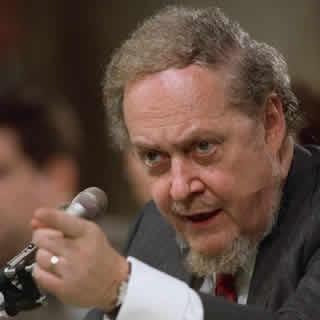
In 1987 when Reagan nominated Judge Robert Bork for the Supreme Court I was teaching at my undergraduate alma mater, Hobart and William Smith Colleges in Geneva, New York. Because I was teaching a course on social satire, and owing to the fact that we were reading Kurt Vonnegut Jr. and Francine Prose, I thought it was appropriate to crack a joke. I said: “How can you nominate someone to the Supreme Court whose name sounds like a fart in a bathtub?”

(Click here to see the late Senator Edward M. Kennedy “borking” Bork.)

I was promptly reported to the college Provost for having the impudence to make such a remark. Mock delirium indeed.

I was far away from the Reagan kids. I saw that they were without political courage and devoid of humor. Lance Mannion’s piece argues that these same folks are now a political force all their own.


outhouse Princeton Man

What I Said to the Provost

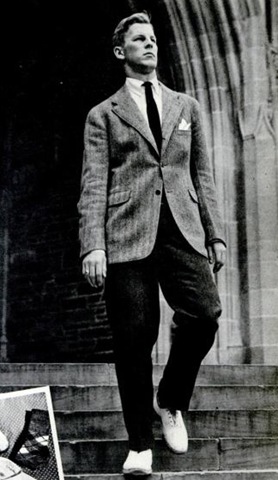
The Provost (who was a Princeton man, who wore his necktie tucked inside the topmost buttons of his Oxford shirt) asked me if it was true that I had employed bathroom humor while discussing Judge Bork in a class.

“Yes I did,” I said. I added that we were studying onomatopoeia.

“Just as an ass will bray a Bork will “bork”” I said.


S.K.

Lance Mannion: The Best Years of Our Lives: What hath Reagan wrought. Part Two.

Please don’t confuse the word successful up there with great or even good in the sense of doing great and good things for the country, although he did do a few of those.  We’ll argue about that later.  But FDR did some bad things.  Lincoln did some bad things.  If good Presidents can go wrong, then it must be possible for other Presidents to do the right thing once in a while.  Look at Nixon.

via lancemannion.typepad.com

A hearbreaking analysis of the lingering Reaganite hangover in America. Tanks Mr. Mannion.

The Interregnum of Disability Rights

Not long ago we blogged here about Rand Paul’s exceptionality where civil rights are concerned. Dr. Paul’s revisionist narrative about civil rights is not a unique one. Those of us with disabilities (and who by turn pay attention to questions having to do with equal opportunity) are well acquainted with the backlash against disability rights.

By using the term “interregnum” I am of course implying that we are between two wars. In general terms I don’t like military metaphors for the body. No one who’s read Susan Sontag’s Illness as Metaphor would want to employ military figuration when speaking of disabilities. Yet the culture wars are very real and the evident peril to people with disabilities is considerable. Again, not long ago we wrote about the effort underway in New Jersey to eliminate the Talking Books Library in that state. In these United States the “less government” crowd is often prone to Social Darwinism.

People with disabilities are standing, sitting, signing, Brailleing, between the ADA (which is having its 20th anniversary and being celebrated around the nation this summer) and the frightening realpolitik of the far right. I feel right now as if people with disabilities are in the eye of the hurricane. Things are calm for the moment. But the rightward tilt of the U.S. promises a far greater dismantling of social programs that benefit the vulnerable.


S.K.  

Maybe Some Strong Storms Across the Area

I live in Iowa where the local TV stations speak of storms both real and imagined. An imagined storm is no fixation or delusion for in Iowa it takes only minutes for a vast storm to whip itself up out of nothing. Since Iowa is a flat state there’s no impediment to sudden storms and entire towns can be destroyed in ten minutes.

As a transplanted easterner who grew up in the mountains of New Hampshire it took me some time to see that Iowans weren’t simply addicted to soap opera weather. The storm they prophesy on the evening news may hit your neighborhood or it may not. But the locality it “does” hit (perhaps the other side of town) likely won’t ever look the same. Tornadoes come. And hail the size of diner plates. The sky turns green. It’s time to go to the basement.

So now the season of “maybe some strong storms” is upon us. And “maybe” is one helluva word. This isn’t your east coast maybe.

You can think of this as an equation: there’s a storm in the mind and a storm brewing just 20 miles away and they are the same storm. The imagination has never been so powerful.


S.K.