Thoughts on “No One Left to Lie To”

When Christopher Hitchens published his grim appraisal of Bill Clinton (“No One Left to Lie To”) in 1999 I was having a bit of a bad time. When you’re disabled even the best moments can be demoralizing. I’d my own first memoir on the stands and while I’d tried to be nuanced and reflective about blindness both as I’d experienced it and as a larger circumstance I found myself on tabloid television where the nuance that disability requires went out the window. I missed reading “No One Left to Lie To” as I was busy dealing with the likes of Oprah Winfrey whose interview had nothing to do with my book. I appeared on the Leeza Gibbons Show with a drugged little girl, fresh from surgery, who’d had a third leg removed.

I was seeing first hand how the TV industry craves emotion over substance. I knew Bill Clinton had lied to the nation about reforming welfare by co-opting the GOP and emoting like a used car salesman looking into the camera and saying the poor would be lifted up. While the 80’s were built in part on fiscal lies the 90’s were about something worse. Clinton might have said: “a red herring in every pot” and few in mainstream journalism would have flinched.

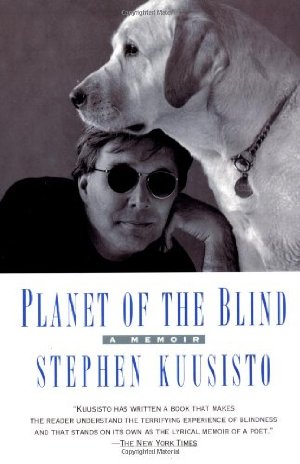
Me? I’d written a book about disablement pre-ADA. Much like my friend Lucy Grealy’s memoir “Autobiography of a Face” which contended with physical deformity in public “Planet of the Blind” spoke to the self-to-self dichotomies of blindness and contempt in the civic sphere. Sitting in those TV interviews I saw that Oprah’s mantra “the truth will set you free” was false at least where disability was concerned. Her true motto should have been: “customary feelings only.” Several years ago I wrote about the Oprah experience. You can find the post here.

Tabloid television and its ugly child, “reality TV” were steamrolling by the end of Bill Clinton ‘s second term. I wish I’d read “No One Left to Lie To” back then. I certainly wish more people would read it now. In his lively introduction Douglas Brinkley writes:

“Hemingway famously wrote that real writers have a built-in bullshit detector—no one has ever accused Hitchens of not reading faces. What goaded him the most was that Clinton, the so-called New Democrat, with the help of his Machiavellian-Svengali consultant Dick Morris, decided the way to hold political power was by making promises to the Left while delivering to the Right. This rotten strategy was called Triangulation. All Clinton gave a damn about, Hitchens maintains, was holding on to power.”

I’m tempted to quote Brinkley’s entire intro but I’ll just add this:

“To Hitchens, there were no sacred cows in Clintonland. With tomahawk flying, he scalps Clinton for the welfare bill (“more hasty, callous, short-term, and ill-considered than anything the Republicans could have hoped to carry on their own”), the escalated war on drugs, the willy-nilly bombing of a suspected Osama bin Laden chemical plant in Sudan on the day of the president’s testimony in his perjury trial, and the bombing of Saddam Hussein’s Iraq on the eve of the House of Representatives’ vote on his impeachment.”

**

Do not forget that when running for the presidency in 1992 Arkansas Governor Bill Clinton signed off on the execution of a mentally disabled man named Ricky Ray Rector. This was death as a political stunt. It was also the exploitation of disablement as human sacrifice. How does a man of decency and conscience do such a thing? He doesn’t of course. Good men (and women) abjure the taking of human life for political theater. It’s permissible to argue about the ethics and merits of the death penalty but whatever your stance (I’m against it) you should know that politics is not only about who’s paying for your lunch (as Gore Vidal famously put it) but it also concerns public spectacle and performance. Democratic countries have always put people to death to make a point. Jim Crow. Sacco and Vanzetti. The Rosenbergs. Henry Ford and striking workers.

bell hooks wrote in her book “The Will to Change: Men, Masculinity, and Love” “Men need feminist thinking. It is the theory that supports their spiritual evolution and their shift away from the patriarchal model. Patriarchy is destroying the well-being of men, taking their lives daily.”

If you’re a disabled writer you have to want spiritual evolution. You have to recognize that the cynical politics of tough talk and any public performance that devalues life will eventually kill innocent women, children and men. Back to Clinton via Hitchens who quotes Robert Reich’s recollection about “ending welfare as we know it”–

“When, during his 1992 presidential campaign, Bill Clinton vowed to “end welfare as we know it” by moving people “from welfare to work,” he presumably did not have in mind the legislation that he signed into law in August 1996. The original idea had been to smooth the passage from welfare to work with guaranteed health care, child care, job training and a job paying enough to live on. The 1996 legislation contained none of these supports—no health care or child care for people coming off welfare, no job training, no assurance of a job paying a living wage, nor, for that matter, of a job at any wage. In effect, what was dubbed welfare “reform” merely ended the promise of help to the indigent and their children which Franklin D. Roosevelt had initiated more than sixty years before.”

A good man would not have ditched the supports Reich lists but a man who’d hang a mentally impaired prisoner would do it in a heartbeat. The point was “triangulation”–the pitting of the left and right against each other not for productive advancement but solely for personal success. Hitchens:

“Two full terms of Clintonism and of “triangulation,” and of loveless but dogged bipartisanship, reduced the American scene to the point where politicians had become to politics what lawyers had become to the law: professionalized parasites battening on an exhausted system that had lost any relationship to its original purpose (democracy or popular sovereignty in the first instance; justice or equity in the second).”

I say it all begins with the execution of a disabled man who was serving a life sentence. Good citizens beware.

Yesterday’s Monsters…

Do you remember when making a scary movie all you needed was a tarantula the size of a city bus?

Sometimes looking at Trump I see the spiders in his eyes.

Alright, I can’t see worth a shit, but you know what I’m talking about.

Remember when cheesy monsters were fit representations of Cold War fears?

Last night I dreamt I was in a strange hotel. Something sinister was going on just a few floors above. I asked the desk clerk what was going on but he spoke a language I couldn’t identity.

He had spiders in his eyes.

My sister fell in love with the Creature from the Blanck Lagoon when she was a kid. She knew he was a victim of neoliberalism.

I also felt this way though I favored Godzilla.

I know a man who owns the copyright for Godzilla figurines.

I once asked him if he made more money from fear or nostalgia.

“Oh, nostalgia,” he said, “everyone loves yesterday’s monsters.”

Why I Dislike Jose Saramago…

If you’re disabled like me and you also happen to love literature you’ll likely have had a moment–a defining one–when you realized that able bodied writers love disabilities as plot devices. A device, in literary terms, can be a matter of tone, imagery, allegory, but metaphorizing people is one of the biggest. Deformed characters are invariably used to suggest villainy. Think of Bond movies: Dr. No with his deformed hand. The man wanted to destroy the world because he had to wear a glove.

The best book on this subject is “Narrative Prosthesis: “Disability and the Dependencies of Discourse” by David Mitchell and Sharon Snyder. Disability is a human fact. It’s also an effective symbolic attribution, a way to develop a plot and simultaneously divorce true disablement from the effects of art. Blindness stands for unknowing, rage, psychic powers, dependency–all of which are unrelated to blindness as a lived experience. No novel has more provenance in this area that Jose Saramago’s “Blindness” which tells the dystopian story of a blinded world. The blind world has been hit with a pandemic. A virus. Sinister nature has afflicted humanity with “petit Mal” that little death which sightlessness always conveys to able bodied readers. Score one for Saramago: he rein scribed the public’s worst fears about blindness and managed to simultaneously give a modest and untroubling condition a dark metaphoric meaning. Blindness is an irrational force from the cosmos.

That I hate the book is hardly surprising. What’s worse though is the silly and nearly endless adoption of the novel as drama, on stage or in film. Able bodied or sighted producers and writers can’t see what a trivial and damaging story it really is. One imagines how a book that suggests a virus turns everyone in the world into some other identity category might be received. It would be laughed at. Not so with blindness.

Why? Because blindness is so thoroughly steeped in metaphor it’s the easiest device at hand when you haven’t got much of a plot to begin with.

Rain falls in my hair…

Rain falls in my hair and there’s a long distance call from the dead, my dead, that vanity of all men. Rain. And not voices really but numerals in the mind. Meantime music quiets in me while I count the generations. Rain. Great grandfather. His wife sobbing behind a tree. He was a wheelwright. He made coffins for children. Music quiets. As a boy I never liked mathematics. Rain this morning. I walk among apple trees. I see paradise in fallen fruit. I want to kneel down.

Twilight

Twilight

Three men came to my door
Asking “who was Jesus?”

They appeared thirsty
Like drunks in Finland

I didn’t let them in
The little dog wouldn’t have it

(In matters theological
Its good to have a dog)

Anyway one had to laugh
Even Christ couldn’t answer

Poor men
Transactional ghosts

They turned and walked away
Across my darkening lawn

Baby Spinoza

There’s a grave inside the grave
Like the spoon
Inside Spinoza, small enough
For forgetfulness
Larger
Than love

I woke in the night
Syllables unspeakable
Still clinging
Big sky with stars
Faint music
Alien world

Spinoza
There’s no hope
Unmingled with fear
How old were you
When you swallowed
Your silver birth spoon?

I’m Old Fashioned That Way…

When the Victorians read Dickens they read for plot and confirmation–they could see their world. When we read Dickens we still read for plot but less for confirmation as we think we are superior to his characters. This is a great mistake. Dickensian sins are fully our own though we’ve one extra: post-modern irony.

I’m thinking of pastiche as Frederic Jameson would say: irony that references itself. Most often it’s mediated consciousness draped with the status conferred by consumer fetishism. Dickens characters were vain or greedy but never so self absorbed they fell into anhedonia.

Most days I read like a Victorian who wants plot and confirmation but also a bit of compassion. I’m also an admirer of Cardinal Newman’s dictum: “We can believe what we choose. We are answerable for what we choose to believe.”

I’m old fashioned that way.

Of Newman I also like: “Nothing would be done at all if one waited until one could do it so well that no one could find fault with it.”

**

Dear Charles: you pushed your wife into the asylum when you were done with her. You rooted for the American Confederacy. You were silly. You thought Anton Mesmer was on to something.

**

Dear Kuusisto: and who are you? (Reader, does he get to answer? Does anyone get to answer?)

He tries: “I was half destroyed by war movies. They tried to brain wash me into thinking the good guys always won. I’d no idea that beneath Roy Rogers’ horse was the blood of indigenous people. Man was I tricked. And you can’t get your money back!”

OK. You’ve said who you aren’t but nothing more.

He tries: “I’m a human consciousness growth project lacking some essential vitamins.”

That’s better.

I spread maps across two tables…

I spread maps across two tables
Though blind I cannot read them

This is the work of the day
And the river spreads

Clouds shaped like birds
Spread above houses I also

Cannot see–work of the day
People come and go

Wind sings the same song
It sang at Viking graves

Stones piled
Beside the sea

Work of the day
Reading what you can’t see

Maps wishes
Pressing my forehead there

Night never wants to end…

Night never wants to end, his backward death
Apes my own, yours, the death of a lonesome neighbor
Once, coming down after acid
I saw the morning star
Was a tombstone
Early it was a mockingbird
Sang a little “Keats”
Ghost limbs of poplars
Held him up
Do you remember
Before you could count
Everything was equal?
This is how it is for night
Falling like Icarus
Away from the sun
Each loss a child’s
“…yes, in spite of all,
Some shape of beauty moves away
The pall
From out dark spirits.”
And wild eyed let’s
Go about our business

The Shocking State of Disability in the Arts

I am presently in the process of reading arts grants. I won’t say “for whom” but let’s say this offers a wide view of contemporary arts funders and in turn offers their various mission statements. What’s shocking is the evidence that the disabled are not broadly conceived as artists nor are they imagined as customers.

Of course I shouldn’t be shocked. I’ve watched for years as numerous national literary conferences have treated the disabled like dirt. I’ve been to arts retreats–formerly known as “colonies” where the disabled artist is a curiosity and the dinner conversation is filled with ableism. During COVID-19 sequestration I’ve watched poetry festivals emerge on-line. Almost none of the feature disabled writers. Maybe the organizers think we’re already dead.

It shouldn’t surprise me at all that while checking the websites of the arts organizations looking for dough I’ve found that nearly all of their sites are disability inaccessible. Yet the words “diversity and inclusion” are plastered everywhere.

Yesterday I asked a friend why she thinks the disabled are so routinely left out of the diversity and inclusion panopticon.

We concluded they think we’re already dead. Or if not, we represent death and who needs it?

Think on this: if you’re a blind poet trying to use “Submittable” the ubiquitous website employed by the majority of literary magazines as a submissions portal you’ll discover its accessibility is deeply flawed. They’ve a web page that says they care about accessibility. But caring and doing are miles apart. Inclusion means doing.

Over the past decade, given how inhospitable most literary magazines are when it comes to disability, I’ve published my poems on my blog. The blog is accessible. Who needs the ableist clotted mechanisms of disability exclusion. As a writer who’s published with the best houses in the US and abroad I don’t need any more gold stars from “Poetry Magazine” or “Spilled Chowder Review. I sure don’t need Submittable screwing with my precious time because they can’t be bothered to make their system fully ADA compliant.

I shouldn’t be surprised.

Here’s a poem I self published some years back:

America with your history of eugenics.
With your hostility to the global charter on disability rights.
With your jails, stocked with psychiatric patients—worse than the Soviet Union. We are Gulag Los Angeles; Gulag Rikers Island; Gulag Five Points in Upstate New York.
America with your young Doctor Mengeles.
With your broken VA.
With your war on food stamps and infant nutrition.
With your terror of autism and lack of empathy for those who have it.
Wih your 80% unemployment rate for people with disabilites.
With your pity parties—inspiration porn—Billy was broken until we gave him a puppy.
With your sanctimonious low drivel disguised as empathy.
With your terror of reasonable accommodations.
With your NPR essays about fake disability fraud, which is derision of the poor and elderly.
With your disa-phobia—I wouldn’t want one of them to sit next to me on a bus.
America when will you admit you have a hernia?
When will you admit you’re a lousy driver?
Admit you miss the days of those segregated schools, hospitals, residential facilities—just keep them out of sight.
When will you apologize for your ugly laws?
When will you make Ron Kovic’s book irrelevant?
America, you threatened Allen Ginsberg with lobotomy.
Ameica you medicated a generation of teenagers for bi-polar depression when all they were feeling was old fashioned fear.
When will you protect wheelchairs on airlines?
When will you admit you’re terrified of luck?