Walt Whitman’s Live-Oak and the Origins of the US Navy

Last night, late, while reading a book about the origins of the United States Navy I learned that 18th century frigates were often built from the wood of Live-Oak trees. I thought right away of Walt Whitman’s famous poem “I Saw in Louisiana a Live-Oak Growing”. Like many readers I first encountered Whitman’s poem in a college class on American literature. I was a blind kid struggling with words and half in the closet about my disability and piercingly lonely. The poem reached deep inside me.

Whitman’s poem is only partly about loneliness—it’s also concerned with art, joy, the uses of solitude, and the ineffable transcendental utility of isolation. It’s shiningly homo-erotic and to my mind it’s one of the most beautiful poems in the English language:

I saw in Louisiana a live-oak growing,

All alone stood it and the moss hung down from the branches,

Without any companion it grew there uttering joyous leaves of dark green,

And its look, rude, unbending, lusty, made me think of myself,

But I wonder’d how it could utter joyous leaves standing alone there without its friend near, for I knew I could not,

And I broke off a twig with a certain number of leaves upon it, and twined around it a little moss,

And brought it away, and I have placed it in sight in my room,

It is not needed to remind me as of my own dear friends,

(For I believe lately I think of little else than of them,)

Yet it remains to me a curious token, it makes me think of manly love;

For all that, and though the live-oak glistens there in Louisiana solitary in a wide flat space,

Uttering joyous leaves all its life without a friend a lover near,

I know very well I could not.

**

My Live-Oak (for we possess things via the arts—and by “possess” I mean enfold, “sweeten” into our minds) has always been the one above—uttering joyous leaves in a rare space; rude, unbending, lusty, glistening. Strong in isolation. Whitman makes it the tree of life. And so it is.

Strange then, to read the following in Ian W. Toll’s Six Frigates: The Epic History of the Founding of the U.S. Navy:

Not long after Europeans settled in North America, shipwrights recognized the potential of the live oak as a building material. Its extraordinary tensile strength and its resistance to both salt air and rot made it ideal for the key load-bearing sections of a ship’s frame. In the joints formed between the trunks and limbs could be found angled pieces that served perfectly for the “short timbers”—the knees and futtocks on which so much of the ship’s structural integrity and longevity depended. Carpenters prized its uniformity of substance, its straightness of fiber, its smooth consistency, its fine grains. Properly seasoned, it was said to have a life span five times that of white oak. But the shipyard workers also dreaded the extra work it took to cut, shape, and manipulate live oak, and they rolled their eyes whenever a new load of raw timber sections was brought into the yard. A nail driven into it was nearly impossible to extract. Axes bounced off it and saws moved back and forth across it again and again, making little or no discernible progress. Nothing took the sharpness out of a ship carpenter’s tools as quickly as well-seasoned live oak. 

In Philadelphia, Fox was busy producing the “moulds” which the cutting parties would use to match the size and shape of the timbers to the dimensions of the frigates. Molds were life-sized, three-dimensional models of each unique timber section, constructed of light wooden battens. The dimensions of each piece, taken from the original plan, were chalked onto the smooth, dark, painted floorboards of a “moulding loft,” typically the second floor of a large warehouse. The dimensions were then taken off the floor, the battens cut and carefully numbered, and the entire package shipped unassembled to the forest. The cutting parties assembled the molds and used them to measure and cut the logs.

Obtaining the timber for the frigates would prove far more difficult, expensive, and time-consuming than anyone might have expected. Several hundred live oak trees were needed for each of the six ships. Because of the great size of Humphreys’s model, the frame pieces could only be cut from the largest and oldest trees. To find the specified timber, the cutting parties would have to journey into the most remote and inhospitable part of the live oak’s range—the uninhabited coastal islands of Georgia.

(Excerpt From: Ian W. Toll. “Six Frigates: The Epic History of the Founding of the U.S. Navy.” iBooks. https://itun.es/us/vSNqx.l)

**

Rude, unbending, lusty, glistening, strong in isolation.

I believe Whitman knew about the war ships.

I choose to believe.

The Live-Oak then, a homo-erotic sword into ploughshare, released from war.

I’m sure you’ll understand that I couldn’t sleep after that.
 

A Dog Named Harmony

I got the call this afternoon from Lisa at Guiding Eyes for the Blind that starting next Monday (August 10) I’ll be united with my fourth guide dog, a yellow Labrador female named “Harmony”.

Timing is everything whether you’re talking of comedy or the calendar. I’ll have ten days to work with Miss Harmony before the start of a new semester at Syracuse University where I both teach and direct the Honors Program for outstanding undergraduates. Ten days are before me when I must study hard to understand the ways of my new canine companion. We say all the time that everyone is different. This is true of guide dogs. Each has his or her unique personality and though they come already trained, it’s the job of a blind handler to relearn dog handling techniques (for some things inevitably change in the land of dog training) and to learn what the new dog knows and expects. The training is a team activity. In my case, though I’m a veteran dog handler, I have lots of new things to learn. “Be curious every day,” I tell my students. “Be open,” I tell them. Well now it’s my turn. With Harmony and trainer Lisa I’ll be practicing what I preach.

My friends and colleagues will see me walking with Harmony and Lisa on the campus at SU. On day one, which will likely be next Tuesday, anyone chancing to see us will see me with a dog in harness and a young woman walking behind. I will be relearning how to be a good dog handler. Harmony’s life and my own will depend on this.

Timing is everything. I’ve just completed a new book (a memoir) recounting what it was like to discover freedom with a guide dog for the first time. In the next few weeks I will be revising the book for the last time before it goes into production at Simon & Schuster. As I’m preparing to revise the manuscript I’ll be walking richly in the open, with more than a little vulnerability, and with lots of trust.

Miss Harmony is coming. My current guide “Nira” will retire as our beloved house pet. Nira is sneaking up on 10. She’s more than a little tired. She loves me deeply as I love her. Now we will have to separate as hourly companions. I know this will be a bit hard for her, and it won’t be that easy for me.

Harmony will have her different ways. A different gait. She will be faster than Nira who has inevitably slowed. I expect Harmony and I will soon be moving fast.

And so for the sake of Nira and Harmony I’ll endeavor to be the best student I can be.

In the new memoir I describe meeting my first guide dog Corky for the first time:

She was brilliant and silly. I couldn’t believe my fortune. Back in our room Corky licked my eyes. She wanted me to invite her on the bed. I told her to remember the rules. Dogs on the floor, people on the beds. The trainers had been clear about guide dog etiquette and I was going to follow the regimen. Guide dogs aren’t encouraged to climb on the furniture. “You stay on the floor,” I said, and she nibbled my nose again as if to say, “I’ll wear you down brother.” I saw in our first moments we were having the manifold dance of relationship—we were joyous and communicating. I talked in a running wave. She bounced, literally bounced, cocked her head, backed up, ran in circles, and came back. All the while I kept talking. “Oh let’s go any place we choose,” I said, feeling I was on the verge of tears. 

Our first hours unfolded. We began the lifelong art of learning to read each other.  

Oh let’s go any place we choose, Harmony. I’m ready.


Disability and Eye Rolling in the Great Big Academy

Its a truism perhaps but having a disability possesses significance because of its permanence. Your blindness or paralysis or autism isn’t going away anytime soon and though it might someday (especially if you believe marketing from the cure industry) holding your breath is both risible and injurious. Keep breathing. You’ll feel better. If you keep breathing you’re at least guaranteed to feel something.

I work at a big university where I’m a senior faculty member and an administrator. Students and staff who experience disability problems often seek me out because they’re having trouble with transportation, parking, information technology, bathroom access, you name it. One side effect of being a disability advocate is that you often earn unjustified eye rolling from non-disabled colleagues. “Here comes Kuusisto again, saying we’re not up to snuff with accommodations.” I know this is true, though of course I don’t know precisely what’s being said about me. “Here he comes again!”

Non-disabled people don’t really understand that disability means permanence. Its not like a week on crutches or pregnancy. Crutches and pregnancy are situational and while they’re entirely inconvenient, they’ll go away. The permanence of disability means, among other things, that barriers to access are a daily feature of life and the eye rolling and obstructive bureaucracy is routine. When you throw away your crutches your difficulties with architecture and bathroom stalls come to an end. When you’re blind with a guide dog and the restroom doesn’t have accessible facilities the impactful disregard for human variability never comes to an end. For wheel chair users the malfunctioning automatic doors and badly constructed ramps (or the absence of ramps) never comes to an end. For deaf people the absence of sign language interpreters or CART never comes to an end. Around it goes.

The eye rolling would be easier for me if I had a misanthropic streak. But the truth is, I like people. I like them quite a lot. I went into teaching because I enjoy young people and admire my elders—or many of them. (If you teach in higher ed long enough you’re likely to meet Professor Polonius or Dr. Fraud, and you slowly learn not to share your cucumber sandwiches with them.) Still, sharing books and probative ideas is a critical aspect of what I do for a living and its made easier because I like human kind.

Historically, people with disabilities in the United States entered public schools on the coat tails of the landmark Supreme Court decision Brown vs. Board of Education. By desegregating schools the Court opened the doors of public education for the blind, the deaf, and people with learning disabilities. I am a first generation “mainstreamed” disabled citizen whose education was made possible by that momentous civil rights victory.  As a result the schoolroom has been the life-long instrument of my citizenship.

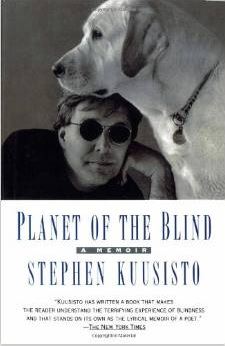
In my memoir Planet of the Blind I describe learning to read with the help of an African-American teacher who put in the extra time to make certain I achieved literacy. She pushed me into writing. Therefore in my own teaching I challenge my students to write with firm control of content and form. In a paper assignment I may ask students to explore the formal elements in Auden’s elegy to Yeats because the exercise will help them see how the lyric component of the poem is central to its political and psychological contents.

Creative writers and theorists who have concerned themselves with the experiences of historically marginalized people influence my teaching. I aim to show students how inherited figurative language may itself become an obstacle for the writer or at least for his or her imagined characters. Raymond Carver’s story “Cathedral” comes to mind as a teaching tool. In Carver’s story the miserable working-class “sighted” narrator guides a blind man’s hand across an oversized sheet of paper in a sympathetic effort to show the sightless man what a cathedral looks like.

I am engaged by what the critic Lennard Davis has called “the construction of normalcy” in the area of Disability Studies. “Normalcy” can be understood as an economic construct of 19th century industrialization. In this kind of analysis no one is normal enough for the factory and no citizen is taught the language of self-identity. In a course on the contemporary memoir I demonstrate for students how Nancy Mairs (who has multiple sclerosis) argues with our culture’s assumptions about the role of women and the value of the disabled. Additionally I strive to show students how a memoirist’s concerns are informed by Feminist Theory, Queer Theory, and African-American Theory and Literature. The memoir is a synthesis of statements about identity whether the writer is Dorothy Allison, John Hockenberry, Paul Monette, James Baldwin, or William Styron—all are engaged in the progressive art of expanding the social parameters of belonging in America, even as they must address the ironic difficulty of that very enterprise.

As a poet and writer of creative nonfiction I hope to demonstrate how imaginative writing transforms the received and static forms of personal language and plot. In turn I aim to show students how to find new and releasing autobiographical material. The art of memoir resides in talking back, but hopefully the memoir or poem or personal essay will become an alchemical romance both for the reader and the writer. I find that I spend a great deal of time “listening” to students both in the classroom and in conferences. Of course in a very literal sense I sometimes need students to read aloud for me a revision of a text. “That’s odd,” I’ll say, “can you hear how you’re saying that?” Ironically blindness often allows me to focus a student’s attention on the emerging or instinctual subject of a poem or essay. At such moments my hearing conceives just beyond a student’s rising music the possibilities for a better line, or a newer theme that still remains to be explored. I try to show my students that where imaginative language is concerned one must cultivate a passionate curiosity about the word—a curiosity that only further writing and “revisioning” will satisfy. I hope I can help them hear their better voices.

The problem for those of us with disabilities is that the permanence of physical or neurological difference is unbridgeable and the built environments that occlude or obstruct our progress are still omnipresent. The Americans with Disabilities Act told us boldly to come into the village square or the agora. We’re here. We like our colleagues. We want them to like us. We feel sad about the eye rolling. The good news? Eye rolling can be a temporary condition.

Essay: You Can’t Please Everybody

Essay: You Can’t Please Everybody

I care what people think of me, but I do not always care. A proverb might be attached: sings to the wind, sings to stillness. Something like that. A student put me in mind of this, asking me how I keep myself buoyant (my words) in a world of endless disappointments (my words) and I said that in my experience those who do not like you would never have liked you, and so what chance do you have? You simply make the music that is your life. I’m always making analogies, not only because that’s what writers do, but because for over a hundred years the thinking of our thinking classes has been infused with metaphor, whether you’re a poet or not. So religion is about ideas of god, science is about wish, far more than scientists will allow, and art is what you make of it. And that’s a fancy way of saying you can’t please everybody.

It is a sobering moment when you first realize that the educated in the US are afflicted by self-loathing and self-doubt to the same degree as your butcher. Talk subsumes surprise all too often, and a grey formalism mixed with gall settles in. You see it in university professors but also in bureaucrats and business people–a vague, unspoken sense that wisdom is not enough in a life. It’s as if the nervous self-awareness of adolescence has become permanent for millions of people; growth has stopped; and so the millions live in thrall to sad confirmations. You can ask why this should be the case and according to the province of theory you’re in, you will get different answers depending on whether you’re reading Osupensky or Marx or Alan Watts. What matters is that one is surrounded by idio-pathic zombies, which is of course why zombie games are so popular on mobile devices.

And so I don’t care what people think of me–I’m a person with an evident disability living in a civilization that sentimentalizes disabilities. The blind man who climbs a mountain can dine out forever giving talks about inspiration–talks that tell millions who live in thrall to sad confirmations that their lives could be bigger if only they dared live bigger. I have a general disdain for these sorts of talks, and in truth would rather have a colonoscopy without anesthetic than listen to the treacle that far too many celebrities with disabilities willingly toss at conferences and conventions. Inspirational speaking is always missing the point–that life is life, and lived with better ideas it’s a better business. Life is not cavalier emulation. It’s something else. It’s perhaps nothing more than a flaunted non-sophistication that finds honest satisfactions. And it’s about inviting your neighbors in, after you’ve swept the house. If you’re going to emulate someone, emulate the teacher who read a book all weekend.

Meantime, I don’t care if I’m not liked. Oh I grieve over it a bit. But what I want isn’t personal. I’m not indifferent to the peculiarities of the world, the one we’ve made. I’m angry that Lockheed Martin can advertise weapons of mass destruction on my television. I’m angry that young people are being told their votes don’t matter; that people of color in my country are being prevented from voting because they don’t have driver’s licenses; I’m wildly angry that my nation has killed a million citizens of Iraq for nothing more than a bullying neo-conservative idea that we could export democracy at gun point. I’m angry that the old damage of American imperialism is so poorly understood by my neighbors, many of whom honestly believe that muslims hate America because we’re Christian–failing to realize that our foreign policy has undermined the dignity of human life in a large part of the world for a generation and that human beings have a good grasp of what has been happening to them. I wake up angry. I go to bed angry. And in the meantime I walk about.

I live in the communion of words with my firm shoulder blades and half groomed head and I read as much as I can about liberty and I say what I must.

If you have a disability you see almost daily how many have learned the language of shoulder shrugging. If you work at a university you see professors who shrug–they’re my pet peeve–the ones who don’t want the students with disabilities in their classes. And the administrators who make it hard for faculty and staff with disabilities to do their jobs–I can’t stand their shrugging. The latter especially as it’s loaded with double talk.

So to that student who asked: I think of the static from the remorseless sun and keep shining.


The AWP and Disability Inclusion

Yesterday I posted on Facebook some rebarbative comments about disability access at the national conference of the AWP, which for those who don’t pay attention to the American university’s creative writing set, stands for Associated Writing Programs. There are hundreds of creative writing programs in the US which offer writers both undergraduate and grad degrees.

I believe wholeheartedly in the academic study of writing—from poetry to post-structuralism. In general I endorse the AWP in its effort to create a national gathering for writers and teachers. In fact, I think the AWP’s work is important. In recent years the organization has steered its national conference toward a greater appreciation of diversity and nowadays its panels and readings are richly representative of the multicultural nature of American society. In sum, the AWP is a largely progressive and affirming outfit. Except where disability is concerned. I must say that after a decade attending their conferences I’ve found the cumulative experience so demoralizing I’ve decided both to speak out about the matter and to skip the affair. The former is appropriate. The latter is sad.

If you’re still reading—here are a few highlights from my years of attending the conference:

  1. Hotel in Chicago tells me I can’t come in with my guide dog. Old game. Get the manager. Checking in takes 45 minutes. Dog is thirsty and hungry after plane trip.
  2. Ask for accessible handouts at panels. None. Shrugs from panelists. Eye rolling.
  3. Complain to national office about accessibility problems with conference website. Eye rolling.
  4. Fall down while entering a big room where a popular panel is about to take place. The panelists walk over me while I’m on the floor. One of them is very famous. He talks about empathy in his prepared remarks.
  5. Ask for escort to find things. Takes 1 hour to find accessibility services table. Miss the panel.
  6. No one is educated about helping disabled people. Lots of “I’ll see what I can do…”
  7. Wheelchair users have lousy time with everything from transportation to access.
  8. Deaf people have to fight to get sign language.
  9. Lots of eye rolling. Here is the AWP’s “statement” on disability from their website:

AWP is committed to making all reasonable arrangements that will allow conference attendees to participate in conference events.

All rooms at the conference are wheelchair accessible. The first row of seating in meeting rooms is reserved for individuals who have accessibility needs. In order to help us better prepare, all requests for accessibility services, equipment, or accommodations should be submitted in advance of the conference. Please submit your request to events@awpwriter.org by Friday, January 29, 2016. Attendees who require special onsite assistance during the conference should request it from personnel at AWP’s Help Desk.

The language is not welcoming, and its of some interest that the disability statment is hidden nearly out of sight on their web page, and appears under “refunds”.

Let me contrast this with the accommodations language employed by the Modern Language Association, which offers another big academic annual conference:

The MLA is committed to making arrangements that allow all members of the association to participate in the convention. Stacey Courtney coordinates arrangements for persons with disabilities; she can be reached at the MLA convention office at scourtney@mla.org.

Meeting Rooms. Meeting rooms at the convention are accessible by elevator, and the doors are wide enough to accommodate wheelchairs. There will be a desk in the MLA registration and welcome center at the Vancouver Convention Centre (Prefunction, level 1, West Building) staffed with personnel who can provide assistance to convention attendees with disabilities. There will also be a desk at the Fairmont Waterfront (Lobby level).

Hotel Rooms. To reserve hotel rooms that are specifically equipped for persons with permanent or temporary disabilities, participants must have checked the appropriate boxes on the convention registration and housing reservation forms or contacted Stacey Courtney in the MLA convention office by 14 November.

Transportation. A complimentary transportation service will be available throughout convention meeting hours to transport attendees with disabilities. Arrangements may be made at the desks for persons with disabilities in the Vancouver Convention Centre (Prefunction, level 1, West Building) and the Fairmont Waterfront (Lobby level). Further details will be available closer to the convention.

Sessions. Speakers are asked to bring five copies of their papers, even in draft form, for the use of members who wish to follow the written text. Speakers who use handouts should prepare some copies in a large-print format (14- to 16-point type size). Speakers should indicate whether they want their papers and handouts returned. Sign language interpreters and real-time captioning are available on request. The deadline to arrange for an interpreter is 14 November, though the convention office will make every effort to accommodate late requests. To arrange for either of these services, write or call Stacey Courtney in the MLA convention office.

Scooter Rentals. Scooters, for navigating the convention more easily, can be rented from Scootaround (888 441-7575 or www.scootaround.com/rentals/m/mla).

**

If disability rights are meaningful and to be honored, I think the AWP needs to organize a committee on disability access best practices. The ironies abound.

I know disabled folks who continue to goto the conference. They believe earnestly that by showing up they will change the dynamics. I no longer believe this.

The AWP should be a leader in all areas of civil rights.

Black Lives Matter: A Nature Poem

The peepers are peeping in my garden, my overgrown garden, and it’s still early, at least until 8 AM. I heard a commuter jet just moments ago. I can detect traffic far off on the interstate. There are gold finches in my yard debating with the crickets. BLACK LIVES MATTER. There’s a mourning dove somewhere among my apple trees. He is sometimes called the Carolina Pigeon. The British call him the Turtle Dove. BLACK LIVES. I think it’s good to be specific. The dove’s wings make a whistling sound when they take off and land. This is called “sonation” and as a blind person I enjoy this. BLACK LIVES MATTER. Long ago, when I was a child, I used to run away from home. Blind kid running. I was often alone among the trees. That was when I learned how to listen. BLACK LIVES MATTER. One thing I like about nature and nature writing is the fulsomeness of it: mourning doves feed their chicks on “crop milk” which is essentially the regurgitation of seeds. I knew an ornithologist once who tasted this. BLACK LIVES MATTER.

I love the morning.

My Father’s Hammer

Now and then I channel my father who hated all things mechanical. He was incompetent with tools and just the idea of hanging a picture could make him sweat. He was the sort of man who panics before touching a hammer.

Back in the day I imagined my father was merely clumsy with amateur carpentry. He was, after all, a scholar, a Harvard trained political scientist. What use did he have for hammers? But this was naive on my part. Everyone needs a hammer at some point. Why did the hammer fill him with dread?

I think I know the answer. The hammer, more than any other instrument, reveals a man’s life is spiced with heavy lies.

This didn’t come to me without help. Late last night I read the following lines in a poem by the late Israeli poet Yehuda Amichai entitled “Travels of the Last Benjamin of Tudela”:

The time has come to engage in technological 

games, machines and their accessories, 

toys that are kinetic, automatic, 

spring-operated, doing it themselves, in their sleep, 

wheels that make things revolve, switches that turn on, 

everything that moves and jumps and emits 

pleasant sounds, slaves and concubines, 

a he-appliance and a she-appliance, 

eunuchs and the eunuchs of eunuchs.

My life is spiced with heavy

lies, and the longer I live, the bigger 

the art of forgery keeps growing inside me

and the more real. 

**

My father stayed inside his books. Those bulwarks against the forged life.

Hammers told him what a liar he was.

The subconscious is filled with angry hammers.

A hammer knows you’re bound to slip out of your life and disappear without anyone noticing.


Thinking of Kenneth Koch


1.

I used to be blind but now I am deliriously dark.

Uptown subway Manhattan big dog.

She owns our money. Yellow canine loot.

Lucky, she spends it on me.

2.

A blind month—

a pomegranate split–

thirty days of seeds.

A mistake to say more.

3.

Bach lived in a violin case.

The man Bach lived inside the strings.

G string black and fizzy

His preferred we think.

The ADA Parties are a Bit Hard to Take

I wish I felt sanguine and celebratory about the 25th anniversary of the Americans with Disabilities Act. A party has been going on across the nation from the White House to community centers. I feel like John Lennon singing: “I don’t want to spoil the party so I’ll go/I’d hate my disappointment to show…”

Daily oppression rocks the disability community and for my money the celebrations have seemed glib. People with developmental disabilities and autism are shot and tasered and die in police custody. Universities sequester disability services, treating accommodations for students as a rehabilitation process rather than a matter of diversity inclusion. Most colleges and universities still treat the ADA with grudging, conditional acceptance, which means among other things, they look for ways to ignore it whenever possible. In turn, college students who are not disabled learn nothing about disability. They become the next generation of managers who believe its a rehabilitation issue rather than an inclusion issue.

So I’m not dancing. In my city (Syracuse) there is almost zero accessible housing for wheelchair users. Tomorrow a group of students and local activists will assemble at city hall to raise this issue. 25 years after the ADA. Imagine.

While people ate classy finger foods at the White House this week, there’s a powerful move afoot in Congress to drastically reduce funding for Social Security disability benefits for our nation’s most vulnerable citizens. Jeb Bush, a leading contender for the Republican nomination for President has argued it’s time to eliminate Medicare. Schedule B of Medicate keeps people with disabilities alive.

Not dancing. I feel as if the celebrations are taking place while Rome is burning.

What a sour puss!

As of today, only 25% of college students with disabilities actually graduate.

As of today, 70% of the disabled remain unemployed.

As of today, airlines destroy wheelchairs in transit at alarming rates.

As of today, public transportation remains marginally accessible in most cities.

As of today, I could go on and on…

Sour puss indeed.

“But Kuusisto,” you say, “haven’t we made significant progress since 1990? Can’t you see that?”

I’m not sure.  Most businesses and universities think of the ADA as “an unfunded mandate” and treat it with disrespect.

I’ll bet the hors d’oeuvres were splendid at the White House.

They Are Murdering My Black Neighbors, My Disabled Tribesmen

Now that murdering black citizens in the United States is legion, and owing to the incontestable fact that the murderers are police, I hereby declare my civil disobedience. Cue: roll the B footage of Thoreau:

“If the injustice is part of the necessary friction of the machine of government, let it go, let it go: perchance it will wear smooth–certainly the machine will wear out… but if it is of such a nature that it requires you to be the agent of injustice to another, then I say, break the law. Let your life be a counter-friction to stop the machine. What I have to do is to see, at any rate, that I do not lend myself to the wrong which I condemn.”

Yes. It’s time to become counter-friction. Of course it was always time. And I’ve been inconvenient before—having protested the Viet Nam war; the war on Nicaragua; successive wars in the mid-east. Sure. I’ve been a peacenik.

But counter-friction means inconveniencing the machine. I have failed to inconvenience it. I see this now.

I’m blind. I walk with a guide dog. I’m 60 years old. What can I do?

I’m grieving for all my black friends.

I grieve for the disabled people who have been routinely brutalized by cops.