More About the University of Michigan Press

This morning I wrote a blog post about my frustration trying to read books from the University of Michigan Press. My essential point is that disability is harder than many people like to think, even within the disability community, and if you’re blind and you want to read books you experience many setbacks—so many it feels like you’ve chosen to climb a mountain. I did something I don’t like to do. I “outed” the U of Michigan Press for having a confounding and largely inaccessible ebook delivery system. I don’t like doing this kind of thing. But as I said in my piece, I’m 60 years old and I’m getting tired of inaccessibility, especially in universities.

I was grateful to receive the following note from Charles Watkinson:

Professor Kuusisto, thank you for your thoughtful post. I am commenting as Director of University of Michigan Press. While we do try and make our books available in a variety of ebook formats (including Kindle and Kobo editions in addition to ePDF, in DRM-free versions on Project Muse as well as in DRM-included formats), we are very aware that we have more to do in making our works more widely accessible. As part of the University of Michigan Library, we are particularly sensitive to the needs of a diversity of users and our disability studies editor, LeAnn Fields, has recently been involved in the recruitment of an Accessibility Specialist for the Library who will be working with us on exactly the issues you raise. This blog post comes at a particularly valuable time, as did the recent open letter/guidelines to publishers written by our author Professor Lennard Davis and his colleagues in June. Please know that we are actively working on the issue and hope to provide a better service to both our authors and readers soon.

When I say I was grateful I really mean it. Grateful means, among other things, pleasing by reason of discomfort alleviated. Mr. Watkinson is candid, thoughtful, and relieving.

There are fewer blind people in higher education than one might think. We are easy to overlook. In this instance I don’t feel overlooked.

My Everest: The University of Michigan Press

I am a blind professor of disability studies and literature. I teach at Syracuse University. I’m now 60 years old though on the day I was born in 1955 I wasn’t expected to live more than a few hours. In fact my identical twin brother died straight away. We were premature babies in small town America.

In general terms I think anyone who pretends disability is easy is dishonest. In the blindness world, which is heavily impacted by charity narratives, we have countless stories of heroic and strenuous accomplishments. I love accomplishments. And though it’s not fashionable, I appreciate inspirational journeys. I loved Sir Francis Chichester’s story of sailing around the world alone and I love all accounts of successful mountain climbs. When Eric Weihenmayer  climbed Mt. Everest I cheered. Please note: I didn’t cheer because Weihenmayer was blind. I simply applaud all persons who live as if it matters.

Displacement narratives of stamina and disability which are designed to inspire the non-disabled trouble the bejeezus out of me. This is because ordinary blindness, the daily “living with it” blindness, is often dreadful.

One way blindness remains grim concerns the ongoing and considerable difficulty of acquiring accessible books. As a blind scholar I must say this is my Mt. Everest. Getting ahold of books I can read is not only difficult, it’s often nearly impossible. When the “i” word enters into disability land, it means more often than not, that inaccessibility is essentially part of the built environment.

Consider my recent experiences. I’ve been trying to access new books about disability from the University of Michigan’s press. In order to read one of their ebooks on an iPad (or iPhone) their website directs you to download an application called “Blue Fire Reader”. It turns out to be inaccessible to the iPad’s screen reader which is called VoiceOver.

Reading deeply on the U of Michigan press’ website you’re instructed that you can read their ebooks with a different application called Adobe Digital Reader. I downloaded it. It also doesn’t work. Next I tried importing the books to other apps including Evernote, Goodreader, and even various cloud apps. No dice.

The only way I can read a Michigan book is on a desktop computer. So, yes, it can be done. I can sit in an upright chair at my desk and listen to a book and I’m glad to be able to do so.

But you wouldn’t know this from the Michigan web site. In fact, there’s no accessibility information of any value on their site, and moreover, they make the experience of attempting to read one of their books nearly impossible.

I find it ironic that a press which publishes books on disability and culture has so little expertise in making its scholarly publications easy to read for blind researchers. But they are not alone. Try reading online journals or downloading articles from major academic websites. You will find its a jungle out there.

My own theory about this is that higher education still treats disability as a mandated form of service provision—accordingly they see it only as a student affairs issue. True accessibility is seldom imagined as an important facet of knowledge delivery.

Books are my Everest. I’m still at base camp one.


How to Write a Memoir

1. Memoir must be about vulnerability. If you’re thin, you have a fat soul; if you’re fat, you have a thin person inside. There’s a shovel inside the shovel…
2. For vulnerability we should substitute a hundred words. One is “susceptibility”–we are susceptible to both complex and simple thoughts and emotions. None are extraneous. Only Capitalism tells us otherwise.
3. There’s a desire under your desire, like the color green in your ribs. Pay attention to “under the ribs”.
4. Vituperation. Everyone is trying to be nice. But its good to say things like: “he was a desperate Santa Claus who beat his wife”–let things out. Roses really want to grow, but so do thistles.
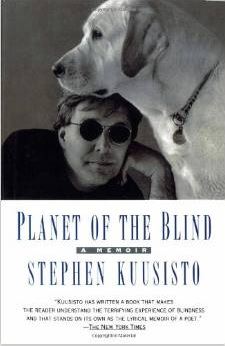
5. More vituperation. In “Planet of the Blind” I describe an old professor who was cruel to me by imagining him snacking on turds.
6. Dare to be forgiving. Dare is the right word. Yes, its a gamble.
7. Open strange doors, just to see what’s there. If its a tiger you can always throw him a strawberry.
8. Disability is “Proteus”–not Jesus.
9. Walk like an Egyptian. (I just wanted to say that.)
10. Optimism. Cultivated. Quote from Helen Keller: “No pessimist ever discovered the secret of the stars, or sailed to an uncharted land, or opened a new doorway for the human spirit.”
11. Resisting inspiration. Overcoming Tiny Tim’s pornography collection.
12. But if inspiration leaks out, because you are persistent, think of it as the imaginative respiration of leaves, a la Whitman.

Homage to Thich Nhat Hahn

Something has happened to me I can’t say what. It seems I’ve stepped from one concentric mandala to a smaller one, a turn toward peace. It’s as though all the laughing I’ve done has blown backwards and now that wind has pushed me to contentment. I can write it. I can dance a little. I believe in peace but now I “am” just so, a difference.

Like anyone I’ve had a hard life—I was bullied in childhood because of my disability. I’ve been oppressed in the work place and all the while, like some refracted ring of sun around a tiny lens inside the spyglass, I knew it wasn’t real, knew I wasn’t in those rooms. I wasn’t there when the famous University of Iowa professor of modernist poetry told me I couldn’t be in his class because of my blindness. Wasn’t there when the college president told me behind closed doors I’d have to learn how to drive a golf cart and hand out towels to summer lacrosse players if I wanted to keep my adjunct teaching job—who told me my blindness simply meant I wasn’t competitive enough.

Wasn’t there and wasn’t there.

All of us take steep paths to find contentment. My setbacks never felt real as I climbed. Oh the arrows hurt and the tears were hot, I won’t contest it. There was the eighth grade teacher who laughed about my blindness in front of the entire class. Who caused me to stumble from the room to peals of adolescent laughter. But as a friend of mine in Finland likes to say, “I’m the bird inside the bird” and somehow I always knew it.

I couldn’t think my way to peace. Of course I tried. Reading played a major role. I read the ascetics and martyrs, the ecstatics and the happiest rebels. The list is long.

But reading was to inner peace as the sound of someone else’s gramophone.

I took long swims; sat beside lakes; spent months alone. And these things were good.

One day in middle age, walking with my white cane sweeping the sidewalk it occurred to me the stick was leaving tiny dots in snow. That was a Zen moment for me and I wrote this tiny poem:

Zen Braille

Basho is that you?

I’m friendless

As the poplar

Still working my way down the street,

Curious, hands moving swiftly

On the book of wind.

When I traveled to China and saw men writing poems with water on the sidewalks I knew we were of the same tribe.

**

The world of course, simply is, but my journey across it changed forever in March, 1994 when I put aside my fear and trained with my first guide dog.

Here’s a journal entry I wrote moments before I met my dog:

Journal, March 3, 1994:

Be willing to be a beginner every single morning.” (Meister Eckhart) I am willing. I am an amenable greenhorn!  

“Afoot and lighthearted I take to the open road, healthy, free, the world before me.” (Walt Whitman) Afoot and lighthearted! Walt! Amen! 

“You know, it’s quite a job starting to love somebody. You have to have energy, generosity, blindness. There is even a moment, in the very beginning, when you have to jump across a precipice: if you think about it you don’t do it.” (Jean Paul Sartre)

**

Peace takes risk. There’s an old Zen adage: “if you want to get across, get across…”

You’ve got to start somewhere. Take a first step. Take it despite your hurt and anger.

When they gave me a yellow Labrador named “Corky” I started.

They told me to walk with her.

And there I was hurrying past storefronts. Corky pulled and I concentrated on breathing, trying to be loose. My arm was straight, my shoulders squared, my posture  upright. In the guide dog lecture it had sounded easy but now I was moving faster than I’d ever gone before. I was scared and joyous as we went. A trainer was behind us, monitoring. We were “stepping out” as they say in guide dog work. Corky was going so quickly I didn’t have time to worry about oncoming shadows—people, street signs—whatever they were, they just dropped behind us.

I’d always been a timid walker. A tippy-toe walker. Now I was putting everything my feet and for the first time I felt alive in relation to my footfalls. It a circumstance for which I’d no prior lingo: a dog driven invitation to forwardness. Pounding up the sidewalk we were forwardness itself.

Then Corky stopped. Firmly. She’d arrived at our first curb. “God,” I thought, “she’s doing what the trainers said she’d do.” Then she backed up. The harness, the well known guide dog accouterment is perfectly rigid. Its handle is a steel fork with a skin of leather. As your dog moves you move.

“Earth will be safe when we feel in us enough safety,” I thought. The words were Thich Nhat Hanh’s, the great Viet Names Buddhist teacher. I felt safe at the curb.

“Nice stop,” said Barbara a trainer stationed just a few feet away. “That’s our Corky girl!”

“And she’ll always do that?” I said—it was half a question, half exclamation.

“Yep,” said Barbara. “She’ll always do that.”

“Earth will be safe,” I said to Corky.

**

Peace is always inside and outside at once. Reading and sitting are good, but you also have to walk it.
Disability and Narrative Dollars

I’ve grown increasingly uncomfortable with the notion of “performativity” where disability is concerned, not because I’m against “doing” (re-visioning) cultural representations of the disabled body—far from it—but because disability differs from Judith Butler’s fungible sense of gender embodiment in two singular ways. Though the disabled body has been seen historically as a site of reception for pejorative and ruinous definitions, no disabled body is truly static, since, in fact, the disabled body doesn’t exist. Only architectures of opposition exist. Secondly, “doing” the disabled body is simply a reified and subjective experience, because, to borrow from Wallace Stevens, and alluding to my point above, disability is the “nothing that is not there and the nothing that is”. Only architectures exist and protesting them might be a better idea than cripping the crippled body. When I say these sorts of things I’m viewed as the Christopher Hitchens of disability studies…a contrarian…but really, I don’t like empty play. You’re not a disability activist because you’ve adopted an ironic stance toward the language of representation.

**

The imprisonment of devalued bodies is the work of capitalism. Only justice can change this.

And a renewed Marxist clarity. I don’t mean by the latter a fixated review of disability as trope, but a potent resistance to the crisis of economic representation that haunts what we’ve come to call the “diversity” landscape and which is, of course a misnomer.

“All the President’s Men”—“Follow the money…” To which we add: “See what the money has done.”

Black bodies in prison in the USA, disabled bodies in sweatshops in Malaysia…they are one and the same.

**

So I like “play” or street theater but only insofar as it refuses the autocracy of narrative dollars.


The ADA at 25 and the Embracing Problem

The Americans with Disabilities Act is turning 25 and there are lots of blog posts and opinion essays circulating right now. The ADA was (and remains) a landmark accomplishment and it is entirely worthy of reflection, especially in these highly partisan times when Capitol Hill can’t agree about the merit of dental hygiene much less civil rights. Yet if I read one more essay about how important it is for people with physical challenges to “embrace” their disabilities I may  combust spontaneously like Dickens’ Mr. Krook.

For the sake of clarity I have nothing against embracing. I love a good embrace. In fact, I’ll embrace almost anything—trees, people, eggplants, even toy ponies, but yes, I’m cynical about abstract embraces. This is because (as Ernst Cassirer once said) we are symbol making animals and we tend to make symbols most often when we want to sell something.

At its core, “embrace your disability” means “love yourself, no matter how you appear” and you may very well say, “no one in his right mind should be opposed to this principle.”

But I am. Opposed. The premise is treacle. It’s American gibberish.

I have no desire to embrace my disability. I’m blind. I’ve learned how to live despite the fact. I am not more beautiful because I’m blind. I’m not less beautiful because of it. In this way, blindness is like a lawn mower. It’s a thing in my life. Who embraces his lawn mower? Maybe Frank Zappa did, I don’t know.

Embrace your disability is the lazy lingo of late stage neoliberal capitalism. It means, at its core, you alone stand for something beautiful against the wide world. Your value is yours alone. That’s too much for me. It should be too much for anyone.

Its OK to like yourself but by god, embracing blindness, autism. spinal cord injury—why? Why can’t these things be no more significanct than house shutters or blue jeans?

I like the motto of the National Federation of the Blind:

“The National Federation of the Blind knows that blindness is not the characteristic that defines you or your future. Every day we raise the expectations of blind people, because low expectations create obstacles between blind people and our dreams. You can live the life you want; blindness is not what holds you back.”

If embracing means raised expectations, I will soften my stance.

But more often than not, the term “embrace your disability” is gratuitous. “Why by god, you need to love your crippled-ness above all else…” In essence the “embrace” is a religious idea. All too often it takes the place of vigorous communitarian work. The phrase suggests  your distinguishing singularity is what matters. I’m not sure. Not sure at all.

Perhaps I’ll feel differently tomorrow. But I doubt it. I endorse universal human rights. I embrace my dog.


Why the New York Times Failed James Tate

One of my favorite quotes about obituary writers appears in Mark Helprin’s novel “Winter’s Tale” and it goes like this:

The obituary writers drew their incomplete sketches, touring through his life like travelers to England who do not ever see swans, sheep, bicycles, and blue eyes.

I was put in mind of Helprin’s squib when I fell onto William Grimes’ obit of the poet James Tate which was clearly ripped from the notebook of a lazy tourist. Given Mr. Tate’s prominence one can scarcely imagine a vaunted paper like the New York Times approving so many cliches in any paragraph let alone the opening one:

Mr. Tate burst on the poetry scene in 1967 with the collection “The Lost Pilot,” selected for publication in the Yale Series of Younger Poets while he was still a graduate student at the University of Iowa Writers’ Workshop. Julian Symons, in The New Statesman, greeted Mr. Tate as “an ironical, original, self-absorbed poet who glances with amusement at love, humanity, himself.”

And if that doesn’t satisfy your appetite for pap, hold on to your bowl for here’s the second crot:

A prolific writer, he turned out one collection after another, none of them slim. “The Ghost Soldiers,” published in 2008, contains nearly 100 poems. He won a wide following, especially among younger readers attracted by his colloquial style, his gift for making unexpected connections, and his ability to extract humor from dark places. John Ashbery, one of his most ardent admirers, called him “the poet of possibilities, of morph, of surprising consequences, lovely or disastrous.

Grimes’ meretricious blab (culled from second hand sources no less) laden with limp lingo and a patrician tone suggests the passing of a first rate American poet deserves nothing more than granulated rubber.

I had to rub my eyes. You’d imagine, reading this that James Tate turned out innumerable fat books of verse, all of them colloquial and vaguely adolescent. Moreover you’d assume the English countryside is home to tiny cows.

Later Grimes tries to right himself but fails to recognize the jokes buried in an interview with the poet Charles Simic and the parodic sensibility Tate brought to discussions about craft–an inheritance from Marcel DuChamp and Stephen Mallarme.

Indeed I thought of Mallarme while reading Grimes as he said famously a newspaper is fit only for wrapping fish.

No one outside of Norman Podhoretz would go to the obituaries for literary consciousness but let’s remember Walter Whitman’s optimistic suggestion that a nation of great poets should be a nation equally filled with great readers.

You will never know from Grimes that James Tate was a student of aleatoric findings in language; that he was deeply read in the contingencies of philosophy; and was a lyric poet of breathtaking originality.

I will let the poet have the last word:

Dear Reader

I am trying to pry open your casket

with this burning snowflake.

I’ll give up my sleep for you.

This freezing sleet keeps coming down

and I can barely see.

If this trick works we can rub our hands

together, maybe

start a little fire

with our identification papers.

I don’t know but I keep working, working

half hating you,

half eaten by the moon.

A Brief Essay on Squalorship

Over lunch yesterday with my friend P (whose identity I shall protect, for he is a goodly man) I uttered the word “squalorship” when detailing “accide”—the term for academic indolence. We laughed at the refinements of mispronunciation. Then, since I’m a blind person, I forked up a slice of lemon from my mediterranean salad. I chewed and swallowed. As for “squalorship” I prided myself on having coined a new term.

Resisting accide I decided to look it up. “Squalorship” is, according the Seadict online dictionary:

The living conditions available to a student who has been issued a

student loan from the Federal or Provincial governments;

also the living conditions available once the collection agencies 

start looking for the loans to be paid back.

**

I ate the lemon. I wondered “what is my name now” having swallowed. I thought “there are divisions of waters between the living and the dead; on the far shore, outside of time, where money is useless, has my father, long gone, also eaten a lemon?”

Here in the half destroyed world where we paint the walls blue, where children leave finger prints on the windows, what reconnaissance do we have? Which protean shape of identity becomes me, or you?

Lemon eater. Glad fool. Resisting accide. Still demanding cut glass ideas against Lilliputian strings.

**

Post lemon, its taste still on my tongue, I walked up a hill and thought of John Locke and his Letter Concerning Toleration. Locke, because he was Jefferson’s muse—more than Montesquieu or Hume. Why Jefferson with lemon? I’m preparing a course on Jefferson’s lives of ideas, both the good ones and the bad.

“That any man should think fit to cause another man — whose salvation he heartily desires — to expire in torments, and that even in an unconverted state, would, I confess, seem very strange to me, and I think, to any other also. But nobody, surely, will ever believe that such a carriage can proceed from charity, love, or goodwill. ”

Excerpt From: John Locke. “A Letter Concerning Toleration.” iBooks. https://itun.es/us/2Z92L.l

Of converted states I know very little, I confess. I can admit this much. And like Jefferson, I’m more of a deist (small “d”) than a contrarian Christian.

I love Locke’s figure (transitive) of a carriage. If salvation has value it must reside in motion. If motion has value it must be progressive.

What do I believe? Resisting accide. Value in the proper carriage.

**

“What of squalorship?”

College should be free.

Thomas Jefferson.

Jefferson and George Washington both enjoyed lemons.


Disability vs. the Wounded: Some Thoughts on Permanence and Nomenclature

Disablement is to disability as the spider is to the cricket. They belong to the same Linnean grid but not in the same terrarium. The reasons are many, but strictly speaking, disablement is transitive implying that just perhaps it has a back door, much like a tarantula. In other words you might not always be in the hole. “Disablement” suggests impermanence, as does the term “wounded warrior”. You’re not disabled if you’re wounded; not a cripple if your present circumstance is marked by disablement.

Compositional figures in language and the interpretational capacities of its speakers are seldom in conflict because “usage” predominates. For instance, we don’t think of direct objects as transitive: He was experiencing disablement is both in terms of embodiment indecipherable, and culturally comforting. (He was not disabled.)

A “wounded warrior” is unspecified and as a figure of embodiment unlocatable. In turn, disability is to the propositionalist’s imagination static and local. A pro tem or makeshift physicality is an inference. Disablement is a variable. Disability a constant.

“Can you be cured?” is the baseline proving the love of the transitive.

When I use the term “transitive body” I echo Merleau-Ponty but I don’t mean the body as a subjectivity in a state of awareness but instead multiple embodiments of what Goffman called “spoiled identity” and in turn the culture’s resistance to a crippling stasis.

It would be better for the Wounded Warrior project to stop its appeals to the imaginary transitive but of course such appeals make money, in large part because like religion, the prevailing narrative is metaphysical.

Moreover the transitive appeal of disablement has as its root, the medical model of disability, and proposes sites of overcoming within an extended charity model. That disability is static and requires a profound commitment to civil rights is never part of the TV commercial.


Two Cripples and the Locked Cathedral

Yesterday ambling around downtown Syracuse with my friend Bill who is a wheelchair user, I thought I’d show him the magnificent Episcopal church, because, well, it was a sunny day and we were in admiring moods. The church was locked. We circumnavigated it. All the doors were locked.

I won’t say we needed to go into the church. Bill is a recovering Catholic and I’m a fair weather Christian and mostly what we were after was beauty which if you’re Jungian means we were feeling spiritual but as anyone who’s read Philip Larkin knows, you can love a church for its lambent emptiness.

It was Friday. It was a national holiday. It was the middle of the day. The big church was locked.

“Well,” I thought, “that’s the high Episcopalians for you. Nothing’s more tasteful than a locked door.”

Syracuse is a tough city. Poverty is high. Homelessness is plentiful. Surely it makes sense to lock a downtown church on a holiday. Then I said to Bill: “Well they could let the homeless sleep in the church and show people around when the need arises.”

I invented a homeless man named “Slappy” who has a cot beside the boiler and a bottle of muscatel.

I felt bad for making jokes.

But I also thought, “Jesus would do this.”

Jesus would not understand homelessness and locked churches.

Then I thought, because the church was flying a rainbow flag above its locked door, “there’s pain in the streets every day.”

The locked doors were very red. There was fresh mulch in the flowerbeds.