(re)Vision Department

The following comes to us from The Inclusion Daily Express:


Ethan Ellis: The "R" Word
(Star-Ledger)
February 12, 2010
EDISON, NEW JERSEY– [Excerpt] Recently, Rahm Emanuel and Rush Limbaugh have focused attention on a campaign by people with developmental disabilities and their supporters to remove the words ‘mental retardation’ and its derivatives from the American lexicon and replace them with ‘cognitive’ or ‘intellectual’ disabilities.

Both Rahm and Rush, unlikely collaborators from opposite ends of America’s political spectrum, unwittingly boosted the campaign to national prominence by using its most pejorative form, ‘retards’ in the same week. Typical of their individual political styles, Rahm invited some of Washington’s disability elite to the White House to witness his signing of the Special Olympians’ pledge to eradicate the word, while Rush tried to bluster his way though his faux pas by repeating it over and over again on his next show.

I support the campaign wholeheartedly. It brings back memories of being stared at by strangers because of my spastic walk and hearing mothers shush their kids when they asked; “What’s wrong with that man.” I can only imagines what it’s like to b called ‘retard’ everywhere you go.

There’s another reason, though. I strongly believe that every oppressed group has the right to define themselves, not be labeled by those who oppress or study them, often the same people.

Entire article:
The "R" Word

http://blog.nj.com/njv_publicblog/2010/02/the_r_word.html
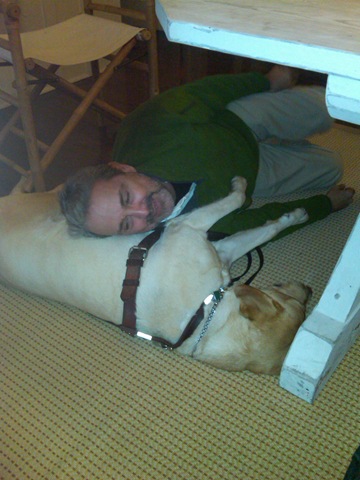
Prelude to a Kiss


Guide Dog Nira and Writer Craig Lucas


Well it doesn’t take guide dog Nira long to make friends. Here she is with playwrite Craig Lucas. Nira knows a kiss when its in the offing but like most Labradors she loves languor and heart—most days I think this is why dogs and people first got together. It’s a high gravity world. We help each other in a thousand ways. Here, Nira, supine says: “Take my purse, darling.”


S.K. 

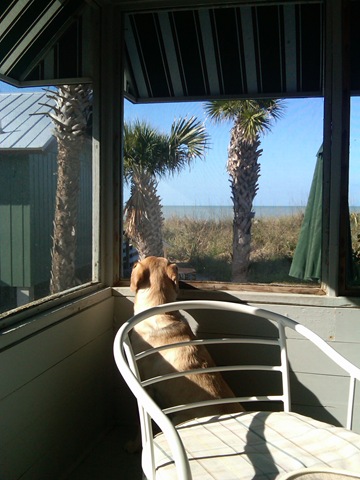
Nira Catches the View


IMG00024-20100216-0931

Here is guide dog Nira enjoying the view at The Hermitage in Sarasota, Florida. Her partner is really writing. But let’s be serious, until his recent eye operation he couldn’t have taken a photo of anything, let alone a lovely Labrador scenting the winds off the ocean. Nira will be sending her own posts of course. Right now she’s smelling a heron’s wings.


Now I’m off to buy dog food for the girl pictured above.


S.K.    

Venereal Soil

The poet Wallace Stevens who spent lots of time in Key West, Florida, and who once got in a fist fight with Ernest Hemingway (he lost) described the sunshine state as “venereal soil” which is as obscure a thing to say about a place as saying that New Jersey is the land of spiritual twilight. It sounds good but it doesn’t mean anything. Of fecundity Florida has plenty; perhaps she even hosts venery (ya think?); she has her obscure museums and post-modern tribes; and yet and yet–well–I’m heading to Sarasota to do some writing and walk my dog on the beach and with the help of Pegassus I hope we see an Osprey, visually impaired be damned! And I desire affirmingly to be inspirited by an osprey which of course sounds venereal enough. Finally, let it be said that I will be posting from the beach for the next five weeks and I’m even going to try and take some pictures, vision impairment be damned, and post them.

Of the famous fist fight Ernest Hemingway remarked that Stevens was big, but like most poets he couldn’t fight.

I don’t know why Hemingway wanted to punch Stevens. Too much venereal soil I imagine. But that was in Key West. I promise not to punch the osprey because, after all, I’m a nature poet of sorts.


S.K. 

Coming Soon to a Bookstore Near You


A Playful Take on the Art of Conversation

Stephen Kuusisto [9781402766961]

Publisher: Sterling
Published: June 2010
112 pages
ISBN: 1-4027-6696-3
ISBN13: 9781402766961
$14.95 US
$19.50 Canadian
Hardcover with Jacket
Territory: North America Only

In this erudite and playful primer on the art of conversation Stephen Kuusisto vigorously tackles the slippery subject of how to converse meaningfully with others. Kuusisto employs a wide range of personal anecdotes, classical texts, and an engaging style to illustrate his points. In seven short, provocative and imaginatively wrought chapters, he spins a compelling argument for the joys of “being connected,” and skillfully shows how to achieve this bond in everyday exchanges.

Stephen Kuusisto is a graduate of the Writer’s Workshop at the University of Iowa and a Fulbright Scholar. He holds a dual faculty appointment at the University of Iowa, where he teaches creative nonfiction in the English Department and serves as a public humanities scholar in the University of Iowa’s Carver Institute for Macular Degeneration. He has made appearances on Oprah!, Dateline NBC, National Public Radio, the BBC, and A&E, among others. His essays and poems have appeared in Harper’s; The New York Times Magazine; Poetry; Partisan Review, and The Washington Post Magazine.


I like the snails on the cover!


S.K.

Getting Paid to Poetize

by Andrea Scarpino

Los Angeles


One thing almost every poet will tell you is that poetry doesn’t pay. At least not in cash. It may pay in more existential ways, helping to make for a fulfilling life, encouraging emotional growth, that kind of thing. But for most of us, poetry isn’t going to build a retirement fund, pay for groceries or send the kids to college. And for the most part, I’m grateful for that. Gregory Orr has a lovely poem that reads:

How lucky we are

That you can’t sell

A poem, that it has

No value. Might

As well

Give it away.

That poem you love,

That saved your life,

Wasn’t it given to you?

For me, the answer is definitely yes. The poem that saved my life was given to me by Dr. Oden while he was preparing to give me anesthesia for a pain treatment. I was in high school and was about to move across the country by myself. He read me Mary Oliver’s poem “The Journey” and then gave me her book with his phone number written inside. Dr. Oden was one of the few adults at that time in my life who I felt actually listened to me, was on my side. “The Journey” ends with the lines, “determined to do/ the only thing you could do–/ determined to save/ the only life you could save.” When he read those words to me, I cried. And I knew I would be okay.

But sometimes, the writing and endless revising of poetry, the constant attention to new publications, new interpretations of old publications, new readings and conferences to attend—well, it just feels like a lot of work for something that few Americans seem to value, that comes with little monetary reward, that feels like a solitary yelp in the wilderness.

Recently, though, I’ve found myself getting paid to poeticize. At one reading, a hat was passed for contributions and the contents folded up neatly, passed discreetly into my hands. A journal sent me a $30 check to pay for the publication of one of my poems. And yesterday, I presented on a local panel about politics and poetry that paid surprisingly well. When I got home and opened up my envelope, I gasped.

These are moments that I love, not because I think poetry should more fully enter the consumer economy—I agree with Orr that we’re lucky a poem “has no value.” But because it feels a little like magic to exchange my writing and thinking, my hours and hours of revision and thought, for a lovely dinner, a glass of fancy wine. In other words, to exchange my mostly invisible, abstract work for something concrete, salient. And to be able to share that exchange with others. To see poetry really at work in the world.


Andrea Scarpino is the west coast Bureau Chief of POTB. You can visit her at:

www.andreascarpino.com

Don't You Just Love Google Translator?


I am proud that my memoir Planet of the Blind is now available in a Turkish translation. But I must say that the Google translator has a strange slant on the Turkish book jacket.

Book Summary

Limited number of books on the visually impaired in our country are published. Human nature loved ones  a nice thing to see in the mirror itself is not.  Life is completely dark for one of the visually impaired. Stephen Kuusisto Stephen Kuusisto considers this aspect of his life trying to be a light for the visually impaired. While travel memories has witnessed throughout his life sometimes laughing and sometimes touched by the events live as you will read. This book does not have enough to think about if we close an important gap, this novel tells the moment-we can think.


Any visually impaired person’s life than with a hot to approach this book in private ‘status’ can say will make clear as possible. Or less visible in their childhood memories for the author in this field focused. Also unique in a world of darkness says it all. See the other hand, also says: Life is beautiful even in the dark!


Book Cover

Körler Gezegeni Planet of the Blind
Stephen Kuusisto Stephen Kuusisto
· Şenocak Yayınları · Şenocak Publications
· Basım Tarihi : 10 – 2009 · Publication Date: 10-2009
· ISBN : 9786055615024 · ISBN: 9786055615024
· Etiket Fiyatı : 14.00 TL · Tag Price: 14.00 TL


S.K.

Opening Books at Random


Sometimes in my abstract moments I pity the ancients. The scholars of Alexandria couldn’t open a scroll and discover the gift of an unanticipated page. (Opening a scroll is much like taming a lion: the whole matter must be handled with extreme delicacy–one needs an assistant or two and equal parts rigor and patience, perhaps even the right body language for papyrus has a mind of its own.)  

There are many great books on the history of literacy. Human kind was transformed first by written language and then by the book with its stitched pages and its articulated, transitive planets of mentation. Open a book at random and there before you is a rising moon, the summer moon of Finland, thin as an old woman’s ear.

I adore opening books somewhere in the middle–anyplace really, just to find wiser hopes than the customary seconds routinely afford. Here are some examples just now:

“I think and I do believe/we know the way to glory, or to what can be/glory for this worn-down bedraggled race–/peace, freedom, losing, and passing on. And place/We know it if anyone would listen.”

–Hayden Carruth from Brothers, I Loved You All

“sometimes I feel like an idiot boychild/longing for mama ocean”

–Anselm Hollo from No Complaints

“But there are beds and beds in this life. Beds of pain, beds of procreation, the irresistible beds of printing presses.”

–Marvin Bell from Old Snow Just Melting

“I thought I heard the sky squeak./Oh, it’s Nothing, it’s Uncle

Nothing/coming down from his tree.”

–James Tate from The Lost Pilot

“Inside me there is a confusion of swallows,/Birds flying through the smoke,/

And horses galloping excitedly on fields of short grass.”

–Robert Bly from Silence in the Snowy Fields

“In summer/come the old dreams of living on a boat/and walking home to it as the evening/

is beginning”

–W.S. Merwin from The Compass Flower

“The stars fatten like pearls./Not enough light to read your face by./And useless to wish on,as restless/

As we are, growing or shrinking./All we can do/is lend our bodies to life.”

–Deborah Tall from Come Wind, Come Weather

“Heavy for you, I hear the futile speech/Of air in trees, of shadows in your hair.”

–James Wright from Saint Judas

“The soul is driven by the hierarchical perspective of spirit into regions it considers even more distal and low, the organic body, where the soul makes its presence known as symptoms.”

–James Hillman from Healing Fiction

“There is nothing so scary/about grasshoppers sharpening scythes./

But when the troll’s flea whispers,/

be careful.”

–Olav Hauge Trusting Your Life to Water and Eternity

(translated by Robert Bly)

And so I open books at random and feel the rings of Saturn, the ghosts of my dogs, the atavistic organs of sensation whispering from their jars. This is a shy, unrehearsed and daily pleasure, a small thing, but maybe not so small, maybe not…


S.K. 

Disability and the Mainstream Sunflowers

First off, let me tell you about my maternal grandfather who had a grade school education and managed to make millions of dollars during World War I by manufacturing munitions for the U.S. Army. He made a fortune on the bad luck of others and at the height of his new found wealth (1917) he invested all his money in the Russian Czarist government. Thereafter my grandfather spent most of his time in the woods of New Hampshire blowing up barns with dynamite, but not as a vocation–dynamite became his hobby and the sole reason for getting out of bed. You can think of my grandfather as a perverse variant of Mozart’s Papageno–he sang to himself in the forest but instead of a bird cage and net he had TNT and blasting caps.

In the field of disability studies we talk about the “defective people industry” –a term that designates organizations both public and private that raise money on behalf of “the disabled” (perhaps for cures but sometimes for social services) and always implicit in the philanthropic pitch is the idea that people with disabilities are a different class of our citizenry. Another way to say this is that people with disabilities are thought of as being irrevocably outside of our cities and towns, our workplaces and universities…

Though its crude to reduce large social forces to simple maxims its possible to say that the defective people industry or DPI has a long standing investment in the idea that disability should be outside the city’s walls. For if PWDs are effectively part of the municipal and social activities of our society then the image of the lost disabled person who needs our cradle to grave support would vanish.

Imagine every corner gas station has a wheelchair repair service. Imagine wheelchair users doing the work…

Picture blind people inside that gas station, selling the gasoline…

Deaf people as television anchor men and women…professors…

As our nation ages and our sophistication about bodily differences continues to grow we will have to effect these transformations.

My university currently has its student disability services in the basement of a dormitory. It should be in the busy university owned shopping mall. They should be encouraged to sell technology and educate the broader public.

My grandfather was disabled by his lack of education. Our culture is disabled by its lingering inability to think with imagination about disability inclusion.

In a poem called “Among Sunflowers” James Wright wrote: “You can stand in among them without/being afraid.”


S.K.

A Sea Change on the "R" Word?


The following excerpted article from the Washington Post comes to us from The Inclusion Daily Express.

Tim Shriver deserves a special Valentine from everyone in the disability rights community.


S.K.


Emanuel Says He Will Join Effort To Stop Use Of ‘Retarded’
(Washington Post)
February 4, 2010
WASHINGTON, DC– [Excerpt] White House Chief of Staff Rahm Emanuel apologized again Wednesday for using the word “retarded” during a private meeting last summer, telling advocates for the disabled that he will join their campaign to help end the use of the word.

The controversy over Emanuel’s remark continued to dog the sometimes foul-mouthed senior Obama adviser despite his having privately apologized to Special Olympics Chief Executive Tim Shriver shortly after the comment was made public last week.

In a statement after an afternoon meeting at the White House, Shriver and five other disability rights advocates said Emanuel had “sincerely apologized” for the earlier comment during a strategy meeting, which was reported in the Wall Street Journal.

“We are happy that he will join more than 54,000 other Americans in pledging to end the use of the R-word at http://www.r-word.org, and that he committed that the administration would continue to look for ways to partner with us, including examining pending legislation in Congress to remove the R-word from federal law,” they said in the statement.

Entire article:
Emanuel says he will join effort to stop use of ‘retarded’

http://www.InclusionDaily.com/news/2010/red/0204a.htm
Related:
Rahm Emanuel “Retarded” Comment Puts Offensiveness in Spotlight (ABC News)

http://abcnews.go.com/print?id=9738134
Obama chief of staff’s ‘retarded’ insult brings fallout, Palin criticism (Yahoo! News)
http://news.yahoo.com/s/ynews/20100202/pl_ynews/ynews_pl1101/print
Palin vs. Limbaugh Over ‘Retard’ Comment? (US News and World Report)
http://www.InclusionDaily.com/news/2010/red/0204b.htm
Spread the Word to End the Word
http://www.r-word.org