Spinoza and Giving Up on Contemporary Fiction…

If, like me, you admire Spinoza, you’re a problem. Here’s a spoonful:

“Those who wish to seek out the cause of miracles and to understand the things of nature as philosophers, and not to stare at them in astonishment like fools, are soon considered heretical and impious, and proclaimed as such by those whom the mob adores as the interpreters of nature and the gods. For these men know that, once ignorance is put aside, that wonderment would be taken away, which is the only means by which their authority is preserved.”

False wonderment and ignorance. The peanut butter and jelly of American society. Yum yum! Donald Trump is selling bibles! Yum yum! The mob can’t get enough. Spinoza of course understood the role of clergy in the promotion of faux miracles. If you truly believe this then you’re the problem. You’re the problem in almost every group. You’re always going to ask “what’s wrong with this story?”

Ernest Hemingway called this sensibility the “bullshit detector” and he was almost right. He meant that first rate writing uncovers or subverts falsities. But what if the dominant narrative of your age is all nonsense? Americans are intensely attracted to victimhood. Everyone is now an undeserving wretch.American fiction is, nowadays, almost entirely unreadable. Every new novel is concerned with sub-Cartesian victimhood. It is unbearable. Do you understand false wonderment? Three divorcees go to a summer house and while walking through a tangle of spider webs come to understand themselves. The interpreter of nature and the gods is Dr. Phil. Self-help tabloid fluoride is in the water.
Yum yum! I’ll get no credit for saying this. I’ll likely be attacked. And don’t read this as an attack on women writers. Men are equally caught up in the sad victim story telling industry. In fact everyone is caught by the shoelaces with this collective hive drone.

Someone recently asked me what fiction I was currently reading. I’m reading about evolution.

Yeats and Ruth Benedict

“Experience, contrary to common belief, is mostly imagination.”

  —Ruth Benedict

You can cross the snowy fields and see castles and diamonds because imagination is there. In Scandinavia they call it troll power. You know the world as trolls do. This is why children can’t answer the question “what did you do today?” And its why poets can’t reply honestly when asked “where did you get that idea?”
When imagination rules experience we’re at a loss for words, at least at first. Later we grow up—the editor inside us who’s an adult tells us experience is not of the imagination at all. In general this is what MFA programs do. The study of creative writing is good for the delete button. When Yeats writes of faeries he’s telling us to resist this. In his 1901 essay “Magic” he says:

“I believe in the practice and philosophy of what we have agreed to call magic, in what I must call the evocation of spirits, though I do not know what they are, in the power of creating magical illusions, in the visions of truth in the depths of the mind when the eyes are closed; and I believe in three doctrines, which have, as I think, been handed down from early times, and been the foundations of nearly all magical practices. These doctrines are —
That the borders of our minds are ever shifting, and that many minds can flow into one another, as it were, and create or reveal a single mind, a single energy.
That the borders of our memories are as shifting, and that our memories are a part of one great memory, the memory of Nature herself.
That this great mind and great memory can be evoked by symbols.”

Yeats had a different view of symbols than the Constructivists or Surrealists. He took them quite literally. The poet Kathleen Raine wrote: “For Yeats magic was not so much a kind of poetry as poetry a kind of magic, and the object of both alike was evocation of energies and knowledge from beyond normal consciousness.”

“A kind of magic” begs the question “what kind of magic?” Only Yeats could answer this and he spent his life working to do so. But at its core he believed the magic resided outside the mind. The poet’s job was to translate nascent signals of mystical experience into ordinary language. He loved Newton’s alchemy; Hermes Trismegistus; most of all he loved the story tellers in the Irish countryside—that place and culture vanishing before his eyes. What kind of magic? Preservational. Yes belief is mostly imagination. And the evocation of spirits though we can’t say who they are. This shouldn’t stop poets from trying.

The lived circumstances of disability are contemporary disruption…

The lived circumstances of disability are now at code red in the United States. From the dismantling of the Department of Education (which has historically supervised ADA compliance in schools—from kindergarten to universities) to denying benefits for people who desperately need Supplemental Social Security the disdain and cruelty are “on” as they used to say on the radio. WE are ON WITH 50,000 WATTS OF rock and roll power!

I spent part of this morning walking around the campus of the University of Iowa where I studied creative writing long ago. Later I came back to teach here. The U of Iowa has always been a disability unfriendly place and now, in Trump 2.0 they’ll be free of any corrective government action. This ain’t just the case in Iowa. As colleges and universities ditch their Diversity Programs, many of them are shoving disability compliance under the bus as well.

I’d be in despair if I wasn’t already in despair. Meanwhile I’m reading “After Disruption: a Future for Cultural Memory” by Trevor Owens. It’s just out from University of Michigan Press. He has many arguments in the book and I won’t highlight all of them—the book is nuanced and shrewd. But one salient contention is that the takeover of our public square, pushed as it is by big tech, is powered by the language of “disruption” which of course reminds one of Elon Musk waving a chain saw while high on Ketamine.
The really interesting thing is that according to Owens the premonitory language of disruption was adopted by Silicon Valley from the academy. I confess to never having thought of this. Disruption in feminist studies or disability studies has always meant the ways in which outlier bodies interfere with normative narratives. This much is true and is still true and will always be true. But by adopting the lingo of disruption the Peter Thiels of the world have been able to push the idea that AI and the erosion of the humanities are excellent things. I urge you to read Owens book. But here’s a quote:

“When Silicon Valley co-opted the vocabulary of disruption, it removed the genuinely radical ideas that had come from feminist critical race theory and shifted them into a blunt fear-inducing instrument. While the rhetoric around disruption often comes with a revolutionary sentiment, at its core, disruptive innovation’s roots are in fear. This rhetoric is about making us afraid and pushing us to believe that Silicon Valley has the secrets to how we address the fear of being made obsolete or being replaced.”

One of the interesting things about ableism is that whatever form it takes it occupies the future perfect. There will be time enough to make things right for the disabled but not today. One may fair say “not today” is the motto of the thing. “Non hodie” in Latin. Picture a flag bearing the image of an indolent house cat. Not today will we question our assumptions about discrimination. BTW: ableists also avoid saying “maybe tomorrow.”

If you require accommodations “Non hodie” is the prevailing reply. What’s so demoralizing is that those who ought to be in the fight for disability inclusion are not interested. How can this be? Well, actually, the matter is simple: “there will be time enough to make things right, but not today.” That this “non hodie” includes administrators and faculty tells you how big a muscle ableism really is. But there’s another issue…

And of course there are gaslighting committees—they have names like “Inclusion and Access for One and All” and they meet privately because its all about “non hodie” and private self-congratulation. The folks on these committees don’t suffer from a lack of accommodations. In general they feel pretty good.

Which gets me back to Owens. Feeling good in today’s universities and in the United States has been replaced by resignation, precarity, and a new form of future perfect. Owens expertly explains this contemporary dread. Your embodied disruption is too disruptive. But it all sounds so good:

“Disrupt. Fail faster. Asking, in almost any meeting, “but will it scale?” Over the last three decades the language of Silicon Valley start-ups and venture capitalists has followed digital technologies into a wide range of industries, cultural-memory institutions included. This vocabulary, which historians of technology Lee Vinsel and Andrew Russell call “innovation-speak,” is now a core part of management cultures across the US and beyond.”

I urge disability activists to read this book.

Who is Andrea Bocelli?

Who is Andrea Bocelli? Does he really love Donald Trump? Is he truly clueless about the devastating policies aimed at disabled people that are in effect because of this White House? I can answer the last two but not the first. As to who Bocelli is I can only speculate. Meanwhile his fan fest with Trump has led, predictably to ableism. Social media trolls are employing blindness as metaphor. The theme? He’s blind to reality. Ah, the old blindness is ignorance trope. How we’ve missed you! Yet another post suggests he’s a “dumb Italian”—another slur I thought we’d finally gotten rid of. My belabored point is that after years of Trump the “left” in these United States feels free to be as objectionable as the GOP. And of course ableism knows no party. The cripples know this.

As for the first question one can only speculate. Bocelli is stage managed. Lives in a bubble. He has no idea about the horrors of blindness in his own country much less in the US. Some years ago I traveled to Italy with my first guide dog and was treated with contempt. It was everywhere. It wasn’t just a lack of knowledge about disability rights. T’was outright disdain. Bocelli must have encountered this, at least in childhood. And I’m guessing his defense mechanism was and is, “I’m not one of you.” I’ve met a few well heeled blind people who have done this. Notably an arch conservative federal judge who had deep pockets and sneered at the blind. I once told him off. He’d characterized the blind clients of a guide dog school as “mooches and leaches…” (And you betcha, he was on the board of directors.) You betcha. Being blind and thinking yourself superior to those other blind people is both not uncommon and a trap. And the only way to avoid that trap is to live a fully protected and curated existence.

And of course maybe Bocelli is just an ass. A vain ass. A chauffeured ass. Yep. I can only guess. But I’ve see such people before.

Thinking of Rousseau on a Rainy Morning

If like me you’re disabled you’ve probably thought about being cured. As I’m blind this would mean having 20/20 vision. I don’t think about it much, but when I do I picture myself on a motorcycle, letting it rip. This is a personal version of fool’s gold.

The idea of “cure” is painful for the disabled. Medicine says we must be fixed or be seen as permanent defectives. Most of us cripples have been told we’re faulty over and over. It’s not “cure” one wants, its freedom from being flawed and suspect in the village square. If I could see and take off on a Harley I’d still remember the struggles of this disability life.

**

Jean Jacques Rousseau had a dog named Sultan who accompanied him to England when his life was threatened in France. Poor broken Rousseau with his malformed urinary tract, cloying hypochondria and hot paranoia–also poor in cash, resolutely poor in friendships. Sometimes we think we understand him–we, the descendant cripples–those who spent fortnights alone in childhood and more than once. We who occupied our attentions with flowers and seeds. Rousseau had the triple whammy: his mother died when he was very young, then his father ran away. He was forced to learn the baleful adolescent art of beseeching strangers for protection and love. He was easily tricked into churches and bedrooms. And he was easily discarded. The cripples understand this.

No wonder he discarded neo-classicism for what others would call the romantic. No wonder Shelley and Byron adored him–passions of betrayal and resolution always feel the most authentic. Rousseau’s enemies substituted “savage” for “authentic” and prided themselves for calling him “uppity” which is of course what is generally done to passionate cripples. Small wonder Rousseau took up the matter of social consent among the governed.

**

Sultan lead him into the English countryside where he seldom encountered another soul. I love knowing this. A dog can stir and extend solitary human concentration which is the reward of stigma, but you must understand it in a canine manner–pay attention to what’s here and here; not yesterday; never tomorrow; and yes, a dog looks the other way when you take from your pocket a handful of French seeds and push them into British soil.

“So here I am, all alone on this earth, with no brother, neighbour, or friend, and no company but my own. The most sociable and loving of human beings has by common consent been banished by the rest of society. In the refinement of their hatred they have continued to seek out the cruellest forms of torture for my sensitive soul, and they have brutally severed all the ties which bound me to them. ”

He was in fact disabled by malformations of his nether parts and he had profound depression. Being a liminal figure owing to these conditions he was caste out by the congealing engines of 18th century normalcies. On this the aristocrats and the bourgeoisie could agree—the salon, the atelier, the coffee houses were not places to be troubled by the inconveniences of broken embodiments. Having a troubled body meant staying away—meant the asylums and hospitals. It meant living in the poor houses. Good bodies meant public bodies. Rousseau’s solitary journeying on foot is disability journeying. He was Basho, a travel weary skeleton.

Poor Roussea! He had porphyria which lead to abdominal pain and vomiting; acute neuropathy, muscle weakness and seizures; hallucinations, anxiety, paranoia—and as if these weren’t enough he had cardiac arrhythmias. He was by turns aggressive, provocative, contrarian, and yes, he was always ill.

Today in the disability arts community we talk of disablement as epistemology. We know altered physicality and neurodiversity offer unique and valued ways of thinking. What’s different now from Rousseau’s time is that the disabled are not as easily caste aside, and though this can be done (one thinks of all the micro aggressions the disabled invariably experience even now, arguing for accessibility, making their point for inclusion and respect against structural ableism) it’s no longer possible to lock the gates of Geneva on that annoying cripple.

On the subject of micro aggressions much of the Reveries of a Solitary Walker tells of the slights and the disdain Rousseau absorbed and encountered. He was in fact an unpleasant man. I too some days am an unpleasant man. Human rights and their advocacy demand it. Seldom does progress develop for polite societies. But I’ll add also that in Rousseau’s time there was no language for depression—the term itself comes from an age when treatment and acceptance are commonly understood. Instead it was called “melancholia” and it was considered a form of madness. You don’t have to read Foucault to know what happened to the mad though why shouldn’t one recommend it? In any event Rousseau lived in an age when mental illness was believed to be a moral failing. This sub-Cartesian idea has never gone away.

I’ll let Rousseau have the last word:

“Always affected too much by things I see, and particularly by signs of pleasure or suffering, affection or dislike, I let myself be carried away by these external impressions without ever being able to avoid them other than by fleeing. A sign, a gesture or a glance from a stranger is enough to disturb my peace or calm my suffering: I am only my own master when I am alone; at all other times I am the plaything of all those around me.”

Hail to the Crippled Writers

Yes optimism for the wretch is a dyer’s art but it must be farcical in its hope. (Think Shakespeare’s Bottom.) One must be ridiculous in the boot black factory.

Let’s celebrate what for lack of a better term one might call the optimistic imagination as practiced by wretches. I’m in mind of G.K. Chesterton’s assessment of Dickens, that he was: “delighted at the same moment that he was desperate. The two opposite things existed in him simultaneously, and each in its full strength. His soul was not a mixed colour like grey and purple, caused by no component colour being quite itself. His soul was like a shot silk of black and crimson, a shot silk of misery and joy.”

Yes optimism for the wretch is a dyer’s art but it must be farcical in its hope. (Think Shakespeare’s Bottom.) One must be ridiculous in the boot black factory. (Dickens-Chaplin.) This is the thing, likely a tee shirt slogan: we hope in misery. As for the literary imagination printed ideas are invariably sad even when they propose optimism and no honest writer can ignore it. What did J.P. Morgan’s library smell like in 1902? Short answer? The vapors of sorrow.

A game I play, more often than I should admit, is a dramatic transference for which there may be a name but I’ve never found one. Perhaps there’s something in German. In short, I employ the characters of Shakespeare and Moliere as standard bearers for people I meet and especially for  public figures. The literary term for this is “comparison” but what I’m describing is better than that—“kayfab” is what they call it in professional wrestling, where everyone, both wrestlers and fans collectively pretend a false drama is real. Essentially I live and have always lived since my late teens in Tartuffe and The Taming of the Shrew and at this stage of life there’s no help for it. This is comedy as it’s lived but not necessarily admired. Moliere:

“The comic is the outward and visible form that nature’s bounty has attached to everything unreasonable, so that we should see, and avoid, it. To know the comic we must know the rational, of which it denotes the absence and we must see wherein the rational consists . . . incongruity is the heart of the comic . . . it follows that all lying, disguise, cheating, dissimulation, all outward show different from the reality, all contradiction in fact between actions that proceed from a single source, all this is in essence comic.”

Both Moliere and Shakespeare grew up watching morality plays, fables whose stock characters were invariably named God, Death, Everyman, Good-Deeds, Angel, Knowledge, Beauty, Discretion, and Strength. Because they lived during the first flowering of public literacy they understood the indispensable healthiness of word flipping. Talk about nature’s bounty! Words were no longer merely to be received and absorbed. Can you imagine the joy of a 17th century adolescent forced to watch Everyman or The Second Shepherd’s Play, as he substituted Satan, Life, Neighbor, Sin, Second Rate Demons, Ignorance, Ugliness, Gossip, and Basic Human Weakness for the stock characters of religious drama? Of course you can. Almost no one who’s lived through a high school production of The Man of La Mancha has not done this.

Comic irony is when you recognize the impostors beyond their appearances on stage. The characters in Tartuffe are at every holiday party. They creep through the workplace. Confidence men, hypocrites, exceptionally vain head cases, the credulous, and all who make their living feigning virtue. Ah, nature’s bounty indeed!

By living Moliere I reside in kayfab—I know the world may be better or worse than this adoption, but I can bear my illusions for not to live in Tartuffe would be, at least for me, unsupportable. Comedic representation is healthier than plodding credulity and more philosophical since incongruity is the mainspring for understanding the irrational. If you’re following me, you’ll say my proscenium of custom if it’s all Moliere, all Shakespeare, all the time, is a matter that must by necessity make me unreasonable. I prefer this to any conversation with the human resources crowd or political canvasers or god help me, professors at a conference. I’d gladly sip the milk of custom and spit it in a potted plant than talk to Orgon or Tartuffe. Contradiction isn’t a customary beverage. It’s milk and iodine and it’s healthier for you than any drink Madame Pernelle will offer.

Shakespeare was the first comic writer to dramatize reverse psychology as Petruchio, a wandering nobleman, undertakes the wooing of Kate who’s notoriously short tempered and cruel:

“Say she rail; why, I’ll tell her plain
She sings as sweetly as a nightingale.
Say that she frown; I’ll say she looks as clear
As morning roses newly wash’d with dew.
Say she be mute and will not speak a word;
Then I’ll commend her volubility,
and say she uttereth piercing eloquence.”

We are the ones invited to say she rail; we’re instructed to become as devious as Petruchio. Taken into his confidence we’re delighted by his promissory book of lies.

That’s optimism as comedy. Not as a vehicle for pratfalls or put downs, but discernment and the vanity of hope.

Hope is comedy. The sadness of the world is irrational. This is how I live. I think of Auden’s line: “All we are not stares back at what we are.” If an empowered disability identity is “out” and on the street it’s ironies are inherently complicated by the acculturated language of normalcy. This is both a signature subject for performance theory and disability studies. It is also the seed bed of literary consciousness. Watch out! The crip writers are comics.

Of Book Tours, Antonio Gramsci, and the Unmade Bed

A friend, characterizing a mutual friend said: “he has a mind like an unmade bed” and trust me that’s how I’m feeling. Of the unmade bed I recall an episode of the television version of “The Odd Couple” when Felix discovers a half eaten submarine sandwich in Oscar Madison’s bed. Oscar didn’t say it, but I will: “detritus ye will always have with ye” though one must surely admit when his defenses are down. I’m finding it difficult to concentrate.

This isn’t listlessness. It’s not the blues. (Though I know I’ve got them—a blind guy’s slumgullion of concerns from genetic testing of fetuses (rooting out probable disabled babies, think eugenics 2.0) to the race baiting narratives of American cleanliness espoused by the United States government and increasingly large parts of the industrialized world (Reich 4.0).
Or I worry about your mentally ill brother, child, mother, especially if they’re a person of color, for they’ll likely wind up dead or in jail in our clotted, Dickensian nation. Meanwhile the eroding middle class watches the Kardashians.

OK. Sorry. But when you’re an unmade bed, well, you become that man who natters on the bus. Some mornings I’m a single dendritic spark away from either mumbling or ranting.
My unmade bed is starting to smolder.

I’ve been on a lovely book tour which has taken me to Los Angeles, Santa Cruz, Calistoga, Denver, Richmond, and upstate New York. Talking with old acquaintances and new friends is a cleansing experience. I always meet good people on the road.

Check box: I’ve been talking to excellent human beings.

Check box: In Denver I got an Uber ride from a man who lectured me about the “end times” for twenty five minutes. He touched my hair. Said: “you’re already one of the saved. God loves you.”

Check: It’s raining in the airplane burial ground, as my friend Jim Crenner once wrote.

Crumbs from the bed…Marx was right about 40% of the time.

Bed: Antonio Gramsci was right about 80% of the time.

The above assertions are not incompatible.

Check: I’ve lately had several graduate students who don’t like to read and when pushed turn deflective and mean spirited. These are the children of “no child left behind” who’ve been trained for a decade to take tests. Confronted by the prose of Salman Rushdie they look at first perplexed, than hostile.

Crumb: The students mentioned believe they’re commodified, neutralized, oppressed, etc. according to their respective identities. They won’t read for strength. They believe ideology is strength. In this way they’re no more sophisticated than Donald Trump.

It’s a very hard time to be a professor.

Crumb: last night I realized for the 41,000th time that baseball won’t save me.

Check: I don’t care for popular music of any kind.

Ort. (Everyone’s favorite crossword bit)—scientists now believe outer space is filled with carbon molecules which they describe as “grease”—it means we’re essentially living in a vast kitchen drain.

Speck: The poet Donald Hall just passed. He was a good man on balance.

Note: I’m reading Dr King’s Refrigerator by Charles Johnson. Also: The Order of Time by Carlo Rovelli.

Speck: the thing about a book tour is you see with sufficient comic irony you’re not terribly important in the grand scheme.

Ort: I once introduced myself to the folk singer Utah Philips. Told him I was an anarchist at heart. He gave me a withering look. It said: “I’m the only god damned anarchist you little shit!”

What was it James Tate said? “No longer the perpetual search for an air conditioned friend….”

My step children are struggling to stay in the middle class.

I’ve a friend who’s lost his health insurance and has no job.

He doesn’t have the leisure for a mind like an unmade bed.

Like most halfway ethical beings I feel guilty.

Is sharing the unmade bed the best thing a writer can do?

That’s mostly what creative writing programs are all about.

The Finnish communist poet Pentti Saarikoski said: “I want to be the kind of poet who builds houses for people….”

Saarikoski was just kidding of course. The way poets do. He never built a house for anyone.

Is the unmade bed a place of ambition or escape. Is it both?

This is the point: I want to create unmade beds for everyone.

Check: we’d take turns being servants. The unmade bed mustn’t be class reserved.

What the hell am I talking about?

I fear for the life of imagination; what we used to call the life of the mind.

A student came to me not long ago and said he wanted to be a writer. Then he told me he hated reading.

I want to be a painter but I hate paint.

I’d like to cultivate my mind but not today.

Gramsci: “I’m a pessimist because of intelligence, but an optimist because of will.”
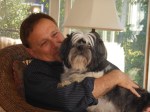
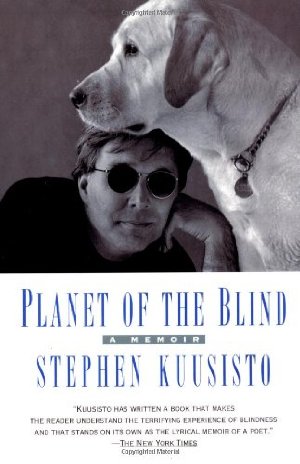
Stephen Kuusisto and HarleyABOUT: Stephen Kuusisto is the author of the memoirs Have Dog, Will Travel; Planet of the Blind (a New York Times “Notable Book of the Year”); and Eavesdropping: A Memoir of Blindness and Listening and of the poetry collections Only Bread, Only Light and Letters to Borges. A graduate of the Iowa Writer’s Workshop and a Fulbright Scholar, he has taught at the University of Iowa, Hobart and William Smith Colleges, and Ohio State University. He currently teaches at Syracuse University where he holds a University Professorship in Disability Studies. He is a frequent speaker in the US and abroad. His website is StephenKuusisto.com.

Have Dog, Will Travel: A Poet’s Journey is now available for pre-order:
Amazon
Barnes and Noble
IndieBound.org
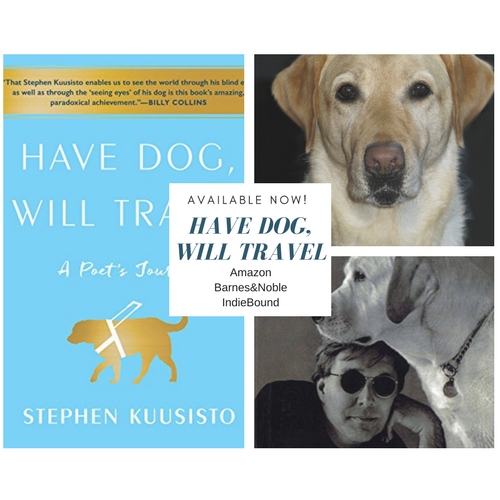
Have Dog, Will Travel by Stephen Kuusisto

(Photo picturing the cover of Stephen Kuusisto’s new memoir “Have Dog, Will Travel” along with his former guide dogs Nira (top) and Corky, bottom.) Bottom photo by Marion Ettlinger