How many burdens do you carry daily?

How many burdens do you carry daily? If I ask myself this question I admit I don’t know the answer. It’s like asking “what should I be doing?” It’s a fool’s game.

Here’s the problem: I carry some baggage because I’m disabled. “No big deal,” says the heart (which I’m told sits reliably in the center of the chest and not to the right hand side as depicted in cartoons.)

The heart is optimistic. It knows it must be. Every pulse beat is optimism.

Now the brain is different. It’s read Duns Scotus and Neruda and Kafka and Hannah Arendt and Frederic Jameson and “Maggie: A Girl of the Streets” and at least a thousand books on disability and who knows how much gloomy nonfiction—so the brain is disposed to contrarian thinking whenever joy comes up.

Alas my brain is more than a little bit like my Finnish grandmother.

Her name was Siiri and unlike her Apple namesake she was gloomy. She couldn’t help it. She was very Lutheran and her husband was a minister during the Great Depression and they’d come to the U.S. to escape hunger and why wouldn’t you become cautionary and somber in the face of a world of gravity and scarcity?

I don’t know about you but I’ll take gloom over despair. I know about this. I have depression as well as vision loss. I ride two horses, one black and the other white. Or something like that. Maybe I’m a shark with two brains: one of appetite and the other of more appetite.

I don’t know as much about the mysteries of consciousness as I pretend.

But I know this: the burdens I carry are the burdens of others.

If the subject is disability, well, I speak up for disabled faculty, students and staff who struggle to acquire basic accommodations both in my own workplace and around the world.

Burden number one: this can make me unpopular. As with racism or misogyny or homophobia the advocate can be characterized as a malcontent almost instantly.

I’ve never completely gotten used to this. The “this” being disapprobation for speaking out against ableism.

I read as much as I can by scholars and poets of color; gay and trans writers; black writers; women writers. And yes, men. I’ve yet to find anyone who’s more deep tissue wise than Walt Whitman.

Last week I participated in a live online town hall discussion about service animals. In the Q &A period several apparently non-disabled questioners asked things phrased thusly:

“Do we have to?”

As in “OK, service animals are legally allowed to enter my space, but can’t we tell those darned blind people where they are to make their dogs relieve themselves?” Or: “OK, a child with a service dog comes to public school—do we have to help that child?” (As if being disabled requires extraordinary extra help; as if a disabled child is a burden.)

I became upset.
I said the following:

“I went to public school before the ADA. I have been told by teachers and school administrators that I’m inconvenient; or worse—that I don’t belong.”

“Frankly, I hope there’s a room in Hell for school administrators where they’ll get to sit throughout eternity with Joseph Stalin, Richard Nixon, and the man who invented the roach motel.”

Then I signed off.

I’ll never not be offended by ableism.

I’ll never sanction the winks.

Just try those questions out if you substitute race or gender or sexual orientation for disability.

How many burdens do any of us carry?

They’re much lighter when we hold them up to scrutiny.

“Not Today” is the core principle of Ableism and Trumpism…

One of the interesting things about ableism is that whatever form it takes it occupies the future perfect. There will be time enough to make things right for the disabled but not today. One may fair say “not today” is the motto of the thing. “Non hodie” in Latin. Picture a flag bearing the image of an indolent house cat. Not today will we question our assumptions about discrimination. BTW: ableists also avoid saying “maybe tomorrow.”

If you’re disabled and you require reasonable accommodations you likely know all about this. Where I work I’ve been agitating, pleading, begging for accessible documents and websites for over a decade. “Non hodie” is the prevailing reply. What’s so demoralizing is that those who ought to be in the fight for disability inclusion are not interested. How can this be? Well, actually, the matter is simple: “there will be time enough to make things right, but not today.” That this “non hodie” includes administrators charged with accessibility and inclusion and faculty who teach disability related subjects tells you how big a muscle ableism really is. But there’s another issue…

Fighting disability discrimination makes you unpopular. One may say that fighting for the full inclusion of all historically marginalized folks does so too. But with disability there’s one more turn of the wrench: very few people want to serve as serious allies. There’s almost no up side to being a real disability activist. If you want to be liked, stay away.

It’s not easy in “non hodie” land. One morning, tired, feeling low, I wrote the following draft of a poem:

This morning talking to Stephen’s head…

“You’ve endured so much,
Bullying, lifelong ableism…”

The architectures of wantonness…

Walking alone one sees Raskolnikov’s room…

Confession: having lived in some bitterness,
I fear the cruelties of human indifference
More than
Anything in this world…

**

“Non hodie” harms actual disabled human beings. It’s not merely that the thing puts accommodations and full inclusion into a murky future—the disabled who need these accommodations are left hanging, and in order to make this palatable, the ableists employ gaslighting. “You’re asking for accommodations in the wrong tone of voice.” “This isn’t the venue for this.” (As if there was a venue.) It’s the old, “you’re a malcontent, you cripple you” defense. Never do such people say, “wow, we’re violating the law and injuring real human beings.”

Another aspect of the gaslighting business is of course to have a gaslighting committee—usually it has a name like “Inclusion and Access for One and All” and it meets privately because its all about “non hodie” and private self-congratulation. These committees never propose to fix the problems. They have cookies. They talk about inclusion. There’s just one thing. The folks on the committee don’t suffer from a lack of accommodations. In general they feel pretty good.

If you’re like me and you need accessible digital materials to teach and participate in the community and no one wants to fix this in real time—so that you’re “non hodied” half to death—you’re not included in the inclusion and access for one and all club. But you betcha they’ll gaslight you. You’re not fun to be around. And that’s the kicker. In the Neo-liberal university feeling good is the game.

Reader’s note: I first published this on my blog a couple of years ago. I’m in mind of this today because of the viral meme photo of Donald Trump who turned his back on a man experiencing medical distress. If Trump knew Latin he’d say “Non Hodie” for illness, disability, medial emergencies disrupt the “now” and if there’s anything Trump hopes always to occupy its the static present tense. For Trump both the past and the future are anathema. This position is not unfamiliar to disability rights activists. From turning his back on AIDS relief for Africans to his wholesale plans for dismantling American healthcare DT is all of a piece. But don’t kid yourselves…in all cases his disdain is about inconvenient bodies.

Who is Andrea Bocelli?

Who is Andrea Bocelli? Does he really love Donald Trump? Is he truly clueless about the devastating policies aimed at disabled people that are in effect because of this White House? I can answer the last two but not the first. As to who Bocelli is I can only speculate. Meanwhile his fan fest with Trump has led, predictably to ableism. Social media trolls are employing blindness as metaphor. The theme? He’s blind to reality. Ah, the old blindness is ignorance trope. How we’ve missed you! Yet another post suggests he’s a “dumb Italian”—another slur I thought we’d finally gotten rid of. My belabored point is that after years of Trump the “left” in these United States feels free to be as objectionable as the GOP. And of course ableism knows no party. The cripples know this.

As for the first question one can only speculate. Bocelli is stage managed. Lives in a bubble. He has no idea about the horrors of blindness in his own country much less in the US. Some years ago I traveled to Italy with my first guide dog and was treated with contempt. It was everywhere. It wasn’t just a lack of knowledge about disability rights. T’was outright disdain. Bocelli must have encountered this, at least in childhood. And I’m guessing his defense mechanism was and is, “I’m not one of you.” I’ve met a few well heeled blind people who have done this. Notably an arch conservative federal judge who had deep pockets and sneered at the blind. I once told him off. He’d characterized the blind clients of a guide dog school as “mooches and leaches…” (And you betcha, he was on the board of directors.) You betcha. Being blind and thinking yourself superior to those other blind people is both not uncommon and a trap. And the only way to avoid that trap is to live a fully protected and curated existence.

And of course maybe Bocelli is just an ass. A vain ass. A chauffeured ass. Yep. I can only guess. But I’ve see such people before.

“You can’t get there from here,” or, the ADA and Higher Ed

“You can’t get there from here,” is the old tag line of a well known New England joke. As we celebrate the 35th anniversary of the Americans With Disabilities Act the line has been circling my head like a horse fly. In our nation’s higher education arena the disabled are blocked by colleges and universities that don’t take the ADA seriously and in turn do the least amount possible to provide accessibility to disabled students and faculty. And campus visitors. Your grandmother shows up for graduation and needs wheelchair access to the convocation. The doors are locked to the adjacent building where the only ramps and elevators are located. No one can find the key because it’s Sunday. No one is in charge. The maladapted ADA Coordinator is at home drinking a root beer. I know thousands of stories like this. A student requires note takers and the university fails to provide them for over half a semester. She flunks the class. When after months of wrangling the university admits it could have done better, they still take another year to expunge the failing grade. This prevents the student from joining a sorority. The ADA Coordinator is home drinking a root beer. The ADA Coordinator is not a bad guy. He simply has no power to fix anything. He’s the master of a Potemkin village. There are disability statements on the website. ‘If you need access click here” it says on the Information Tech page. Click it, and well, years go by. They’re not equipped to solve your problem with the new Blackboard learning software or the brand spanking new admissions website. Small wonder that only one in four students with disabilities who enter college actually graduates. Small wonder there are so few faculty with disabilities. I’ve railed about this situation on this blog and in meeting after meeting. What’s really interesting is that in the meetings where I talk about these problems no one ever, and I mean ever, says “how can I help?” Even though on the face of it the non-disabled faculty are progressive types, access isn’t important to them.

Thinking of Rousseau on a Rainy Morning

If like me you’re disabled you’ve probably thought about being cured. As I’m blind this would mean having 20/20 vision. I don’t think about it much, but when I do I picture myself on a motorcycle, letting it rip. This is a personal version of fool’s gold.

The idea of “cure” is painful for the disabled. Medicine says we must be fixed or be seen as permanent defectives. Most of us cripples have been told we’re faulty over and over. It’s not “cure” one wants, its freedom from being flawed and suspect in the village square. If I could see and take off on a Harley I’d still remember the struggles of this disability life.

**

Jean Jacques Rousseau had a dog named Sultan who accompanied him to England when his life was threatened in France. Poor broken Rousseau with his malformed urinary tract, cloying hypochondria and hot paranoia–also poor in cash, resolutely poor in friendships. Sometimes we think we understand him–we, the descendant cripples–those who spent fortnights alone in childhood and more than once. We who occupied our attentions with flowers and seeds. Rousseau had the triple whammy: his mother died when he was very young, then his father ran away. He was forced to learn the baleful adolescent art of beseeching strangers for protection and love. He was easily tricked into churches and bedrooms. And he was easily discarded. The cripples understand this.

No wonder he discarded neo-classicism for what others would call the romantic. No wonder Shelley and Byron adored him–passions of betrayal and resolution always feel the most authentic. Rousseau’s enemies substituted “savage” for “authentic” and prided themselves for calling him “uppity” which is of course what is generally done to passionate cripples. Small wonder Rousseau took up the matter of social consent among the governed.

**

Sultan lead him into the English countryside where he seldom encountered another soul. I love knowing this. A dog can stir and extend solitary human concentration which is the reward of stigma, but you must understand it in a canine manner–pay attention to what’s here and here; not yesterday; never tomorrow; and yes, a dog looks the other way when you take from your pocket a handful of French seeds and push them into British soil.

“So here I am, all alone on this earth, with no brother, neighbour, or friend, and no company but my own. The most sociable and loving of human beings has by common consent been banished by the rest of society. In the refinement of their hatred they have continued to seek out the cruellest forms of torture for my sensitive soul, and they have brutally severed all the ties which bound me to them. ”

He was in fact disabled by malformations of his nether parts and he had profound depression. Being a liminal figure owing to these conditions he was caste out by the congealing engines of 18th century normalcies. On this the aristocrats and the bourgeoisie could agree—the salon, the atelier, the coffee houses were not places to be troubled by the inconveniences of broken embodiments. Having a troubled body meant staying away—meant the asylums and hospitals. It meant living in the poor houses. Good bodies meant public bodies. Rousseau’s solitary journeying on foot is disability journeying. He was Basho, a travel weary skeleton.

Poor Roussea! He had porphyria which lead to abdominal pain and vomiting; acute neuropathy, muscle weakness and seizures; hallucinations, anxiety, paranoia—and as if these weren’t enough he had cardiac arrhythmias. He was by turns aggressive, provocative, contrarian, and yes, he was always ill.

Today in the disability arts community we talk of disablement as epistemology. We know altered physicality and neurodiversity offer unique and valued ways of thinking. What’s different now from Rousseau’s time is that the disabled are not as easily caste aside, and though this can be done (one thinks of all the micro aggressions the disabled invariably experience even now, arguing for accessibility, making their point for inclusion and respect against structural ableism) it’s no longer possible to lock the gates of Geneva on that annoying cripple.

On the subject of micro aggressions much of the Reveries of a Solitary Walker tells of the slights and the disdain Rousseau absorbed and encountered. He was in fact an unpleasant man. I too some days am an unpleasant man. Human rights and their advocacy demand it. Seldom does progress develop for polite societies. But I’ll add also that in Rousseau’s time there was no language for depression—the term itself comes from an age when treatment and acceptance are commonly understood. Instead it was called “melancholia” and it was considered a form of madness. You don’t have to read Foucault to know what happened to the mad though why shouldn’t one recommend it? In any event Rousseau lived in an age when mental illness was believed to be a moral failing. This sub-Cartesian idea has never gone away.

I’ll let Rousseau have the last word:

“Always affected too much by things I see, and particularly by signs of pleasure or suffering, affection or dislike, I let myself be carried away by these external impressions without ever being able to avoid them other than by fleeing. A sign, a gesture or a glance from a stranger is enough to disturb my peace or calm my suffering: I am only my own master when I am alone; at all other times I am the plaything of all those around me.”

Love to All the Cripples and the Ships at Sea…

I am a writer who speaks about the importance of disability as a dynamic of power which means I believe cripples are at the center of life itself. Perhaps another way to say this is that life is imperfection regardless of whatever Richard Dawkins might say. (Dawkins understands DNA as a purity symbol rather than a concatenation of genetic mistakes.) (One may think of Dawkins and all social Darwinists this way.) (It is altogether splendid to see Jeremy Bentham taxidermed with his head down by his feet.)

Disability is life itself. Not an idea about life; not a held breath and a prayer; not a shrug or shudder. As the poet Marvin Bell once put it, life will blow you apart. I’m often in the position of urging the temporarily normal to admit that life is nefarious, thrilling, dark, urgent, and never without dynamism. All the sad metaphors employed against disability are failures of the intellect.

The random errors which produce "junk" DNA–the mutations in our genes, are in fact, wait for it, "random." Richard Dawkins is weak in this area as he prefers the ghost in the machine that’s always looking to improve itself, an idea which no respectable paleo-geneticist believes.

Disability is neither good or evil. It’s a natural fact. And it makes for beauty just as anything will if it’s understood properly.

So forgive me for starting with a grayness but as I recently joked with a paralyzed friend, “I feel like a battered old fish with many dents in his flesh”—the context—that it’s not probable I’ll see the advances I’d hoped for us when the Americans with Disabilities Act was enacted over a quarter century ago. I’m old enough to be feeling what academics call accidie, a weariness, and if I’m not defeated I’m suspicious. Shorthand: we haven’t gotten far enough, and daily the news is incontestable. The “fish conceit” is what can happen to believers and how not to become the fish is the story (mine and yours) since disability bias surrounds us. (Bias is a story with many chapters like Bocaccio and knowing it never renders comfort, though if you’re a bigot you may enjoy schadenfreude. I once had an “iffy” friend who practiced “vengeance fantasy”—as he said, doing it nearly as much as he masturbated, seeing his enemies staked out in the Colosseum with lions chewing at their entrails, etc. He’d rub his hands and imitate Charles Laughton: “how do you like your God now, Christian?”)

Bias is a variorum edition. My spotty pal really meant what he said—if he’d had his way he’d have fried you in oil. Everyone has his own grayness. Discrimination, personified, wants us to join the Centurions, at least inside, and its first sign is indifference. In my experience street theater is one way to resist it. Thirty years ago when I was a Fulbright Scholar in Helsinki, Finland I went one night to a gritty, working class bar where I was accosted by a wildly drunken laborer. Everyone was painfully drunk–that manly near death atavistic Viking berserk hallucination of everything, and I thought: “all these years, so many wounds, so few praises.” That was when a man I did not know turned to me and said: "You are a Jew!" "You’re right," I said, since I was young and in love with poetry, "I am a Jew!" It was the first time I’d ever felt the pins of anti-Semitism, I, a Lutheran with a long beard. He reached for me then but missed and grabbed another man. "You are a Jew!" he shouted. "No, it is I," I said, "I am the Jew!" But it was too late. They were on the floor and cursing, two men who had forgotten the oldest notion of them all: in Jewish history there are no coincidences.

As Kurt Vonnegut would say, “bias is a clunker” and though it must be taken seriously, if you’re one of its chapter headings having a shield of irony becomes essential. You’re a cripple. You don’t belong in here. Don’t belong on this website, on this campus, don’t belong in a customary place of business. For years I used to carry custom made stickers depicting the universal disability access symbol inside a red circle with a line through it. I’d paste them on the doors of inaccessible restaurants and academic buildings and the like. I really need to get more of them but I can’t remember where I they came from, and as I say, I’m in danger of weariness. Dear young Cripples, I’ve been fighting a long time. Thank God for ADAPT. And don’t stop fighting. But don’t stop laughing either. As the great disability writer and activist Neil Marcus says: “Disability is not a ‘brave struggle’ or ‘courage in the face of adversity’…Disability is an art. it’s an ingenious way to live.”

Once while I was teaching at The Ohio State University I was invited to a meeting with a dozen faculty and former astronaut and Senator John Glenn. We discussed the future of digital teaching. Afterwards I boarded a Columbus City bus only to face a woman who loudly asked if she “could pray for me”. She assumed blindness was a sad matter—or worse—a sign I needed spiritual rescue. My guide dog shook his collar. Suddenly I felt wickedly improvisational. I stood up, grabbed the overhead pedestrian bar, and announced loudly so every passenger could hear: “Certainly Madame you may pray for me, but only if I can pray for you, and in turn pray for all the sad souls on this bus—souls buttressed on all sides by tragedies and losses, by DNA and misadventures in capitalism, for we’re all sorrowing Madame, we’re all chaff blown by the cruel winds of post-modernism. Let us pray, now, together; let’s all hold hands!” She fled the bus at the next stop. Strangers applauded. Improvisation allows us to force the speed of associational changes, transforming the customs of disability life. Disability Studies scholar Petra Kuppers writes: If the relations between embodiment and meaning become unstable, the unknown can emerge not as site of negativity but as the launch pad for new explorations. By exciting curiosities, by destabilizing the visual as conventionalized primary access to knowledge, and by creating desires for new constellations of body practice, these disability performances can attempt to move beyond the known into the realm of bodies as generators of positive difference.

The polarizations, magnetic fields of crippledness are generators. It is not true that rebellion simply makes us old. We’re old when we give up.

And yet…the fights before us are promising to be both rewarding and very hard.

So I have the happenstance blues. They’re both accidental (aleatoric) and whatever is the opposite of accident, which, depending on your point of view might have something to do with the means of production, racial determinism from same, or all the other annotated bigotries of the culture club. As a disabled writer I know a good deal about the culture club. Now back to my happenstance blues…

I’m right here. I’m terribly inconvenient. Blind man at conference. Blind man in the lingerie shop. All built environments are structured and designed strategically to keep my kind out. My kind includes those people who direct their wheelchairs with breathing tubes, amble with crutches, speak with signs, type to speak, roll oxygen tanks, ask for large print menus or descriptive assistance. I’m here standing against the built geographical concentrations of capital development. I’m here. I’m the penny no one wants anymore. My placement is insufficiently circulatory in the public spaces of capital. Which came first, the blues or the architectural determinism that keeps me always an inconvenience?

Capital creates landscapes and determines how the gates will function. Of course there was a time before capital accumulation. It’s no coincidence the disabled were useful before capitalism. The blind were vessels of memory. The blind recited books. Disability is a strategic decision. Every disabled person either knows this or comes a cropper against the gates when they least expect it.

What interests me is how my happenstance-disability-blues are exacerbated by neoliberal capital accumulation. For accumulation one must thing of withholding money from the public good or dispossession, which is of course how neoliberal capital works. Here is geographer David Harvey in an interview, talking about just this:

Accumulation by dispossession is about dispossessing somebody of their assets or their rights. Traditionally there have been rights which have common property, and one of the ways in which you take these away is by privatizing them. We’ve seen moves in recent years to privatize water. Traditionally, everybody had had access to water, and [when] it gets privatized, you have to pay for it. We’ve seen the privatization of a lot of education by the defunding of the public sector, and so more and more people have to turn to the private sector. We’ve seen the same thing in health care.

What we’re talking about here is the taking away of universal rights, and the privatization of them, so it [becomes] your particular responsibility, rather than the responsibility of the state. One of the proposals which we now have is the privatization of Social Security. Social Security may not be that generous, but it’s universal and everybody has part of it. What we are now saying is, "That shouldn’t be; it should be privatized," which, of course, means that people will then have to invest in their own pension funds, which means more money goes to Wall Street. So this is what I call privatization by dispossession in our particular circumstance.

At the neoliberal university and all its concomitant conferences, workshops, and “terms abroad” (just to name some features of higher ed where my own disability has been problematized) the provision of what we call “reasonable accommodations” under the Americans with Disabilities Act is often considered to be in opposition to accumulation. For instance: I was asked to teach a term abroad in Istanbul. When I pointed out that Istanbul isn’t a guide dog friendly city and that I’d have trouble with the traffic and requested a sighted guide accompany me there, I was told this was too expensive. Think about it! One additional human being to keep me from getting run over was too expensive! The “term abroad” was actually designed to accumulate capital, right down to the lint in each student’s and instructor’s pockets. I decided to avoid getting run over and didn’t go.

Privatized culture means everything, including your safety is your own responsibility. I’m in mind of this. I’m not fooled.

Yet I declare cripples are beautiful and we’re at the whirling heart of this life and never at the edges of the constellations.
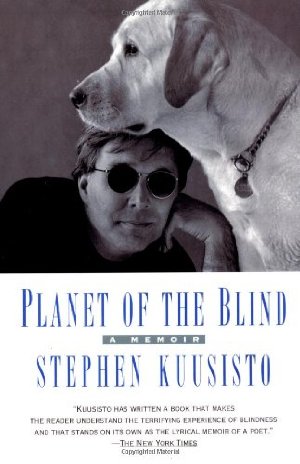
Living Beyond Disability: A Poet’s Reflection

I grew up on a steep divide but it wasn’t geographical. Instead it was a ridge or a chain of mountains both inside and outside me. I didn’t wish to be blind. I wanted to play baseball. And perhaps, more significantly, I wanted to be a scientist. Neither baseball or physics would happen for me. I became a poet. Compared to physics I think poetry is easy. All you have to do is step barefoot on a worm like Theodore Roethke, and you’ve got a poem. Poems fall out of cupboards like a box of starch loaded with spiders.

A popular phrase in advocacy circles is “embrace your disability”—but I’ve always thought the “d” word too mountainous for a hug. No one who’s disabled experiences a singular thing—a kewpie doll of physical difference that can be clutched to the chest. No. You can’t embrace your disability because, in fact, it’s a chain of mountains—highly articulated peaks with physical and metaphorical obstacles. I can’t stand it when I hear someone say “embrace disability”—one might as well embrace the Grand Tetons.

But I have another reason for hating the phrase “embrace disability”—one thinks of how difficult “embraces” really are for the disabled whose hopes for love and sexual life are often next to impossible.

Do you embrace your human loneliness and the near impossibility of intimacy with others?
Do you embrace your unemployment? The erosion of rehabilitation and health services?
Or the fact that doctor’s offices in the US are largely inaccessible?
Or that colleges and universities are woefully trapped in a 1970’s model of disability services?
Or that public transportation, especially airlines, treat you like a cockroach?

So I don’t like the word “embrace” which is just plain tomfoolery. And I don’t like “accept” because it’s too passive and vaguely defeatist.

Exult. Rejoice. Be rapturous. These are all too American. Don’t worry. Be Happy.

It just isn’t easy. The emotional rain isn’t gentle.

Once upon a time in Ithaca, New York, I encountered a man, a rather disheveled and clattering old man, someone the locals seemed to know, for we were in a diner, and he was going from table to table chattering with breakfasters, not asking for money, but essentially playing the role of the Id, sassing people, perhaps in ways they required, who could say, but there he was, pressing into each person’s space, piercing the psyches of strangers with his needle. He called a cop “Porky” and an elderly woman “Grandma” as he lurched steadily toward me. “Oh Doggy!” he said. “Doggy doggy doggy!”

Then he said, “What kind of fucking person are you?”
I tried my best Robert deNiro impression: “Are you talking to ME?”
He was not amused.
“A prisoner!” he shouted, for the whole diner was his stage. “This dog’s a prisoner!”

For a moment I felt the rising heat of embarrassment and rejection. Then, as he repeated my dog was a slave, I softened. In a moment of probable combat I stepped far back inside myself, not because I had to, but how to say it? Corky was unruffled. She actually nuzzled my leg. The nuzzle went up my torso, passed through my neck, went straight for the amygdala.

I smiled then. I said, “You’re right. And I’m a prisoner too.”

I don’t know if it was my smile, or my agreement that did the trick, but he backed up, turned, and walked out the door. Strangers applauded.

I’d beaten a lifetime of bad habits. I hadn’t fallen into panic, or rage, or felt a demand to flee.

I sat at the counter, tucked guide dog Corky safely out of the way of walking customers, and ordered some eggs. I daydreamed over coffee.

When I was eleven years old I fell onto a pricker bush. It’s hard to say how I did it, but I was impaled on hundreds of thorns. My sister who was six at the time, and my cousin Jim who was maybe nine, fell to the ground laughing as if they might die. I begged them for help which of course only made them laugh all the harder. I remember tears welling in my eyes and their insensible joy. I also knew in that moment they were right to laugh—that I was the older kid, was a bit bossy, disability be damned. I was the one who told my sister and cousin what to do. Now I was getting mine. My just deserts. In the end I tore myself from the monster shrub and stormed into the house. I sulked while they continued laughing outside.

Perhaps I thought, there in the diner, I could live henceforth in a new and more flexible way.

“Is it as simple as this?” I thought. “One simply decides to breathe differently.”

I saw, in a way, it was that simple.

Saw also how a dog can be your teacher. And while eating wheat toast I thought of the Buddha’s words from the Dhammapada:

Live in Joy, In love,
Even among those who hate.
Live in joy, In health,
Even among the afflicted.
Live in joy, In peace,
Even among the troubled.
Look within. Be still.
Free from fear and attachment,
Know the sweet joy of living in the way.

But you see, that’s the poet in me. It’s easy to imagine disabled life is a matter of grace.
And though I have these moments, I know I’m high in the Grand Tetons, still looking for a path.

And so I’m getting to my point. We are in the fight of our lives, all of us who hail from historically marginalized. This is a fearful time. I want to fight for us all. Embrace or don’t embrace your disability Stephen. Its all the same our there where so many are prisoners. Be better. Think a little bit about John Lewis. Think of good trouble. Right now the emotional rain is toxic. Get your umbrellas.

A Morning Journal About Monsters

If you think you’re the monster that’s alright
If you think you’re alright that’s monstrous
Let’s telephone the monster
“If you want to speak with the monster, press one…”

**
I was raised on moonbeams that came through a small window…

**

“What would an ocean be without a monster lurking in the dark? It would be like sleep without dreams.”

― Werner Herzog

**

Up early rummaging through the medieval stronghold of my skull
But I do it with confidence like a chess master

**

If you think you’re the monster that’s alright
It worked for Nietzsche

**

Sometimes when I call the monster I get Werner Herzog

**

The joke about the freak show is the monsters were at the edge of the fairground thriving on their emptiness

The “freaks” were just birds with damaged wings…
**

Oh come see the monster
Hurry…one slight bruise and he dies…

**

Michel Foucault thought he understood how monsters are made
He imagined they came from architecture and the bourgeois tendency to shuffle papers
He was a child of his age
Monsters need no scripts
They make and remake themselves from slivers of imaginary glass

**

Once while teaching at the University of Iowa I told graduate students that 90 per cent of the imagination is bad for you. I’m revising this to 95 per cent.

Eventually the monster’s tears turn into spectacles…

The Truth About Taxicabs and Ride Shares and Disability

I’ve been blind all my life and have traveled with guide dogs at my side for the past thirty years. Since guide dogs are trained to watch for traffic and take evasive maneuvers to avoid danger, my dogs have opened up limitless horizons for me, enabling me to travel across the globe. And I have: from Helsinki to Milan; San Francisco to Miami. But there are places I can’t go despite laws which say I can—for even though service dogs are permitted everywhere the public goes, taxi cabs and ride share services often discriminate against me.

There are very few service dogs in the United States. The number is likely somewhere around 30,000 when one includes dogs trained to assist with all kinds of disabilities and not just blindness. The odds of meeting a service dog team are not high. I like to say we’re the few, the proud, the canine-human equivalent of the Marines. We’re exceptionally trained. How many times have I been in a restaurant with my dog lying still under the table only to have other customers remark with pleasure and admiration when we get up to leave. They say: “I didn’t know there was a dog under there! That’s amazing!” A service dog is not just polite, it knows how to be an ambassador for the distinction of working dogs everywhere.

So wha’t with the cabs and ride shares? The drivers pull up, see the guide dog and drive away. Or they roll down their windows and complain loudly that they won’t take a dog. When I say its a guide dog and its allowed in their vehicle by law, well, you guessed it, they drive away. This has happened to me dozens of times over the years. Sometimes I ask a stranger on the sidewalk to flag me a cab and open the door and then I jump in. Sometimes I report the ride share driver to the head office. But nothing stops the discrimination.

Wheelchair users also face ride refusals. This has lead me to understand that the problem isn’t the dog at all. It’s the stigma associated with disability. In his famous book “Stigma: Notes on the Management of Spoiled Identity” Erving Goffman reminds us that deviant physicality has a long history: “The Greeks, who were apparently strong on visual aids, originated the term stigma to refer to bodily signs designed to expose something unusual and bad about the moral status of the signifier. The signs were cut or burnt into the body and advertised that the bearer was a slave, a criminal, or a traitor—a blemished person, ritually polluted, to be avoided, especially in public places. Later, in Christian times, two layers of metaphor were added to the term: the first referred to bodily signs of holy grace that took the form of eruptive blossoms on the skin; the second, a medical allusion to this religious allusion, referred to bodily signs of physical disorder. Today the term is widely used in something like the original literal sense, but is applied more to the disgrace itself than to the bodily evidence of it.”

People like me represent signs of physical disorder and even though our dogs are cute we’re to be avoided. I’ve come to realize its not the dog that’s the problem its my own physical presence. Yes, I now believe the drivers who refuse me would happily take the dog and leave me behind.

D.H. Lawrence, Disability and Two Fires in the Mind

When I entered college in 1973 I found no one was teaching Lawrence. He was considered a kook. At best he was a polemicist for psychoanalysis and at worst a pornographer but in any case professors assured me he was nothing more. If you wanted an English moralist you were instructed to read Hardy.

I fell in love with D. H. Lawrence as a high school student. His poems reached me first; then the essays. I don’t know if it matters what kind of reader I was back then. We spend so much time pre-fronting our subjectivities nowadays but yes I was legally blind. I read what I could get via long playing records and tapes from the Library of Congress. I listened slowly and in more than ordinary solitude. (It wasn’t possible in those days to hear a record while sitting under a tree.) I received my Lawrence in dark rooms.

When I entered college in 1973 I found no one was teaching Lawrence. He was considered a kook. At best he was a polemicist for psychoanalysis and at worst a pornographer but in any case professors assured me he was nothing more. If you wanted an English moralist you were instructed to read Hardy.

The photo on my freshman I.D. shows a boy-child who was 5′ 6″ tall and weighed 102 pounds. I’d barely survived a bout of adolescent anorexia. I started reading poetry in the hospital. I read this:

“The Uprooted”

People who complain of loneliness must have lost something,
lost some living connection with the cosmos, out of themselves,
lost their life-flow
like a plant whose roots are cut.
And they are crying like plants whose roots are cut.
But the presence of other people will not give them new, rooted connection
it will only make them forget.
The thing to do is in solitude slowly and painfully put forth new roots
into the unknown, and take root by oneself.

Of course I read all the poems of Lawrence I could find in recorded formats. “The Ship of Death” with its Egyptian incense, “The Snake” and the lesser known “Almond Blossom”:

“Trees suffer, like races, down the long ages.
They wander and are exiled, they live in exile through
long ages
Like drawn blades never sheathed, hacked and gone black,
The alien trees in alien lands: and yet
The heart of blossom,
The unquenchable heart of blossom!”

If you’re lonely by circumstance and you’re in “alien lands” then you’ve got to make something of it. You must believe the “unquenchable heart of blossom” is the signature of all things.

Lawrence was disabled. Like so many people born in the latter part of the 19th century he had tuberculosis. He was born on September 11, 1885. He was ten years younger than Thomas Mann who’s canonical novel “The Magic Mountain” offers the best description of the social psychology of TB.

No one has written with greater lyric urgency and intelligence than Lawrence about the side by side flames of soul and death. And yes eventually they become one flame but our work is different for now. We must adore them both:

“Medlars and Sorb-Apples”

I love you, rotten,
Delicious rottenness.

I love to suck you out from your skins
So brown and soft and coming suave,
So morbid, as the Italians say.

What a rare, powerful, reminiscent flavour
Comes out of your falling through the stages of decay:
Stream within stream.”

Jeffrey Meyers writes in his excellent biography of Lawrence:

“Lawrence’s life and character were strongly influenced by the progress of his disease. He had (at various times) all the symptoms of consumption, which intensified toward the end of his life. He suffered from irregular appetite, loss of weight, emaciation, facial pallor, flushed cheeks, unstable pulse rates, fever, night sweats, shortness of breath, wheezing, chest pains, frequent colds, severe coughing, spitting of blood, extreme irritability and sexual impotence. The toxemia of Lawrence’s lungs influenced the state of his mind and provoked febrile rages. As John Keats had told Fanny Brawne, emphasizing the gulf between the sick and the well: “A person in health as you are can have no conception of the horrors that nerves and a temper like mine go through.” Witter Bynner wrote of Lawrence’s stoic attitude but uncontrollable anger: “He had never given me any evidence of his illness by complaint in words or faltering in spirit but only by bursts and acts of temper.”

One supposes Bynner wasn’t much of a reader when it came to Lawrence’s poetry since poem after poem stills us, stands us on the by turns dark, then evanescent unseeable line between living and dying; between apprehension and the vatic. Here’s the end of
“Medlars and Sorb-Apples”:

“Sorb-apples, medlars with dead crowns.
I say, wonderful are the hellish experiences,
Orphic, delicate
Dionysos of the Underworld.
A kiss, and a spasm of farewell, a moment’s orgasm of rupture,
Then along the damp road alone, till the next turning.
And there, a new partner, a new parting, a new unfusing into twain,
A new gasp of further isolation,
A new intoxication of loneliness, among decaying,
frost-cold leaves.”

“Parting, partner, infusing, twain,” “a new gasp of further isolation.”

This is conceivably the greatest description of disability as lived experience at the hot core of soul and body as they engage in tug of war.