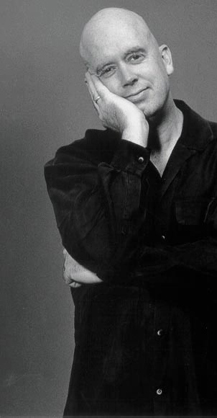
World Premier in Iowa City: See you there, Friday night, Feb 5th!

Imagine your world going dark. Contemplate the fading sight of a loved one. Grapple with the responsibility of delivering a diagnosis. Renowned
theater artist and UI graduate Rinde Eckert takes you behind the eyes
and into the heads and hearts of those surrounded by the shadows of
blindness. Crafted from interviews collected via an unusual
collaboration between Eckert and the University of Iowa Carver Family
Center for Macular Degeneration, Eye Piece
will feature performers from the UI Theatre Arts and Dance departments
and the School of Music as well as Eckert himself. With humor and
compassion Eckert will lead us on a journey through darkness toward a
different kind of illumination.

Rinde Eckert, Eye PieceRinde
Friday and Saturday, February 5 and 6, 8 pm
Sunday, February 7, 2 pm
Friday and Saturday, February 12 and 13, 8 pm
Sunday, February 14, 2 pm
Mabie Theatre

A HANCHER COMMISSION AND WORLD PREMIERE

Imagine your world going dark. Contemplate the fading sight of a loved one. Grapple with the responsibility of delivering a diagnosis. Renowned
theater artist and UI graduate Rinde Eckert takes you behind the eyes
and into the heads and hearts of those surrounded by the shadows of
blindness. Crafted from interviews collected via an unusual
collaboration between Eckert and the University of Iowa Carver Family
Center for Macular Degeneration, Eye Piece
will feature performers from the UI Theatre Arts and Dance departments
and the School of Music as well as Eckert himself. With humor and
compassion Eckert will lead us on a journey through darkness toward a
different kind of illumination.

RELATED EVENTS
Monday, January 25, 5:30 pm / 1289 Carver Biomedical Research Building,
Kelch Conference Room. Panel discussion about the creation of Eye Piece with Rinde Eckert, Dr. Ed Stone, Steve Kuusisto, and two cast members. Open to the public.

Tuesday, January 26, 12-1 pm / Braley Auditorium in UIHC’s Pomerantz Family Pavilion. Discussion about the impact of vision loss on family members with Rinde Eckert, Dr. Mark Wilkinson, and others. Open to the public.

This
project is made possible in part by a grant from the Association of
Performing Arts Presenters Creative Campus Innovations Grant Program, a
component of the Doris Duke Charitable Foundation.

It
is presented in collaboration with the UI Theatre Arts Department’s
Partnership in the Arts and the UI Division of Performing Arts’
Creating the Future Initiative. It is also presented in collaboration
with the University of Iowa Carver Family Center for Macular
Degeneration and the University of Iowa Carver College of Medicine
Writing Program.

ADA Restoration Act Clears Hurdles

While you won’t hear much about it from the national press the “ADA Restoration Act of 2007” cleared two House committees yesterday with only one opposing vote. (I’ll have more to say on that in a minute…) 

You can read all about yesterday’s proceedings and learn a good deal about the history  of the “ADARA” at the website of the American Association of People with Disabilities (AAPD):    

It is heartening that in a time of divisive squabbling in Washington the cause of Americans with disabilities has once again “shown the way” for true bi-partisan legislation and negotiation.

Disability is universal—it transcends race, class, gender, point of origin, sexual orientation, social status, age, fortune, and happenstance. Just so: the lives and concerns of people with disabilities are in fact the most logical point of “ethos” for a largely divided country to reassert its American values of fairness and decency.

While you wouldn’t always know it from the strident qualities of my prose I am at heart an optimist about the United States. I have lived to see kids with disabilities get a real chance in public education—when, not so long ago I was one of those “mainstreamed” kids who struggled without civil rights or appropriate educational supports. Yes, we’re a decent nation. We’ve come a long way in many areas. There’s reason for  a positive outlook. And yes, there’s also reason to stay strident. Rights and liberty are inconvenient for the ruling classes and we forget this at our peril.

“Aw, c’mon, Kuusisto, you don’t really think we have a ‘ruling class” in the United States, do you? I mean, don’t you agree that we’re a ‘classless society” etc. etc.?”

Continue reading “ADA Restoration Act Clears Hurdles”

New Radio Show: A Different Perspective

Howard Renensland, CEO & Founder of [with]tv, has officially launched A Different Perspective, a radio program of, by and for people with disabilities…and everyone else on WebTalkRadio

Howard’s first interview is with Stephen Kuusisto, author of Planet of the Blind and Eavesdropping: A Memoir of Blindness and Listening and of the blog Planet of the Blind.
A minor bug during the recording process via this telephone interview
resulted in a less than ideal sound quality at times, but ninor
technical difficulties aside, the content of the interview is certainly
worth a listen!

In his second interview, Howard enjoys a conversation with Dr. Scott Rains, a recognized authority and
writer on accessible travel, Universal Design, disability advocacy and
education and access to worship for people with disabilities. Dr. Rains
is also the Executive Producer of Taking the 9:05
a unique television travel program in development on what is current in
accessible travels destinations, fine dining and entertaining at home
in an accessible kitchen!

Congratulations to Howard who has been working tirelessly behind the
scenes to learn the art of being a radio show host and "engineer" – as
if he didn’t already have enough on his plate developing [with]tv!

For readers of this blog who may be deaf or hearing impaired, these
interview is being professionally transcribed and will be available
soon.  Stay tuned!

Merging Hunanities with Medicine

Professor making University of Iowa community look at disabilities in new ways: an article in the Iowa City Press Citizen, Wednesday, April 16, 2008 by Brian Morelli.

"People with disabilities often are labeled either as a social problem
or a medical problem, University of Iowa professor Stephen Kuusisto
said…"

(Click the link above to to proceed to the article.)

~ Connie

Today's "Talk of the Nation"

I was fortunate to be asked by National Public Radio to appear as a guest today on their nationwide program "Talk of the Nation". I stress "fortunate" because it’s a privilege to be asked to share with the public ideas about disability in general and blindness in particular.

But I felt a sense of disappointment with the interview today.  Today’s host, Lynn Neary asked me questions like explain "how" I (a blind person) could know what a painting by Jackson Pollock might look like. I gave the obvious answer–namely that I have descriptive friends who tell me these things.

Unfortunately, I think we ran out of time before the really important questions could be asked. What I had hoped for was an interview in which I might talk about "why" 70 per cent of the nation’s blind and visually impaired people who are of working age remain unemployed. I wanted to talk about our contemporary inheritance from the Victorians who saw a disabled body as an economic liability in the machine driven world of the Industrial Revolution. I wanted to talk about "why" these outworn ideas persist in the United States–so much so that we continue to stand in amazement when a superbly intellectual and gifted man like Governor David Paterson emerges from the pack.

Instead the interview sputtered badly I’m afraid, though I tried to explain that blind people bring critical thinking and emotional intelligence to their public and professional lives.

The good news is that tomorrow I am scheduled to appear on NPR’s "On Point" program.  With any luck, I’ll have an opportunity to discuss some of this then.

S.K. 

LINK:

NPR’s Blog of the Nation "Colors and Fog": What It Means to be Blind

fyi: featuring Steve and guide dog Nira

The University of Iowa has a great news magazine for faculty and staff called "fyi" and this month features Steve and "Nira" in an article and "picture show"!  This is very nicely done if you ask me.

~ Connie

Read article: Blind professor helps others see another side to disability
Photo feature: Steve and Nira’s first day of class
Audio slide show: Professor, Nira get acquainted with UI campus, each other

Thank you, Guiding Eyes

Back in 1998 a book reviewer at The Boston Globe suggested that I am a shill for the guide dog schools. What he meant is that my first book of nonfiction is richly devoted to sharing the experience of training with my first guide dog “Corky”—a life changing event for me and the glue that holds together my book.
I didn’t mind being called a shill. I’ve been called worse.

Today as I was walking in the Iowa snow with my third dog from Guiding Eyes I remembered that old Steve Martin joke where he says to his audience “I want to thank each and every one of you” Then he proceeds to say over and over: “Thank you thank you thank you thank you” etc.

Occupied in this way it dawned on me that Guiding Eyes for the Blind is worthy of every thank you I could pronounce. Guide dogs are expensive creatures to breed, raise, train, and then pair with a blind person. Despite the fact that each dog and person team costs well over 40,000 dollars to create, Guiding Eyes absorbs all the costs through its non-profit program of charitable donations.

I am a comparatively lucky blind person. I have a good job and a wonderful wife and family. Yet I can assure you that if I had to pony up 40K for my street mobility would be very hard pressed indeed. This in turn gets me to my point. Some will doubtless think of me as being too sentimental. Thanking those who have helped you is perhaps, in the minds of some “too old fashioned” or “too caught up in the charity model of disability”.

I believe that as I walk safely and in most cases euphorically that I have a big team behind me. Donors, puppy raisers, puppy breeders, veterinarians, fund raisers, construction and buildings and grounds personnel, volunteers, guide dog trainers, orientation and mobility specialists, dietitians, nurses, folks who work in the kennels, and the blind men and women who have trained alongside me with their new dogs.

Today, walking in the snow I heard in memory the voice of Steve Martin thanking everybody.

S.K.