Life Sentence for Mental Illness, A Human Rights Issue

Prisoner Gets 97-Year Sentence For Mental Illness Symptoms
(American Civil Liberties Union)
September 30, 2011

TAMMS, ILLINOIS– [Excerpt provided by Inclusion Daily] Anthony Gay was sentenced to an incredible 97 years in prison for throwing feces out his food slot, behavior experts characterize as symptomatic for severely mentally ill people held in solitary confinement. Yesterday the ACLU joined the National Disability Rights Network, Mental Health America and many others in filing a friend-of-the-court brief in Gay's appeal, calling the sentence "an unconscionable and shocking criminalization of his mental illness." 

Anthony's story is a tragic, but all too common, tale in our criminal justice system, where the severely mentally ill are routinely held in solitary confinement for months, years and even decades — their condition, and the punishment for it, worsening.

Anthony originally entered prison on a low-level charge after violating probation on a seven year suspended sentence. Had he been able to conform to prison rules, he should have served three-and-a-half years in prison. Unfortunately, Gay's mental illness led to bizarre and disturbing behaviors. Rather than treating his mental illness, officials punished him repeatedly for his symptoms; his security level was raised and he was increasingly banished to solitary confinement.

Eventually Gay was sent to Illinois' "supermax" prison, Tamms Correctional Center, reserved supposedly for the "worst of the worst." Subjected to 23 hours or more of isolation a day in a small cell with little to no human contact, Gay repeatedly tried to commit suicide and began to engage in horrific self-mutilation . . . Yet he was still not given meaningful psychiatric evaluation or treatment.

Entire article:
97 Years in Prison for a Mentally Ill Man Who Threw Feces

http://tinyurl.com/3jcdjw5
Related:
Inmate wants out of Tamms; attorney says years of solitary confinement harmed his mental health (Belleville News-Democrat) 

http://tinyurl.com/3k33nc7


Disability On Theory Road

–after Pentti Saarikoski


In the morning on Theory Road

Ableists and doctrineaire landscapers accosted me

Told me I was sily wanting to go places like everyone else

A little higher up under my apple tree a fawn and her twins nosed fallen fruit

Malice, dressed as a bureaucrat told me to give up

His forehead wavy, eyes quite specific, didn't much like the blind he said

I climbed the steps to the dance floor

Late summer clouds calling me

To dance with them but I lay down on my back

& listened as if my life depended 

Some Poor Writing About Syracuse in the Chronicle of Higher Education

There's an article by Robin Wilson in the latest issue of The Chronicle of Higher Education entitled "Syracuse's Slide" that seems, at first glance, to be a substantive news article. In a nutshell Wilson's piece asserts that under the leadership of Chancellor Nancy Cantor, SU has declined academically, dropping some five points in a recent ranking by US News & World Report–a rating mechanism that is relatively non-transparent and which is highly contested within higher education. What's troubling about the article is it's reliance on the rhetorical device known by the Greeks as "pathos"–it asserts a decline is underway at one of the nation's premier universities, thereby raising the emotional temperature of the Agora. Pathos is an excellent tool and it's the one you want if you seek histrionics and readerly credulity. Wilson seems to have been duped by a minority group of faculty who are increasingly unhappy because they do not share the Chancellor's vision of "scholarship in action"–a plan to make the pursuit of higher education and engagement with local educational and civic organizations into a model for 21st century American colleges. That such a plan would have it's critics is hardly surprising. Certainly the histories of contention in higher education would make a generous, if unreadable book. But it's the pathos of the Chronicle piece I find most surprising and disappointing. Pathos is distinct from facts (logos) but it pretends to facts. Enter Wilson's reliance on a disgruntled minority–they assert that funding dollars drawn from tuition have gone up for the administration at the expense of teaching. That this is untrue and that the claims come from an unreliable source seems to have evaded Ms. Wilson who also seems to have failed to question the assertion that Syracuse University's bold embrace of community based scholarship and civic engagement is responsible for a five point drop in the US News index. There is no evidence for this, only pathos, and the latter belongs both to bad writing and to the evident angst of the oddly selective group of faculty who Wilson seems to have consulted. It's interesting that she didn't talk to Deans or faculty with endowed chairs or University Professorships. In fact the article is so unbalanced that one simply returns to pathos in the absence of careful reporting. One wonders who is really responsible for the claim that Nancy Cantor's administration engages in "divisive" leadership? I can attest that having taught at two Big Ten universities and at a first tier liberal arts college I've never and I mean never been a part of such a diverse and energized intellectual community before. All of which makes me wonder about the term "divisiveness"–that can't be code for saying we're concentrating too much on the poor, can it?


SK

BBC E-mail: Germany returns Namibian skulls

Earlier, Ueriuka Festus Tjikuua, a member of the Namibian delegation, told reporters: "We have come first and foremost to receive the mortal human remains of our forefathers and mothers and to return them to the land of their ancestors."

I saw this story on the BBC News iPad App and thought you should see it.

** Germany returns Namibian skulls **
A delegation of Namibian tribal leaders visits Berlin to collect the skulls of 20 compatriots which were taken to Germany during colonial times.
< http://www.bbc.co.uk/news/world-europe-15127992 >

** BBC Daily E-mail **
Choose the news and sport headlines you want – when you want them, all in one daily e-mail
< http://www.bbc.co.uk/email >

** Disclaimer **
The BBC is not responsible for the content of this e-mail, and anything written in this e-mail does not necessarily reflect the BBC's views or opinions. Please note that neither the e-mail address nor name of the sender have been verified.

Sent from my iPad

Stealing the Pears from a Blind Guy's Tree

Pear Tree


Someone has stolen my pears. I have a suspect in mind but I won't confront him (or her)–rather I shall say: "Have you noticed anyone in my yard picking my fruit?" 

Stealing pears from a blind dude. Man, does that ever stink!

Of course, there are so many dreadful occurences on this planet that my little pear tree's violation is as nothing…

But I hope they choke on my little Anjous. I hope they get gout! I hope they bite into a live wasp! 

Hey, maybe he or she will grow up to be a saint, like Augustine, regreting the theft of pears. 

I hope they get gout! 

S.K. 


Disability Rights Advocates Sue New York City For Failing On Disaster Plans


(Thomson Reuter)
September 28, 2011

NEW YORK, NEW YORK– [Excerpt provided by Inclusion Daily Express] Disability-rights advocates on Monday accused New York City of failing to account for the unique needs of its nearly 900,000 disabled residents during disasters like Hurricane Irene and the attacks of Sept. 11, 2001. 

The proposed class-action lawsuit, filed Monday in Manhattan federal court, contended that the city is violating federal and state anti-discrimination laws by failing to make emergency plans, shelters, announcements and transportation fully accessible to individuals with physical disabilities. 

The suit was brought by the Brooklyn Center for Independence of the Disabled, the Center for Independence of the Disabled New York, and Tania Morales, a Brooklyn resident who uses a wheelchair. Morales was one of more than 250,000 New Yorkers asked to evacuate from low-lying areas during Hurricane Irene. 

Morales said she arrived at a designated emergency shelter to find the gates leading to the wheelchair ramp were locked. Volunteers at the shelter tried to track down the keys, but after 10 minutes Morales returned home, saying she was afraid to wait any longer on the sidewalk and had no way to get to another shelter.

Entire article:
NYC disaster plan ignores disabled people: suit

http://tinyurl.com/3d8slhd
Related:
Bloomberg's "Irene Preps" Provoke Federal Discrimination Suit (Public News Service)

http://tinyurl.com/45595pz
Disability groups sue city, claims its emergency planning is subpar (AMNY)
http://tinyurl.com/6j8vp77


National Federation of the Blind Condemns New Amazon Kindle


FOR IMMEDIATE RELEASE


CONTACT:

Chris Danielsen

Director of Public Relations

National Federation of the Blind

(410) 659-9314, extension 2330

(410) 262-1281 (Cell)

cdanielsen@nfb.org


National Federation of the Blind Condemns
 Lack of Access to New Kindle Fire


Baltimore, Maryland (September 29, 2011): The National Federation of the Blind commented today on the release of Amazon’s new Kindle Fire, which cannot be used by people who are blind.


Dr. Marc Maurer, President of the National Federation of the Blind, said: “Blind Americans have repeatedly asked Amazon to include accessibility for the blind in its Kindle product line.  The feasibility of including accessibility in similar products has been demonstrated.  The Department of Education and the Department of Justice have made it clear that Kindle devices cannot be purchased by educational institutions, libraries, and other entities covered by this country’s disability laws unless the devices are fully accessible.  Despite all this, Amazon has released a brand new Kindle device, the Kindle Fire, which cannot be used by people who are blind.  Enough!  We condemn this latest action by Amazon and reiterate that we will not tolerate technological discrimination.  The National Federation of the Blind seeks nothing less than equal access to all technology for blind people.  It is one of the most critical civil rights issues facing blind Americans in the twenty-first century, and we will do everything in our power to see that this right is secured.”


###


About the National Federation of the Blind

With more than 50,000 members, the National Federation of the Blind is the largest and most influential membership organization of blind people in the United States.  The NFB improves blind people’s lives through advocacy, education, research, technology, and programs encouraging independence and self-confidence.  It is the leading force in the blindness field today and the voice of the nation's blind.  In January 2004 the NFB opened the National Federation of the Blind Jernigan Institute, the first research and training center in the United States for the blind led by the blind.


Dyslexia, Neurodiversity, Autism: All Out of the Box

Out of the Box


There's a very interesting article at US News by Meryl Davids Landau which highlights the work of progressive college admissions deans who are seeing the advantages of disability inclusion on their campuses. Here's a taste: 

"Some 45 college admissions deans from across the country gathered at Stanford University this past June to learn about high-achieving dyslexic applicants. Experts shared the latest research, and well-known figures—including California Lt. Gov. Gavin Newsom, financier Charles Schwab, and Delos "Toby" Cosgrove, a heart surgeon and CEO of the Cleveland Clinic—described their experiences coping with the disability.

"Our goal is to help colleges realize that, because of their intelligence, out-of-the-box thinking, and perseverance, these students can add luster" to their schools, says Sally Shaywitz, the Audrey G. Ratner professor in learning development at Yale University who helped organize the event."

From a disability studies perspective this is a hopeful sign. They key phrase that Professor Shaywitz offers is "to help colleges realize"–for surely, as those of us in dis-studies have long known, neuro-atypical students and colleagues have spent their lives outside the box and thereby bring fresh thinking to the classroom and the work environment each and every day. I would add though, that this is not simply true for high achieving students with dyslexia–it also holds for nonspeaking people with autism, blind students, students with profound poly-trauma. The recent special issue of Disability Studies Quarterly devoted to autism and neuro-diversity edited by Ralph and Emily Savarese highlights the remarkable insights and imaginative atypicalities of autists and is critically important reading. I like what Jamie Burke, a college student with autism says as a brief epigraph to the issue:

"I must send forward my bold appreciation for taking the soul of this topic … to be shared among the many and diverse hearts who will attempt a new understanding. It can be very lovely when curious old patterns of comprehension shift to a more connected and true demonstration of the improved focus. My deep thanks, then, for the spirit of change and challenge." 


S.K. 


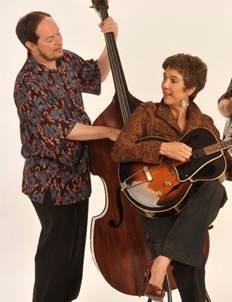
Come Hear My Friends Phil Flanagan and Hanna Richardson


Hanna and Phil


Greetings friends!

We’ve just returned from a wonderful southern mini-tour

and can’t wait for our next concert at the Westcott

Community Center (corner of Westcott and Euclid in

Syracuse).


Hanna on tenor guitar

Phil on upright bass

Brian Earle on clarinet


So delighted to welcome our friend Brian Earle from Ithaca!

Two sets of classic, swinging American music, guaranteed

to leave you with a song in your heart and a spring in your step.


Next week! Saturday, October 8, 8:00 p.m.

$15 ($12 for WCC members)

$10 for students with ID


Reservations:  315-478-8634  or available at the door


One of our few local gigs this fall!  Hope to see you there.  Come check out Hanna’s beautiful new tenor guitar, custom made by local luthier Tom Fay…


“One of the best chamber-jazz ensembles you’ll ever hear.” – Jazz Lives