Help Braille Literacy

National Federation of the Blind Partners with Groupon Grassroots

Buy an NFB Groupon June 4–10 to Support Braille Literacy

Baltimore, Maryland (May 31, 2012): The National Federation of the Blind, the nation’s leading advocate for Braille literacy, and Groupon Grassroots, the philanthropic arm of Groupon, are teaming up to bring Braille into the lives of more blind children who need it.

The National Federation of the Blind campaign will be available on the Baltimore Groupon page beginning on June 4, and running throughJune 10. Groupon subscribers can pledge support for the National Federation of the Blind Braille Literacy initiative in increments of $10, with each $15 purchased providing one Braille Reading Pals packet to a blind child.

Braille Reading Pals is an early literacy program that fosters positive attitudes about Braille for children and their families and promotes a love of reading by encouraging parents to read daily with their blind or low-vision child. Participants receive a print/Braille book to read with their child and to encourage an independent exploration of Braille. Participants also receive a plush “Reading Pal” to accompany reading time and help young blind children develop fun and positive associations with reading Braille. Each $15 purchase will pay for a full set of Braille Reading Pals materials for a blind child and help set a blind child on the path to Braille literacy and future success.

Dr. Marc Maurer, President of the National Federation of the Blind, said: “We are pleased to be partnering with Groupon Grassroots to bring Braille literacy into the lives of more young blind children who desperately need it. There is a proven correlation between Braille literacy and employment, and yet only one out of ten blind children is being taught Braille in schools today. We would never accept such a low literacy rate among our sighted children, and our blind children should be no exception. The Braille Reading Pals program is an initiative to increase the number of blind children learning Braille by introducing a love of Braille and reading into a blind child’s life at an early age. Please help us to create a bright future for blind children by purchasing a Groupon that will go toward giving one blind child the tools needed to become a literate and successful person.”

You must be a Groupon subscriber to purchase a Groupon. If you are not currently a Groupon subscriber and would like to become one in order to purchase a National Federation of the Blind Groupon, you may visitGroupon’s subscription Web page.
Tales From Switzerland

Outside Lausanne

By Andrea Scarpino


It may be too much to call this trip to Europe a homecoming–I’ve never met this branch of my Italian family before, so I can’t really come home to them. But I feel something similar, a coming-home-for-the-first-time. Which means that I want to meet everyone who has any interest at all in meeting me. Most of my family is still in the South of Italy–Calabria–but Salvatore lives in Florence, and my cousin Patrizia and her husband Seamus in a small Swiss town outside of Lausanne.


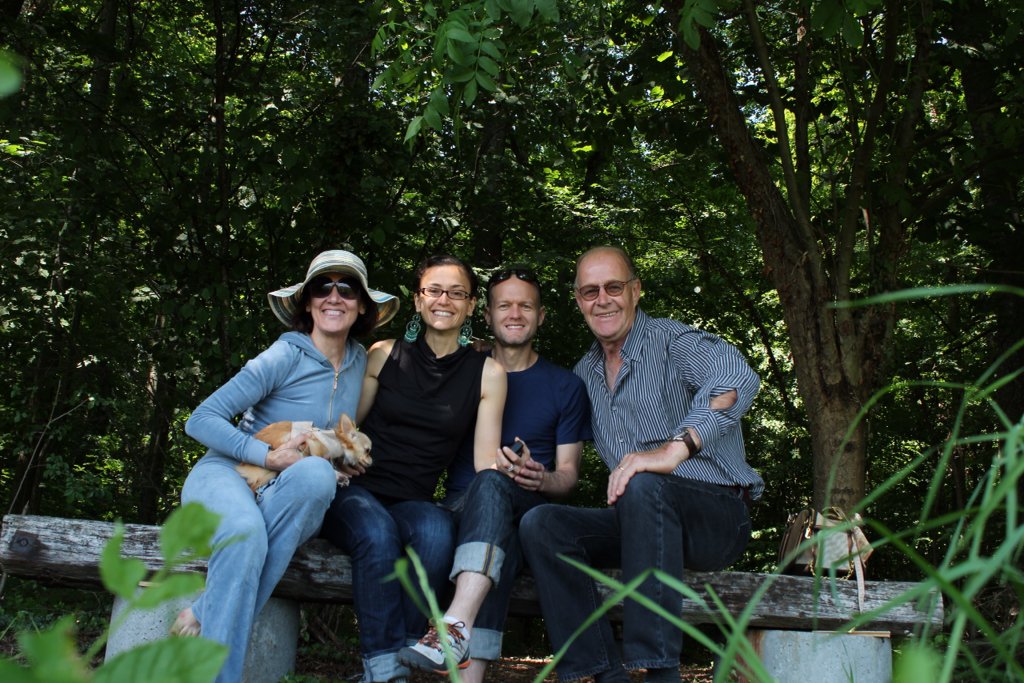
So here we are in Switzerland, staying with Patrizia and Seamus on property that’s been in Seamus’ family for hundreds of years. Right down the hill from us: Seamus’ uncle’s chateau and a garden full of irises. And beyond: Mont Blanc looming.


Our first day here, we walked the iris gardens, learned how carefully they’re grown and tended, that no one has yet developed a purely red iris, that thousands of visitors come each year during the month that the irises bloom. We walked beyond the gardens through a wooded area and on a sloped hillside above us, the ringing of bells: cows grazing with bells tied to their necks. We sat in the woods and listened to the bells and talked constantly–about our childhoods, our family, Swiss politics, the troubled economy, how grapes are tended and made into wine (Patrizia is a sommelier), how worried we are for Obama’s re-election.


That night: a dinner party. Seamus is renowned chef, and in seemingly no time at all, he pulled together a vegetarian dinner party in our honor: cheese soufflé, asparagus risotto with a hollandaise sauce I would have eaten like soup, stuffed peppers and eggplant and zucchini, a green salad, cheese plate with six different cheeses, strawberries with meringue and fresh cream. And wine from his brother’s vineyard–crazy delicious.


And that was just the beginning of the amazing food we’ve eaten–Patrizia’s chickpea and potato soup with a drizzle of the best olive oil, fresh white asparagus perfectly steamed, artichoke pasta, green pea soup with cream, endive salad, red Thai curry that Zac says is the best he’s eaten. And last night, at a typical Swiss restaurant overlooking all of Lausanne, raclette and fondu, crusty bread, miniature pickles that aid digestion.


It’s true my pants have grown tighter since being is Switzerland, but it’s also true that I couldn’t care less. I feel full in every sense: with scenery–stepped vineyards, red tiled roofs, row after row of irises, red poppies peeking through wheat fields, snow-topped mountains that dip down into the lake, grassy parks, stone chalets–with food, with wine, with conversation, with new friendship. New plans.


The Summertime Blues

“You don’t have to suffer to be a poet; adolescence is enough suffering for anyone.”

–John Ciardi

I have been waking up sad. Summer is sliding in and I am sad. Like most people I aim for casual philosophy, what the poet Donald Justice called “mordancies of the armchair” since much of life is deeply sad and escapism is at best ineffective. I take my sadness like a baby in my arms and carry it from room to room. I talk to it. Sing softly to it. It’s better to honor the infanta dolorosa than humor it so I sing the saddest things I know: songs from the Finnish, from the age when people kept coffins in the parlor, ate off them. Death has always inhabited the furniture. This is, then, something more than a sad song, it’s the branch of philosophy called “the blues” and like Leadbelly “I see my coffin comin’ Lordy Lord in my back door” –there’s no product from Madison Avenue that can fix it.


Maybe I should try a new anti-depressant? Maybe a new drug could turn the casket into a sailing ship? Maybe I could be Herman Melville without the sandstorm in his head? I could be just another literate tourist floating on our blue planet. I would own a gentler view, something like Walt Whitman’s idea that death is not what we suppose, and better. Death is better than the imagination’s grasp of it. I told you I’ve been waking up sad. I have been this way from childhood, seized by tears even on sunny days.


Then something happens. The blues heat up. I feel it all over, like ants. I want to crawl under the kitchen sink and press my eyes to the cool pipes and cry.


In ancient times I’d have been the one in the hut at the edge of the woods, the one laughing and crying, singing to himself, feeding the stray animals with bartered food.


You see, this is adulthood. In the United States this is not properly understood.


James Hillman: “Depression opens the door to beauty of some kind.”


Lately I have a depression “of some kind” and I suppose by lately I mean all my life.


Meantime here’s a great psychiatry joke:


Joe has been seeing a psychoanalyst for four years for treatment of the fear that he had monsters under his bed. It had been years since he had gotten a good night’s sleep. Furthermore, his progress was very poor, and he knew it. So, one day he stops seeing the psychoanalyst and decides to try something different.

A few weeks later, Joe’s former psychoanalyst meets his old client in the supermarket, and is surprised to find him looking well-rested, energetic, and cheerful. “Doc!” Joe says, “It’s amazing! I’m cured!”

“That’s great news!” the psychoanalyst says. “you seem to be doing much better. How?”

“I went to see another doctor,” Joe says enthusiastically, “and he cured me in just ONE session!”

“One?!” the psychoanalyst asks incredulously.

“Yeah,” continues Joe, “my new doctor is a behaviorist.”

“A behaviorist?” the psychoanalyst asks. “How did he cure you in one session?”

“Oh, easy,” says Joe. “He told me to cut the legs off of my bed.”


Handcuffing Kids with Disabilities in America

Police Handcuffing 7-Year-Olds? The Brutality Unleashed on Kids With Disabilities in Our School Systems
(AlterNet)
May 25, 2012

SAN FRANCISCO, CALIFORNIA– [Excerpt provided by Inclusion Daily Express] There’s a danger looming in schools today that’s putting our nation’s most vulnerable children at risk. Around the country, teachers and administrators are struggling to meet the needs of a growing population of disabled students, who are entering school environments ill-prepared to educate them responsibly, thanks to a lack of both adequate training and resources.

This lack of preparation for handling students’ special needs is, in turn, sparking a disturbing and dangerous trend: the use of harmful “zero tolerance” policies that end in seclusion, restraint, expulsion and — too often — law enforcement intervention for the disabled children involved.

From coast to coast, the incidents are as heartbreaking as they are shocking

Cases like these, of students trapped by school policies rarely designed to deal with the nuances of their diagnoses, are growing — and the situation is further clouded by race, class and social factors. These factors can determine what kinds of evaluations, interventions and treatments are provided to students with disabilities or suspected disabilities, and ultimately decide whether children are able to successfully complete their educations, or fall by the wayside.

The increased use of law enforcement to deal with behavioral issues in schools gained heightened attention this year when Salecia Johnson, age 6, had a temper tantrum in her principal’s office, and was handcuffed and detained by local police as a result. She was so traumatized by the experience that she has trouble sleeping at night — and she’s not the only one.

Entire article:
Police Handcuffing 7-Year-Olds? The Brutality Unleashed on Kids With Disabilities in Our School Systems
http://tinyurl.com/ide0525123a

The Black River Chapbook Competition: Deadline May 31, 2012

About the Prize

Dear Friends,

This is just a friendly reminder that the deadline for the Spring 2012 Black River Chapbook Competition is approaching.

The Black River Chapbook Competition is a semi-annual prize from Black Lawrence Press for a chapbook of short stories or poems. Entries should be between 16 and 36 pages in length. The winner will receive $500 and publication. Previous winners of The Black River Chapbook Competition include Helen Marie Casey, Frank Montesonti, D. E. Fredd, Sandra Kolankiewicz, Tina Egnoski, T. J. Beitelman, David Rigsbee, Lisa Fay Coutley, Amelia Martens, Charlotte Pence, Russel Swensen, and Nick McRae.

How to Enter

Please follow this link for information on how to submit your manuscript for The Black River Chapbook Competition.

The deadline for submissions is May 31. That’s this Thursday!

We look forward to reading your work!

Black Lawrence Publishing • 326 Bigham Street • Pittsburgh • PA • 15211

www.blacklawrence.com

DRI Backs Duchess Of York In Exposing Abuses To Children In Turkish Institutions

DRI Backs Duchess Of York In Exposing Abuses To Children In Turkish Institutions
(Disability Rights International)
May 24, 2012

WASHINGTON, DC– [Excerpt provided by Inclusion Daily Express] This morning, an Op-Ed by DRI President Laurie Ahern was published in the Washington Post. The Op-Ed defends the actions of the Duchess of York, Sarah Ferguson, who is currently being prosecuted by the Turkish government for "acquiring footage and violating the privacy" of children in a Turkish state-run orphanage.

The ITV of London investigation was a follow-up to DRI's 2005 report, "Behind Closed Doors: Human Rights Abuses in Psychiatric Facilities, Orphanages and Rehabilitation Centers in Turkey," which documented the abusive treatment of children and adults locked away and forgotten in state facilities.

Toddlers in Turkey who scratched, hit and bit themselves — a result of mind-numbing boredom and lack of stimulation — had their hands "covered" by plastic liter bottles that had been cut in half and duct-taped around the children's wrists.

As the Op-Ed states, "The hypocrisy of the Turkish government in prosecuting the duchess, who courageously exposed torture and neglect of Turkish children, is appalling. Turkish officials seem concerned with the privacy of children, most of whom have intellectual and physical disabilities, even as they violate those children's most basic human rights . . . Children with disabilities hidden away in closed institutions have no voice, no choice and no control. They are the population most vulnerable to abuse at the hands of state actors."

Entire article:
Nations Must Protect Their Children, Not Their Reputation

http://www.disabilityrightsintl.org/2012/05/21/1097/
Related:
Nations must protect their children, not their reputations (Washington Post)

http://tinyurl.com/ide0524121b
Behind Closed Doors: Human Rights Abuses in Psychiatric Facilities, Orphanages and Rehabilitation Centers of Turkey (DRI)
http://tinyurl.com/ide0524121c


News From Florence

By Andrea Scarpino

This is the story my cousin Salvatore tells about how our meeting in Florence came to be. A year and a half ago, he was in his hometown of Crotone after living in Australia for five years. He was trying to teach his mother how to use the computer and internet, so he asked his mother for a name to search online. She said, “Andrea Scarpino.”

“Who?” Salvatore asked. He had never heard of me before–as I had never heard of him. He entered my name into Google, chose “images,” and immediately, his mother pointed to a photograph pulled from my website. “That’s her,” his mother said. Salvatore asked how she knew, and his mother replied, “Just look at her face. Of course that’s her.”

A year and a half later, Zac and I are sitting in Salvatore’s apartment with his girlfriend Silvia waiting for him to return from work. Their apartment has tall, open windows, is full of light and plants and two fish: a bright blue fighting fish and a goldfish. We’ve already discovered that Silvia is from the same small Canadian town that our good friend Carol is from–it’s a small world, as the saying goes. And then Salvatore comes home.

He has an Australian accent which I love, is a little bit shorter than me and very muscular, strong. His eyes remind me of my father’s eyes, a lovely almond brown. Here in front of me, my second cousin on the Scarpino side of my family. A man I didn’t know exists.

That night, he takes us on a tour of Florence–the Duomo, the Ponte Vecchio, Medici family buildings. We eat an amazing pasta with fresh sauce that Silvia makes from tomatoes on the vine, olive oil, and bright green basil. We eat the best olives I’ve ever eaten–salt cured, but plump and full, oily–totally unlike the dry salt-cured olives in the US. The next day, Silvia takes us on a walk up a hilly overlook showing all of Florence below us, and just as we reach a church on the top of the hill, a black Audi decorated with white lace pulls up. A wedding; the bride has arrived. We drink white wine on a terrace overlooking the city, orange-red tile roofs and lush green trees and the constant whiz of scooters and cars and people.

Florence is lovely in every way, and Zac and I are already scheming ways to return, to stay for an entire summer perhaps. For the first time in as long as I can remember, I feel relaxed, at ease, untroubled. We sleep until 11 in the morning. But the best thing is having found new family–Salvatore and Silvia argue over which of his sisters I look the most like. And in his Sal’s eyes, I see my father.

News From Florence