Disability Today

Like you no doubt I wake and reach for the newspaper. If you’re younger maybe you reach for your Twitter feed but the instinct to see what’s happened overnight beyond the cave is universal. I’m still a newspaper dude though I view them online with screen reading software. Assistive technology keeps me in the game though I don’t really believe in that term since all technology is assistive whether you’ve a disability or not and there shouldn’t be any categorical distinctions.

Reading the news with a computer generated voice is not a good aesthetic experience. Hearing that a woman has just killed her autistic son with a band saw because “she couldn’t take it anymore” is shattering no matter how you encounter the story, but there’s something about the dolorous and impersonal computer that further shivers one–as if my Mac knows something I don’t. As if the Voiceover software invented by Apple to make all their products usable by the blind has been in touch with Hal from 2001 Space Odyssey and together they know disability doom is coming.

Disability doom is a large subject. From pre-natal testing and the abortion of Down syndrome babies to a new militant rightwing hostility to the Americans with Disabilities Act there’s every reason to think there’s a war on the disabled.

As what’s left of Western democratic traditions wilts under corporatized Neo-liberalism and nationalist populism (fascism) the disabled are in the cross hairs. Everyone’s in the crosshairs: high school children, people of color, women, trans and gay people. Fascism, allowed in the mainstream, sees all difference as deviant. Yet there’s something unique about the disabled: they trigger apprehension across all cohorts of diversity. As people literally struggle to survive, it’s easy to imagine the disabled are a burden. They’re a burden at your rally, your business, and yes, on the streets.

Cries come from all directions: we must get the mentally ill back into gated institutions. If we no longer have money to build these facilities we should put them all in prison. Currently the largest mental health faculty in California is the Los Angeles county jail.

Even as I type there’s a concerted movement on Capitol Hill to roll back important parts of the ADA. Even as I type the unemployment rate for the disabled remains at close to 70%. Even as I type veterans with disabilities are being denied services or or made to wait in line for help–a line that grows longer and longer.

As a poet who’s disabled I know a thing or two about irony. When disability is talked about in political circles there’s an assumption that “they” are not “us”–as if disability is something that happens to some other tribe, as if the disabled aren’t your mother, your father, sister, brother, uncles, neighbors, children, children, children. It’s this othering strategy that scares me the most. When the Americans with Disabilities Act was signed into law in 1990 there was a strong bi-partisan sense that the disabled are us. I think there’s an erosion going on. The irony works this way: we celebrate singular disability achievements–Aimee Mullins running on her blades and wearing designer clothing for the cameras; Marlee Matlin’s acting, Stevie Wonder’s music, and yet we think of them as exceptions, even as we imagine they’re representative of a large population. You can’t have it both ways. The disabled are us. Black, white, trans, gay, women, men, oh, wait I’ve already said that.

Right now I’m on a book tour of sorts. When interviewers ask me about my experience growing up pretending I could see more than I really could, asking as though I’m unique in that regard, I say: “this is not an uncommon story” because it’s true, and also to underscore that the singularity of one blind poet shouldn’t be mistaken for an isolating and categorical representation. The disabled I know, both here in the United States and around the world are struggling to stay in the public square.
Stephen Kuusisto and HarleyABOUT: Stephen Kuusisto is the author of the memoirs Have Dog, Will Travel; Planet of the Blind (a New York Times “Notable Book of the Year”); and Eavesdropping: A Memoir of Blindness and Listening and of the poetry collections Only Bread, Only Light and Letters to Borges. A graduate of the Iowa Writer’s Workshop and a Fulbright Scholar, he has taught at the University of Iowa, Hobart and William Smith Colleges, and Ohio State University. He currently teaches at Syracuse University where he holds a University Professorship in Disability Studies. He is a frequent speaker in the US and abroad. His website is StephenKuusisto.com.

Have Dog, Will Travel: A Poet’s Journey is now available for pre-order:
Amazon
Barnes and Noble
IndieBound.org
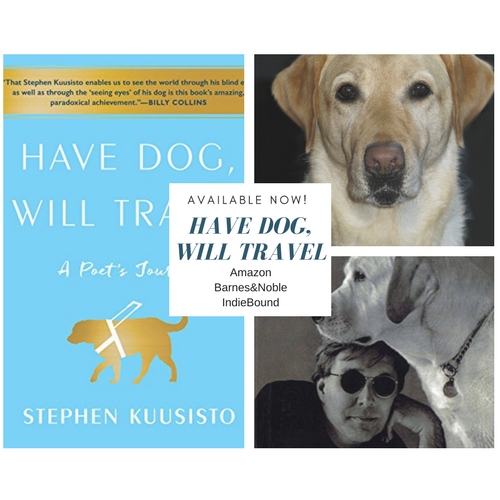
Have Dog, Will Travel by Stephen Kuusisto

(Photo picturing the cover of Stephen Kuusisto’s new memoir “Have Dog, Will Travel” along with his former guide dogs Nira (top) and Corky, bottom.) Bottom photo by Marion Ettlinger 
From a Birthday Notebook….

Happy Birthday Stephen—

Sitting alone with Thelonious Monk

Aged fifteen

Solo in the attic

With a radio…

**

The Finnish poet Jarkko Laine once told me he lived on Deep Ditch Road.

The Egyptologist on the subway told me about mummified beetles in tiny sarcophagi.

**

Now and then I recall a certain turtle.

^^

Happy birthday.

The fence will not be fully repaired.

I fear my teeth have more wisdom than my hands.

This is also my Finnish grandmother’s birthday.

She was a devout Lutheran and therefore not much fun.

She did however send me photos of herself, not having much fun.

**

Just this morning, for a time, I became Heraclitus, the dark one, then, just as sudden, I was my father who when young imagined he would be a writer before World War II changed him, made him somber, until he believed literature was a childish thing. He’s gone now. The poems he loved are still on my bookshelf. I admit I try to read them as he did—mindful of another’s joy and curiosity and yes, apprehension.

**

On his birthday—I’m not sure which one—Heraclitus invented the string clock….

Stephen Kuusisto and HarleyABOUT: Stephen Kuusisto is the author of the memoirs Have Dog, Will Travel; Planet of the Blind (a New York Times “Notable Book of the Year”); and Eavesdropping: A Memoir of Blindness and Listening and of the poetry collections Only Bread, Only Light and Letters to Borges. A graduate of the Iowa Writer’s Workshop and a Fulbright Scholar, he has taught at the University of Iowa, Hobart and William Smith Colleges, and Ohio State University. He currently teaches at Syracuse University where he holds a University Professorship in Disability Studies. He is a frequent speaker in the US and abroad. His website is StephenKuusisto.com.

Have Dog, Will Travel: A Poet’s Journey is now available for pre-order:
Amazon
Barnes and Noble
IndieBound.org

Have Dog, Will Travel by Stephen Kuusisto

(Photo picturing the cover of Stephen Kuusisto’s new memoir “Have Dog, Will Travel” along with his former guide dogs Nira (top) and Corky, bottom.) Bottom photo by Marion Ettlinger 
Optimism, Cripples, Family Bibles, and Good Old John Rawls….

“Call me Ishmael” says the family bible which sits lithically on its shelf and which no one has opened since grandmother died. “Please call my Ishmael” it says, adding: “let me wander to the far off houses…” But the Bible you see is like an impoverished man who must sit and sit. In this way the old thing is like a cripple alone in a back room in a farm house in a country town. The lame one who, if revealed, will spoil the daughter’s arranged marriage. Try this if you think I’m kidding: take the dark, thick, dusty family bible into the street and offer it to passersby and see what happens…

**

“Change the subject,” says Uncle History. He’s sick of religion. I don’t blame him. “Let’s have some of those American prunes,” he shouts.

Meantime: Pierre Fournier, Beethoven, Sonata for Cello and Piano #1 in F.

**

“For the most part I examine the principles of justice that would regulate a well-ordered society. Everyone is presumed to act justly and to do his part in upholding just institutions.”

John Rawls “A Theory of Justice”

Oh Rawls, you were such a willful optimist. But you see, I struggle with you—yes, you’ve a fictive epistemology; yes, the rights of the disabled derive from just such optimism.

The lesson: imagine rational utopias. Evidence may come later.

**

Meanwhile the disabled, people like me, we trouble the mechanisms.

**

I want more patience. Dear Rawls…..

**

So the river with all its catfish is filled with various kinds of music. Let’s get that straight.

**

“But the main reason we are so anxious about the genomic revolution is that we are psychologically equipped to misunderstand it. Unlike, say, the study of subatomic physics, where almost no one outside of the physics community feels that he or she can make heads or tails of it, the notion that we possess genes that make us who we are makes intuitive sense. But it turns out that conclusion is inaccurate, or at least imprecise. Yet we persist in this belief that our genes control our lives. We are genetic fatalists.”

Excerpt From: “DNA is Not Destiny.” iBooks.

And so, back to the dark toad family bible….

I picture a two horse race: science is in the lead, but wait, here comes superstition…oh my, this race is coming down to the wire!”

**

For me, well, it takes a bus load of Beethoven to get by.

Piano and cello off shore in a boat….

**

Please, I just want a horse race where the animals are trained with optimism and no one gets hurt.

Stephen Kuusisto and HarleyABOUT: Stephen Kuusisto is the author of the memoirs Have Dog, Will Travel; Planet of the Blind (a New York Times “Notable Book of the Year”); and Eavesdropping: A Memoir of Blindness and Listening and of the poetry collections Only Bread, Only Light and Letters to Borges. A graduate of the Iowa Writer’s Workshop and a Fulbright Scholar, he has taught at the University of Iowa, Hobart and William Smith Colleges, and Ohio State University. He currently teaches at Syracuse University where he holds a University Professorship in Disability Studies. He is a frequent speaker in the US and abroad. His website is StephenKuusisto.com.

Have Dog, Will Travel: A Poet’s Journey is now available for pre-order:
Amazon
Barnes and Noble
IndieBound.org

Have Dog, Will Travel by Stephen Kuusisto

(Photo picturing the cover of Stephen Kuusisto’s new memoir “Have Dog, Will Travel” along with his former guide dogs Nira (top) and Corky, bottom.) Bottom photo by Marion Ettlinger 
Fear of Falling, Twenty Times Each Day

I walk up and down stairs while I’m awake and as far as I know I don’t do it in my sleep. Stairs are bad enough in my waking life. My blindness means every set of steps will be both challenging and vaguely frightening. Often walking with sighted friends they sail down staircases talking all the while as I nervously feel my way with electrostatic feet. I’ve always loved James Tate’s line: “when riding an escalator I expect something orthopedic to happen.” Me too James. Or worse. I expect to fall face forward into death’s arms.

No matter how proficient you are at traveling blind you’re always aware of the manifold instances when, frankly, you’re risking physical harm. It is not fashionable to say this. What’s fashionable is to assert blindness is a minor inconvenience—with the proper accommodations it is practically nothing.

And then there are stairs, intersections, drunk drivers, distracted bicycle messengers, tiny revolving doors, all the daily invitations to behead myself.

On the surface I appear collected. Underneath, even with a guide dog by my side I feel that old fear of falling, feel it at least twenty times a day.

Connie Kuusisto :
Stephen Kuusisto and HarleyABOUT: Stephen Kuusisto is the author of the memoirs Have Dog, Will Travel; Planet of the Blind (a New York Times “Notable Book of the Year”); and Eavesdropping: A Memoir of Blindness and Listening and of the poetry collections Only Bread, Only Light and Letters to Borges. A graduate of the Iowa Writer’s Workshop and a Fulbright Scholar, he has taught at the University of Iowa, Hobart and William Smith Colleges, and Ohio State University. He currently teaches at Syracuse University where he holds a University Professorship in Disability Studies. He is a frequent speaker in the US and abroad. His website is StephenKuusisto.com.

Have Dog, Will Travel: A Poet’s Journey is now available:
Amazon
Barnes and Noble
IndieBound.org

Have Dog, Will Travel by Stephen Kuusisto

(Photo picturing the cover of Stephen Kuusisto’s new memoir “Have Dog, Will Travel” along with his former guide dogs Nira (top) and Corky, bottom.) Bottom photo by Marion Ettlinger 

Thoughts on the AWP, Christopher Hitchens, and Jefferson’s Idea of Happiness

Last evening I spoke with several scholars who are researching histories of confinement among the disabled. This morning I’m reading about the latest failure of the AWP (The Association of Writers and Writing Programs) which just concluded its annual national conference having once again treated disabled attendees miserably. Confinement means the asylum or special hospital but it is also the product of disdain—find a conference site with insufficient elevators, no shuttle service, make sure no one answers the accessibility helpline, make public your indifference to disability inclusion and you’ve got what the leading consortium of academic creative writing programs thinks is OK where the cripples are concerned. Maybe they’ll go back to the institution—and we don’t mean the Ivory Tower.

**

“Imagine that you can perform a feat of which I am incapable. Imagine, in other words, that you can picture an infinitely benign and all-powerful creator, who conceived of you, then made and shaped you, brought you into the world he had made for you, and now supervises and cares for you even while you sleep. Imagine, further, that if you obey the rules and commandments that he has lovingly prescribed, you will qualify for an eternity of bliss and repose. I do not say that I envy you this belief (because to me it seems like the wish for a horrible form of benevolent and unalterable dictatorship), but I do have a sincere question. Why does such a belief not make its adherents happy? It must seem to them that they have come into possession of a marvelous secret, of the sort that they could cling to in moments of even the most extreme adversity.”

Excerpt From: Christopher Hitchens. “God Is Not Great.” iBooks. https://itunes.apple.com/us/book/god-is-not-great/id357657047?mt=11

I’m a fan of Hitchens’ book “God is Not Great” as it forces me to play with aspirational circuits in the spiritual Neo-cortex. The “SNC” is where creative optimism fires its fastest signals—listen to Beethoven’s sixth symphony for an example of its art—so here, thinking of the above, lets just say that Christopher Hitchens has planted a red herring and I suspect he knew it. In truth all people are sad. It’s possible melancholy plays a role in human evolution for no matter what you may say about it, it’s the precursor for growth. Religious people are human too—their sadness is in no way different from the miseries of atheists. Thank you Mr. Hitchens for reminding me of this. There’s no secret among the sincerely religious—only what I’ll call muscular hope and a willingness to not give up on decency. And you bet there are bad Christians.

**

You see, I’m able to say, though it may be un-American, that I often wake up unhappy. My job as I see it is to work it. I say un-American with irony, as I think Jefferson’s pursuit of happiness long ago morphed into the expectation of happiness. I’m in the Jeffersonian camp. And you bet: I won’t mind the help of others as I lift my portion of weight.


Stephen Kuusisto and HarleyABOUT: Stephen Kuusisto is the author of the memoirs Have Dog, Will Travel; Planet of the Blind (a New York Times “Notable Book of the Year”); and Eavesdropping: A Memoir of Blindness and Listening and of the poetry collections Only Bread, Only Light and Letters to Borges. A graduate of the Iowa Writer’s Workshop and a Fulbright Scholar, he has taught at the University of Iowa, Hobart and William Smith Colleges, and Ohio State University. He currently teaches at Syracuse University where he holds a University Professorship in Disability Studies. He is a frequent speaker in the US and abroad. His website is StephenKuusisto.com.

Have Dog, Will Travel: A Poet’s Journey is now available for pre-order:
Amazon
Barnes and Noble
IndieBound.org

Have Dog, Will Travel by Stephen Kuusisto

(Photo picturing the cover of Stephen Kuusisto’s new memoir “Have Dog, Will Travel” along with his former guide dogs Nira (top) and Corky, bottom.) Bottom photo by Marion Ettlinger 

Publication Day: Have Dog, Will Travel

Today is pub day for my new memoir Have Dog, Will Travel: A Poet’s Journey. The book is a love poem in prose to my dear friend Corky, a yellow Labrador who changed my life for the better. She entered my circle as I say in the book, like a clown, my first ever guide dog who was meeting me for the first ever time:

She was brilliant and silly. I couldn’t believe my luck. Back in our room she bounced, cocked her head, backed up, ran in circles, and came back. All the while I kept talking. “Oh let’s go any place we choose,” I said, feeling I was on the verge of tears.

As our first hours unfolded we began the lifelong art of learning to read each other.

She was happy but she had something else, a quality of absorption. She looked me over like a tailor. She took me in. She wasn’t searching for a ball to be thrown. Was it my imagination or did she actually have the most comprehending face I’d ever met? There are times when you can’t describe your feelings. You say, “so this is the new life.”

I thought: “so this is the new man with the big dog— the big yellow dog, who cares not a whit about the old man’s history and already believes in his goodness.”

Have Dog is a little bit like Robert Pirsig’s Zen and the Art of Motorcycle Maintenance. It’s a book about focus. About giving myself and my precious ego over to something that’s decidedly not me. In this way it’s a sixties book—spiritually optimistic without the irritable reach of staid determinism or contemporary vexation about using the word soul. Learning to go places in the company of a superb dog was like writing poems: I had to open my head and heart.

In an early chapter I describe walking with Corky in a busy city for the first time:

It was Corky’s moment. She’d show me what she could do.
I’d show her I wasn’t afraid.
There is even a moment, in the very beginning, when you have to jump across a precipice . . 

We hurried past storefronts. Corky pulled and I con- centrated on my breathing, trying to stay loose. My arm was straight, my shoulders squared, my posture upright. In lecture it had sounded so easy but now I was moving very fast. I was scared and joyous. Kylie was behind us, monitoring.We were“stepping out”as they say in guide- dog work. Corky was going so swiftly I didn’t have time to worry about oncoming shadows—people, street signs—whatever they were, they just dropped behind us.

I’d always been a tippy-toe walker. Now I was put- ting everything into my feet and for the first time I felt vital in relation to my footfalls. It was a circumstance for which I had no prior lingo: a dog-driven invitation to living full forward. Racing up the sidewalk we were forwardness itself.

This is a book for readers who like to walk, who love animals, and who still have Walt Whitman on their bookshelves. Corky allowed me to walk in New York. She took me back to my childhood home in Helsinki. She walked on the Golden Gate Bridge. She drifted in a Gondola past Mozart’s apartment in Venice.

Corky changed my life so thoroughly that I wanted her to have a book of her very own.

***************************************************************

Stephen Kuusisto and HarleyABOUT: Stephen Kuusisto is the author of the memoirs Have Dog, Will Travel, Planet of the Blind (a New York Times “Notable Book of the Year”), and Eavesdropping: A Memoir of Blindness and Listening and of the poetry collections Only Bread, Only Light and Letters to Borges. A graduate of the Iowa Writer’s Workshop and a Fulbright Scholar, he has taught at the University of Iowa, Hobart and William Smith Colleges, and The Ohio State University. He currently teaches at Syracuse University where he holds a University Professorship in Disability Studies. He is a frequent speaker in the US and abroad. His website is StephenKuusisto.com.

Have Dog, Will Travel: A Poet’s Journey is available at:
Amazon
Barnes and Noble
IndieBound.org

Have Dog, Will Travel by Stephen Kuusisto

(Photo picturing the cover of Stephen Kuusisto’s new memoir “Have Dog, Will Travel” along with his former guide dogs Nira (top) and Corky, bottom.) Bottom photo by Marion Ettlinger 

The Hive


1.
In the summer of 1965 when I was ten I became enamored of a giant wasp nest. The thing was as large as a basketball, perhaps bigger, and it depended from a birch limb. I was in love with the very fact of the nest and I loved that I couldn’t see it. Blindness meant nothing in the presence of those wasps; I had no hunger to understand them visually. That hive became my Bodhi tree. I was entirely still in its company. If you’re sighted you likely haven’t placed yourself strategically under a wasp hive and held yourself still. Sometimes in a convex schadenfreude mental leap I feel sorry for sighted people. They haven’t heard the zith of fast wasps leaving the house.

I know: wasps have nests, not hives but I knew it was more than a nest. I called it a hive. Adults corrected me when I talked about it. I didn’t care. It was the Taj Mahal. That was my first experience with the art of blind-decision. I’d no use for sighted words. Or if I did, I could pick and choose them. Meanwhile the wasps didn’t care. They were beautiful. They let me sit underneath them. They didn’t sting me.

Yes I see the trouble with this story: unstinging paper wasps and sightlessnesss combine and swap around until they are a mystical alembic. Yes I’m in danger of saying I was a boy-Tiresias, a seer, Orphée des guêpes. But that’s just what I was. I was the maestro of stinging insects. I was stealthy. Mindful. Given to curiosity. Those are facts. At the center of romanticism you’ll find the truth. Crippled romanticism is no different.

2.

The disabled must anticipate objections to their viewpoint in advance. In rhetoric this is called “prolepsis” and its a dynamic of argument. I know you won’t believe me. You shopkeeper I know you don’t want me in your store. You physician, I realize you don’t want cripples I your waiting room. And the Human Resources types—how they can’t stand us with our breathing tubes, crutches, oversized wheelchairs, dogs, assistive technologies, sign language, Braille transcribers—just the sight of us can cause Better Business Bureau types to faint.

Blind I must anticipate expostulations and grievances. One may say that being disabled in a world clinging desperately the fiction of normalcy and good health is much like the act of writing. We must know what contrarian abstract readers will find troubling or inconvenient and find ways to put it over. And one more thing: to get the point across without apology.

3.

Ableism, the experience of it, requires the French adjective écœurante —for disability discrimination is heartless and sickening. I recall the professor of English at the University of Iowa who said blindness would preclude me from being in his “famous” graduate class on Charles Olson. Another prof snickered because I read books on tape. When I protested, the chairman of the English department said I was a whiner. I wept in the Men’s room of the English-Philosophy Building. My path to a Ph.D. in English at the University of Iowa was blocked. This was six years before the ADA was signed into law. Who was I to imagine a place at the table?

If you want to be in the world as a cripple you’ll live in prolepsis, step by step, wheel rotation by rotation, breath by breath.

4.

Sometimes the wasps got drunk on rotten fruit.

Sometimes they carried beetle larvae.

Sometime they sounded like buttons thrown against glass.

Sometimes I fell asleep listening.

Yes, the wasp will build you an inner life.

Yes, they carry yeast back to the spring grapes.

Yes, there’s no wine without them.

Yes, they are wholly misunderstood.

5.

So I must anticipate you, always, whoever you are. “You” a receptor whose thoughts of disability are cinctured with Victorian string.

I see this is imprisonment. I who must think about you thinking about me in the pejorative.

In a meeting at the university where I teach I must raise my hand to say the power point is inaccessible; the texts are inaccessible; the website…

Even as I commence lifting my arm I feel threads of prolepsis growing taut under my skin.

6.

Of course you my reader can’t be the you I anticipate.

Of course the wasps were themselves, aleatoric, driven by winds.

“Label jars, not people,” says the sign on the bulletin board outside my office.

I can’t straighten my citizenship to fit the sidewalk.

I walk in circles and they are altogether warming.

The wasps were to be admired because they did not circle.

7.

Wasps were my very first accommodation.

Stephen Kuusisto and HarleyABOUT: Stephen Kuusisto is the author of the memoirs Have Dog, Will Travel; Planet of the Blind (a New York Times “Notable Book of the Year”); and Eavesdropping: A Memoir of Blindness and Listening and of the poetry collections Only Bread, Only Light and Letters to Borges. A graduate of the Iowa Writer’s Workshop and a Fulbright Scholar, he has taught at the University of Iowa, Hobart and William Smith Colleges, and Ohio State University. He currently teaches at Syracuse University where he holds a University Professorship in Disability Studies. He is a frequent speaker in the US and abroad. His website is StephenKuusisto.com.

Have Dog, Will Travel: A Poet’s Journey is now available for pre-order:
Amazon
Barnes and Noble
IndieBound.org

Have Dog, Will Travel by Stephen Kuusisto

(Photo picturing the cover of Stephen Kuusisto’s new memoir “Have Dog, Will Travel” along with his former guide dogs Nira (top) and Corky, bottom.) Bottom photo by Marion Ettlinger 


Independent Local Bookstores: My Kind of Community

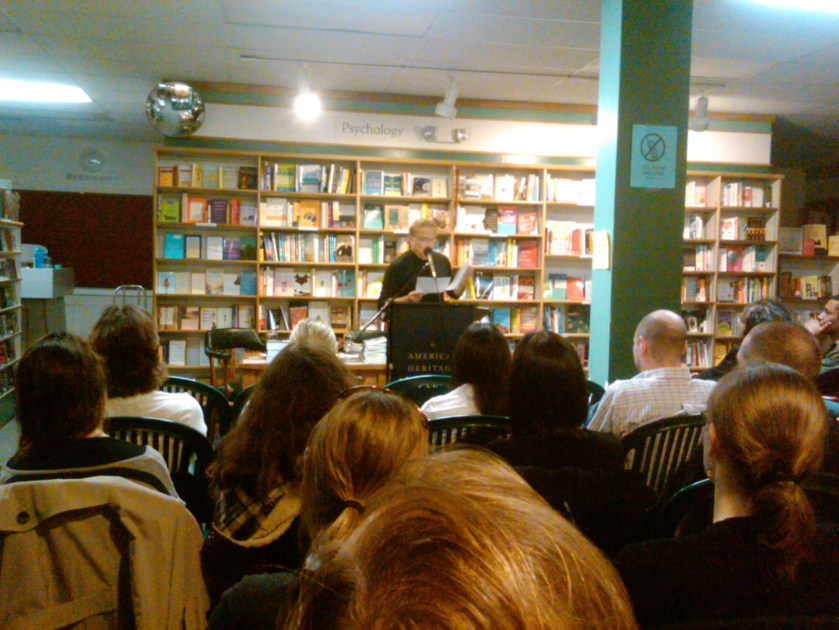
Author, Poet Stephen Kuusisto reads from his work
Poet Stephen Kuusisto reading at Prairie Lights Bookstore, Iowa City, IA

You wouldn’t know it to look at me but I’m wildly supportive of independent bookstores or “indies” as habitués call them. If you see someone like me on the street with a guide dog you might think: “there’s someone who doesn’t go to bookshops.” Ah but you’d be wrong! So wrong!

Whenever I enter an indie bookshop my spirits lift. Really, they do. I’m no longer at the bottom of life’s stairs, l’esprit de l’escalier, like Diderot—hoping I might be wise or “wiser”—thinking all the sharp people are one floor above me. No, the independent bookstore is where all those who like being alive come for books.

I first learned this in my early twenties. I was fortunate enough to go to graduate school and felt lucky to find myself among bookish people. I was also lucky because despite my greenness and other deficiencies I was studying creative writing in Iowa City, Iowa.

In general it’s good to know you’re lucky. And of course the sensation isn’t ubiquitous. One can’t feel kind fortune every minute. My poetry classes at the Iowa Writer’s Workshop were contentious. The teachers were famous and my fellow poetry grad students were talented and ambitious. Such conditions should make for satisfaction if not happiness but often classes (known as workshops) could be rebarbative affairs. Occasionally a student would run from the room in tears because a Pulitzer winning poet-teacher had made a moue of disgust at a line in a poem. It was crazy. Old and young people fighting about poetry. Sometimes discussions about the merits of a student’s poem or lack thereof felt to me as fatuous and exaggerated as that section in Jonathan Swift’s Gulliver’s Travels where we see that a civil war has been fought over the question “which end of the boiled egg do you crack first—big or little?”

Enter the bookshop. In the summer of 1979 a fellow named Jim Harris opened a store in downtown Iowa City called “Prairie Lights” and he hired some of us anemic baby poets to help build bookshelves and lug boxes. Maybe this doesn’t seem like much—sweat and sawdust and the emergence of a new kind of store—but then you see there’s this quality of community that stands behind every indie bookstore. I knew it right away. And my hammering poetry pals knew it too. This, I saw, was a genial space.

To his credit Jim Harris made Prairie Lights an ever more genial place, hosting poetry readings, talks, events for kids. He hired people who genuinely loved books and who also—wait for it—liked talking with customers.

The playwright Edward Albee once said he wasn’t interested in living in a city where there wasn’t a production by Samuel Beckett running. By the time I was 25 I knew I didn’t want to live in a town without a warm, jazzy, welcoming and vital bookstore.

In a few days I’ll be publishing my sixth book, a memoir about poetry and a special dog. Have Dog, Will Travel: A Poet’s Journey will be released on March 13, by Simon & Schuster. Like many authors I’m thinking ahead about places where I might read from the book. Indie bookstores are at the top of my list.

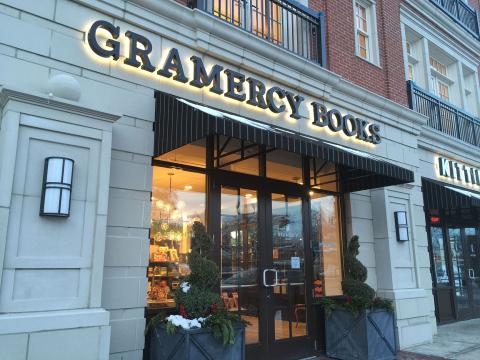
On April 9 I’ll be reading at my beloved Prairie Lights where I’ve been fortunate to read a number of times and then I head to Bexley, Ohio both to read and celebrate Gramercy Books—a new “indie” that’s already proving to be remarkable. As Linda Kass, owner of Gramercy Books says on her website: “our name, Gramercy, comes from the French words ‘grand merci,’ which translates to ‘big thanks’ or ‘many thanks.’ We’re so grateful. For books. For our customers. And for the opportunity to bring you this experience.”

Gramercy Books, Bexley, OH

And that’s really what I’m trying to convey—indie bookstores are about thankful experiences. This of course is not a customary dynamic in capitalism but it’s the manifest hope of independent book sellers that we might warm each other with good words.

********************************************************************

Stephen Kuusisto and HarleyABOUT: Stephen Kuusisto is the author of the memoirs Have Dog, Will Travel; Planet of the Blind (a New York Times “Notable Book of the Year”); and Eavesdropping: A Memoir of Blindness and Listening and of the poetry collections Only Bread, Only Light and Letters to Borges. A graduate of the Iowa Writer’s Workshop and a Fulbright Scholar, he has taught at the University of Iowa, Hobart and William Smith Colleges, and Ohio State University. He currently teaches at Syracuse University where he holds a University Professorship in Disability Studies. He is a frequent speaker in the US and abroad. His website is StephenKuusisto.com.

Have Dog, Will Travel: A Poet’s Journey is now available for pre-order at an Indie Bookstore near you:
Prairie Lights
Gramercy Books
IndieBound.org

Have Dog, Will Travel by Stephen Kuusisto

(Photo picturing the cover of Stephen Kuusisto’s new memoir “Have Dog, Will Travel” along with his former guide dogs Nira (top) and Corky, (bottom.) Bottom photo by Marion Ettlinger

Have Dog, Will Travel: Book Giveaway!

Finally! This book of mine is soon to be officially released!  I’m in a celebratory mood and thought hosting a giveaway should be part of the fun.  So…..let the fun begin, shall we?!

Click the image below or follow this link.

Contest will start at midnight, March 5, 2018.

Have Dog, Will Travel Book Giveaway Contest

The reviews are coming in and I’m so very grateful for the kind words being attributed to my work.  A special thanks to the folks at Simon & Schuster for their trust and guidance.

********************************************************************

Stephen Kuusisto and HarleyABOUT: Stephen Kuusisto is the author of the memoirs Have Dog, Will Travel; Planet of the Blind (a New York Times “Notable Book of the Year”); and Eavesdropping: A Memoir of Blindness and Listening and of the poetry collections Only Bread, Only Light and Letters to Borges. A graduate of the Iowa Writer’s Workshop and a Fulbright Scholar, he has taught at the University of Iowa, Hobart and William Smith Colleges, and Ohio State University. He currently teaches at Syracuse University where he holds a University Professorship in Disability Studies. He is a frequent speaker in the US and abroad. His website is StephenKuusisto.com.

Have Dog, Will Travel: A Poet’s Journey is now available for pre-order:
Amazon
Barnes and Noble
IndieBound.org

Have Dog, Will Travel by Stephen Kuusisto

(Photo picturing the cover of Stephen Kuusisto’s new memoir “Have Dog, Will Travel” along with his former guide dogs Nira (top) and Corky, bottom.) Bottom photo by Marion Ettlinger