Stop With Your Ableist Lazy Rage

Over the course of the last two years (post election and the year prior) I’ve watched people throw ableist insults. From the right the favored term is “libtard” and from the left one hears “moron” “idiot” and “imbecile” all echoing eugenics both in Germany and the United States when the disabled were marked for elimination.

When disability must be employed to register rage then its nothing more than lazy rage. Rather than call a Trump supporter an imbecile why not say: “there’s a person who doesn’t understand his shadow.” Not so much fun as ableizing him or calling him a pig or weasel.

Lazy rage is fun rage. Even in their discontent Americans like to have fun. Trump knows this. Its perhaps the only thing he knows.

We’re got rape culture to worry about; children in cages; wholesale destruction of the environment at hand; black men in the school to prison pipeline; eroding medical services for veterans and the poor; unending American involvement in ruinous wars; the collapse of public education; big Pharma slinging opioids in every corner of the nation; religious extremism attacking science; an outright war on the Americans with Disabilities Act—I’m just getting started.

And all I see on facebook is callow name calling with an especially able bodied smugness.

As John Lennon might say: here’s another clue for you all. You are as much the problem as the problem.

Read Carl Jung on “the shadow” and know your own deep despairs before saying someone else is “lame” and for god’s sake join a volunteer organization of some kind.

More About Hating Smokey the Bear

I don’t like Smokey the Bear. I’ve already written about it. He’s a slick defier of logic. Children are powerless to prevent forest fires and telling kids they’ve a singular moral responsibility fo forestall contagion is the kind of cartoon horse shit Americans are forced to grow up with.

Meanwhile the forests are being systematically cut down by Weyerhaeuser and fried by acid rain from “clean coal”—a phrase I’m sure Smokey the Bear would approve.

Now you will say: “But Kuusisto, is it Smokey the Bear you don’t like, or is it the fatuous, bloated, running dogs of the bourgeoisie who created him who you dislike?”

Of course I dislike Madison Avenue. But it’s the cartoon Bear I hate. He’s the kind of anthropomorphic dungaree wearing shovel toting ranger hat wearing dingus who will pick your pockets if you’re not careful. He’s out to mess with your conscience. He wants you to feel responsible when bad things happen in nature.

Only you can prevent hurricanes.

Only you can prevent global warming.

He’s anti-democratic and the purveyor of superstition.

Thomas Jefferson would have despised Smokey the Bear.

Why am I “on” about this?

Because when you make a woman who’s survived sexual abuse stand alone before a room fool of smug, pink, hostile men on Capitol Hill, you’re saying, “only you can prevent sexual assault”—the American social lie…the idea that the culture isn’t responsible, only you, only you.

Stephen Kuusisto and HarleyABOUT: Stephen Kuusisto is the author of the memoirs Have Dog, Will Travel; Planet of the Blind (a New York Times “Notable Book of the Year”); and Eavesdropping: A Memoir of Blindness and Listening and of the poetry collections Only Bread, Only Light and Letters to Borges. A graduate of the Iowa Writer’s Workshop and a Fulbright Scholar, he has taught at the University of Iowa, Hobart and William Smith Colleges, and Ohio State University. He currently teaches at Syracuse University where he holds a University Professorship in Disability Studies. He is a frequent speaker in the US and abroad. His website is StephenKuusisto.com.

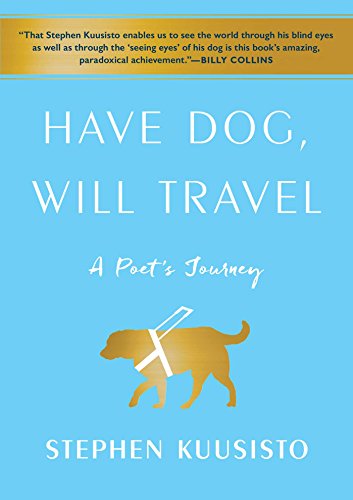
Have Dog, Will Travel: A Poet’s Journey is now available for pre-order:
Amazon
Barnes and Noble
IndieBound.org

Have Dog, Will Travel by Stephen Kuusisto

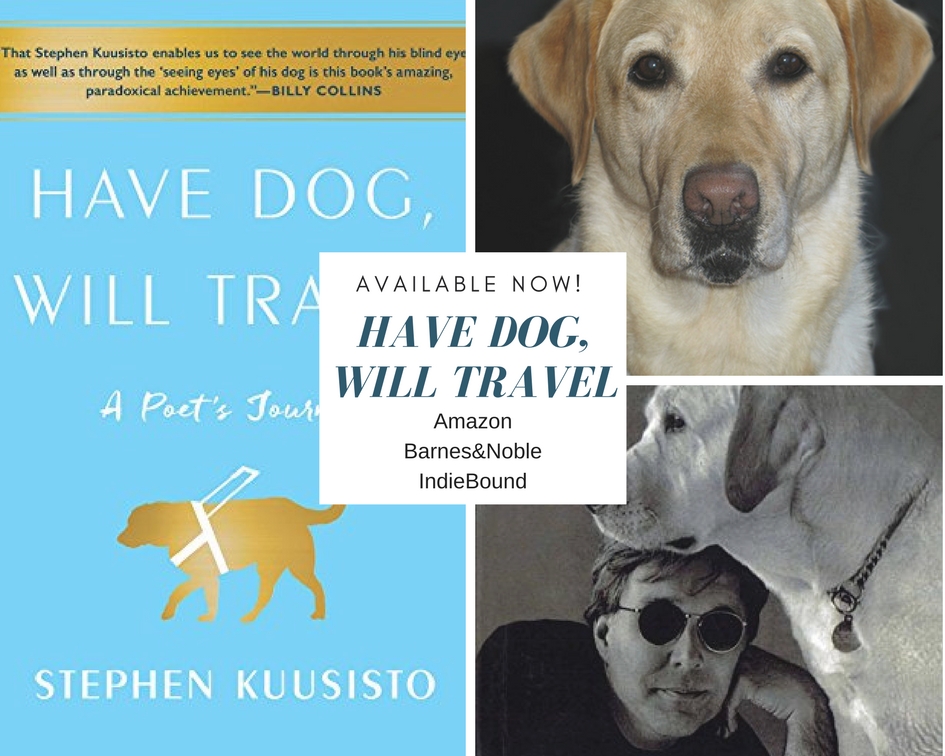
(Photo picturing the cover of Stephen Kuusisto’s new memoir “Have Dog, Will Travel” along with his former guide dogs Nira (top) and Corky, bottom.) Bottom photo by Marion Ettlinger 

This is the Smokey the Bear Social Lie Complex.

The corridors of power depend on this.

I’ll Be Dipped Redux

Well I’ll be dipped! (White privilege of course, for being dipped means soaked in oil usually as punishment for running away when you were a black slave…sometimes poor whites were also dipped in oil but only to serve as examples to the poorer people.) Anyway, I’ll be dipped cuz believe it or not, someone wrote to say I’m too angry on this blog. What was her tipping point? I said Karl Ove Knausgaard, Anthony Doerr, and Jose Saramago were phony writers who use disablement or ennui to suggest they are more interesting than they really are.

Pfffffft! You’d think I’d said the Statue of Liberty wears a Victoria’s Secret thong stitched from a Russian flag. (She does.)

We’re living in an era of great literature and also a moment of terrible creative writing. Its not polite to say so and few are brave enough to even hint at the hornswoggling of taste. (Taste is automatically denigrated because it is “privilege” to have it and you bet taste makers have always been top dogs and by jinkies they’re university educated and generally white. (Think Rudyard Kipling.)

Taste rises from grass roots as much as the top. James Baldwin didn’t get invited to The MacDowell Colony in 1958 because the folks at Yale understood him. In America there’ve always been sharp readers in the underbrush.

I digress….

For all the sharp readers in the tall grass there are middle brow forces at work—in overdrive.

By this I mean middle brow which actually tends to low brow. Today’s literary reviews are essentially fifth grade book reports—even in the New Yorker. Its enough these days to say what happens in a novel or nonfiction treatment. Maybe toward the conclusion the ersatz reviewer will say: “I do with we’d heard more from Hitler’s chauffeur…”

So today’s mainstream creative writing is mostly TV pap and the reviewing industry is largely dead.

There are superb novels being written in our midst but you’ll seldom hear of them unless you read the Times Literary Supplement.

Meanwhile we’re forced to read in the NY Times about Knausgaard who’s contentless, talentless naval gazing is passed off as literature.

Min Jin Lee is a terrific novelist.

I don’t say she’s ignored.

I do say we’re awash in awful writing and we’re told to spoon it up.

Stephen Kuusisto and HarleyABOUT: Stephen Kuusisto is the author of the memoirs Have Dog, Will Travel; Planet of the Blind (a New York Times “Notable Book of the Year”); and Eavesdropping: A Memoir of Blindness and Listening and of the poetry collections Only Bread, Only Light and Letters to Borges. A graduate of the Iowa Writer’s Workshop and a Fulbright Scholar, he has taught at the University of Iowa, Hobart and William Smith Colleges, and Ohio State University. He currently teaches at Syracuse University where he holds a University Professorship in Disability Studies. He is a frequent speaker in the US and abroad. His website is StephenKuusisto.com.

Have Dog, Will Travel: A Poet’s Journey is now available for pre-order:
Amazon
Barnes and Noble
IndieBound.org

Have Dog, Will Travel by Stephen Kuusisto

(Photo picturing the cover of Stephen Kuusisto’s new memoir “Have Dog, Will Travel” along with his former guide dogs Nira (top) and Corky, bottom.) Bottom photo by Marion Ettlinger 

I’ve Had It….

I’ve had it with these amateur sufferers, these sons of bitches who think their D League oppressions are anything more than a hangnail. Karl Ove Knausgaard for example. He’s what my grandmother would call a shallow piss pot of a man and he should thank his lucky stars he’s writing and publishing his pissant Little Bo Peep books in an age of literary decline. Invented struggle is beneath contempt. Why do I bother? Maybe because there are genuine writers, especially those with disabilities who are ten thousand times more powerful than Knausgaard or Anthony Doerr or Jose Saramago—just to name three writers I cannot stand though for different reasons and I won’t bore you. At least not right now.

What else? I’ve had it with men. All of them. And many women—the Trump girls and the boys club girls—the latter you find in higher ed administration rather frequently. I’ve had it with junior high mean girls who’ve grown up only in physical stature.

I’ve had it with corporation tee shirts, sports radio, Ted Cruz, the Great Cheeto in Chief, the oil and gas lobby, Ax deodorant, Big Pharma television advertising, other peoples fuchsia hair, bad tattoos, New York Yankees hats, BMW convertibles, slick supersonic info wars.

I’ve had it with congress which I won’t capitalize. It rhymes with emptiness.

I’ve had it with the pope the army the endomorphic police state, Vladimir Putin, Teresa May, all the little diapered Nazis who salute the Great Cheeto; I’ve had it with misogynistic rap, Diet Coke, school boards, free hotel breakfasts, cable news, the National Football League, the NCAA, single issue politics, flag worshipers, Monsanto, border walls, nuclear power, and dollar shave clubs. If it costs you, don’t shave.

I love Walt Whitman, Toni Morrison, rain at night, baseball, the Bill of Rights, and sailboats.

Thank you for listening.

Stephen Kuusisto and HarleyABOUT: Stephen Kuusisto is the author of the memoirs Have Dog, Will Travel; Planet of the Blind (a New York Times “Notable Book of the Year”); and Eavesdropping: A Memoir of Blindness and Listening and of the poetry collections Only Bread, Only Light and Letters to Borges. A graduate of the Iowa Writer’s Workshop and a Fulbright Scholar, he has taught at the University of Iowa, Hobart and William Smith Colleges, and Ohio State University. He currently teaches at Syracuse University where he holds a University Professorship in Disability Studies. He is a frequent speaker in the US and abroad. His website is StephenKuusisto.com.

Have Dog, Will Travel: A Poet’s Journey is now available for pre-order:
Amazon
Barnes and Noble
IndieBound.org

Have Dog, Will Travel by Stephen Kuusisto

(Photo picturing the cover of Stephen Kuusisto’s new memoir “Have Dog, Will Travel” along with his former guide dogs Nira (top) and Corky, bottom.) Bottom photo by Marion Ettlinger 

Ode to my Twin Brother Who Died at Birth

Of course I found a spoon in the snow

While missing you, gulls above the harbor

Baltic yellow mid day mid winter light

A policeman talked softly to his horse

I was proud of my new wristwatch 

Cheap but Swiss made

Being of the scholar class

It was a totem thrill on my wrist

You my brother my twin 

Gone in infancy who followed 

And follow—listen

I’m sewing together 

A seahorse like the one

We rode in the womb

Against Bio-political Confusion

It is a mistake I imagine to avow you know much of the world. Its right and proper to admit intellectual limits. One sees this is harder than it should be owing to postmodernity with its filigreed relativisms. These days if you’re educated you’re easily forgiven for saying what you don’t know is of little consequence. What is unknown to you is less important than a celebration of confusion. 

 What if you don’t like confusion? In the best sense this suggests you don’t much like bureaucracies and burdensome hierarchies. You like to drink spring water from a tin cup. You like baseball’s “three strikes and you’re out” and you favor the romanticism disguised in the language of the Enlightenment as revealed in the Declaration of Independence though you know why the document still to this day stands for hypocrisy. 

I cry out: “I am a simpleton!” In bio-cultural terms I’m that citizen who burns his draft card or her brassiere. I’ve no compunction about these acts of protest. As a blind man I know my disability stands for defectiveness when I enter the bank on the corner but I don’t acknowledge the bank or the genome editing biotechnology company that is even now seeking to erase my footsteps from the great German airport of American civic life. (Oh I’m all for curing blindness. If you can modify the genes that cause macular degeneration I’ll applaud. But your medical model of disability as standing for social disadvantage remains unbroken from the days of eugenics.)

Its unfashionable for academics to reveal what they don’t know. Here’s what I know I don’t know: I’ve no idea what the future of genetically modified human beings will look like. What I do know is I’m not confused. I’m for curing illnesses. I’m against eliminating people with Down syndrome or deafness or blindness or any other disabling condition without a constitutional amendment guaranteeing human dignity and human rights and health care and education for every single kind of human body.

Now I will return you to your original broadcast with its tawdry celebration of celebrity fashion. 

“Its Against the Rules, Disabled Person…”

If you’ve a disability you’re used to hearing: “its against the rules” in hundreds of settings. “Its against the rules for you to stand near that painting”; “against the rules to sit in a wheelchair in this section”; “have extra time on a test”; “wear those headphones in class”; “take three incompletes in a semester”; on and on. “Against the rules for a guide dog to ride this bus”; “against…blah blah blah….”

A major facet of ableism rests with the rhetoric of rules and rule bound thinking. A friend of mine a blind attorney who graduated from Harvard Law once said in a job interview something like, “dude, my whole life is outside the box.”

Bureaucrats, administrators, college faculty, politicians, etc. like to say they want to “think outside the box” but their boxes are never open where disability is concerned.

Rules are good. Don’t walk on the grass. Don’t shout fire in a theater. But rules preventing the disabled from participating in mainstream activities are always ableist and ugly.

I was told as a child I wasn’t allowed to play games with other kids. Told I didn’t belong in almost any room where I found myself.

All disabled people know that story.

It especially kills me when administrators at colleges and universities can’t find it within themselves to solve an accessibility problem because the problem defies the ordinary.

My friend Scott Lissner the ADA Coordinator at The Ohio State University once found a way to get a wheelchair using student aboard a tractor.

Accommodations require imagination and a can do spirit.

When you’re tempted to say “against the rules” where disability access is concerned its time to scratch you head and say, “what if we….?”

Disability accommodations represent old fashioned American know how.

Stephen Kuusisto and HarleyABOUT: Stephen Kuusisto is the author of the memoirs Have Dog, Will Travel; Planet of the Blind (a New York Times “Notable Book of the Year”); and Eavesdropping: A Memoir of Blindness and Listening and of the poetry collections Only Bread, Only Light and Letters to Borges. A graduate of the Iowa Writer’s Workshop and a Fulbright Scholar, he has taught at the University of Iowa, Hobart and William Smith Colleges, and Ohio State University. He currently teaches at Syracuse University where he holds a University Professorship in Disability Studies. He is a frequent speaker in the US and abroad. His website is StephenKuusisto.com.

Have Dog, Will Travel: A Poet’s Journey is now available for pre-order:
Amazon
Barnes and Noble
IndieBound.org

Have Dog, Will Travel by Stephen Kuusisto

(Photo picturing the cover of Stephen Kuusisto’s new memoir “Have Dog, Will Travel” along with his former guide dogs Nira (top) and Corky, bottom.) Bottom photo by Marion Ettlinger 

Oh, the Poor Sighted People, etc.

I will tell you how to be blind but only when first you tell me how it is to be sighted. You will tell me what you see which has very little to do with the matter. You cannot help yourself. To see, seeing is this sail turning before the wind, this nearly transparent orchid. When your thoughts turn atavistic your vision has much to do with being a prey animal for humans have a great deal in common with horses.

So by turns, given this is what you believe about sight—that it is the sum of its contexts and each “peep” stands for something universal—you must believe the absence of sight is nothing more than a mineral blank.

You think there’s a tribe called “the blind” and we are pulling off a sinister trick by our very attempt to live in the world. You want to ask: “how can you live if you can’t see?” You know you want to ask it. A famous fiction writer once asked me during a job interview: “How can you write so clearly if you can’t see?” Translation: “How exactly are you fooling us? Maybe you can see? In any event you must be dishonest.”

Blindness is dishonesty to many sighted. If I can be called “blind” you can be called “sighted” though I prefer mis-sighted for you. In any event you believe you’re the sum of your sights however poorly apprehended.

Yes, you see as through a glass darkly. Most of you know it and are afraid. “Why if I lost my little peephole it would be like death itself.”

The blind are, to the poorly apprehended, the walking dead.

Yes. The blind are zombies to the P.A. kids.

Yes. The poorly apprehended are just kids.

Children who believe they’re the sum of their toys.

Seeing is toy collection.

Wouldn’t life without toys be impossible?

You’d have to be a zombie.

**

Not long ago while visiting a famous arts colony I heard a notable writer say that henceforth the famous arts colony would no longer be blind and poor when it comes to appreciating outlier forms of art. He said it twice during a formal speech.

And there I was with my guide dog. I’ve spent the last thirty years writing six books which argue that blindness is a rich way of knowing.

I was insulted and remain so. Yet this is business as usual for the poorly apprehended who can’t describe sight but imagine they know it thoroughly and think the blind are among the sighted “on sufferance” and yes, we make the P.A. tribe nervous by our very appearance.

I share with my black and LGBTQIA pals and all my foreign friends a capacity to make the poorly apprehended nervous. All of us are believed to be “here on sufferance” but there’s something especially dishonest about the blind, the lame, the halt.

The dishonest thing is that you, the sighted, unable to tell me what vision means, and only able to describe your toys, you fascinations as it were, the majority of you have no spiritual center. Without this you can’t imagine the glory of life itself. You think sight seeing is the secret to living.

And if you believe this, then you also must believe that language isn’t much of a thing.

My answer to the famous writer who wanted to know how I could write about the world with clarity was simple: all nouns are images. Horse. Battleship. Rose bush.

All I have to do is jot down a noun and voila! I saw what you saw little dude.

Or: of course I didn’t see it. But according to neurological findings, neither did you.
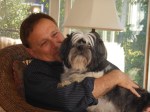
Stephen Kuusisto and HarleyABOUT: Stephen Kuusisto is the author of the memoirs Have Dog, Will Travel; Planet of the Blind (a New York Times “Notable Book of the Year”); and Eavesdropping: A Memoir of Blindness and Listening and of the poetry collections Only Bread, Only Light and Letters to Borges. A graduate of the Iowa Writer’s Workshop and a Fulbright Scholar, he has taught at the University of Iowa, Hobart and William Smith Colleges, and Ohio State University. He currently teaches at Syracuse University where he holds a University Professorship in Disability Studies. He is a frequent speaker in the US and abroad. His website is StephenKuusisto.com.

Have Dog, Will Travel: A Poet’s Journey is now available for pre-order:
Amazon
Barnes and Noble
IndieBound.org
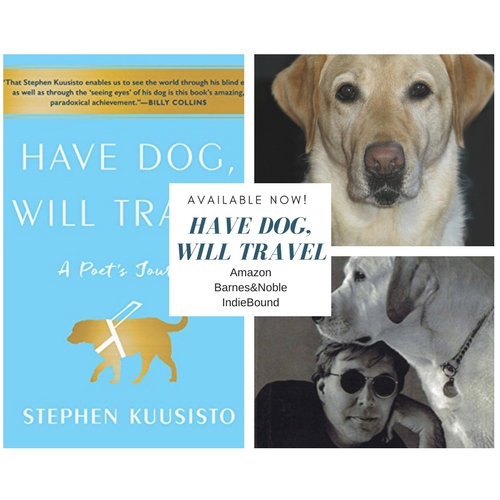
Have Dog, Will Travel by Stephen Kuusisto

(Photo picturing the cover of Stephen Kuusisto’s new memoir “Have Dog, Will Travel” along with his former guide dogs Nira (top) and Corky, bottom.) Bottom photo by Marion Ettlinger